

A homepage is often the first place where customers judge a digital business. If it loads slowly, feels unresponsive, or makes products difficult to find, the impact extends beyond user experience. It can affect engagement, conversions, search visibility, and brand credibility.
When rebuilding the ZealousWeb Store homepage, our objective was not limited to creating a visually updated page. We wanted to develop a faster, more scalable, and performance-focused storefront while evaluating how effectively AI-assisted development could support a real Magento implementation.
Claude Code became an active part of the development workflow. It supported code generation, frontend structuring, responsive development, dependency review, optimization, and iterative refinement. Our development team remained responsible for architecture, technical decisions, Magento validation, testing, security, and final quality control.
This combination of AI automation and experienced engineering helped us turn a complex homepage redevelopment into a structured, measurable, and performance-led initiative.
Why Homepage Performance Matters for an Online Store
An eCommerce homepage carries more responsibility than a standard website landing page. It may display product categories, promotional content, dynamic sections, featured products, search functionality, navigation elements, and campaign assets at the same time.
Each component adds design and development requirements. Without careful planning, it can also add unnecessary scripts, styles, image requests, and browser processing.
For a store, these technical issues can quickly become business issues.
A slow or unresponsive homepage may lead to:
- Visitors leaving before viewing products
- Delayed interactions on mobile devices
- Reduced engagement with promotional sections
- Poorer Core Web Vitals
- Lower customer confidence
- More development effort for future updates
We therefore approached performance as part of the homepage architecture-not as a correction to be applied after development.
Why Incremental Fixes Were No Longer Enough
The earlier homepage included frontend resources that increased browser workload and JavaScript execution.
Magento provides a broad set of default libraries, styles, and scripts to support different store functions. However, not every resource is required on every page. When unnecessary dependencies are loaded, they can increase page weight, block the browser’s main thread, and delay user interaction.
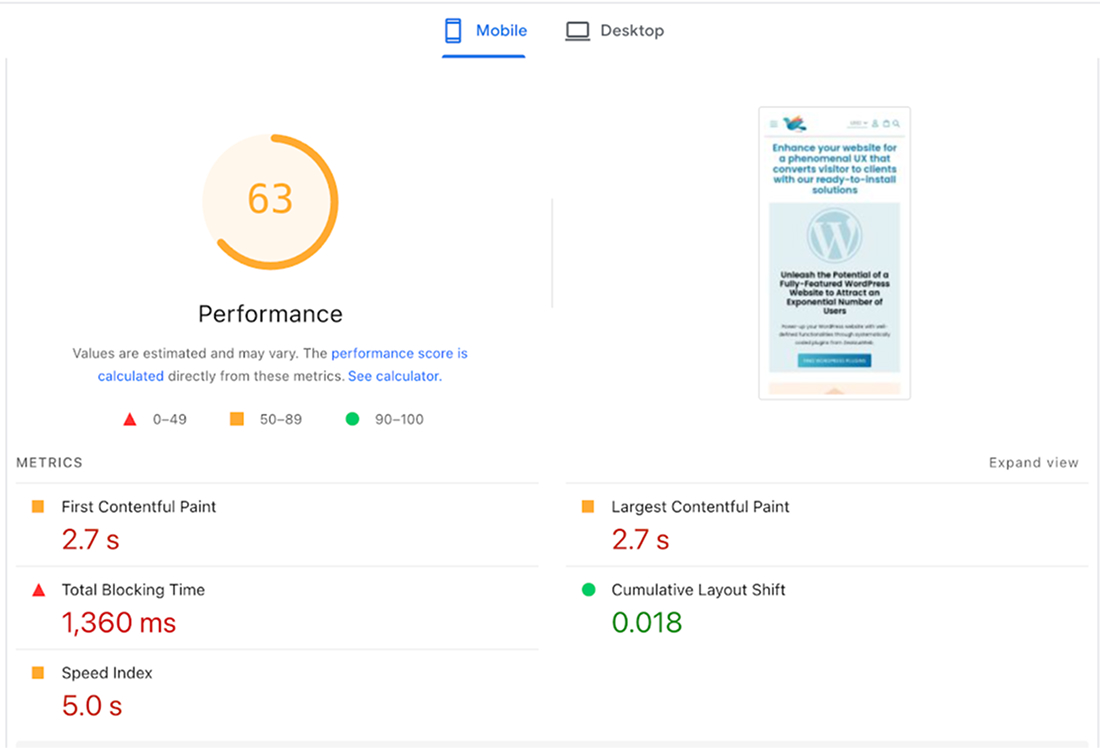
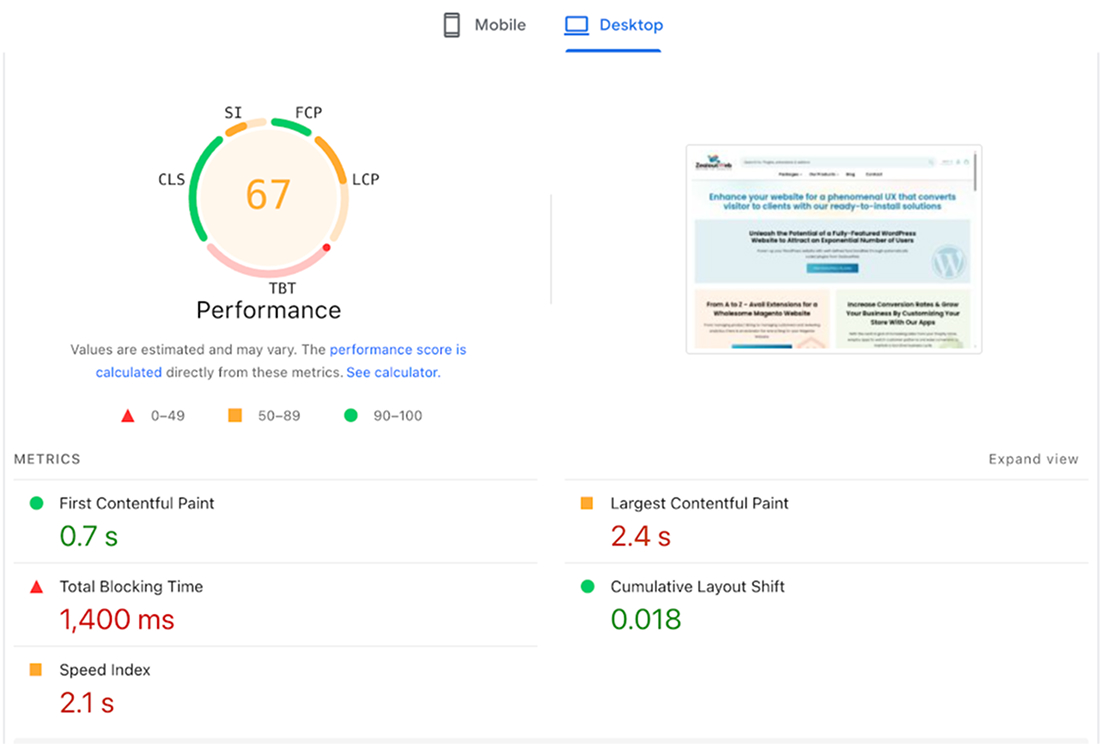
The previous homepage recorded a Lighthouse performance score of 63 on mobile and 67 on desktop. Mobile Total Blocking Time reached 1,480 milliseconds, while desktop Total Blocking Time was 1,310 milliseconds. These figures indicated that the browser remained occupied processing scripts even after visible content had started loading.
Instead of applying isolated fixes, we chose to rebuild the homepage with a cleaner performance strategy from the beginning.
Homepage Performance Before Redevelopment
The initial audit helped us establish a clear performance baseline across mobile and desktop. While the homepage remained functional, the data revealed that frontend processing and script execution were limiting responsiveness, particularly on mobile.
| Performance Metric | Mobile | Desktop |
| Lighthouse Performance Score | 63 | 67 |
| First Contentful Paint | 2.7 seconds | 0.7 seconds |
| Largest Contentful Paint | 2.7 seconds | 0.7 seconds |
| Total Blocking Time | 1480 ms | 1310 ms |
| Speed Index | 5.1 seconds | 1.8 seconds |
| Cumulative Layout Shift | 0.0018 | 0.018 |
The most significant issue was Total Blocking Time.
On mobile, the browser’s main thread remained occupied for 1,480 milliseconds, which could delay interactions even after visible content had started loading. Desktop content appeared faster, but the 1,310-millisecond Total Blocking Time still affected responsiveness and the overall Lighthouse score.
The audit made one thing clear: isolated fixes would not deliver the level of improvement we wanted. The homepage needed a cleaner, performance-first architecture built around selective resource loading, reduced JavaScript execution, and more efficient frontend delivery.
Mobile
Desktop
How We Integrated Claude Code Into Development
Claude Code was not used as a basic code-completion tool. It was included across the homepage development lifecycle.
Before implementation began, our team defined:
- Homepage structure
- Section layouts
- Magento data sources
- Responsive behaviour
- CSS and JavaScript requirements
- Image-loading priorities
- Font-delivery requirements
- Performance targets
- Libraries that should be excluded
Claude Code used this context to help generate, organize, optimize, and refine the frontend implementation.
It supported tasks such as:
- Creating individual homepage sections
- Generating responsive templates
- Writing and reorganizing CSS
- Handling section-specific JavaScript
- Reviewing unnecessary dependencies
- Separating critical and non-critical resources
- Implementing lazy loading
- Supporting performance analysis
- Refining code after testing
This was an AI-assisted workflow, but it was not an unsupervised one.
Our developers reviewed the output, verified Magento compatibility, checked data sources, tested responsive layouts, inspected code quality, and approved every production-level decision.
The value of Claude Code came from combining development speed with precise human direction.
Building With a Mobile-First Strategy
Mobile performance was one of the primary requirements of the new homepage.
Rather than creating a desktop-heavy layout and adjusting it later, we began with the mobile experience. This helped us focus on essential content, simplified layouts, cleaner components, and minimal frontend processing.
Claude Code was guided to prioritize:
- Lightweight mobile styles
- Responsive section behaviour
- Essential content visibility
- Reduced rendering work
- Cleaner component structures
- Limited desktop-specific code on smaller screens
This approach helped avoid the common problem of sending unnecessary desktop assets and styles to mobile visitors.
The result was a homepage architecture that responded more efficiently across devices while remaining easier to maintain.
Removing Unnecessary Magento Dependencies
One of the most significant improvements came from reducing frontend resources that were not required for homepage functionality.
Claude Code helped us review implementation needs section by section. Scripts and libraries were included only where they served a clear functional purpose.
Reducing unnecessary dependencies helped lower:
- JavaScript execution time
- Main-thread workload
- Browser processing
- Network requests
- Frontend payload size
- Total Blocking Time
This was especially important for mobile visitors, where device processing power and network quality can vary considerably.
The optimization contributed to reducing mobile Total Blocking Time from 1,480 milliseconds to 10 milliseconds. On desktop, it fell from 1,310 milliseconds to zero.
Smarter CSS and JavaScript Delivery
Loading every stylesheet and script at the same priority can delay the content users need first.
To improve rendering, we separated homepage styles according to where and when they were needed.
Above-the-fold CSS was treated as critical and prioritized for the initial viewport. Styles for sections further down the page were handled separately so they did not delay the first visible content.
JavaScript was also managed at the section level. Interactive code was used only where required instead of being applied broadly across the page.
This improved:
- First Contentful Paint
- Largest Contentful Paint
- Speed Index
- Initial responsiveness
- Overall Lighthouse performance
The approach also made the codebase more manageable because each section had clearly defined resource requirements.
Automating Image and Font Optimization
Images are among the heaviest resources on most eCommerce homepages. Loading every image immediately can consume bandwidth and delay important content.
Claude Code helped implement an image-delivery strategy that included:
- Defined image dimensions
- Lazy loading below the fold
- Priority loading for key visual assets
- Responsive image behaviour
- Reduced unnecessary requests
Images further down the page were loaded only as users approached those sections. This allowed the browser to focus first on the content visible within the initial screen.
Important fonts were also preloaded so the browser could request them earlier. This improved text rendering and reduced delays caused by late font discovery.
These improvements were not applied manually as disconnected fixes. They were incorporated into the development rules used throughout the homepage build.
Section-Specific Development and Automation
The homepage was divided into independent sections, each with its own content, data source, styling, scripts, image behaviour, and rendering priority.
Claude Code received detailed instructions for every section rather than one broad request to build an entire homepage.
This section-specific method offered several advantages:
- Cleaner Magento templates
- Less unnecessary code
- Easier testing
- Faster issue isolation
- Better long-term maintainability
- Simpler future updates
- More reusable components
It also created a more dependable automation workflow. AI-generated output became more relevant because it was based on clearly defined requirements instead of generic prompts.
Where AI Acceleration Meets Expert Validation
AI can accelerate development, but generated code should never move directly into production without review.
Once the first implementation was complete, our developers tested the homepage across screen sizes and devices. They reviewed Magento logic, content sources, responsive behaviour, CSS delivery, JavaScript usage, and interactive functionality.
Lighthouse tests were conducted after major updates. Claude Code was then used to help analyse issues, refine implementation details, and support further optimization.
The process followed a continuous cycle:
- Define the requirement
- Generate or update the implementation
- Review the output
- Test the page
- Identify performance or functional issues
- Refine the instructions
- Retest the result
This iterative process was essential. The strongest outcome did not come from a single AI prompt. It came from giving Claude Code structured context and combining its speed with experienced technical review.
The Performance Impact
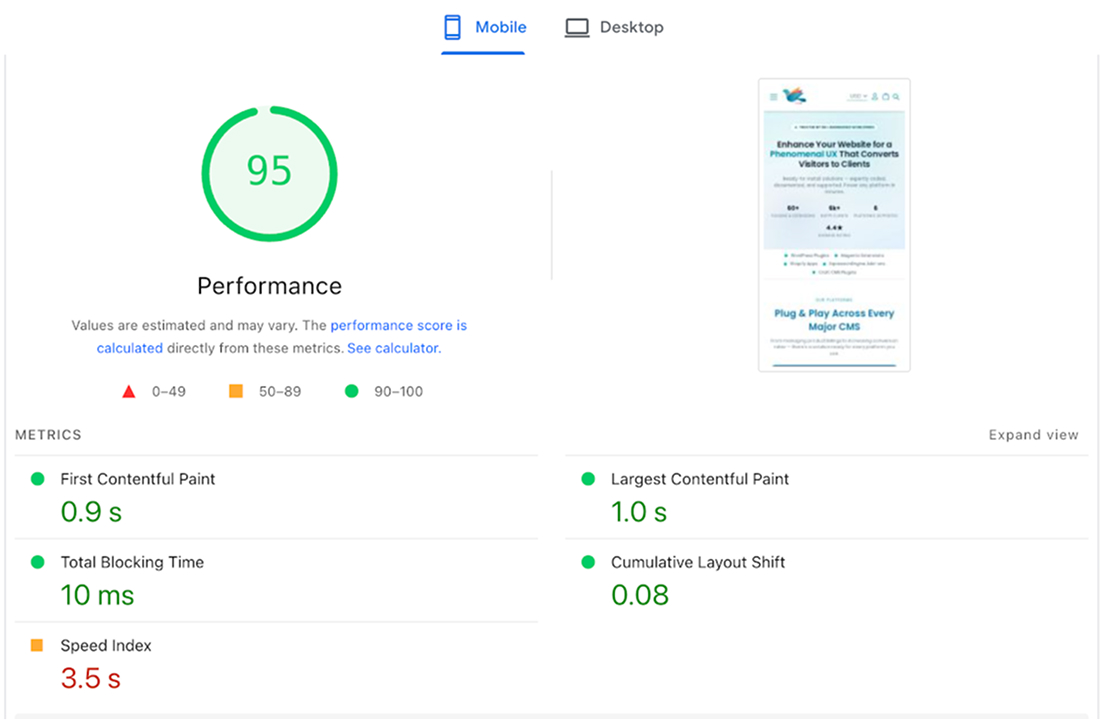
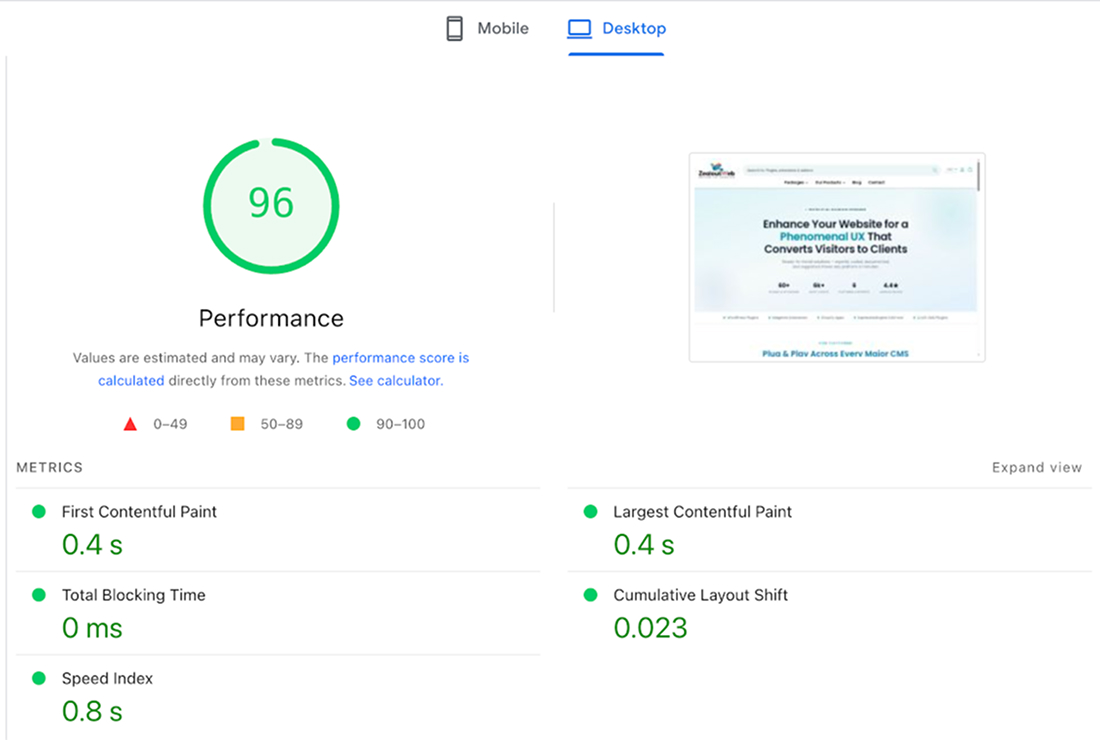
After the AI-assisted redevelopment and optimization process, the new homepage achieved a Lighthouse performance score of 95 on mobile and 98 on desktop.
| Performance Metric | Mobile Previous |
Mobile AI-Built |
Mobile Improvement |
| Lighthouse Performance Score | 63 | 95 | 32 Point increase |
| First Contentful Paint | 2.7 Seconds | 0.9 seconds | 66.7% faster |
| Largest Contentful Paint | 2.7 Seconds | 1.0 second | 63% |
| Total Blocking Time | 1480 ms | 10 ms | 99.3 % reduction |
| Speed Index | 5.1 seconds | 3.5 seconds | 31.4% faster |
| Cumulative Layout Shift | 0.018 | 0.08 | Remained within a good range |
Desktop Performance
| Desktop Previous |
Desktop AI-Built |
Desktop Improvement |
| 67 | 98 | 31-point increase |
| 0.7 seconds | 0.4 seconds | 42.9% faster |
| 0.7 seconds | 0.4 seconds | 42.9 % faster |
| 1310 ms | 0 ms | 100% reduction |
| 1.8 seconds | 0.8 seconds | 55.6% faster |
| 0.018 | 0.023 | Remained low |
What the Results Mean
The strongest improvement was in Total Blocking Time. On mobile, it dropped from 1,480 milliseconds to just 10 milliseconds, making the homepage significantly more responsive. On desktop, it was completely eliminated, falling from 1,310 milliseconds to zero.
Visible content also loaded much sooner. Mobile First Contentful Paint improved from 2.7 seconds to 0.9 seconds, while Largest Contentful Paint reached 1 second. On desktop, both metrics improved to 0.4 seconds.
The Speed Index also improved across both devices, indicating that visitors could see and interact with meaningful homepage content much faster.
These results demonstrate how AI-assisted development, selective resource loading, cleaner frontend architecture, and continuous performance testing translated into a faster and more dependable store experience.
The Business Benefits of AI-Assisted Development
The project demonstrated how AI automation can support real business and development outcomes when applied with clear intent.
For businesses, this approach can provide:
- Faster development cycles
- More efficient technical execution
- Earlier identification of performance issues
- Cleaner and more maintainable code
- Better mobile experiences
- Reduced rework during optimization
- Stronger readiness for future features
- More scalable digital commerce infrastructure
AI did not replace technical expertise. It increased the capacity of that expertise.
By automating repetitive development tasks, supporting code organization, and accelerating refinement, Claude Code allowed our team to spend more time on architecture, performance strategy, validation, and business-critical decisions.
Conclusion
The new store homepage represents more than a successful Magento redevelopment. It reflects how ZealousWeb has adopted AI automation as a practical part of modern digital engineering.
Claude Code supported planning, component development, responsive implementation, resource optimization, performance analysis, and iterative refinement. Every AI-assisted output, however, was guided by developers with deep expertise in Magento architecture, frontend performance, scalability, and production readiness.
That balance defines our approach.
We do not use AI simply to generate code faster. We use it to create more efficient development systems, reduce repetitive effort, strengthen technical decision-making, and deliver measurable improvements.
By combining AI-assisted workflows, automation-led optimization, platform expertise, and human validation, ZealousWeb is building digital experiences that load faster, scale more efficiently, and remain ready for evolving business demands.
The result is now live-experience how this AI-assisted transformation has reshaped the ZealousWeb Store homepage.
Explore our Homepage Reimagined With Claude Code
See AI-Powered Development in Action
FAQs
Does Claude Code help businesses launch digital experiences faster?
Yes. Claude Code can support faster prototyping, frontend development, testing, and iteration. This allows businesses to move from approved requirements to production-ready experiences more efficiently without compromising essential review and validation.
How did the team prevent AI-generated code from creating technical debt?
Every output was reviewed for Magento compatibility, code structure, resource usage, security, responsiveness, and long-term maintainability. AI accelerated implementation, while experienced developers controlled architecture and production readiness.
Does adopting AI automation mean replacing experienced teams?
No. AI delivers the strongest outcomes when it extends human expertise. It can accelerate development, analysis, testing, and optimization, while experienced professionals remain responsible for strategy, architecture, quality, security, and final decisions.
What does the Store homepage demonstrate about AI adoption?
The homepage shows that AI automation can move beyond experimentation and deliver measurable results. By combining Claude Code with Magento expertise, performance engineering, and human validation, we created a faster, more scalable digital experience-and a practical model for how businesses can begin adopting AI with purpose.