

ZealousWeb
Technical SEO execution improves client retention

How Technical SEO Execution Improves SEO Client Retention and Client LTV

July 10, 2026Posted By: Jalpa Gajjar
client retentionSEO AgencyTechnical SEOWhite Label SEO

The fastest way to grow an SEO agency is not always to win more clients. It is to stop losing the ones already paying you. According to a business review, acquiring a new customer can be 5 to 25 times more expensive than retaining an existing one. Yet most agencies still treat SEO client retention as a relationship problem – when it is almost always a delivery problem.

Clients rarely leave because the SEO strategy was weak. They leave because recommendations stay unresolved, technical SEO fixes remain stuck in development queues, and month after month, reporting shows what should be done instead of what has actually improved.

That is where technical SEO execution becomes a direct client LTV driver.

When crawlability issues, indexation errors, Core Web Vitals improvements, schema implementation, internal linking updates, on-page technical fixes, and site performance improvements are handled consistently, agencies create visible progress. And visible progress is what protects trust, strengthens retainer value, improves organic visibility, and gives clients a clear reason to stay.

Before looking at execution as a process, it is important to understand where the revenue leak actually begins. For most agencies, client LTV does not drop suddenly. It erodes quietly through delayed fixes, unresolved technical SEO issues, weak implementation follow-through, and reporting cycles that show activity without visible progress.

The image below breaks down where agency revenue actually leaks when technical SEO execution is not handled consistently.
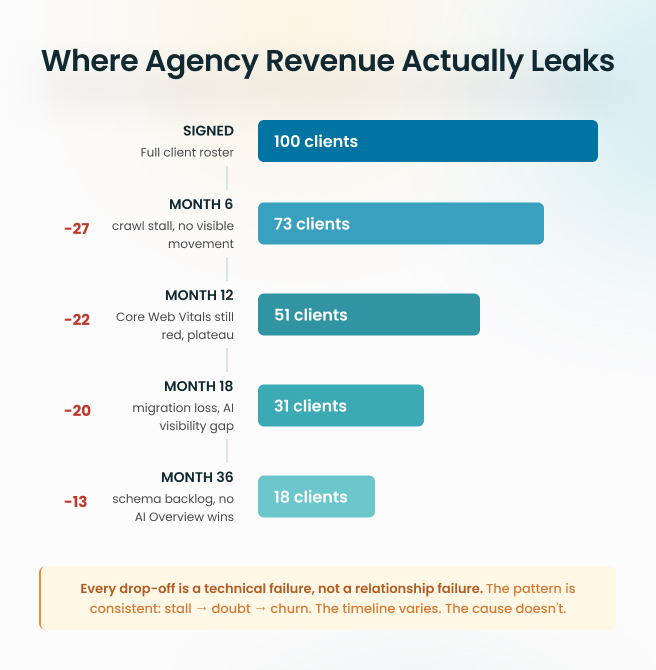
Agency Revenue Leak

Why SEO Clients Actually Churn

Ask any agency owner why a client left, and you’ll get versions of the same answer: they didn’t see results fast enough, or results plateaued, or the reporting felt disconnected from anything that mattered to the business. But drill a layer deeper and what you’ll almost always find is a technical execution gap – crawlability issues that quietly throttled indexation for months, Core Web Vitals that stayed in the red, schema markup that was requested but never shipped, or an AI overview visibility problem nobody diagnosed until the client noticed their traffic stagnating.

Clients don’t read audit documents. They watch their numbers. When the numbers stall, they stop trusting the strategy – even if the strategy is sound. Technical SEO execution is what turns strategic intent into visible outcomes, and visible outcomes are what retention is actually built on.

According to HubSpot’s Agency Pricing & Financial report, the top reason clients leave agencies is a perceived lack of results – not price, not communication, not fit – Delivery is the gap.

What Does Technical SEO Execution Actually Mean in 2026?

Technical SEO used to mean a crawl audit and some redirect fixes. It still includes those things. But the scope has expanded dramatically – and agencies that miss the expanded definition are delivering incomplete work without knowing it.

Today, technical SEO execution means ensuring your client’s site is consistently crawlable and indexable by traditional search engines, while also being citable and parseable by AI systems. That second part is what most delivery workflows still don’t account for.

What Are the Core Layers of Technical SEO in 2026?

.
Crawl & Index Health Robots.txt governance, sitemap accuracy, crawl budget allocation, canonicalization, internal link architecture, 404 and redirect chains
Rendering & Performance Core Web Vitals (LCP, CLS, INP), JavaScript rendering, server response time, image optimization, mobile usability at a component level.
Structured Data & Schema FAQ, Article, Product, LocalBusiness, and HowTo schema implemented and validated – directly increasing AI Overview eligibility
AI Crawler Accessibility (GEO layer) llms.txt implementation, passage-level content structuring, AI crawler permissions (GPTBot, ClaudeBot, PerplexityBot), citation architecture for generative search


That last layer – Generative Engine Optimization (GEO) – is where the competitive gap is widening fastest. Agencies that execute at this level are delivering something most competitors can’t yet replicate. That’s a retention moat, not just a service add-on.

How Does Technical SEO Directly Affect Client Lifetime Value?

LTV (lifetime value) in an agency context is a function of three things: how long a client stays, how much they spend per period, and how often they upgrade or refer. Technical SEO execution influences all three – but most agencies only think about the first.
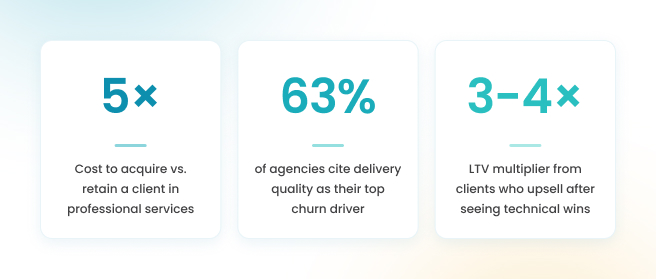
Technical SEO Impact

Here’s how the mechanics work. A client that sees measurable technical wins in their first 90 days – faster page speed, improved indexation, a schema-driven rich result appearing in search – associates those wins with your agency. That association creates confidence. Confident clients renew. They ask what else you can do. They refer.

A client that sees the same technical backlog untouched at their 90-day review starts calculating whether the engagement is worth continuing. Even if your content strategy is excellent and your keyword targeting is precise, a stagnant technical foundation signals to clients that delivery is not actually happening.

Retention isn’t a relationship skill. It’s a delivery discipline. The agencies with the best retention rates aren’t the most communicative – they’re the most consistent at shipping technical wins.

What Is Answer Engine Optimization and How Does It Affect Client Retention?

Answer Engine Optimization (AEO) is the practice of structuring content to be surfaced directly inside AI-generated answers – in Google’s AI Overviews, ChatGPT, Perplexity, and similar platforms. It’s one of the fastest-growing client concerns right now, and it’s almost entirely a technical SEO problem.

AI Overview visibility depends on three things that are all technical in nature: structured data quality, page load performance (AI crawlers time out on slow pages), and content passage architecture. If your client asks why their competitor is being cited in AI search results and they’re not, the answer is nearly always found in a technical audit – not a content gap.

Agencies that can deliver AEO-ready technical infrastructure are providing something clients are actively asking about right now. That’s a retention argument and a prospecting argument simultaneously. When you can show a client their schema is blocking AI Overview eligibility, and then fix it, you’ve created a win that’s visible and attributable. Those wins compound into renewed contracts and expanded scope.

.
GEO + AEO: The Emerging Technical Requirement
Generative Engine Optimization requires clean site architecture, validated structured data, and AI-friendly content structure – all classic technical SEO deliverables. Agencies that position technical execution as the foundation of AI search visibility are solving a problem that clients can feel urgency around. That urgency extends engagement timelines and justifies premium retainers.


Why Do Most Agencies Have a Technical SEO Execution Gap?

Here’s the uncomfortable reality: most agencies have a strategy-to-execution gap that’s significantly larger than they realize. The audit gets written. The recommendations are solid. But implementation depends on the client’s dev team – which has a six-week sprint queue – and the technical fixes sit in a backlog while the strategy stalls.

This is where SEO client retention starts becoming vulnerable. Crawl errors, indexation issues, Core Web Vitals fixes, schema updates, internal linking improvements, and on-page technical changes may look small individually, but when they remain unresolved month after month, clients begin questioning the value of the retainer.

For agencies, the real problem is not lack of SEO expertise. It is lack of reliable technical SEO execution capacity. Without a system to turn recommendations into completed fixes, even the best SEO strategy can lose momentum, weaken reporting conversations, and reduce long-term client LTV.
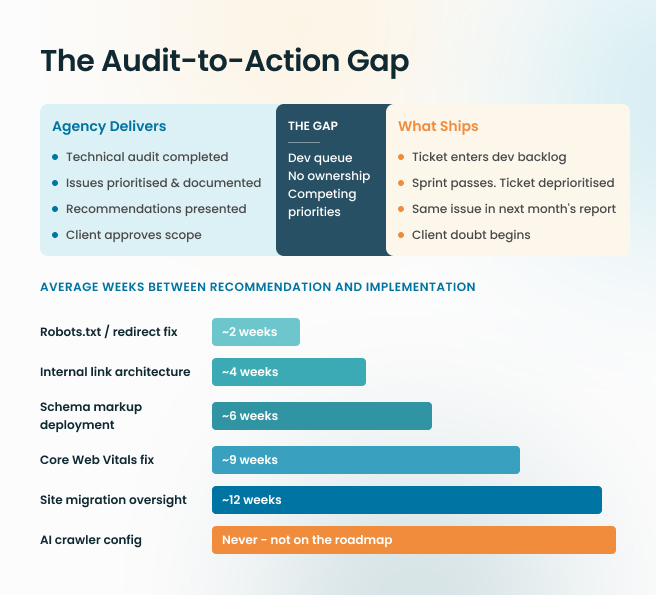
SEO Execution Gap

This is where retention starts bleeding. Not at the renewal conversation. Not at the QBR. It bleeds in the 60-day window between “we identified these technical issues” and “nothing has changed yet.” That window is where client doubt forms.

Where Technical Execution Typically Breaks Down

.
✅ Technical audits completed but recommendations never prioritized or implemented
✅ Core Web Vitals issues flagged in month one, still red in month four
✅ Schema markup approved but not shipped due to dev team backlog
✅ AI crawler permissions not configured – client invisible to GPTBot, ClaudeBot, PerplexityBot
✅ Internal link architecture issues identified but never addressed at scale
✅ Redirect chains left unresolved after site migrations


Each of these is a retention risk. Not because the client knows the technical terminology, but because they can see the outcome: their rankings didn’t move, their traffic didn’t grow, their AI visibility didn’t improve. The diagnosis is invisible to them. The stagnation is not.

How Does White-Label Technical SEO Delivery Solve the Retention Problem?

The most direct solution to the strategy-to-execution gap is white-label technical SEO delivery – bringing in a specialist team that handles the implementation end-to-end, under your agency’s brand, without requiring you to hire, train, or manage technical staff.

When execution is reliable and fast, the agency-client dynamic shifts. Instead of quarterly conversations about what’s in the backlog, you’re running monthly reviews of what shipped and what moved. That shift – from backlog management to delivery momentum – is what changes the client’s perception of the engagement.

What Changes When Execution Is Handled

When technical SEO execution is handled properly, the impact is not limited to completed tasks. Agencies begin to see stronger delivery control, faster issue resolution, cleaner reporting, and more confident client conversations. Instead of repeatedly explaining unresolved audit findings, the focus shifts to measurable SEO progress, improved organic visibility, better site performance, and stronger client retention.

The checklist below shows how consistent technical SEO execution directly supports client LTV by turning strategy into action, recommendations into fixes, and monthly retainers into visible outcomes.

.
✅ Technical wins appear on dashboards within 30 days – not 90 – creating early proof of value
✅Schema implementation happens at scale, accelerating AI Overview eligibility across the site
✅ Core Web Vitals are resolved systematically rather than in piecemeal dev sprints
✅ AI crawler access is configured correctly, removing a hidden barrier to GEO performance
✅ Site migrations are managed with zero indexation loss – a category of failure that ends client relationships fast
✅ Monthly reporting reflects real changes, not just audits and recommendations


From the client’s perspective, this feels like a different agency. The same strategy that was previously generating audit documents is now generating visible improvements. That’s the whole retention mechanism in one sentence.

Does Higher Client Retention Actually Lower Customer Acquisition Cost?

Customer acquisition cost (CAC) is the metric most agencies optimize by default – more leads, better conversion rates, tighter pitches. But the fastest path to lowering CAC is making it irrelevant: when clients stay for three years instead of eighteen months, your CAC per dollar of revenue drops by default.

Strong technical execution extends average engagement length in ways that are hard to attribute directly but easy to see in the numbers. A client who sees their site migrate cleanly, their AI Overview appearances grow quarter-over-quarter, and their Core Web Vitals improve consistently has no reason to evaluate competitors. They’re winning. They associate the wins with you.

The agencies with the lowest effective CAC are rarely the ones with the best sales process. They’re the ones with the highest renewal rates – because their delivery makes the renewal conversation unnecessary. The client doesn’t need to be resold. They already know what they’d be giving up.

How Should Agencies Build Technical SEO Into a Client Retention Framework?

If you’re building or refining a retention system, technical SEO execution needs to be a structured component – not a dependency on the client’s dev team or a line item that appears in audits and disappears from action plans.

The practical framework looks like this: technical audits run on a defined cadence (quarterly for established sites, monthly during the first six months), implementation milestones are owned by delivery – not the client – and AI search visibility is tracked and reported alongside traditional keyword rankings. When a client asks why their competitor is appearing in AI Overviews, your team should have an answer within the week and a fix in the queue the week after.
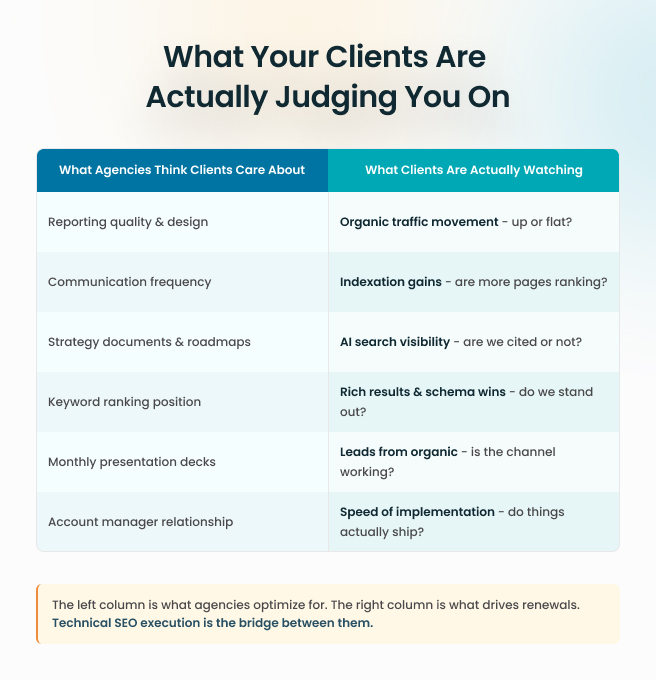
Client Retention Metrics

That responsiveness, at scale, is what white-label technical SEO delivery makes possible. ZealousWeb handles the technical execution layer – crawl health, Core Web Vitals, structured data, AEO and GEO readiness – so your agency’s strategic work shows up in client results without the operational overhead of hiring and managing a specialist technical team.

Your Client Deserves Execution That Matches Your Strategy

See How We Deliver

Technical SEO Execution

The Retention Problem Is a Technical SEO Problem

Agencies that approach retention as a relationship or communication challenge will keep fighting the same churn cycle. The clients who leave aren’t leaving because the reporting wasn’t clear enough or the check-in calls weren’t frequent enough. They’re leaving because the results weren’t there – and in most cases, the results weren’t there because the technical execution wasn’t keeping pace with the strategy.

Fix the execution gap, and the retention numbers follow. Extend the average engagement from 18 months to 36, and LTV more than doubles without a single new client logo. That’s not a growth strategy – it’s a math problem. And the answer is technical delivery that actually ships.

Conclusion

The fastest way to grow an SEO agency isn’t to win more clients. It’s to stop losing them. Most agencies still treat client retention as a relationship or communication challenge – better check-ins, clearer reporting, more frequent calls. But the clients who leave aren’t leaving because nobody called. They’re leaving because the work didn’t move the needle fast enough, and nobody could clearly explain why.

In almost every case, that explanation traces back to one place: technical SEO execution. The audits were written. The strategy was sound. But the implementation stalled, the crawl issues stayed unresolved, and the AI search visibility problem nobody had diagnosed quietly eroded the client’s confidence until the renewal conversation became a churn conversation.

The agencies winning on retention right now are not the ones with the best pitch decks or the most polished QBR templates. They’re the ones whose clients open Search Console every month and see something that moved. Clean crawl health. A new rich result. An AI Overview citation that wasn’t there last quarter. Those wins don’t happen by accident – they happen because someone executed the technical work, on time, without waiting for a dev sprint to free up.

That’s the retention model worth building toward. And it starts with treating technical SEO delivery as infrastructure, not a line item on an audit document.

ZealousWeb handles the technical execution layer for agencies that want to close that gap – crawl health, Core Web Vitals, structured data, AEO and GEO readiness – under your brand, on your timeline, without the overhead of building an in-house technical team. If your delivery is already where it needs to be, this post was useful context. If it isn’t, the gap is costing you in renewals you don’t know you’re losing yet.

Grow Your Business With Our Professional White Label SEO Services

Partner With ZealousWeb

White Label SEO

FAQs

Related Blog Posts

White Label SEO

How Agencies Deliver on Every SEO Recommendation at Scale Without Stretching the Team

July 10, 2026
Marketing AgenciesSEO OutsourcingTechnical SEOWhite Label SEO
AI Search Optimization Guide

How to Do Generative Engine Optimization: Best Practices for Agencies and Brands for AI Visibility

July 07, 2026
AI Search OptimizationAI VisibilityDigital Marketing Strategygenerative engine optimization
AEO Best Practices

AEO Best Practices: How to Get Your Business Featured in AI-Generated Answers

June 29, 2026
AEO Best PracticesAI Search VisibilityAnswer Engine OptimizationGoogle AI Overviews
ZealousWeb

How Does Answer Engine Optimization Work: Strategies, Tools, and Best Practices for AI Visibility

June 11, 2026
AI SearchAnswer Engine OptimizationGenerative SearchSEO Strategy
delivery systems for agencies

Why Good Workflows Fail at Scale and How Agencies Can Build Delivery Stability

May 20, 2026
Delivery Managementexecution systemwhite-label agencyworkflow clarity
Pathlab Meta ad landing page optimization

What a Pathlab Should Put on Its Meta Ad Landing Page to Boost Conversions

February 26, 2026
Healthcare Digital MarketingLanding Page OptimizationMeta AdsPathlab Lab Marketing
30-Day Digital Marketing Plan

Your Lab’s 30-Day Growth Plan: A Simple Digital Marketing Roadmap That Actually Works

February 26, 2026
Diagnostic Lab GrowthGoogle Business ProfileHealthcare Digital Marketinglab marketing