

Here’s something most agencies won’t say out loud: they already know what’s wrong with their clients’ websites.
The crawl errors, the slow Core Web Vitals, the broken redirects, the missing schema it’s all sitting in a spreadsheet or a PDF deck somewhere. Probably color-coded. Probably presented on a video call where everyone nodded.
And then? Nothing moved.
Agencies don’t lose SEO momentum because they lack insight. They lose it because turning those insights into completed, validated, client-visible work is genuinely hard to manage at scale. Especially across ten, twenty, or fifty client accounts running on different platforms, different dev teams, and different approval timelines.
The audit was never the problem. Execution is.
This article breaks down exactly where the delivery gap lives, how it compounds across accounts, and what a white-label technical SEO execution partner actually looks like in practice so agencies can start converting recommendations into results their clients can see.
Why Most SEO Audits Never Reach Their Full Revenue Potential
An SEO audit is a diagnosis. Useful, necessary, and completely worthless on its own. A site with 47 identified technical issues and zero fixes implemented is in the same position it was before the audit — except the client now knows what’s wrong. That awareness doesn’t generate a single click, ranking improvement, or lead.
Revenue comes from fixing things. Not finding them.
40%
of audit recommendations get fully implemented within 90 days of delivery. The number drops further when developer dependency is involved — across agency operations consistently.
The Gap Between Insight and Progress
Most audits produce a prioritized list of issues. What they don’t produce is a system for moving those issues from “identified” to “fixed” to “verified” to “reported.” That gap — between insight and visible client progress — is where SEO value quietly disappears.
💡Key Insights
The Agency Looks Busy. The Client’s Site Isn’t Moving.
The deliverables are technically complete. But the client’s site isn’t ranking better, the crawl budget is still being wasted, and the page speed is still failing the Core Web Vitals threshold.
Implementation Discipline Is the Missing Layer
The agencies that retain clients long-term and grow SEO retainers aren’t necessarily the ones with the best audit frameworks. They’re the ones with the tightest execution systems. Strategy matters. Delivery matters more.
An audit only creates value when its recommendations move into action. For agencies, the real revenue opportunity is not in finding more issues — it is in building the execution discipline to fix, verify, and prove progress consistently.
The Technical SEO Delivery Gap Most Agencies Underestimate
Most agencies assume the hard part of SEO is the analysis. Build a solid audit framework, identify the right issues, prioritize them correctly — and the rest follows. In practice, that’s rarely how it works. The real challenge in technical SEO support for agencies isn’t finding what’s broken. It’s building a system that actually moves fixes from identified to implemented, verified, and reported. That gap — between insight and action is where most SEO engagements quietly lose their momentum.
Where Recommendations Get Stuck
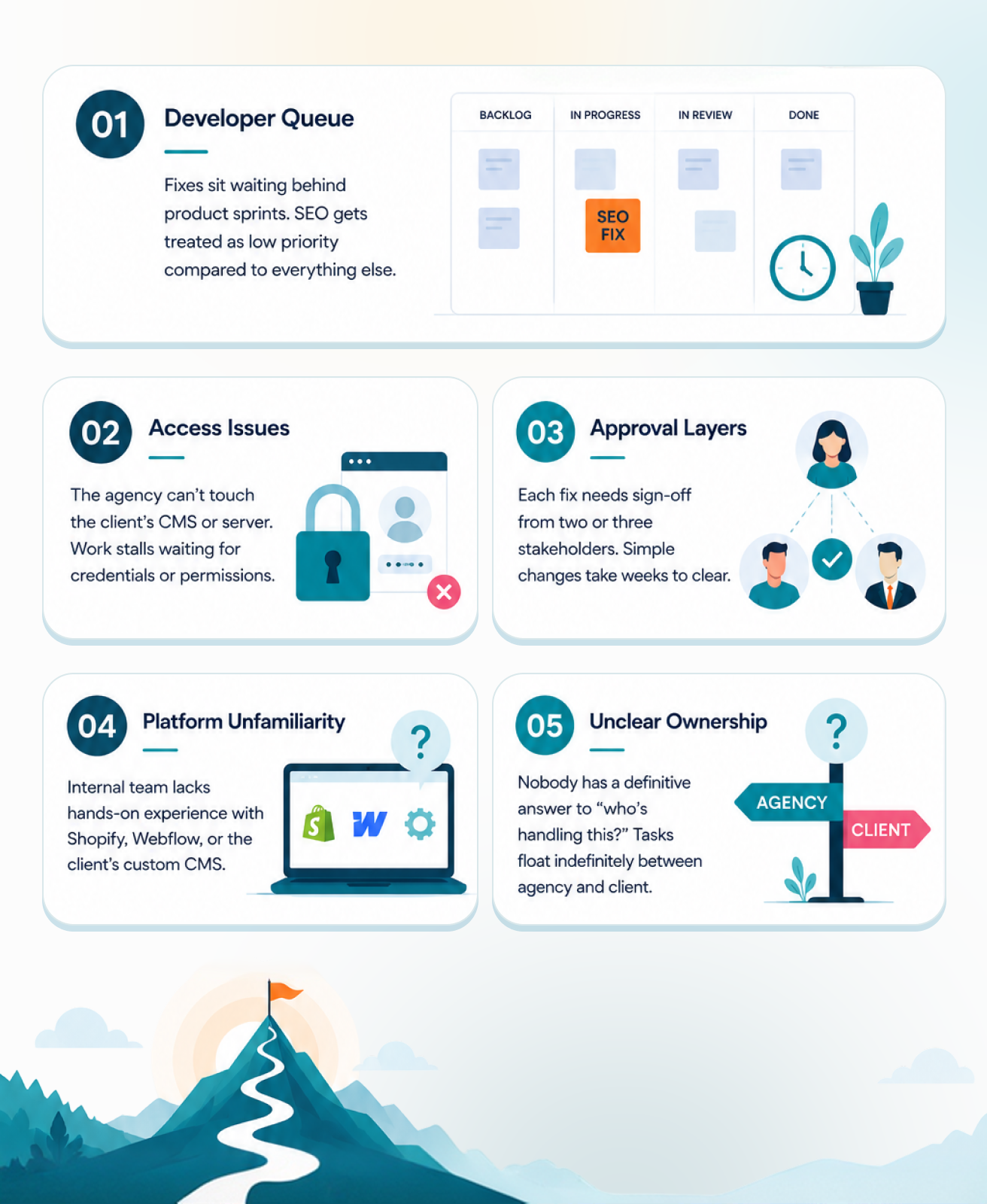
Ask any agency head where SEO fixes actually stall, and you’ll hear the same answers. The audit went to the client. The client sent it to their developer. The developer had three other priorities. Six weeks later, nothing has moved and the monthly report has nothing new to show. That’s not a client problem. That’s a workflow problem.
Why Unresolved Fixes Erode Client Confidence
Clients are paying for SEO progress. When they see the same issues flagged across two, three, or four monthly reports without resolution, they stop questioning the delay they start questioning the agency.
It rarely starts with a complaint. It starts with a question. “We noticed this was flagged last month too what’s the status?” Manageable once. By the third consecutive review call, it’s no longer a question about a fix. It’s a question about whether you have control of the engagement.
The problem is almost never intent it’s the gap between audit and action. Recommendations sitting unread, developers waiting on clearer briefs, no system tracking what’s flagged versus what’s actually resolved. The client doesn’t see any of that. They see the report. And when the same issues appear month after month, it stops feeling like a progress document.
A white-label technical SEO partner closes that gap. When fixes are tracked end-to-end — flagged, in progress, implemented, GSC-verified — every monthly report becomes a progress report. And the client conversation shifts from “why hasn’t this been fixed” to “what are we working on next.
Why Technical SEO Execution Becomes a Cost, Capacity, and Retention Problem
Most agencies don’t lose SEO clients over strategy. They lose them over execution. The audit is solid, the recommendations are right, but somewhere between the report and the resolution things stall. Fixes don’t get implemented. Reports start repeating themselves. And what began as a strong retainer quietly becomes a liability.
The problem compounds across three dimensions simultaneously: it costs more than you think to manage internally, it stretches teams that are already at capacity, and it erodes the client confidence that keeps retainers renewing. Left unaddressed, it doesn’t just affect one account it sets a ceiling on how many SEO clients your agency can realistically service without the quality starting to slip.
When Audit Recommendations Turn Into Delivery Backlog
Every unresolved audit finding is a liability that quietly compounds. One month, three fixes roll over. The next month, five more are added. By month four, the outstanding list is long enough that nobody can say with confidence which items are urgent, which are in progress, and which have been silently abandoned.
The backlog doesn’t just represent missed SEO impact. It represents conversations an account manager is dreading, a retainer renewal that’s less certain than it should be, and a client who is starting to wonder whether the engagement is actually moving.
| . | |
| Why Internal Teams Get Stretched
The Role Mismatch Nobody Admits Senior SEOs are hired to think strategically. Account managers are hired to manage relationships. Neither role is designed to function as a technical implementation unit across eight to fifteen simultaneous accounts. But that’s often what happens — and the whole team gets stretched across work it was never hired to do. |
Margin Pressure Reality Check
If a senior SEO earning £55,000 per year spends 30% of their time on implementation chasing that a delivery partner could handle, that’s roughly £16,500 per year of senior-level cost going toward work that shouldn’t require senior-level involvement. Multiply that across two or three senior hires and the math becomes very hard to ignore. |
How Delayed Fixes Affect Retainers and Reporting Conversations
Here’s what a delayed implementation does to a client relationship in practice. The monthly report arrives. The data shows limited movement. The agency has to explain why. The honest answer is that the fixes identified three months ago are still waiting on a developer, still pending client approval, or still sitting in a queue nobody is actively managing.
That explanation is survivable once. Twice, it starts to erode trust. Three times, the client begins exploring alternatives.
Why Building an Internal Technical SEO Team Is Not Always the Most Efficient Path
Hiring in-house feels like the natural next step when technical SEO demand grows. But for most agencies, the fixed cost, narrow specialism, and uneven workload of a full-time hire creates more overhead risk than delivery advantage. A white-label SEO execution partner gives you the same depth and output without the commitment.
The Hiring Math Doesn't Always Work Out
Let’s take a real example. A mid-level technical SEO specialist in the US costs between $55,000 and $85,000 annually. Layer in everything that comes with a full-time hire and the number climbs fast.
- COST BREAKDOWN: ONE TECHNICAL SEO HIRE (US AGENCY)
Base Salary — $55,000 to $85,000 Employer Payroll Taxes (FICA ~7.65%) — $4,200 to $6,500 Health Insurance Contribution — $6,000 to $12,000 401(k) Match (3% typical) — $1,650 to $2,550 Onboarding and Training — $1,500 to $3,000 SEO Toolstack (Screaming Frog, rank tracker, crawl platform) — $3,000 to $8,000 per year
- Approximate Total Year One Cost: $71,000 to $117,000+
To put that in perspective: at $2,000 per client per month in technical SEO billing, you need that specialist fully utilized across four to five accounts every single month just to break even. Fully billable. Every month. All year.
That rarely happens. Demand is lumpy a migration one month, a quiet schema cleanup the next. The fixed cost stays the same regardless. For most agencies, that’s more overhead risk than the hire is worth.
Specialist Dependency Is a Real Problem
Technical SEO is not one skill. It’s a cluster of them. Crawl optimization, Core Web Vitals, structured data, hreflang, log file analysis, JavaScript SEO, migration strategy each area has its own depth. Agencies that hire one “technical SEO person” quickly discover the gaps when a client needs something outside that person’s core expertise.
In-House vs. White-Label: The Core Trade-Off
| Factor | In-house Team | White-label Partner |
| Upfront cost | High salary, tools, hiring | Low project or retainer pricing |
| Specialist depth | Limited to whoever was hired | Multi-specialism by design |
| Scalability | Slow-tied to hiring cycles | Fast-on-demand capacity |
| Platform coverage | Depends on team experiences | Broad across CMS & Frameworks |
| Fixed overheads | Yes, regardless of workload | No- scaleswith client volume |
| Client brand visibility | Internal only | Fully white-labeled |
| Onboarding time | Weeks to months | Days to one week |
Building internally makes sense when demand is stable, predictable, and broad enough to keep the team fully utilized. For most growing agencies, a white-label technical SEO partner offers a more flexible path giving access to specialist depth, faster execution, and lower fixed risk without slowing growth.
The SEO Execution System Behind Consistent Technical Delivery
Good technical SEO delivery doesn’t happen by accident. It follows a repeatable system that agencies can build internally or access through a white-label partner. Here’s what that system looks like end to end.
The 5-Stage Technical SEO Execution Workflow
| . |
|
Critical Note
Stage 4 Is Where Most Execution Falls Apart
Fixes that go live and stay broken are worse than fixes that were never attempted. They erode trust without delivering any benefit. QA is not optional — it’s the stage that determines whether the work actually counts.
Consistent technical SEO delivery depends on a system where every fix is prioritized, implemented, validated, and reported clearly. When execution follows a repeatable workflow, agencies move from reactive issue-chasing to reliable technical progress clients can trust.
Where a White-Label Technical SEO Execution Partner Fits Into the Workflow
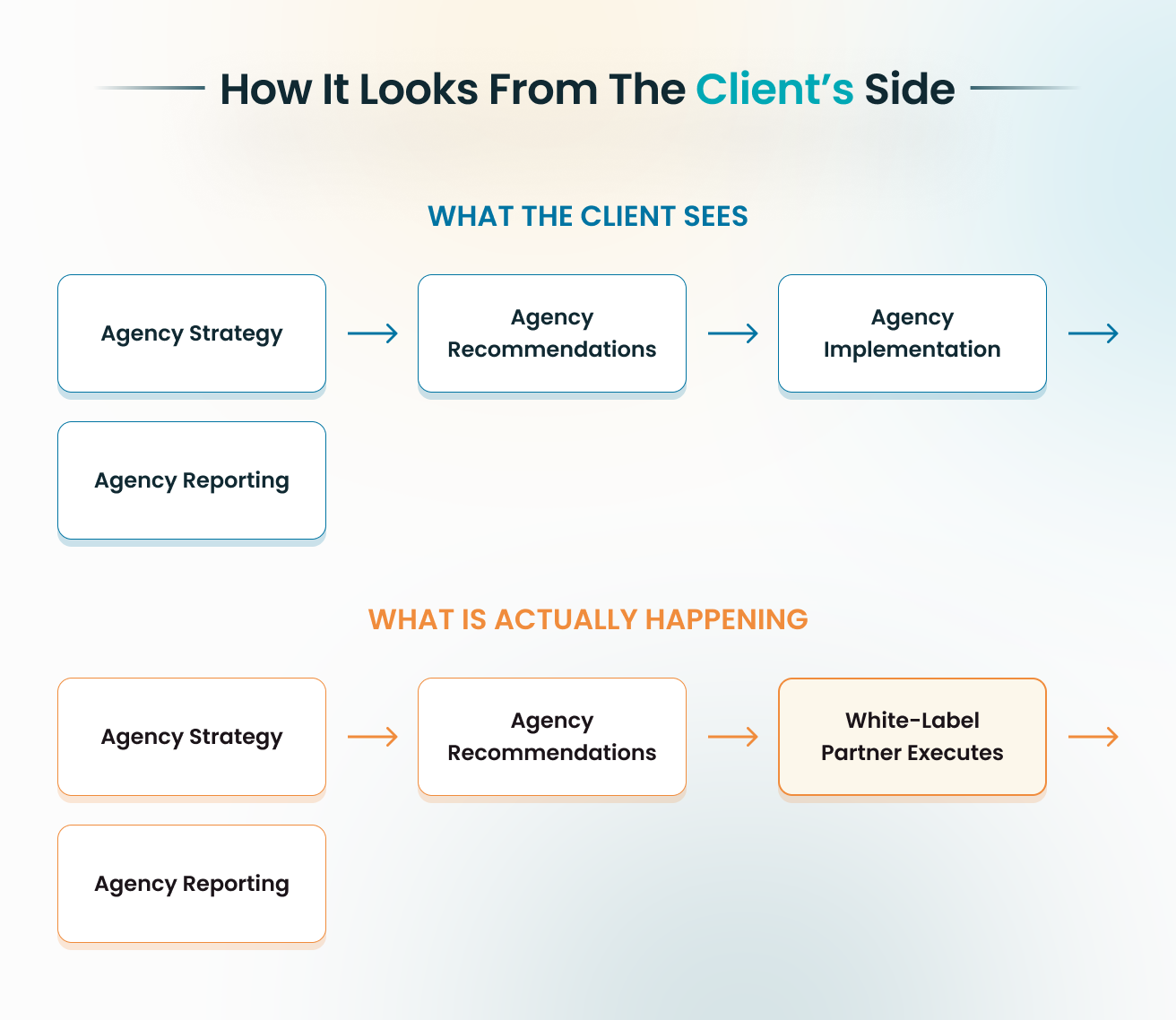
The agency owns everything the client actually sees. The partner handles everything that makes those outputs possible. Here’s exactly how the division of responsibility works.
How Client Ownership Stays With the Agency
White-label execution doesn’t mean handing off the relationship. The partner works inside the agency’s systems, uses the agency’s reporting templates, follows the agency’s communication rhythm, and never touches the client directly unless the agency explicitly chooses to include them. The client experience is seamless. The agency’s brand is protected. The work gets done.
Struggling to move audit findings into implemented fixes?
Request a Free Scoping Call
What Agencies Actually Outsource and What They Keep In-House
This is the question agencies ask before committing to a white-label model. The answer matters for margins, workflow design, and making sure client relationships don’t feel diluted.
| . | |
| Agency Owns
Strategy, Communication & Relationship
|
Partner Handles
Implementation, Fixes & QA
|
| . |
| Pre-Engagement Checklist
✅ Before Bringing a White-Label Partner Into Your Workflow, Confirm: ✅ Access protocols — who provides CMS, GSC, or server access and how? ✅ Communication channel — does the partner work inside your PM tool or theirs? ✅ Reporting format — does their output match your client template? ✅ Escalation path — who does the partner contact when a blocker appears? ✅ Brand rules — naming conventions, logos, and language standards. ✅ Turnaround expectations — standard and urgent SLAs defined upfront. ✅ QA ownership — who signs off before a fix is marked complete? |
A strong white-label model does not replace the agency’s role — it protects it. When strategy, client trust, and communication stay in-house while execution runs through a reliable partner, agencies can scale delivery without weakening the client relationship.
Technical SEO Deliverables Agencies Can Move From Audit to Action
An audit without execution is just a list. Here are the ten technical fix types a white-label execution partner can take off your plate — from crawl errors and Core Web Vitals to migrations and schema and deliver back to you validated, documented, and client-ready.
| . | ||
| Search Console Configuration
Setting up Google Search Console to monitor indexing performance, crawl statistics, and key search visibility metrics. |
Core Web Vitals Optimization
LCP, CLS, and INP improvements. Image compression, render-blocking removal, lazy loading, and layout shift debugging. |
Schema Markup Implementation
Structured data for articles, products, FAQs, local business, breadcrumbs, and reviews. Validated via Rich Results Test. |
| E-commerce Technical SEO
Faceted navigation, pagination fixes, product schema, canonical issues from filter parameters, large catalog crawl budgets. |
Redirects & Canonical Mapping
Reports covering broken URLs, redirect chains such as 301s and 302s, and recommendations to resolve duplicate content issues. |
Site Architecture Mapping
Guidelines for simplifying website navigation so search engine bots can easily access deeper pages without encountering dead ends. |
| Page Speed Diagnostics:
Actionable recommendations to improve website performance through image optimization, faster server response times, and effective browser caching. |
Technical QA & Validation
Post-implementation checks using crawl data, Search Console, and speed tools before any fix enters the client report. |
Crawl & Indexation Fixes
Resolving crawl errors, noindex conflicts, duplicate content signals, XML sitemap cleanup, and crawl budget allocation. |
Technical SEO delivers value when every issue moves from discovery to implementation, validation, and reporting. With the right execution support, agencies can turn complex technical fixes into measurable progress clients can see, understand, and renew for.
Protecting Agency Margins: The Economics of Technical SEO Execution
Every technical SEO retainer you deliver through a white-label partner carries margin built in. You set the client price, the partner handles the execution at a lower cost, and the difference stays with your agency. No salary overhead, no idle capacity, no toolstack investment just clean, scalable profit on work that gets done.
How White-Label Technical SEO Is Typically Priced
Most execution partners offer either project-based pricing for defined scopes — a migration, a Core Web Vitals sprint, a schema implementation — or monthly retainer pricing for ongoing execution support. Project pricing gives agencies cost certainty for one-off work. Retainer pricing works better when consistent volume justifies a flat monthly rate.
Most agencies price white-label SEO work at a 30 to 60 percent margin on the partner cost, depending on complexity and whether implementation is bundled into a broader retainer or sold as a standalone service.
| . | |
| Monthly Retainer Example Partner (Approx)
Cost — $1,500 / month Agency Charges Client — $2,200 to $2,500 Agency Margin — 33 to 40% |
Project-Based Example Partner Cost (Approx)
(Schema + QA) — $500 Agency Charges Client — $750 to $900 Agency Margin — 33 to 43% |
Cost of In-House vs. White-Label: The Real Comparison
The figures below are approximate ranges based on typical US agency hiring costs. Actual numbers will vary by location, seniority, and benefits structure — but even at the conservative end, the cost difference is hard to ignore.
| Cost Type | In-house Technical SEO | White-label Execution |
| Annual base salary | $55,000 to $85,000 | $0 |
| Employer NI+ Pension | $10,000 to $18,000 | $0 |
| Tools & Software | $3,500 to $8,000 per year | Usually included |
| Onboarding and Training | $1,500 to $3,000 | $0 |
| Idle Cost(Quiet Months) | Full salary regardless | Pay only for work done |
| Specialism Coverage | Limited to hires made | Full multi-specialism |
| Total Annual Risk | High — fixed overhead | Low — variable cost |
For agencies that need flexibility, specialist coverage, and predictable delivery, the comparison becomes less about hiring cheaper and more about scaling smarter.
How Agencies Reduce Technical SEO Risk While Maintaining Quality Control
Every technical SEO fix carries risk. A misapplied canonical tag can deindex content. A faulty redirect map on a migration can tank rankings overnight. An incorrectly structured hreflang implementation can create international targeting chaos. Quality control is not optional — it’s what protects agency reputation.
QA Validation Checklist
Post-Implementation — Complete Before Marking Any Fix Done
| . | |
| Crawl affected URLs and verify fix is visible in crawl data | Check Search Console for new errors or coverage changes |
| Run before-and-after page speed comparison | Validate structured data via Rich Results Test |
| Confirm redirect chains resolve with no loops | Verify canonical tags point to intended URLs |
| Check hreflang with a dedicated validator | Review robots.txt for unintended rule additions |
| Document all changes with timestamps for reporting |
Migration Risk Management
Website migrations are the highest-stakes technical SEO work an agency handles. A poorly executed migration can take months to recover from. The framework must always include a pre-migration baseline crawl, a full redirect map, post-go-live monitoring for at least 30 days, and a rollback plan in case something critical breaks. No migration should go live without a signed-off redirect map and a monitoring plan in place.
Accountability Frameworks
Clear task ownership, defined SLAs, and documented delivery milestones mean that when something goes wrong — and occasionally something will — there is a clear record of what was agreed, what was done, and where the gap occurred. That transparency protects both the agency and the partner.
From Technical SEO Fixes to Client Retention and ROI
Completed implementation is the single most powerful retention lever an SEO agency has. Not the audit. Not the strategy deck. The actual finished work showing up in the data.
A monthly report built around completed technical fixes tells a completely different story than one built around what’s still in progress. “We resolved 12 crawl errors, improved your LCP from 4.2s to 2.1s, and implemented product schema across 340 product pages” is a retainer renewal conversation. “We’re still waiting on the developer” is the opposite.
| . |
| How Technical Fixes Connect to Business Results
🔍Crawl Budget Improvements: More pages indexed → more ranking opportunities → more organic visibility across the site. ⚡Core Web Vitals Improvements: Better user experience → lower bounce rate → higher conversion rate → more revenue from existing traffic. ⭐Schema Implementation: Rich results in search → higher click-through rate → more organic traffic without needing to move rankings. 🔗Redirect Cleanup: Removes wasted crawl spend → consolidates link equity → stronger rankings on the pages that actually matter. |
Retention Insight
Agencies that deliver consistent technical implementation report significantly higher retainer renewal rates than those that produce audits without execution. The work that’s actually done — and can be shown in data — is what clients renew for.
Technical SEO earns trust when fixes move from recommendations to measurable outcomes. The agencies that retain clients longer are the ones that turn implementation into visible business progress.
When Agencies Should Bring in a White-Label Technical SEO Partner
Not every agency needs a white-label execution partner immediately. But there are clear signals that the time is right. If three or more of these apply to your agency right now, the cost of not having an execution partner is already higher than the cost of bringing one in.
| . |
| . |
Trigger Checklist
|
A white-label technical SEO partner becomes valuable when execution starts slowing down growth, delivery confidence, or client trust. The right time to bring one in is before missed fixes become missed renewals.
Conclusion
The SEO industry has spent years getting better at audits. Smarter crawl tools. Better reporting frameworks. More granular issue classification. Agencies now find more problems, faster, with better documentation than ever before.
But finding problems is not the same as fixing them.
The agencies that grow are not necessarily the ones with the most sophisticated audit process. They are the ones with a reliable execution layer beneath the strategy — one that turns recommendations into completed fixes, validates the work, and shows progress in the client’s data.
That execution layer does not always need to be built entirely in-house. It needs to be consistent, technically sound, and visible in business outcomes. This is where ZealousWeb supports agencies as a white-label technical SEO execution partner — helping them move from SEO recommendations to real implementation, measurable ROI, and stronger long-term client retention.
Agencies keep the strategy, the client relationship, and the brand. The right execution partner handles the work that turns audit findings into completed fixes, completed fixes into stronger performance, and stronger performance into retained clients.
That is what scales. Not just the audit — the delivery.
The agencies that grow aren’t necessarily the ones with the most sophisticated audit processes. They’re the ones that have built a reliable execution layer underneath the strategy.
Scale Your Agency to 7 Figures Without Building an In-House Team
Get In Touch
FAQs
We already have an SEO team. Why would we need a white-label execution partner?
Your SEO team's time is best spent on strategy, client communication, and growth — not chasing developer queues or manually implementing redirects. ZealousWeb steps in as your execution layer, handling the technical delivery so your team can focus on the work that actually grows the agency.
Will our clients know ZealousWeb is involved?
Never. Everything we deliver — implementation, QA, reporting — goes out under your brand. Your client relationship stays exactly where it belongs: with you.
How quickly can ZealousWeb start delivering on our client accounts?
Most agencies are up and running within a week. We align on your workflows, reporting templates, and access protocols upfront so there is no lag between onboarding and first delivery.
What if we only need execution support for one or two clients right now?
That works for us. We operate on both project and retainer models, so you can start small, validate the workflow, and scale when you are ready. No minimum volume commitments.
How do we protect our margins when reselling your services?
Our pricing is structured to give agencies a consistent 30 to 50 percent margin on white-label technical SEO work. We work within your budget, not against it.
How do we get started?
The fastest way is to book a free Technical SEO Execution scoping call. We will walk through your current client accounts, identify where execution support adds the most value, and put together a delivery model that fits your workflow and margins — no commitment required.