

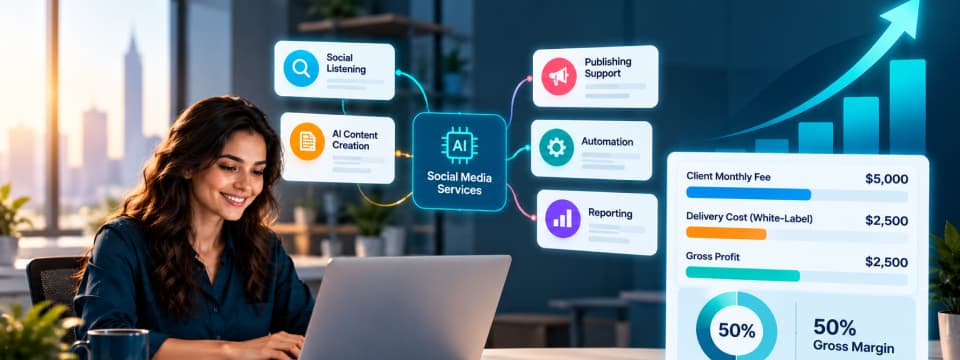
Agencies do not need to build another full-time team to start selling AI-powered social media services.
By keeping strategy, client relationships, approvals, and pricing in-house while outsourcing specialist delivery, agencies can add services such as AI-assisted social listening, content creation, creative production, automation, publishing support, and reporting without carrying the cost of permanent headcount.
For example, an agency charging a client $5,000 per month and spending $2,500 on delivery would retain $2,500 in gross profit-a 50% gross margin before internal account management, software, sales, and other overhead.
But margin is only part of the equation.
The bigger question is how agencies can package AI social media into a service clients will actually buy, decide what should stay in-house, determine what can be white-labeled, and connect social visibility with the wider shift toward AI search, AEO, GEO, and brand discovery across platforms like Google, ChatGPT, Gemini, and Perplexity.
Can Agencies Offer AI Social Media Services Without Hiring In-House? Yes. Agencies can sell AI social media services without building an internal social media, creative, automation, and analytics team from scratch.
A practical white-label model lets the agency retain control of the client relationship, strategy, pricing, brand voice, and approvals while a specialist delivery partner handles defined execution tasks behind the scenes.
This can include:
- AI-assisted social listening and competitor monitoring
- Social media content creation and repurposing
- Creative and short-form content production
- Content scheduling and publishing support
- Engagement and community support
- Workflow and marketing automation
- Social performance reporting
- AI-driven audience and content insights
The model works best when the agency is clear about three things: what it will sell, what it will keep client-facing, and what delivery work can be outsourced profitably.
That becomes even more important as social media, SEO, AEO, GEO, and AI search increasingly influence the same customer discovery journey. A brand may first appear in a LinkedIn post, later be searched on Google, and eventually be compared or recommended inside an AI-generated answer.
For agencies, the opportunity is no longer simply to “manage social media.”
It is to build a repeatable, profitable visibility service that supports how clients are being discovered across both traditional and AI-driven channels.
Why Agencies Are Adding AI Social Media Services Now
Clients are not asking agencies for “more posts.” They are asking for more visibility, faster content production, stronger engagement, better reporting, and clearer proof that social media is contributing to growth.
AI is changing how agencies can deliver all of that.
HubSpot’s 2026 Social Media Marketing Report found that 94% of social media marketers already use AI somewhere in their workflow, while 59% say increasing brand awareness is their top social media goal. At the same time, consistently producing high-quality content remains one of marketers’ biggest challenges.
That creates an opportunity for agencies.
Instead of hiring separately for strategy, copy, design, social listening, analytics, automation, and reporting, agencies can use AI-assisted workflows and specialist delivery support to package more of those capabilities into one recurring service.
The opportunity is not simply to produce content faster.
It is to help clients stay visible wherever their audiences are discovering, researching, comparing, and talking about brands.
Social Media Is Becoming Part of the Wider Search Journey
A prospect may discover a company through LinkedIn, watch its videos on Instagram, search the brand on Google, read a Reddit discussion, and later ask ChatGPT, Gemini, or Perplexity which provider they should consider.
That makes social media increasingly connected to SEO, AEO, GEO, AI search visibility, and overall brand authority.
HubSpot’s 2026 research specifically points to the growing connection between brand awareness, social conversations, and answer engine optimization. The report also notes Reddit’s increasing importance for community listening and visibility in AI-generated search results.
For agencies, this changes the value proposition.
Social media can no longer be sold only as:
“We will create 12 posts a month.”
A stronger offer is:
“We will help your brand consistently create, distribute, monitor, and learn from content across the channels influencing how customers discover you.”
That is a much easier conversation to connect with AI SEO, AEO, GEO, content marketing, reputation, and lead generation.
AI Makes Broader Social Media Services Easier to Productize
AI tools can now support work that previously took multiple people and a lot more manual time, including:
- audience and competitor research
- social listening and trend identification
- content ideation
- caption and copy development
- content repurposing
- creative variations
- scheduling workflows
- performance analysis
- reporting summaries
- engagement insights
HubSpot reports that some of the most common AI uses among social media marketers include ideation, short-form copy, image generation, and image editing.
That does not mean agencies should automate everything.
In fact, Sprout Social’s 2026 research found that consumers want brands to prioritize human-generated content, with AI better used for insights and process efficiency rather than replacing human judgment and creativity.
That distinction matters.
The agencies with the stronger offer will not be the ones promising:
“AI will run your social media for you.”
They will be the ones using AI to reduce repetitive delivery work while keeping strategy, brand voice, creative judgment, client knowledge, and quality control human-led.
The Bigger Agency Opportunity: More Services Without More Fixed Headcount
This is where AI social media becomes commercially interesting.
An agency may already have SEO, PPC, web, content, or digital marketing clients asking for help with social media.
Traditionally, saying yes could mean hiring several specialists before enough recurring revenue exists to justify those salaries.
A white-label AI social media delivery model gives agencies another option. They can validate demand, build packages, sell recurring services, and increase account value before making a major internal hiring commitment.
That means the business decision becomes less about:
“Should we hire a social media team?”
and more about:
“Can we turn existing client demand into a profitable recurring service without increasing fixed overhead at the same rate?”
For many agencies, that is the more useful question.
AI Search Makes Brand Visibility Broader Than Rankings
There is another reason agencies should pay attention.
Traditional SEO still matters, but clients increasingly want to know whether their brands appear in AI-generated answers, AI Overviews, ChatGPT, Gemini, Perplexity, and other discovery environments.
That is pushing agencies toward AEO and GEO alongside traditional SEO.
And measuring that visibility is becoming a business issue of its own. Search Engine Land recently highlighted the difficulty of attributing AEO performance because LLM referral traffic captures only part of AI search’s influence on demand and revenue.
Social media fits into this broader picture because brand visibility is no longer created by one channel.
Search content, social discussions, expert commentary, community mentions, reviews, third-party references, and branded content can all contribute to how a company is discovered and evaluated online.
For agencies, that creates room to move beyond isolated services and build more connected visibility offerings across social media, SEO, AEO, GEO, and AI search.
The opportunity is not to add another service to the menu.
It is to build a service agencies can sell repeatedly, deliver efficiently, and expand across existing client accounts without adding equivalent headcount every time revenue grows.
What Can Agencies Actually Sell as an AI Social Media Service?
The easiest way to productize AI social media services is not to sell “AI.” Clients are paying for better visibility, stronger content, faster execution, useful audience insights, and measurable social performance.
For agencies, that means packaging AI-assisted delivery around outcomes clients already understand.
| Service | What the Client Gets | What Can be White-labeled |
| Social media strategy | Channel, audience, and content creation | Research and strategy support |
| AI social listening | Brand competitors and audience insights | Monitoring and analysis |
| Content creation | Posts, captions, campaigns, and content calendars | Research, writing and repurposing |
| Creative production | Social graphics and short-form assets | Design and creative adaptation |
| Publishing support | Consistent content distribution | Scheduling and workflow management |
| Engagement support | Faster response and community monitoring | Monitoring and response assistance |
| Reporting | Clear performance and growth insights | Data analysis and report preparation |
The agency does not have to hand over the parts that make the client relationship valuable.
Strategy, positioning, pricing, client communication, and final approvals can remain in-house, while repetitive and specialist delivery work is handled by a white-label social media partner.
Where Do AEO and GEO Fit Into Social Media?
Social media should not be treated as a replacement for SEO, Answer Engine Optimization (AEO), or Generative Engine Optimization (GEO). But the channels increasingly support the same wider goal: making a brand easier to discover, understand, trust, and reference online.
For example, social listening can reveal the questions customers repeatedly ask, the language they use, competitor comparisons, common objections, and emerging topics.
Those insights can then inform:
- SEO and long-tail keyword strategies
- People Also Ask and question-led content
- AEO-focused FAQs and direct answers
- GEO content built around real customer questions
- thought leadership and expert commentary
- social content that reinforces important brand topics and expertise
This gives agencies a stronger offer than simply promising a set number of posts every month.
They can connect social media marketing, AI search visibility, SEO, AEO, and GEO around the same customer journey while still keeping each channel focused on what it does best.
And that creates the next commercial question:
What Does It Cost to Build AI Social Media In-House?
Building AI social media services in-house usually means more than hiring one person. Agencies may need strategy, content, creative, automation, analytics, community support, software, and management capacity working together.
| Cost Area | What Is Meant for Agency |
| Specialist talent | Strategy, content, creative, automation, and analytics skills may require multiple people |
| Software | Social listening, AI, publishing, analytics, and automation tools add recurring costs |
| Management | QA, approvals, coordination, and reporting create non-billable time |
| Utilization | Salaries continue even when client demand is inconsistent |
| Training & Replacement | AI, AEO, GEO, and social platforms keep changing, creating ongoing training and hiring costs |
The real question is not “What does one social media hire cost?”
It is:
“How much recurring client revenue do we need before the entire team stays profitable and fully utilized?”
What Does a 50% Margin AI Social Media Service Actually Look Like?
For agencies still validating demand, a white-label AI social media model can reduce that fixed-cost exposure and tie delivery capacity more closely to active client work.
A 50% gross margin means the agency keeps half of the client fee after outsourced delivery costs, before accounting for sales, account management, software, taxes, and other overhead.
The Agency AI Social Margin Model
| Client retainer | Outsourced Delivery | Gross Profit | Gross Maring |
| $3,000/month | $1500 | $1500 | 50% |
| $5,000/month | $2500 | $2500 | 50% |
| $7,500/month | $3750 | $3750 | 50% |
Formula: Gross Margin = (Client Revenue − Delivery Cost) ÷ Client Revenue × 100
In this model, the agency still owns the client relationship, strategy, pricing, approvals, positioning, and upselling, while a white-label partner handles agreed delivery work.
The exact margin will vary by scope, content volume, creative requirements, automation, reporting, and service complexity. The point is not that every package should deliver exactly 50%.
The goal is to price the service so delivery costs scale with revenue instead of adding fixed headcount before demand is predictable.
What Should Agencies Keep In-House vs Outsource?
The decision is not simply about which option is cheaper. Agencies are choosing between owning fixed capacity and accessing flexible delivery capacity.
| Factor | Build-in House | White-label Partner |
| Hiring cost | Higher upfront commitment | Lower initial commitment |
| Expertise | Limited to hired roles | Access to multiple specialits |
| Capacity | Mostly fixed | Can scale with demand |
| Utilization risk | Agency carries it | Reduced |
| Training | Agency responsibility | Primarily partner responsibility |
| Client ownership | Agency | Agency |
| Speed to launch | Depends on hiring | Faster when capacity exists |
An in-house team can make sense when an agency has consistent volume and wants full operational control.
A white-label model can make more sense when demand is still growing, specialist skills are needed across social media, AI automation, AEO, GEO, and analytics, or the agency wants to launch a new service without committing to another full internal team.
For agencies, the real question becomes: Do we need to own every delivery resource-or do we need reliable access to the right expertise when client demand requires it?
AI Social Media Team vs White-Label Partner: What Are Agencies Really Paying For?
The decision is not simply about which option is cheaper. Agencies are choosing between owning fixed capacity and accessing flexible delivery capacity.
| Factor | Build In-house | White-label Partner |
| Hiring Cost | Higher upfront commitment | Lower initial commitment |
| Expertise | Limited to hired roles | Access to multiple specialists |
| Capacity | Mostly fixed | Can scale with demand |
| Utlization risk | Agencies carries it | Reduced |
| Training | Agency responsibility | Primarily partner responsibility |
| Client ownership | Agency | Agency |
| Speed to Launch | Depends on hiring | Faster when capacity exists |
An in-house team can make sense when an agency has consistent volume and wants full operational control.
A white-label model can make more sense when demand is still growing, specialist skills are needed across social media, AI automation, AEO, GEO, and analytics, or the agency wants to launch a new service without committing to another full internal team.
For agencies, the real question becomes:
Do we need to own every delivery resource-or do we need reliable access to the right expertise when client demand requires it?
When Does White-Label AI Social Media Make Financial Sense?
A white-label AI social media model usually makes the most financial sense when the agency already has demand but does not want to build fixed delivery capacity too early.
It is a strong fit when:
- Clients are already asking for social media support.
- Demand is growing, but not enough to justify a full internal team.
- You want to test the service before hiring.
- You need AI, automation, social listening, or reporting expertise.
- Client workloads fluctuate from month to month.
- You want to retain client ownership without adding permanent delivery headcount.
The goal is not to outsource for the sake of outsourcing.
It is to keep delivery costs aligned with actual client revenue while protecting service quality, turnaround time, and agency margin.
For agencies expanding into AI social media services, AEO, GEO, AI SEO, or automation, that flexibility can make it easier to add new capabilities without turning every new service into another hiring decision.
How ZealousWeb Helps Agencies Build AI Social Media Services Under Their Brand
Agencies keep the client relationship, pricing, positioning, approvals, and brand. ZealousWeb works behind the scenes to support the delivery layer.
Our white-label support can cover:
- AI-assisted social research and listening
- content creation and repurposing
- creative production
- scheduling and publishing support
- workflow and AI automation
- reporting and performance analysis
- ongoing optimization support
The agency remains client-facing, while our team adds the delivery capacity and specialist support needed behind the scenes.
That means you can expand into AI social media, automation, AEO, GEO, and AI search visibility services without having to build every capability in-house first.
Capacity can scale with client demand, communication can stay aligned with your workflow, and the service remains positioned under your agency brand.
For agencies, the commercial advantage is simple: more capability, less fixed delivery overhead, and more room to protect margin as client demand grows.
Ready to Add AI Social Media Without Adding Headcount?
Explore Our Approach
FAQs
What social media tasks can agencies outsource?
Agencies can outsource research, social listening, content production, creative adaptation, scheduling, automation, reporting, and optimization while keeping client-facing strategy in-house.
How much margin can agencies make with white-label social media services?
Margins depend on pricing, scope, and delivery costs. Our goal is to help agencies structure delivery so costs stay aligned with revenue rather than fixed headcount.
Is white-label AI social media suitable for small agencies?
Yes. It can be especially useful for smaller agencies that want to expand services without committing to multiple full-time hires before client demand is proven.
How quickly can an agency start offering AI social media services?
That depends on scope, workflows, and client requirements, but using an existing delivery team is typically faster than recruiting and building every capability internally.
Can ZealousWeb support AI automation, AEO, and GEO alongside social media?
Yes. Our teams can support agencies across AI social media, automation, AI SEO, AEO, GEO, and wider AI search visibility requirements.