

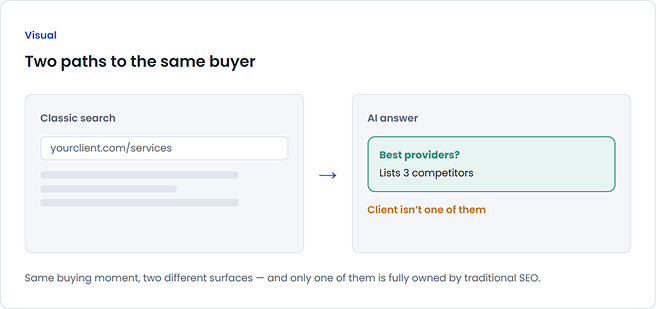
Your agency got the client onto page one. Great. Then the client opens ChatGPT, asks for the “best providers,” sees three competitors mentioned and asks the question every agency knows is coming:
“Why aren’t we showing up here?”
That conversation is becoming harder to avoid. Google says AI Overviews now reaches more than 2.5 billion monthly active users, while AI Mode has surpassed 1 billion monthly users. OpenAI says ChatGPT is now available to more than 1 billion weekly active users. Buyers are moving beyond short keywords to conversational searches, People Also Ask queries, comparisons, follow-up questions, and AI-generated answers and recommendations assembled before they ever visit a website.
So, what does that actually mean for an agency trying to protect SEO accounts, grow retainers, and keep delivery profitable?
That is the opportunity. Not renaming SEO, automating a mountain of AI content, and adding “GEO” to the invoice. Nice try.
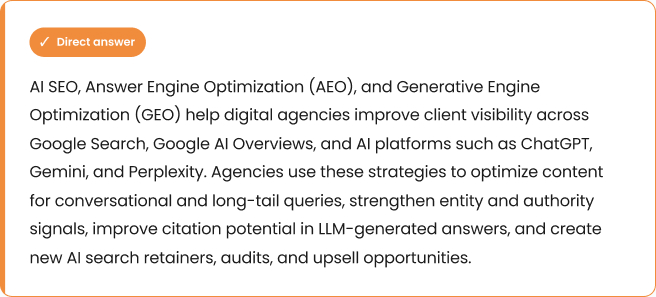
For agencies, the real play is turning existing SEO capability into a broader AI search offering that improves client visibility, opens new upsell paths, strengthens retention, and adds recurring revenue without letting specialist hiring and delivery costs eat the margin.
AI SEO, AEO & GEO: What Agencies Actually Need to Know
For agencies, the alphabet soup matters less than the outcome. Your client still wants to rank on Google, but now they also want their brand surfaced when buyers ask longer questions, explore People Also Ask, compare providers through conversational searches, read AI Overviews, or ask an LLM to recommend a solution.
| Approach | What It Means For An Agency | Where Client Visibility Appears |
| SEO | Strengthen technical foundations, content, authority, and organic rankings. | Traditional Google search results |
| AI/SEO | Extend SEO toward how AI-powered search discovers, interprets, and surfaces client content. | Google Search, AI Overviews, AI Mode, and AI-assisted discovery |
| AEO | Structure content around direct answers, buyer questions, long-tail keywords, FAQs, and clear information retrieval. | AI Overviews, featured answers, People Also Ask, and answer engines |
| GEO | Improve the signals that help generative systems understand, cite, mention, or recommend a client. | ChatGPT, Gemini, Perplexity, Claude, Copilot, and other LLM-driven experiences |
This is already mainstream search behavior, not an experimental side channel. Google reports that AI Overviews now has more than 2.5 billion monthly active users, while AI Mode has surpassed 1 billion monthly users. Google also explicitly says that traditional SEO best practices remain foundational to generative AI visibility and recognizes AEO and GEO as terms used for optimization focused on AI search experiences.
For agencies, that means keyword research now needs to stretch beyond head terms into People Also Asked questions, related searches, long-tail conversational queries, query fan-out, entity coverage, and citation-worthy answers. AI automation can help scale research, monitoring, and reporting, but it does not replace the technical SEO, authority, original insight, and content quality that make a client worth citing in the first place.
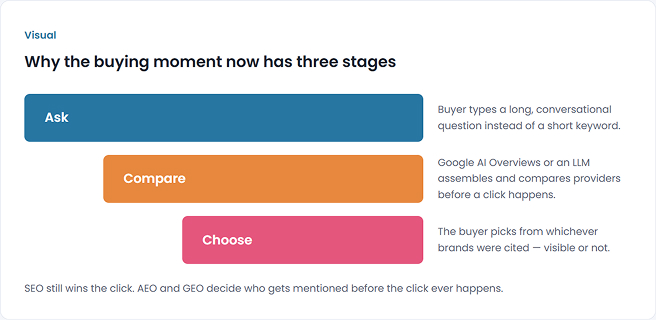
The practical takeaway: SEO, AI SEO, AEO, and GEO should not become four disconnected retainers-they can work together as one broader AI search visibility offering that agencies can package, sell, and scale.
Why AI Search Is Becoming a Client Growth Opportunity for Agencies
Google processes more than 5 trillion searches annually, and the company says AI Overviews are driving over 10% more usage for the query types where they appear, with commercial queries also increasing. For agencies, that matters because AI search is moving closer to the same discovery, comparison, and buying moments clients already pay SEO teams to influence.
Protect Existing SEO Accounts
Clients will increasingly expect their SEO agency to explain why competitors appear in AI Overviews, People Also Ask, ChatGPT, Gemini, or Perplexity while they do not. Expanding keyword research into long-tail questions, related searches, entity coverage, and LLM citation opportunities helps agencies protect existing SEO relationships instead of leaving an obvious capability gap for another provider to fill.
Create A New Retainer Or Upsell
AI visibility audits, answer-focused content optimization, citation monitoring, prompt tracking, and AI-search reporting create natural add-ons to established SEO retainers. AI automation can make research and monitoring more efficient, while the agency still owns strategy, implementation, quality control, and client reporting.
Expand Existing Client Accounts
An SEO client already investing in rankings does not need an entirely separate strategy conversation. Agencies can extend that account into AI SEO, AEO, and GEO by showing where the client appears-or disappears-across AI-generated answers, Google AI Overviews, and LLM recommendations.
For agencies, the opportunity is simple: use AI search to increase the value of existing client relationships before it becomes a capability clients expect you to provide anyway.
What Should Agencies Actually Sell as AI SEO, AEO & GEO?
Clients are unlikely to get excited about buying “GEO.” They will care about whether their brand appears when a prospect asks Google or an LLM a buying question. So agencies need to turn the acronyms into clear, billable deliverables tied to visibility, citations, and reporting.
That matters even more as search becomes conversational. Google reports that the average AI Mode query in the U.S. is three times longer than a traditional Search query-exactly the kind of long-tail, question-led behavior that AEO and GEO
| Agency Deliverable | What The Client is Actually Buying |
| AI Visibility Audit | Finding where competitors appear across AI Overviews and LLM answers while the client is missing. |
| AI Overview Optimization | Improving content structure, relevance, authority, and answer readiness for Google’s AI-generated results. |
| Answer-Focused Content | Building content around long-tail keywords, People Also Ask, related searches, comparisons, and real buyer questions. |
| Entity & Schema Optimization | Making the client’s brand, services, expertise, and relationships easier for search and AI systems to understand. |
| Citation and Authority Building | Strengthening credible third-party mentions and sources that can support citing the brand in LLM models. |
| LLM Visibility Tracking | Monitoring brand mentions, citations, prompts, and competitors across ChatGPT, Gemini, Perplexity, Claude, and other platforms. |
| AI Search Reporting | Turning rankings, AI Overview appearances, citations, referral traffic, and visibility trends into something a client can actually understand. |
AI automation can reduce the manual work behind prompt monitoring, content research, gap analysis, and reporting. It should make fulfillment more efficient-not become the service itself.
The agency opportunity is to package these capabilities around a client outcome: becoming easier to find, understand, cite, and choose across both traditional and AI-driven search.
How Much Can Agencies Charge for AI SEO, AEO & GEO?
This is where AI SEO becomes less about buzzwords and more about margin.
There is no government-published “standard price” for AEO or GEO services, so agencies should price around delivery effort, specialist cost, technology, account management, and target gross margin. For context, the U.S. Bureau of Labor Statistics reports a $78,760 median annual wage for market research analysts and marketing specialists, or $37.87 per hour. In June 2026, total employer compensation for U.S. management and professional workers averaged about $78.88 per hour once wages and benefits were combined.
That makes “we’ll just add GEO to the SEO package” an expensive strategy if nobody checks the hours.
AI SEO & AEO/GEO Pricing Models for Agencies
Agencies do not need one rigid AEO/GEO package for every client. The smarter approach is to match the commercial model to the client’s existing SEO investment, visibility gaps, and level of ongoing support.
| Pricing Model | Where it Fits |
| Monthly SEO/AEO Add-On | For existing SEO clients that need AI Overview optimization, answer-focused content, LLM visibility tracking, and reporting. |
| Standalone AI Search Retainer | For clients investing specifically in AI SEO, AEO, GEO, citations, prompt visibility, and generative search performance. |
| One-Time AI Visibility Audit | For identifying gaps across AI Overviews, long-tail queries, competitor citations, entities, and LLM-generated answers before committing to ongoing work. |
| White-Label/Reseller Model | For agencies that want to sell AI search services under their own brand without building every specialist capability in-house. |
The important part is not creating more packages for the sake of it. It is giving agencies enough flexibility to upsell existing accounts, win new AI-search retainers, or expand delivery capacity without damaging margin.
How Much Are Agencies Charging for AEO & GEO Services?
What an agency charges depends heavily on what sits behind the retainer. AEO and GEO are rarely just content optimization; delivery can involve search strategy, long-tail and People Also Ask research, AI Overview optimization, technical implementation, authority building, LLM citation monitoring, and client reporting.
For context, the U.S. Bureau of Labor Statistics reports average total compensation of $78.85 per hour for management, professional, and related occupations as of June 2026. Using that as a blended U.S. labor benchmark shows how quickly fulfillment costs can add up.
| Cost Area | Typical Agency Effect | Illustrative Labor Cost |
| AI SEO/AEO/GEO strategy and research | 4-6 hours | $315-$473 |
| Content creation and answer optimization | 5-10 hours | $394-$789 |
| Technical SEO, schema, and implementation | 2-4 hours | $158-$315 |
| Technical SEO, schema, and implementation | 2-3 hours | $158-$315 |
| Authority and citation work | 2-4 hours | $158-$315 |
| Reporting and account management | 17-30 hours | $1,340-$2,366 |
This is why two agencies can quote very different prices for what appears to be the same AEO/GEO retainer. One may only optimize content; another may be handling AI Overview visibility, technical SEO, long-tail queries, entity signals, citation building, ChatGPT or Gemini monitoring, and reporting.
For agencies, the number that matters is not simply what the market charges-it is what remains after the real cost of delivering AI search visibility is accounted for.
U.S. Agency Pricing vs. Delivery Cost
| Agency Offer | Typical Monthly Scope | Estimated Fulfillment Cost | Approx Client Pricing |
| AEO/GEO SEO Add-On | 10-15 hrs/mo | $789-$1,183 | $1,578-$2,958 |
| Standalone AI Search Retainer | 20-30 hrs/mo | $1,578-$2,366 | $3,156-$5,915 |
| AI Visibility Audit | 12-20 hrs | $947-$1,578 | $1,894-$3,945 |
| White-Label/Reseller | Partner support + 3-5 agency hrs | Partner fee + $237-$394 | Based on total fulfillment cost |
The pricing reality is simple: AI SEO, AEO, and GEO can become attractive agency revenue, but only when AI automation reduces delivery effort, and the retainer is priced around the actual cost of earning rankings, AI Overview visibility, and citations in LLM models-not around a shiny new acronym.
Add AI Search Without Adding Fixed Cost
Explore White-Label AEO/GEO
What Makes AI SEO, AEO & GEO Profitable for an Agency?
Profit comes from a fairly simple equation: grow the value of the account without letting delivery hours, software costs, and headcount grow at the same rate. For agencies adding AI SEO, AEO, and GEO, that means improving how the work is packaged and delivered.
| What Agencies Can Do | How It Helps Profitability | Practical Efficiency Target |
| Upsell Existing SEO Clients | Uses an established client relationship, strategy, and reporting setup | 15-25% less setup effort |
| Reuse SEO Workflows | Technical SEO, content, internal links, and authority work can support AI search too. | 20-30% less duplicate work |
| Automate Repeatable Tasks | Speed up research, content briefs, prompt tracking, monitoring, and reporting. | 20-40% less manual time |
| Price Setup Separately | Keeps audits, schema, entity work, and technical fixes outside the monthly retainer. | Protects 10-20% of delivery capacity |
| Keep Staffing Flexible | Add specialist capacity as client volume grows instead of hiring too early. | Lower fixed delivery cost |
| Set Clear Scope Limits | Define prompts, platforms, content volume, reporting, and refresh cycles upfront. | 10-20% fewer unplanned hours |
The biggest profitability gain usually comes from combining existing-client upsells, reusable SEO workflows, AI automation, and controlled fulfillment hours.
If agencies can increase revenue per client while reducing repetitive delivery work, AEO and GEO become a scalable service line-not another retainer that looks profitable until someone checks the timesheets.
What Actually Scales: Build In-House or Outsource AEO/GEO Delivery?
Hiring an AEO/GEO team sounds like the obvious next step-until client demand changes and the payroll does not. In the U.S., employer compensation in professional and technical services averaged about $75.98 per hour in June 2026, including wages and benefits. That makes full-time hiring sensible when an agency has steady recurring volume, but expensive when AI-search demand is still uneven.
| Delivery Model | Works Best When | Cost Structure | Ability to Scale | Agency Control |
| In-house Team | Client volume is stable and predictable | Higher fixed cost | Medium | High |
| Freelancers | Work is occasional or specialized | Pay per project/hour | Low-Medium | Medium |
| White-label Partner | Demand is growing but inconsistent | Variable delivery cost | High | Medium-high |
When Does White-Label AI SEO Make More Financial Sense?
White-label AEO services, GEO outsourcing, and AI SEO outsourcing make the most sense when agencies are winning work faster than they can responsibly hire for it. They can add delivery capacity, specialist skills, and LLM visibility support without immediately carrying another full-time salary, benefits, software stack, and training cost. It also lets the agency keep strategy, client communication, pricing, and brand ownership while moving execution to a delivery partner.
The scalable choice is the one that keeps capacity close to actual client demand-without turning every new AEO/GEO opportunity into another permanent hire.
When White-Label AEO & GEO Makes More Sense for Agencies
White-label delivery makes the most sense when an agency has client demand before it has enough specialist capacity to fulfill it profitably. Instead of rushing into full-time hiring, new tools, training, and additional management overhead, agencies can use a delivery partner to add AEO, GEO, and AI SEO capability as demand grows. This keeps capacity flexible while giving the agency more room to protect margins and move faster on new client opportunities.
- When demand is growing faster than hiring A white-label partner lets agencies take on AEO, GEO, and AI SEO work without waiting to recruit, train, and onboard a full internal team.
- When AI-search skills are still fragmented AEO, GEO, AI Overview optimization, entity work, LLM citation tracking, and prompt monitoring can require different skill sets. White-label fulfillment gives agencies access to that capability without building every role in-house.
- When margins matter more than headcount Variable delivery costs can be easier to control than adding permanent salaries, software, and management overhead before recurring revenue is predictable.
- When the agency wants to sell faster Instead of spending months building processes, agencies can launch white-label AEO services, white-label GEO services, and AI SEO outsourcing under their own brand much sooner.
- When client ownership must stay with the agency The agency can keep strategy, pricing, communication, reporting, and the client relationship while the delivery partner works behind the scenes.
- When multiple accounts need to scale at once White-label fulfillment gives agencies extra capacity without rebuilding the delivery team every time a new AI-search client signs.
White-label is not automatically better than in-house. If an agency has stable recurring demand and enough volume to support dedicated specialists, internal hiring can make sense.
But when demand is uneven or growing quickly, white-label AEO and GEO gives agencies a faster way to expand capability, keep costs flexible, and protect margins without over-hiring.
How Agencies Can Improve AI Search Visibility With a White-Label Partner
Hiring a white-label partner should do more than add another pair of hands. The real value is giving agencies access to the research, technical execution, content optimization, and AI visibility monitoring needed to improve how clients appear across Google AI Overviews, AI Mode, ChatGPT, Gemini, Perplexity, and other LLM-driven searches.
Google confirms that existing SEO fundamentals remain important for AI Overviews and AI Mode, including crawlability, internal linking, useful content, and accurate structured data. A strong white-label AEO/GEO workflow builds on those foundations rather than chasing shortcuts.
- Find The Questions Buyers Actually Ask Use search intent, People Also Ask, related searches, long-tail keywords, competitor gaps, and conversational prompts to uncover where clients need greater answer visibility.
- Make Client Content Easier To Surface Improve answer-first copy, comparisons, FAQs, internal links, entities, schema, and supporting evidence so important information is easier for search and AI systems to understand.
- Strengthen Citation And Authority Signals Identify where brands need stronger expert proof, credible mentions, original insights, and third-party authority to improve their chances of being referenced or cited in LLM-generated answers.
- Track Visibility Beyond Google Rankings Monitor AI Overview appearances, prompts, brand mentions, LLM citations, competitor visibility, and AI referral traffic instead of assuming page-one rankings tell the whole story.
- Use AI Automation Without Losing Oversight Automate repetitive research, monitoring, gap analysis, and reporting while keeping strategy, editorial review, and technical decisions under human control.
For agencies, white-label AEO services, white-label GEO services, and AI SEO outsourcing make the most sense when the partner adds specialist execution without taking over the client relationship.
The result is scalable AI SEO fulfillment: the agency keeps the brand, strategy, and client ownership while gaining the delivery capacity needed to compete for visibility across both search engines and LLMs.
Conclusion
AI SEO, AEO, and GEO give agencies another way to grow beyond traditional SEO retainers-but only if the delivery model makes commercial sense.
The opportunity is in helping existing clients improve visibility across Google AI Overviews, ChatGPT, Gemini, Perplexity, and other AI-driven searches while creating new audits, upsells, retainers, and recurring optimization work.
The challenge is building that capability without letting specialist hiring, tools, and fulfillment costs eat into the margin.
That is where ZealousWeb can play a significant white-label role behind your agency. From AI SEO and AEO/GEO execution to content optimization, technical implementation, AI visibility tracking, and reporting, ZealousWeb can help agencies expand what they offer while keeping the client relationship under their own brand.
Your agency owns the client. ZealousWeb helps strengthen the delivery behind it.
Sell More AI Search Without Hiring More
Add AI Search Services
FAQs
Will the white-label partner communicate directly with our clients?
That depends on the engagement model. Most agencies prefer to retain full ownership of client communication, strategy, pricing, and account management while the white-label partner works behind the scenes on AI SEO, AEO, GEO, content, technical implementation, and reporting.
How does white-label pricing usually work?
We define the fulfillment scope clearly so your agency knows what is included before setting client pricing. This can cover delivery hours, content, technical work, reporting, revisions, and tools, giving your agency room to price the service around its own margin goals.
Can the delivery team scale if we onboard several clients at once?
Yes. Our white-label model is designed to give agencies additional delivery capacity as demand grows. We can support multiple accounts across AI SEO, AEO, GEO, AI Overview optimization, content, technical work, LLM visibility tracking, and reporting.
How is our agency brand and client relationship protected?
We work as an extension of your delivery team. Our role is to support your agency, not compete for the client relationship. We follow agreed confidentiality, communication, reporting, and delivery processes so your agency remains the visible partner.
Who owns the client relationship, reports, and deliverables?
Your agency retains the client relationship. We support the delivery behind it. Our team provides the agreed reports, optimization work, strategy inputs, and deliverables your team needs to manage the account confidently under your own brand.