

Fraud Blocker
Marketing Budget Allocation Strategy

Where Is Your Marketing Budget Going? AI & Automation Gaps That Cost Growth

November 03, 2026Posted By: Jalpa Gajjar
AI Marketing StrategyMarketing AutomationMarketing BudgetMarketing ROI

Quick Summary: What You’ll Learn

  • Marketing Budgets Aren’t Always Driving Growth: Businesses may increase spending on AI, automation, SEO, and paid campaigns without improving qualified leads, conversions, or revenue.
  • Poor Budget Allocation Increases Costs: Investing in more campaigns and tools before addressing performance gaps can increase customer acquisition costs and reduce marketing ROI.
  • Disconnected Marketing Systems Limit Results: Inconsistent campaign execution, fragmented customer data, and weak CRM integration make it harder to turn marketing investments into sales.
  • Smarter Reallocation Improves Marketing Performance: Businesses can protect profitable channels, reduce unnecessary expenditure, and prioritize investments based on measurable customer acquisition and revenue contribution.
  • AI and Automation Need a Clear Business Purpose: ZealousWeb helps businesses connect marketing strategy, AI-powered solutions, intelligent automation, and performance analytics to make marketing investments more accountable and growth-focused.

Businesses are investing in AI-powered content, marketing automation, paid campaigns, SEO, and customer data platforms to reach more customers and accelerate growth. Yet spending across more channels does not guarantee better returns.

According to HubSpot’s 2026 State of Marketing Report, 33% of marketing professionals identify measuring ROI as a major challenge, 29.6% struggle with generating quality leads, and 25.7% cite effectively using AI as a challenge.

blog.hubspot.com

For businesses, the concern is not simply how much they spend. It is whether those investments work together to attract qualified prospects, convert enquiries, and contribute to revenue.

When AI tools increase content output, automation fails to connect with sales, and campaign reports cannot explain revenue contribution, businesses risk investing more without understanding what is actually working.

That makes marketing budget allocation a question of execution and accountability, not just expenditure.

Why Is My Business Spending More on Marketing but Not Getting Results?

Businesses often spend more on AI tools, automation, SEO, and paid campaigns without aligning them with clear revenue goals. Poor targeting, disconnected CRM systems, weak lead follow-ups, and inaccurate attribution increase costs without improving conversions. The mistake is scaling marketing investments before identifying what’s generating qualified leads, sales, and measurable returns.
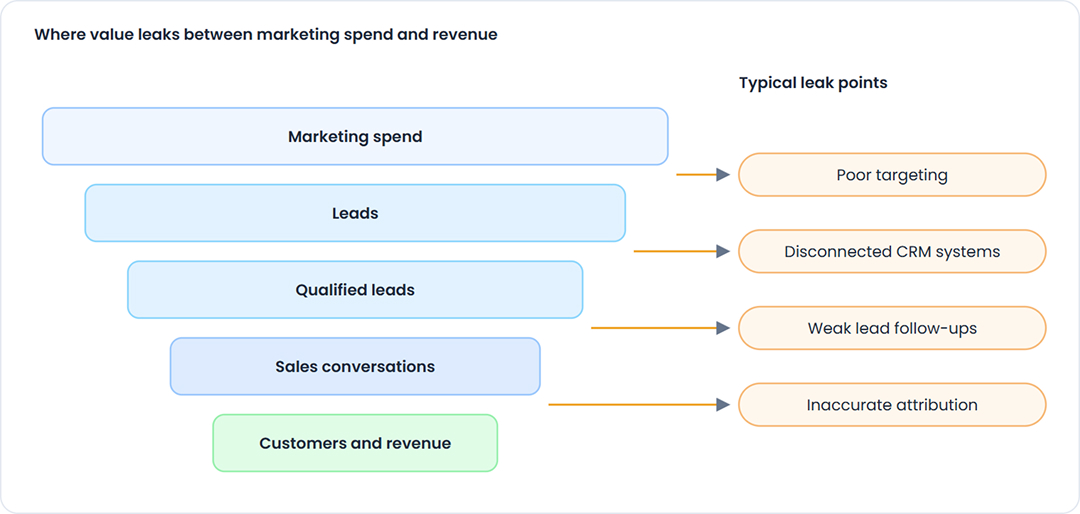
Marketing Budget Leakage

How Are Businesses Allocating Their Marketing Budgets?

Businesses are prioritizing customer acquisition, paid media, and AI, but investment in the systems and skills needed to convert that spending into revenue is not always keeping pace. According to Gartner’s 2026 CMO Spend Survey, paid media accounts for 31.4% of marketing budgets, while AI initiatives receive an average allocation of 15.3%. Meanwhile, 56% of CMOs report insufficient budgets to execute their strategies.

The issue is often how spending decisions are made. Businesses fund campaigns to generate demand but may postpone improvements to lead management, attribution, and internal capabilities because those investments produce less immediately visible results.

Where Marketing Budgets Go and Why Results Fall Short

Consider a business with a $20,000 monthly marketing budget. The following is an illustrative allocation, not an industry average.

Investment Monthly Budget Why Businesses Prioritize it Why Returns May Fall Short
Paid advertising $8,000 (40%) Generates immediate traffic and enquiries Spending scales before lead quality and conversion performance are validated
SEO and content $4,000 (20%) Build search visibility and organic demand Content is funded by publishing volume rather than customer intent or qualified enquiries
AI tools $2,000 (10%) Promises faster production and lower manual workload Software is purchased before workflows, quality controls, and success metrics are defined
CRM & Automation $3,000 (15%) Reduces manual follow-ups and organizes leads Systems are implemented without reliable lead routing, integration, or sales ownership
Analytics and Optimization $1,000 (5%) Tracks campaign performance Reporting focuses on platform conversions without adequately verifying sales outcomes
Strategy & specialist support $2,000 (10%) Provides expertise and campaign direction Specialists work in separate channels without shared commercial targets
Total $20,000 (100% )

Why Are Businesses Struggling to Get Results From Their Marketing Budgets?

According to Gartner’s 2026 CMO Spend Survey, 56% of CMOs report insufficient budgets, 54% lack the resources needed to execute their strategies, and only 30% report mature AI readiness. Meanwhile, HubSpot’s 2026 research finds that 33% of marketers struggle to measure marketing ROI.

The deeper problem is how businesses connect spending decisions to results. Campaigns are funded before conversion bottlenecks are addressed, AI tools are purchased without defined outcomes, and automation is deployed without fixing the processes it is supposed to improve.

Where businesses go wrong Why it happens How it affects growth
Spending more on ads without improving sales Businesses focus on getting more clicks and leads rather than checking how many become customers Higher advertising costs with fewer sales
Investing in AI without a clear purpose AI tools are purchased to save time, but teams lack the skills or plans to use them effectively More content and activity without better results
Automating the wrong processes Businesses automate follow-ups without fixing poor lead management or disconnected systems Potential customers are missed despite investing in automation
Tracking leads instead of actual sales Ad platforms show conversions, but businesses don’t connect that data with completed sales Money goes into campaigns that may not generate revenue
Lacking the right skills and resources Teams manage multiple campaigns and tools without enough expertise or support Delayed campaigns, wasted effort, and missed growth opportunities


The real problem: Businesses often invest in more tools, advertising, and automation before fixing what’s preventing their existing marketing activities from generating sales.

Consider a business spending $10,000 on paid advertising:

Performance measure Scenario A Scenario B
Advertising spend $10000 $10000
Leads generated 200 100
Cost per lead $50 $100
Customers acquired 5 10
Advertising cost per customer $2000 $1000


Illustrative calculations. Advertising cost per customer excludes sales, creative, technology, and other acquisition expenses.

Scenario A generates twice as many leads at half the CPL, yet costs twice as much in advertising to acquire each customer. A business optimizing only for cheaper leads could mistakenly increase spending on the weaker campaign.

This is why conversion quality and closed-sale data matter. Google’s enhanced conversions for leads documentation explains how businesses can connect offline lead outcomes with advertising interactions to improve conversion measurement and bidding signals.
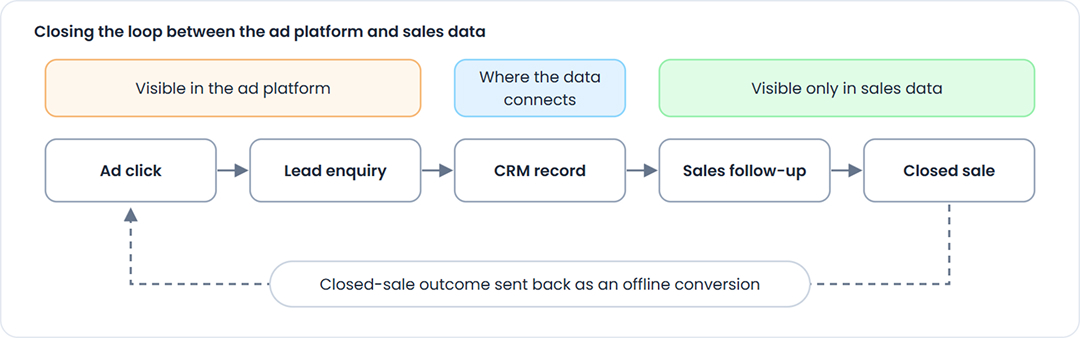
Offline Conversion Tracking

The underlying mistake is not simply poor marketing budget allocation. It’s allowing individual channels, tools, and teams to define success independently of customer acquisition and revenue.

A stronger marketing investment strategy gives every major expense a defined business outcome, an accountable owner, and a reliable way to measure its contribution before additional budget is approved.

Where Are Businesses Losing Value From Their Marketing Investments?

A business spending $20,000 per month on marketing commits $240,000 annually. Even a small amount of avoidable expenditure or lost conversion opportunities can have a significant financial impact over 12 months.

The cost isn’t limited to wasted advertising. It also includes software that goes unused, sales opportunities that never progress, and the additional expense of acquiring customers through inefficient campaigns.

Consider this illustrative monthly scenario:

Area Business situation Potential monthly impact
Unused marketing software 3 Underused tools costing $150 each $450 in avoidable costs
Missed sales opportunities 20 qualified leads not followed up, with an assumed 10% conversion rate and $1,500 average sale value $3,000 in potential revenue at risk
Higher acquisition costs 10 customers acquired at $150 more per customer than a realistic benchmark $1,500 in additional advertising costs
Total Avoidable costs plus potential revenue at risk $4,950


Illustrative figures, not industry averages. The $4,950 combines $1,950 in potential cost savings with $3,000 in possible revenue, not profit. Actual recoverable value depends on lead quality, conversion rates, margins, and operating conditions.

What Do These Numbers Reveal?

  • Small recurring costs accumulate. Three unnecessary software subscriptions costing $450 monthly represent $5,400 annually. Reviewing actual tool usage can release funds without reducing customer acquisition activity.
  • Missed leads carry an opportunity cost. Twenty unanswered qualified enquiries do not guarantee twenty lost customers. However, applying a realistic historical conversion rate helps businesses estimate the revenue opportunities at risk.
  • Acquisition inefficiency compounds as campaigns scale. Paying an additional $150 to acquire each of 10 customers adds $1,500 in monthly advertising costs. At 50 customers, the same cost difference becomes $7,500, assuming the benchmark remains achievable.

The critical distinction is between money already lost through unnecessary expenditure and revenue that might have been earned under better conditions. Treating both as guaranteed savings can produce misleading marketing ROI projections. Businesses should assess these amounts separately before deciding whether to increase advertising budgets, improve lead management, or reduce technology expenditure.

The financial priority is to recover value from existing marketing investments before committing additional money to growth.

How Can Businesses Identify Where Their Marketing Budget Is Underperforming?

A marketing budget audit should reveal which investments deserve more funding, which need improvement, and which are no longer commercially justified. The most useful starting point is to compare actual performance against business targets, historical results, and customer profitability rather than relying on industry averages alone.

Five Checks to Find Underperforming Marketing Investments

What to audit How to identify underperformance What it tells your business
Channel profitability Compare acquisition costs with customer gross profit and lifetime value Which channels generate customers worth the investment
Budget utilization Compare planned spending with actual expenditure and completed deliverables Whether resources are being used as intended
Customer conversion trends Review conversion rates across different periods, campaigns, and customer segments Where performance is improving or declining
Marketing payback period Calculate how long it takes to recover customer acquisition costs Whether growth is putting pressure on cash flow
Incremental returns Compare additional spending with the extra customers or revenue it generates Whether increasing a channel’s budget still makes financial sense

What Should Businesses Look for Before Making Budget Decisions?

A campaign may have a positive marketing ROI but still be a poor candidate for additional investment. If increasing expenditure produces progressively smaller gains, the next dollar may deliver more value elsewhere.

Businesses should therefore evaluate three questions:

  • Is performance improving? Compare results over consistent periods while accounting for seasonality, pricing changes, and campaign maturity.
  • Is the investment financially sustainable? Assess acquisition costs against gross profit, repeat purchases, and the time required to recover spending.
  • Would additional funding produce incremental growth? Test budget increases in controlled stages rather than assuming past performance will scale proportionately.

For incremental investment decisions, Google’s guidance on conversion lift also highlights the importance of measuring conversions caused by advertising rather than simply those attributed to it.
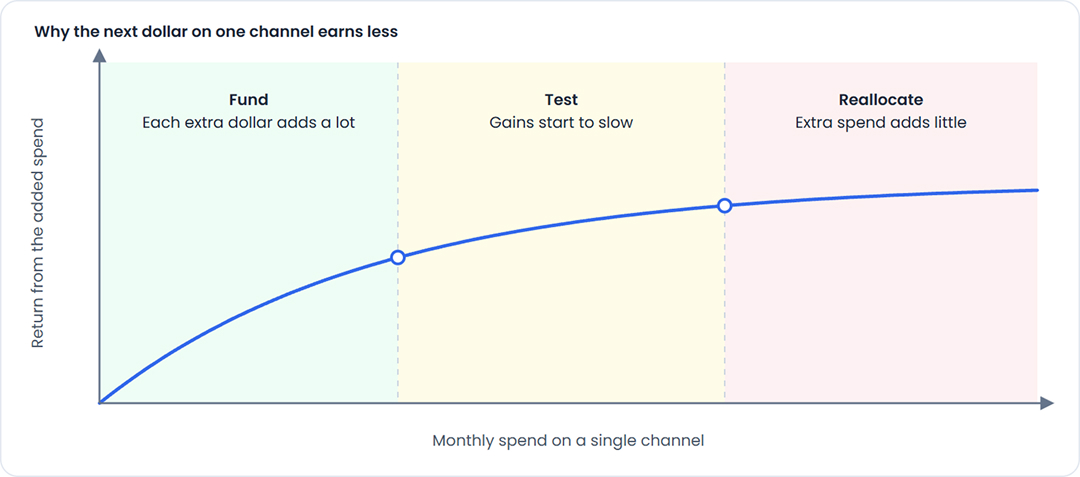
Marketing Budget Returns

The goal of a marketing performance audit is not to identify the cheapest channel. It is to establish where the next dollar of investment is most likely to produce profitable, measurable growth.

How Should Businesses Reallocate Marketing Budgets for Better Performance?

Businesses can reallocate their marketing budgets in 3 steps: protect investments generating profitable customers, reduce spending with weak incremental returns, and redirect funds toward opportunities with measurable growth potential. The objective is not to divide money equally across AI, automation, SEO, and paid advertising, but to fund each according to its commercial contribution.

What Does Effective Marketing Budget Reallocation Look Like?

Consider a business with a $20,000 monthly marketing budget. After reviewing performance, it decides to redistribute $3,000 rather than increase total spending.

Investment Current Budget Revised Budget Reason for Change
Paid advertising $8,000 $7000 Reduce spending on weak-performing campaigns
SEO and Content $4,000 $5000 Expand content targeting purchase-ready searches and relevant AI search queries
AI Tools $2,000 $1,500 Retain tools with demonstrated value
CRM and Automation $3,000 $4,000 Improve customer nurturing and sales capacity
Analytics $1,000 $1,500 Support more reliable investment decisions
Strategy and Specialists $2,000 $1,000 Reduce overlapping external work
Total $20,000 $20,000 No increase in spending


Illustrative scenario, not a recommended universal allocation. These changes would need to be supported by the business’s own performance data.

Why Reallocation Must Be Based on Business Priorities

A higher-performing channel doesn’t automatically deserve more money. Businesses must account for diminishing returns, customer demand, and how quickly additional spending can produce results.

According to Gartner’s 2026 CMO Spend analysis, businesses should manage marketing investment across immediate performance, long-term growth, and future capabilities rather than relying on fixed annual allocations.

Gartner

Before shifting funds, businesses should:

  • Protect what works: Avoid cutting profitable campaigns or established organic visibility simply to finance new tools.
  • Test before committing: Move a limited amount of budget into promising initiatives, then compare results against an agreed performance target.
  • Account for delayed returns: SEO, AEO/GEO, and customer retention initiatives may need longer evaluation periods than paid acquisition campaigns.
  • Set a review point: Reassess the allocation after sufficient conversion data has accumulated, accounting for sales-cycle length and seasonality.
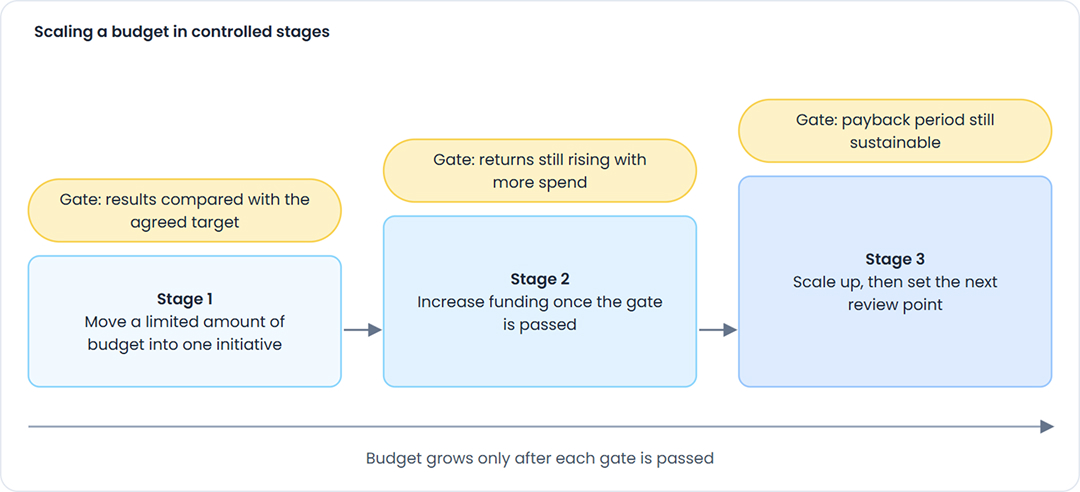
Strategic Budget Scaling

The goal is to make each budget increase earn its place. Businesses should redirect spending only when the expected improvement outweighs the cost of reducing investment elsewhere.

How ZealousWeb Helps Businesses Connect Marketing Spending With Growth

Marketing performance isn’t determined by how much a business spends, but by how effectively that investment translates into customer acquisition, conversions, and revenue.

ZealousWeb brings together marketing strategy, performance analytics, AI-powered solutions, and intelligent automation to help businesses get greater value from their marketing investments. Our expertise goes beyond individual campaigns. We connect SEO, AEO/GEO, paid advertising, AI, and marketing automation to build a coordinated approach focused on measurable business outcomes.

Our approach focuses on three priorities:

  • Uncover Revenue Opportunities: Analyze marketing expenditure, acquisition costs, and conversion performance to identify where businesses can improve returns and reduce unnecessary spending.
  • Put AI and Automation to Work: Apply AI-driven insights, CRM automation, and connected workflows to improve audience targeting, streamline lead management, and reduce manual effort without compromising customer experience.
  • Turn Performance Data Into Growth Decisions: Connect paid campaigns, organic visibility, AI search performance, and sales data to help businesses prioritize investments based on qualified leads, conversions, and revenue contribution.

More tools and bigger campaigns won’t automatically deliver growth. The right strategy, supported by AI, automation, and measurable execution, can make every marketing investment more purposeful.

Conclusion

Business growth demands more than increased marketing spending. When AI, automation, paid campaigns, and organic strategies operate without clear objectives, even substantial budgets can fall short of expectations.

The opportunity lies in making smarter investment decisions-strengthening what delivers results, correcting performance gaps, and using AI and automation where they create measurable value.

With ZealousWeb’s expertise in marketing strategy, AI-powered solutions, and intelligent automation, businesses can turn disconnected marketing investments into coordinated efforts that support customer acquisition, conversions, and sustainable growth.

Lets' Make Your Business Visible

Let's Talk

AI Marketing Growth

FAQs

Related Blog Posts

AI Homepage Development

AI-Powered Homepage Development With Claude Code and Automation

August 04, 2026
AI DevelopmentClaude CodeMagento DevelopmentWebsite Performance Optimization
AI operational clarity for business growth

Businesses Don’t Need More AI Tools. They Need More Clarity.

May 13, 2026
AI AutomationBusiness SystemsOperational ClarityWorkflow Automation
agency growth systems

Turning Insights Into Action: How System Assessments Drive Effective Growth

April 24, 2026
Agency GrowthExecution Systemsscalable systemssystem assessments
agency operational system

From Overloaded to Operationally Calm: One Agency’s Shift to System-Led Growth

April 07, 2026
Agency OperationsDelivery Systemssystem-led growthWorkflow Automation
delivery execution system

Stop Hiring to Fix Delays — Build the Execution System That Makes Delivery Predictable

April 06, 2026
Agency Scalingdelivery systemproject deliveryQA process
agency systems assessment

From Tools to Intelligence: A Systems Assessment for SaaS & Agency Leaders

April 01, 2026
Agency GrowthAI readinessExecution Systemssystems assessment
Automate client reporting with AI

How to Automate Client Reporting and Retention with AI Content Personalizer for WP

March 30, 2026
AI reportingclient retentionlead trackingMarketing Automation
execution data decision system

Why Execution, Data, and Decisions Must Work as One System for Scalable Growth

March 25, 2026
Execution Systemsintelligence systemsleadership systemsscalable growth