What Is PPC Advertising?
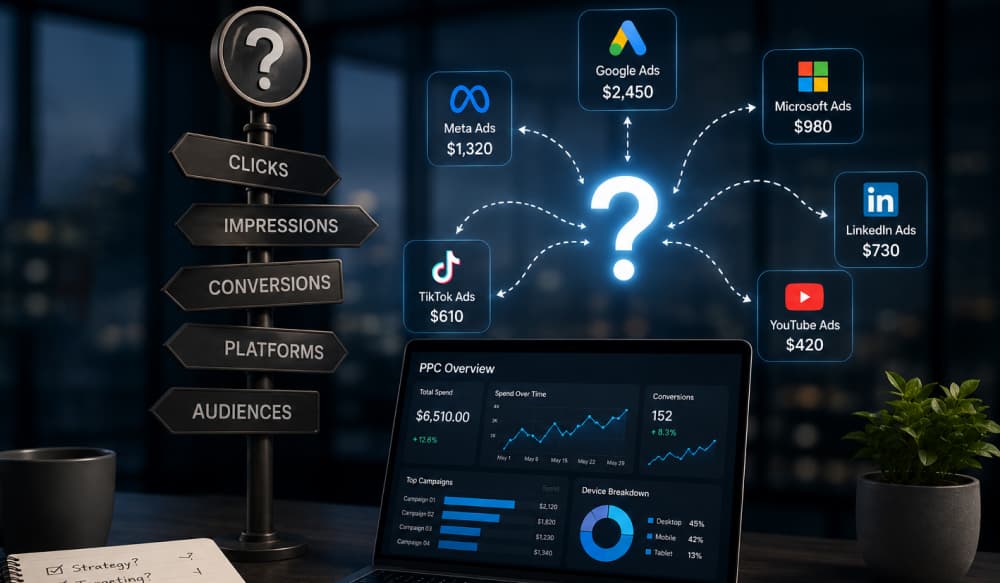
PPC advertising – pay-per-click advertising – is a model where a business pays a platform each time someone clicks its ad, rather than paying for the placement itself. It covers search ads, shopping listings, display banners, video pre-rolls, and paid social placements. What makes it different from almost every other marketing channel is that spend and results are connected at the click level, not estimated after the fact.
Under the hood, every impression is decided by an auction. When someone searches, scrolls, or opens an app, the platform runs a real-time bidding process among all advertisers eligible to show up at that moment.
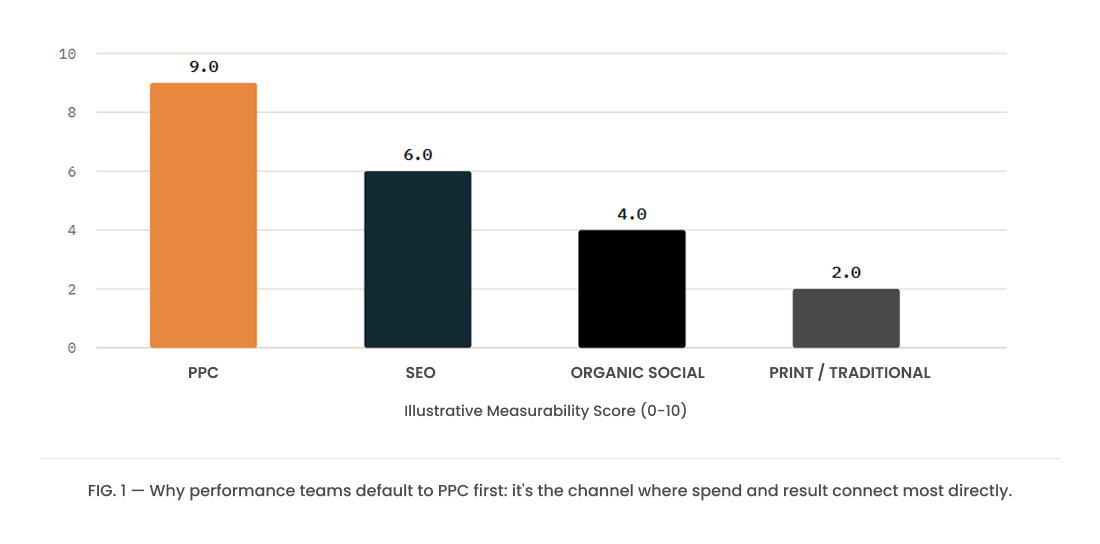
The winner isn’t simply whoever bids the most – it’s whoever produces the best combination of bid, ad quality, and predicted relevance to that specific person. It’s a detail that trips up a lot of people trying to figure out what PPC advertising actually is: pay-per-click advertising was never a spend-the-most game, not even inside Google Ads.
That auction runs in fractions of a second, millions of times a day, which is exactly why the industry has handed so much of it over to machine learning. No PPC campaign manager was ever going to out-calculate that in real time – and none is expected to anymore. This is exactly where PPC automation and AI PPC management services earn their keep: instead of a person nudging bids every few hours, PPC intelligence pulled from live conversion signals makes that call thousands of times before anyone could even open a dashboard. It’s also why more businesses are handing this layer of PPC management to a dedicated PPC marketing agency rather than running it in-house – the tooling behind automated AdWords management has simply outpaced what one in-house marketer can track by hand.
How PPC Advertising Is Changing in 2026
The biggest PPC advertising trends right now all point in the same direction: less manual control at the tactical level, more responsibility at the strategic level. Search platforms have consolidated dozens of individual levers – keyword match types, device bid adjustments, audience layering – into automated campaign types that make most of those decisions internally. Google Ads is the clearest example of this shift, and it’s part of why so many people still ask what PPC advertising even means today compared to five years ago.
That’s not a loss of control so much as a relocation of it. The advertiser’s job in 2026 isn’t clicking bid-adjustment sliders – it’s setting the right goal, feeding the algorithm clean conversion data, and building creative that survives being tested thousands of times a day. This is really what modern PPC management has become: less hands-on-keyboard, more hands-on-strategy, with automated AdWords management handling the mechanical layer underneath.
Three things define a workable PPC strategy approach: treating automation as a system to configure rather than a black box to fear, connecting ad platforms to real revenue data instead of platform-reported conversions, and building for more than one channel from day one instead of bolting on channels later. That first point is where PPC automation earns its value – but only when it’s paired with PPC intelligence drawn from real pipeline data, not just platform signals. Businesses figuring out how to use PPC lead intelligence properly tend to be the ones whose AI PPC management services actually show up in revenue, not just in a cleaner-looking dashboard.
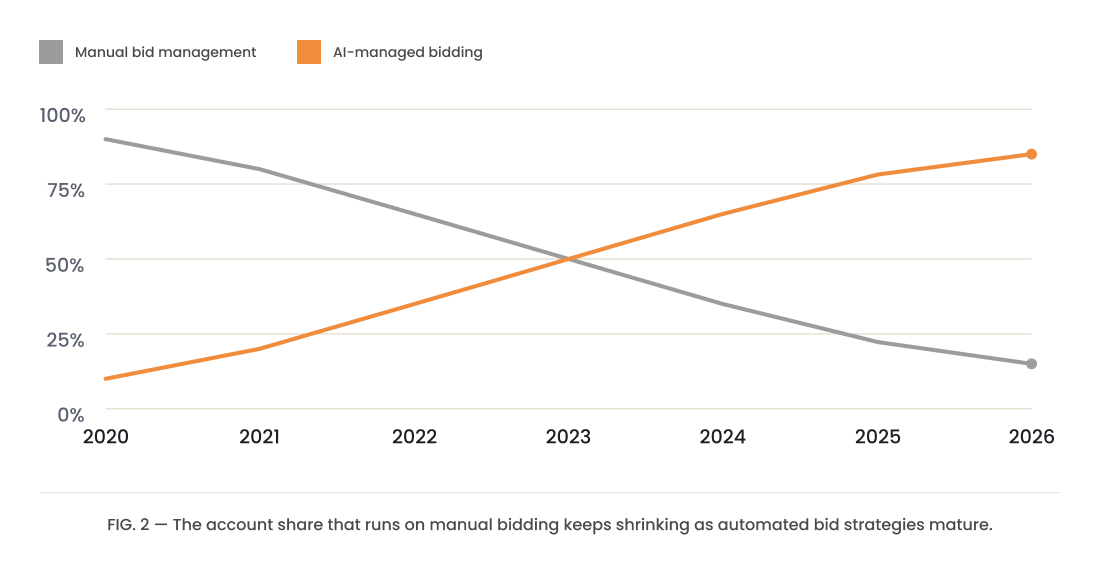
The account structures that worked in 2021 are actively working against advertisers in 2026 – because they were built to give humans control the algorithms no longer need.
The Role of AI and Automation in PPC
AI-powered PPC now sits underneath almost every part of a campaign: bid adjustments happen per auction rather than per day, audience targeting expands based on live conversion signals instead of static lists, and creative variations get generated and tested automatically. None of that is optional anymore – it’s simply how the platforms are built.
What’s still a human responsibility is everything the algorithm can’t see: business margin by product line, seasonal context that isn’t in the historical data yet, brand tone, and the judgment call on when a “smart” recommendation is actually a bad idea for this specific business. Good PPC campaign management in 2026 looks less like operating switches and more like managing a very capable, very literal junior analyst who needs clear instructions and regular auditing.
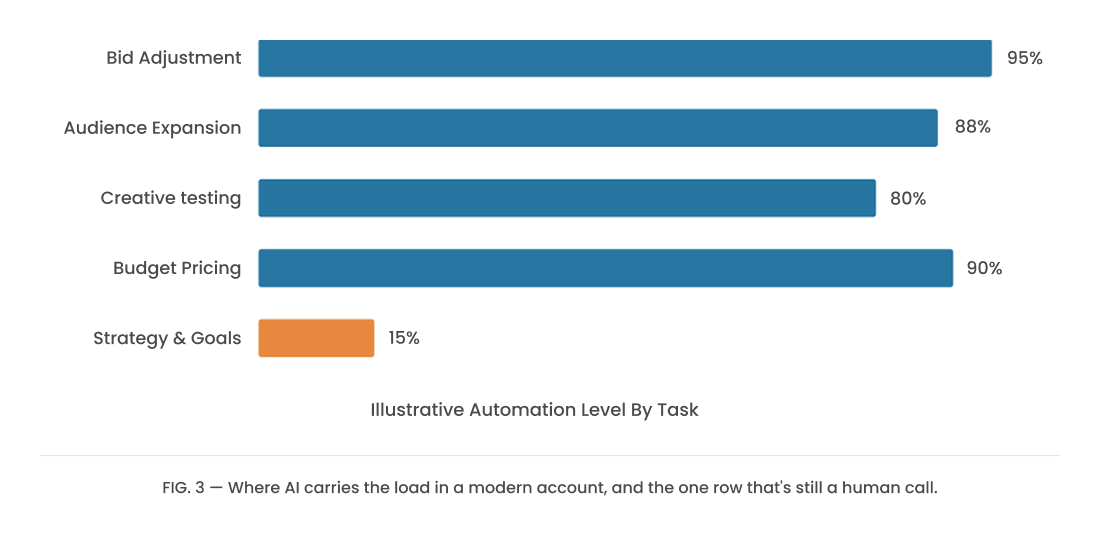
The businesses getting hurt by AI in PPC right now aren’t the ones using it too much – they’re the ones that turned it on and stopped paying attention, feeding it messy conversion data and letting it optimize toward the wrong goal at speed.
Performance Max and Cross-Channel Advertising
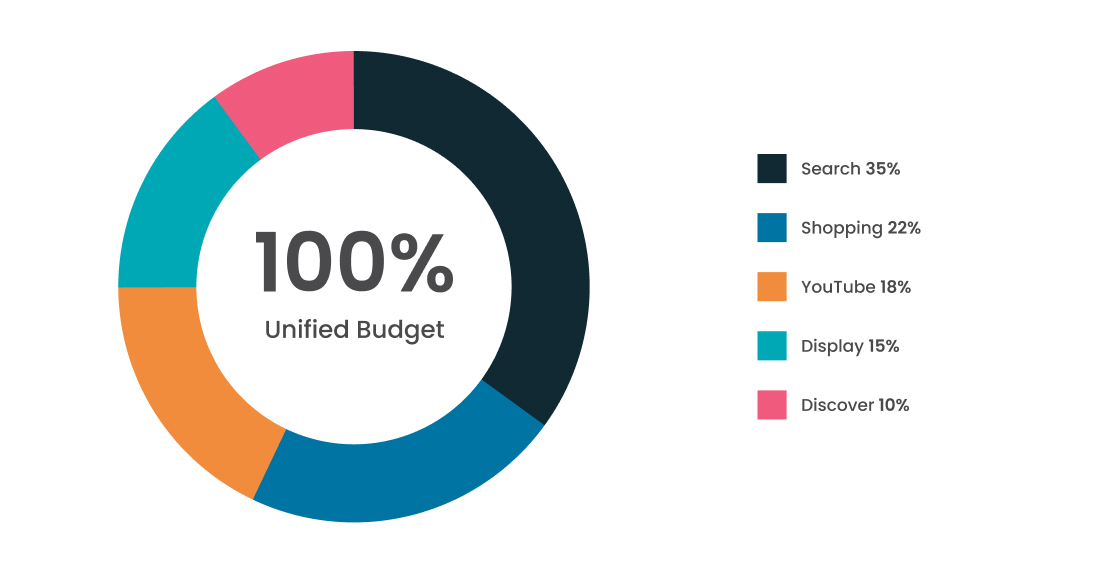
Performance Max collapsed what used to be separate search, shopping, display, video and Discover campaigns into a single campaign type that decides where a budget goes based on where it performs. That’s the clearest example of cross-channel PPC becoming the default rather than an advanced tactic – the platform is now making channel-mix decisions that used to sit with a media planner.
The trade-off is visibility. Advertisers get less granular control over exactly which placement served which ad, in exchange for a system that can shift budget toward whichever channel is actually converting, in near real time. Running this well means feeding the campaign strong first-party signals and asset groups, and reading results at the account level instead of expecting placement-by-placement detail.
Cost-per-click and click-through rate tell a business almost nothing about whether a campaign is actually working. A channel with a high cost per click and a low customer acquisition cost can be far more valuable than a “cheap” channel that fills a pipeline with leads that never close.
Mature PPC management pushes past platform dashboards entirely – including the one built into Google Ads. It connects ad spend to CRM data so a business can see cost per qualified lead, not just cost per form fill – and further still, to revenue and margin per channel, so budget moves toward what’s actually profitable rather than what simply reports the most conversions.
This is where PPC intelligence starts to matter more than raw platform metrics: knowing how to use PPC lead intelligence means tracing a click all the way to a closed deal, not stopping at a form submission. It’s also the piece most AI PPC management services get wrong when they optimize purely for conversion volume instead of the revenue sitting behind it.
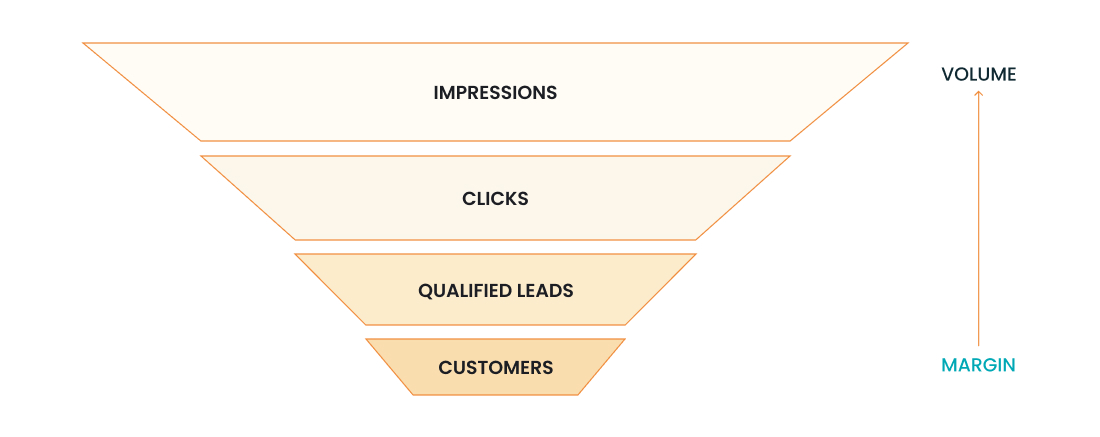
This is also where most PPC reporting quietly breaks down: a platform will happily report a “conversion” on a lead that a sales team never even calls back. Without that CRM connection, an advertiser is optimizing toward a number that doesn’t reflect the business at all.
First-Party Data and Privacy-Safe Tracking
Third-party tracking keeps getting less reliable – browser restrictions, platform-level privacy changes, and tightening regional data rules have all chipped away at the old model of following a user across the web with a pixel. That’s pushed first-party data, information a business collects directly through its own site, CRM and email list, from a nice-to-have into the foundation of accurate PPC measurement.
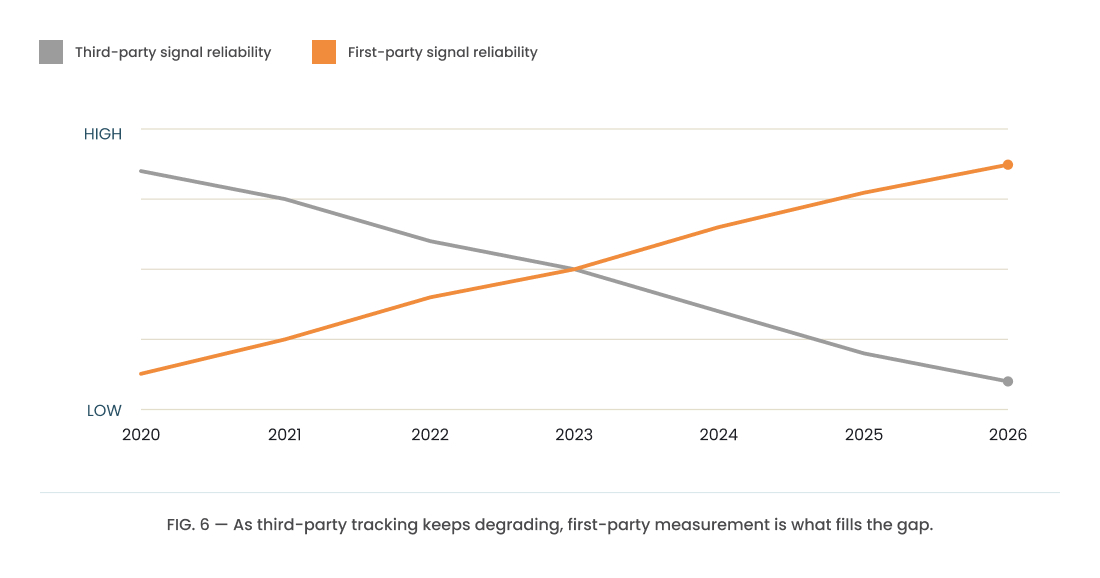
In practice, that means feeding platforms hashed conversion data through server-side tracking, using consent-based modeling to fill measurement gaps honestly instead of guessing, and treating a clean CRM as core advertising infrastructure rather than a sales team’s separate concern.
Scaling PPC Campaigns Across Global Markets
A global PPC strategy is not one campaign translated into six languages. Search behavior, competitive density, payment norms, and even what counts as a persuasive offer all shift market to market – and so do privacy and advertising compliance rules. Treating every region the same way is one of the fastest ways to waste a global budget.
The businesses that scale PPC internationally well tend to follow the same rough sequence: research demand and competition per market before writing a single ad, localize creative and landing pages rather than just translating them, confirm compliance requirements for that region, and launch in phases so each market gets tuned before the next one opens. That first step – researching demand and competition – is also where PPC management decisions get made or lost, because the same keyword can behave completely differently on Google Ads depending on which market it’s running in.
Costs are the clearest example. There’s no single answer to what a campaign “should” cost, since it depends on industry, competition, and season – but the relative gap between markets tends to hold steady enough to plan around:
| Region | Approx. CPC Range (Local Currency) | Competitive Density |
| North America | US $1 – $4 | Very high |
| UK/Australia | £0.75 – £3 / A$1 – A$4 | High |
| Western Europe | €0.70 – €3 | High |
| Middle East | AED 3 – AED 12 | Medium |
| Latin America | US $0.30 – $1.20 | Medium |
| Southeast Asia | US $0.20 – $0.90 | Medium |
| India | ₹8 – ₹35 (higher in metro markets) | Medium (high in metros) |
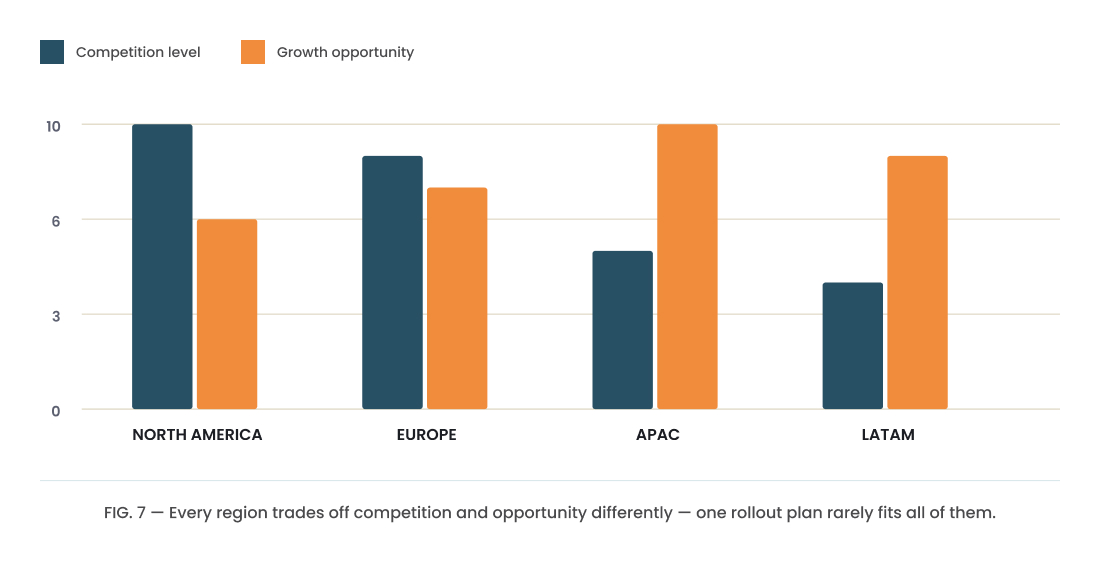
This is exactly where PPC automation earns its keep once you’re running more than one or two markets – a human team re-checking bids market by market doesn’t scale, but automated AdWords management built on PPC intelligence can react to regional cost swings the moment they happen.
India is a good example of why that matters: national-level CPCs sit low, but automation needs to catch the metro-market spikes (Mumbai, Delhi, Bengaluru) that a flat, country-wide bid strategy would otherwise miss. The businesses getting real value out of global PPC are usually the ones who’ve also worked out how to use PPC lead intelligence to tell which markets are converting into pipeline, not just which ones are cheap to click in. Layer AI PPC management services on top of that groundwork, and phased international rollout stops being guesswork and starts being a repeatable system.
What Businesses Should Expect From a PPC Agency
The best PPC management services earn their fee by doing the things automation can’t: structuring accounts so the algorithm has clean signal to work with, telling a client honestly when a “recommended” platform feature isn’t right for their business, and reporting in terms of pipeline and revenue rather than impressions and clicks.
- Account structure and campaign strategy tailored to the business’s margin, not a templated setup copied across every client
- Transparent reporting that shows what’s actually driving revenue, not just what the platform is willing to take credit for
- A clear point of view on where automation should run freely and where it needs guardrails
- Regular, plain-language communication – not a dashboard link and silence between reviews
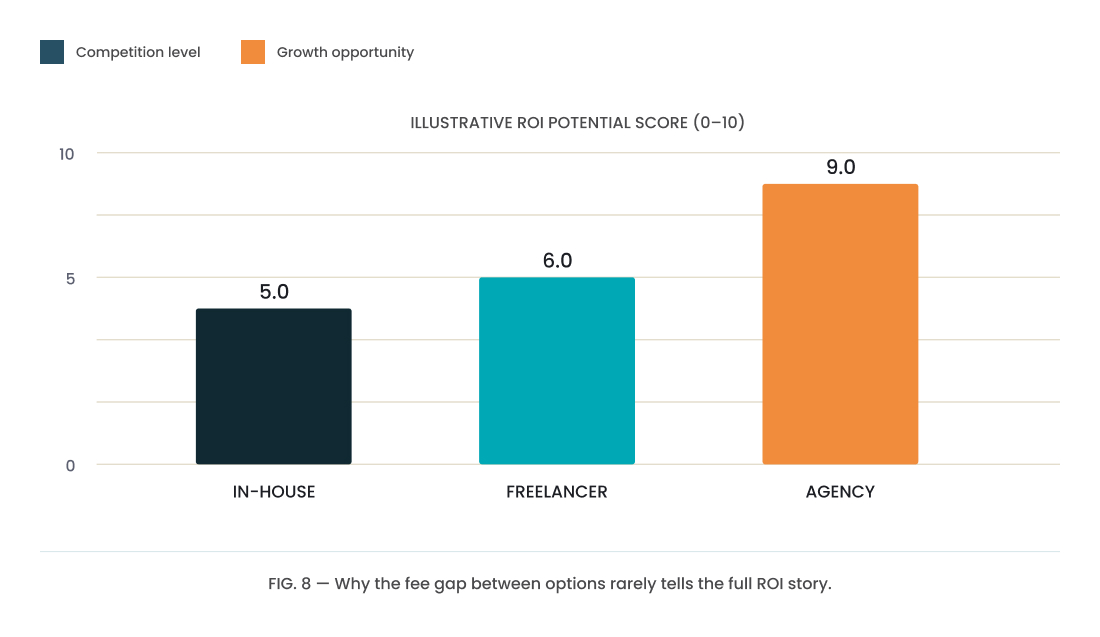
A business shouldn’t need to learn bidding algorithms to have a productive relationship with its PPC agency. What it should expect is a partner who already has, and who can explain the “why” behind every recommendation in language that connects back to the business, not the platform.
Not Sure Where Your PPC Budget Is Actually Going?
Request PPC Performance Review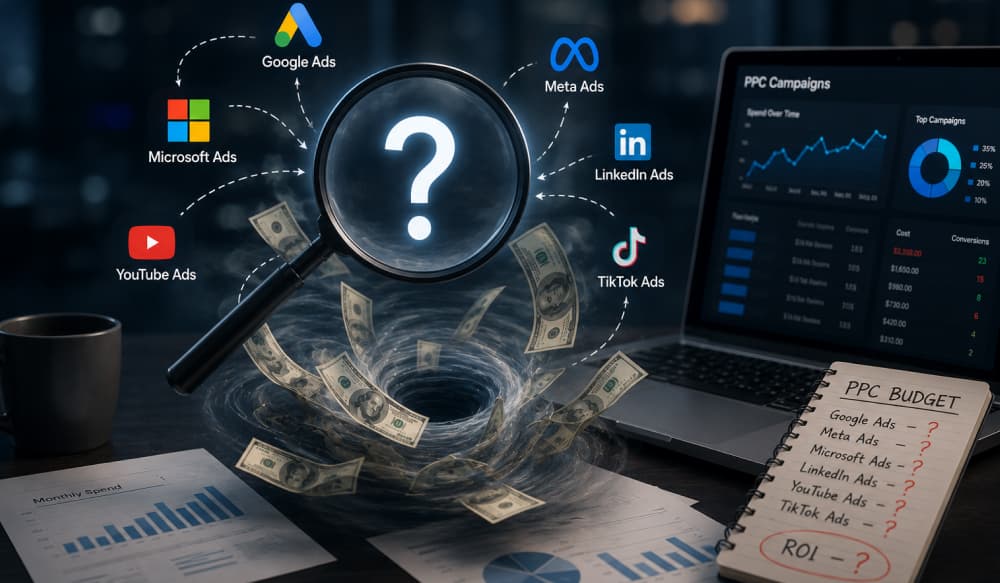
How to Build a Future-Ready PPC Strategy
The future of PPC advertising isn’t a single new channel or platform feature – it’s a shift in which skills actually matter. Bid management is commoditized. What separates a strong account from a mediocre one now is data quality, creative volume and range, cross-channel cohesion, and a measurement setup that reaches all the way to profit.
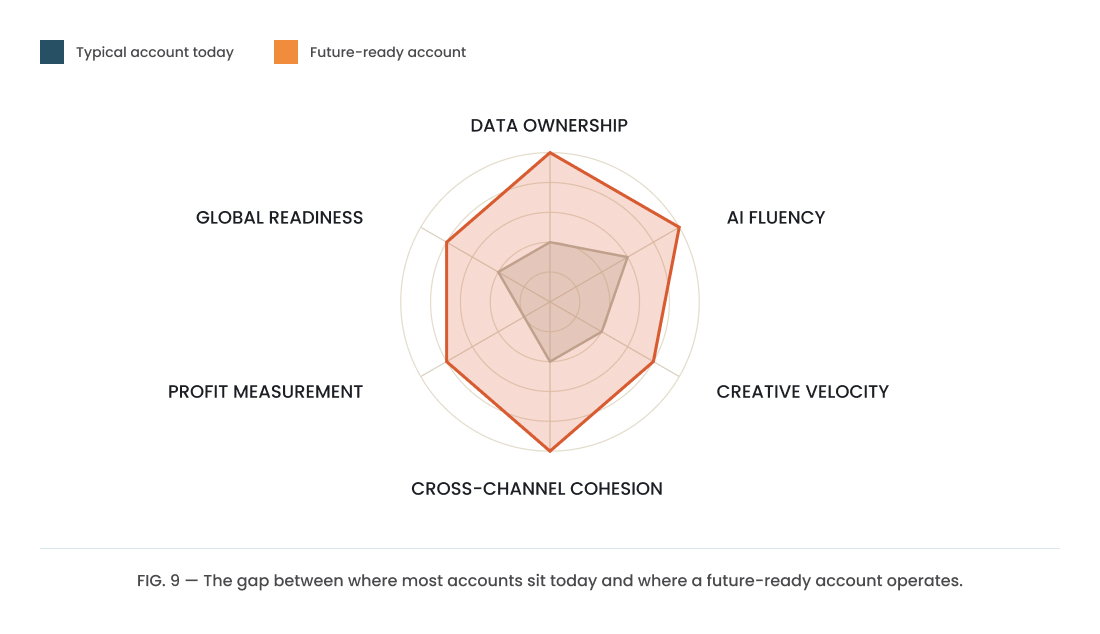
None of these are speculative. They’re the parts of PPC that don’t get automated away, because they depend on decisions only the business itself can make – what a customer is worth, what story the brand tells, and which markets are worth entering next.
Conclusion
PPC advertising in 2026 rewards businesses that treat it as a measurable investment rather than a media line item – and that gap between “running ads” and “generating ROI” is exactly where most budgets quietly go to waste. The businesses and agencies pulling ahead right now are the ones pairing AI-led automation with clean first-party data, cross-channel structure, and measurement that reaches all the way to profit, not just clicks. Get that chain right, and PPC stops being a line item you have to defend and starts being a number your finance team trusts on its own.
If any part of that chain is missing in your accounts, that’s exactly where ZealousWeb’s PPC campaign management team steps in – auditing account structure and automation, reconnecting measurement to real revenue, and building a plan around your margins, not just your conversion count. Share a few details and our team will follow up with a straight answer on where the opportunity is.
- Account structure and automation review across Google, Meta, and beyond
- Measurement setups that connect ad platforms to real revenue data
- Global and cross-channel rollout planning for agencies and direct brands
Let's Look At What Your PPC Accounts Are Actually Doing
Book a Discovery Call