Fraud Blocker
White Label PPC

Why White-Label PPC Can Cost 40% Less Than Hiring In-House

September 22, 2026Posted By: Jalpa Gajjar
Agency GrowthPaid Media ServicesPPC OutsourcingWhite-Label PPC

Winning another PPC account should feel like growth. Then someone asks, “Do we need another full-time PPC specialist?” and the celebration becomes a hiring spreadsheet.

For agencies, the real cost of an in-house PPC hire is not the salary alone. Recruitment, onboarding, tools, training, QA, management time, benefits, and non-billable capacity all sit behind it. That is why white-label PPC services for agencies can be commercially attractive: they add specialist delivery without forcing permanent overhead to grow every time the client roster does.

The direct answer is simple: white-label PPC can cost less when an agency pays for the capacity it needs instead of carrying the full cost of keeping that capacity on payroll all year.

Cheaper, however, is not the goal. Profitable, scalable, transparent delivery is.

In-House PPC vs White-Label PPC: What Does Each Really Cost Your Agency?

A fair comparison starts with the same question on both sides: what does it cost your agency to deliver PPC work to clients reliably? Comparing one employee salary with one white-label invoice is neat, quick, and usually incomplete.

The cleanest way to see the difference is to compare the cost layers.

Salary vs White-Label Delivery Fee: The Number Nobody Compares Correctly

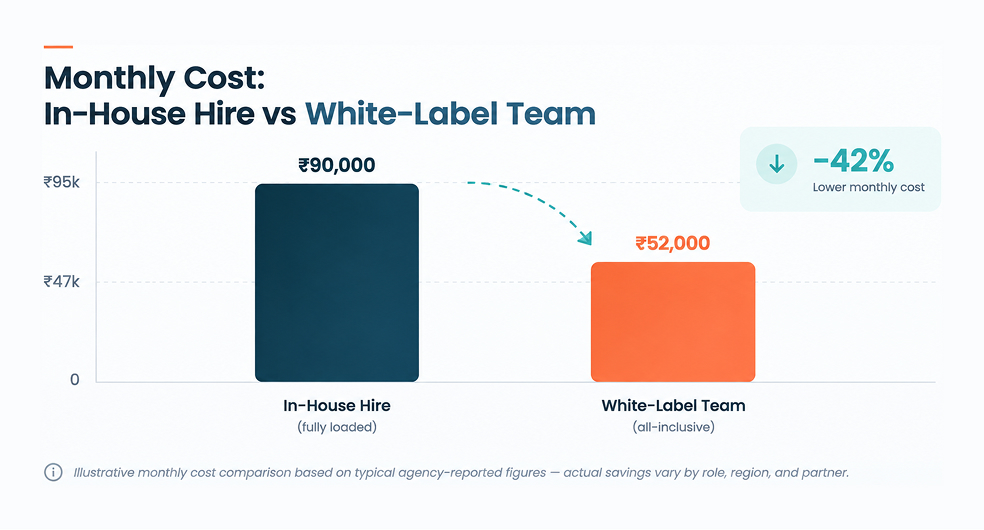
A ₹6-8 LPA PPC specialist salary looks like the whole cost. It’s the opening bid. The real comparison is salary-plus-overhead against one white-label delivery fee that already includes delivery, reporting, and management.

Cost line In-house Hire White-label Team
Base compensation ₹45,000-65,000/mo Included in the fee
Employer contribution and benefits +15-20% Included
Tools & software seats Separate line Included
Effective monthly cost ₹75,000-95,000 ₹45,000-55,000

Recruitment and Onboarding: The Cost That Starts Before Day One

Sourcing, interviewing, and onboarding a PPC specialist typically eats 4-6 weeks and one to one-and-a-half months’ salary in recruiter time and lost productivity – before the person has touched a single campaign. A white-label team is already trained, certified, and live inside 48-72 hours. That gap alone changes the math before you’ve spent a rupee on ad spend.

Tools, Reporting, and AI Automation: Who's Paying for the Stack?

Google Ads Editor is free. The bid automation layer, the cross-channel reporting dashboard, the AI-powered anomaly detection, the white-label client portal – none of that is. In-house, your agency buys every seat. With a white-label partner, the AI automation stack, dashboards, and reporting tools are already built, licensed, and shared across dozens of accounts, so the per-client cost drops sharply.
PPC Cost Comparison

Training, Certifications, and Specialist Coverage: One Person Can't Know Everything

Google Ads, Meta, Microsoft Ads, programmatic, GA4, server-side tracking – the certification list keeps growing, and one in-house hire can’t be deeply fluent in all of it. White-label teams split specialists by platform, so your account gets a Google Ads expert and a Meta expert instead of one generalist juggling both, learning as they go.

Management and QA: The Invisible Salary Line

Someone has to review campaigns, catch the mistakes, and sign off before the client sees anything. That’s usually a senior team member’s time – unbilled, unbudgeted, and rarely counted against the “cost of the junior hire.” White-label delivery bakes QA and account management into the fee, so it stops being a hidden tax on your seniors’ calendars.

Benefits, Leave, and Employment Overhead: The Line Items That Never Show Up in the Job Ad

Provident fund, gratuity, paid leave, sick days, insurance, appraisals, exit costs – none of it appears on the offer letter, all of it appears on the balance sheet. Industry estimates put statutory and benefits overhead at 15-25% on top of base salary for most Indian agencies. A white-label fee has none of this baked in because there’s no employment relationship to manage.

Non-Billable and Underutilized Capacity: The Cost Agencies Rarely Talk About Out Loud

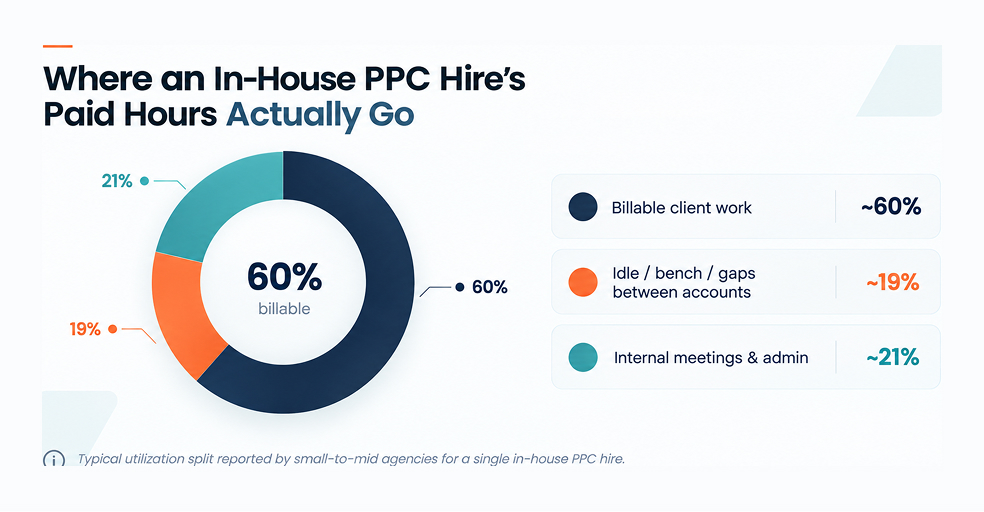
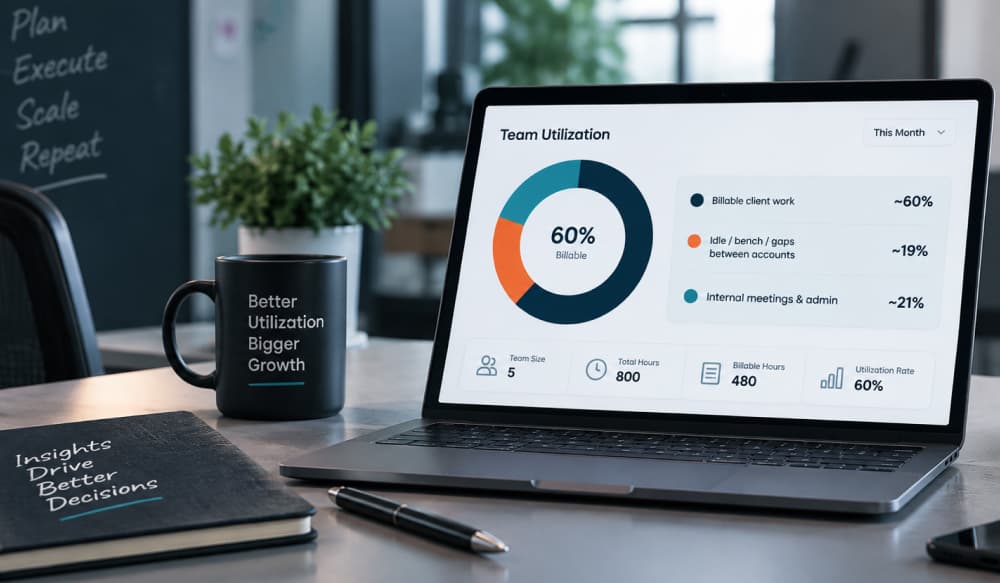
Here’s the uncomfortable part. You’re paying your PPC hire for eight hours a day, but client work rarely fills all eight – not every week, anyway. Slow months, account gaps between clients, internal meetings, training time – it all counts as paid hours with zero billable output. White-label pricing sidesteps this entirely: you pay for delivered work, not idle seat time.
PPC Utilization Costs

White-Label PPC vs In-House Hiring: Where Can the 40% Saving Come From?

Not from paying specialists less – good white-label partners pay their people well; they’re just spread across many accounts. The saving comes from elimination, not negotiation: no recruitment cost, no idle hours, no duplicated tool licenses, no separate QA layer. Your agency isn’t buying a person’s time anymore. It’s buying finished, reviewed output – and that’s a fundamentally cheaper thing to purchase.

The Cost Agencies Often Miss: Billable Utilization

Here’s the reality check most owners skip: a ₹70,000/month PPC hire who’s only 60% utilized is quietly costing you ₹1,16,000 per billable hour of output. Nobody puts that number in the hiring plan, but it’s the number that actually hits your margin. White-label delivery removes utilization risk from your side of the ledger entirely – the partner absorbs it, you don’t.

Reality check: If you’ve ever paid a PPC hire’s full salary during a slow client month, you’ve already learned this lesson the expensive way.

Curious What Your Agency's Actual Utilization Number Looks Like?

Get a Cost Breakdown
Cost Breakdown

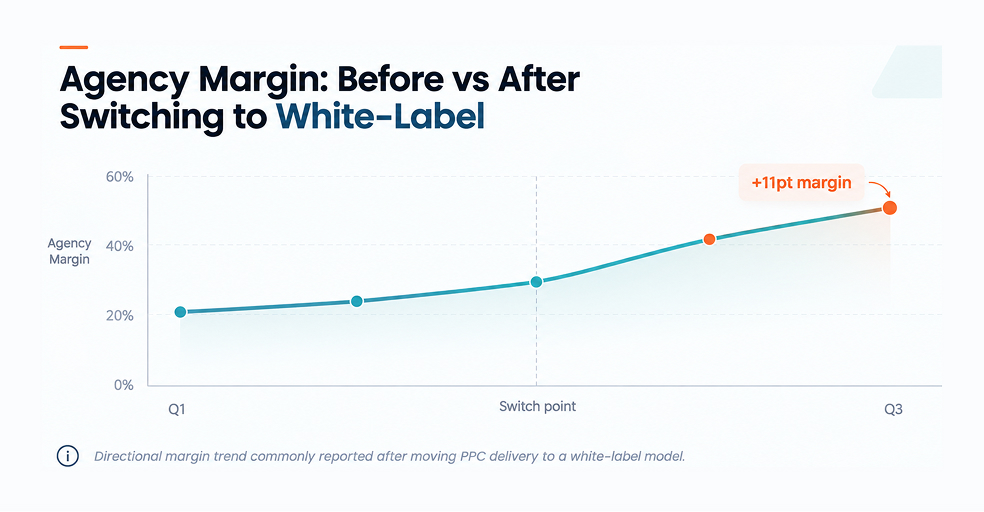
White-Label PPC vs In-House: What Happens to Your Agency Margins?

Agency margins improve when fulfillment cost stays predictable relative to client revenue.

The basic equation is uncomplicated:

Client retainer − fulfillment cost = delivery margin

An in-house salary stays fixed when a client pauses, reduces scope, or leaves. A flexible white-label PPC model can make it easier to align fulfillment cost with active revenue.

That does not rescue poor pricing. Nothing does. But clearer delivery costs make it easier to protect gross margin, account profitability, and forecasted capacity before the proposal goes out.
Agency PPC Margins

PPC Outsourcing vs Hiring: When Does Each Model Make Financial Sense?

Here, PPC outsourcing means an agency outsourcing delivery to a white-label PPC partner, not a business hiring a PPC agency.

An in-house hire makes sense when your agency has predictable demand, high utilization, stable recurring revenue, and enough accounts to keep the specialist productive.

White-label PPC can make more sense when:

  • Paid media demand changes month to month.
  • Sales is moving faster than recruitment.
  • You are launching PPC as a new service line.
  • Clients need multiple platform specialists.
  • You need capacity now without committing to another permanent role.

A hybrid model can also work well: keep strategy and client ownership internally while extending campaign execution, optimization, reporting, and specialist capacity through a white-label team.

The right model is not the one that looks cheapest on paper. It is the one that protects delivery quality and margin as the agency grows.

Does Lower Cost Mean Less PPC Expertise?

It should not. If it does, you found a cheap vendor, not a white-label delivery partner.

A capable team should bring expertise across Google Ads, Meta Ads, Microsoft Advertising, LinkedIn Ads, conversion tracking, analytics, CRO, AI-powered bidding, automated creative testing, and conversion-value optimization.

AI automation matters here, but only with governance. Ask who reviews automated recommendations, who owns strategic decisions, and where human QA happens.

“The platform optimized it” is not a particularly useful answer when your client asks why ROAS dropped. Lower overhead should come from a better delivery model-not lower standards.

What Agencies Should Check Before Choosing a White-Label PPC Partner

Cost gets a partner onto the shortlist. Operating discipline determines whether they stay there.

Before choosing a white-label PPC agency or fulfillment partner, look past the pitch deck and check how the relationship will work in real life.

Commercial Transparency

Confirm pricing, billability, minimum commitments, scope boundaries, and how additional work is approved.

Delivery Expertise and Accountability

Know who will work on the accounts, what platform expertise they have, how QA works, and what happens when a specialist is unavailable.

Agency Control

Clarify account access, white-label reporting, NDAs, confidentiality, client communication rules, and ownership of the client relationship.

Communication and Scalability

Agree on a dedicated point of contact, response windows, time-zone coverage, escalation paths, and how quickly resources can scale up or down.

AI Governance

Understand where AI automation is used and where human review remains mandatory.

A genuine white-label partner should make your agency look more capable to the client-not make the client wonder who is actually running the account.

Conclusion

For agencies, the true cost of PPC capacity is not salary alone. It is the cost of keeping the people, tools, skills, oversight, and unused capacity available throughout the year.

That is where white-label PPC can become commercially valuable. It gives agencies a way to expand paid media delivery without forcing permanent overhead to grow at the same rate.

Before making the next hire, compare cost per productive PPC hour, cost per active account, and expected utilization. The answer may make the hiring debate considerably shorter.

White Label Performance Marketing Services Built to Help Agencies Scale

Talk with your Growth Partner
Growth Partner

FAQs

Related Blog Posts

Landing page optimization for paid ads performance

Landing Page Mistakes Hurting Your Paid Ads? How to Fix Them

September 22, 2026
conversion rate optimizationLanding Page OptimizationPaid AdvertisingPerformance Marketing
Diagnosing Ad Performance Drop

How to Diagnose a 30% Drop in Client Ad Performance in 15 Minutes

September 17, 2026
Campaign PerformanceGoogle AdsMeta AdsPaid Media
delivery systems for agencies

Why Good Workflows Fail at Scale and How Agencies Can Build Delivery Stability

May 20, 2026
Delivery Managementexecution systemwhite-label agencyworkflow clarity
ChatGPT for SEO

ChatGPT For SEO: The Future Of Optimized Content In Digital Marketing

January 23, 2024
AI ImpactContent WritingSEO Strategies
ChatGPT’s AI Impact on SEO Content Writing

ChatGPT’s Impact On SEO Content Writing In 2024

January 09, 2024
AI ImpactContent WritingSEO Strategies
LinkedIn for Business Growth

9 Reasons LinkedIn Is Essential For Business Growth In 2024

December 27, 2023
Growth HackingLinkedIn StrategiesNetworking Tips
Google Lead Form Extension

How Do Google Lead Form Extensions Supercharge PPC Campaigns In 2024?

December 13, 2023
Campaign AnalyticsConversion TipsLead Forms Benefits
Facebook Evolution

Facebook Evolution-Managing The Business Social Wave In 2024

November 28, 2023
Brand PresenceFacebook AnalyticsSocial Trends