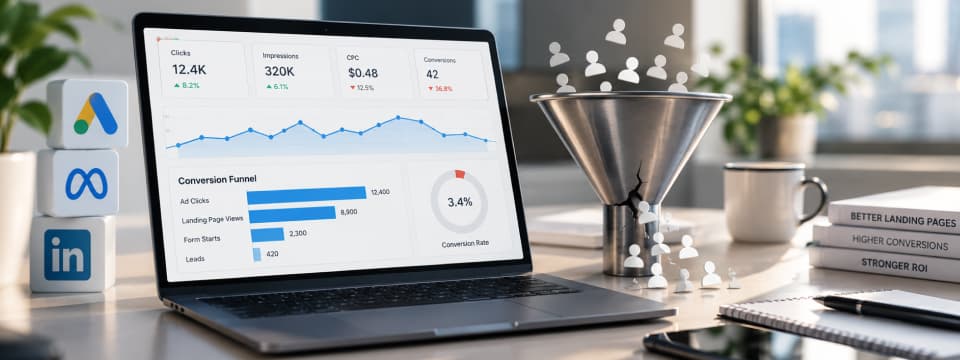
Your campaigns are “performing.” CTR looks decent. CPC is under control. The dashboards look healthy – until the client asks the question every agency eventually faces: “Why aren’t these clicks turning into leads or revenue?”
The first suspect is usually the ad account. Targeting gets changed. Creatives get refreshed. Budgets get adjusted. But sometimes, the issue is not the campaign bringing people in – it is the experience waiting after the click.
A paid ad can create interest, but the landing page determines whether that interest becomes action. If the page does not match the ad message, communicate value quickly, build trust, or guide visitors toward a clear next step, even well-optimized campaigns can struggle.
For agencies managing Google Ads, Meta Ads, or other paid channels, improving performance is not only about getting more traffic. It is about making sure the traffic you already paid for has the right experience to convert.
Understanding Why Paid Ads Get Clicks but Fail to Generate Results
A click is only the first step toward conversion, not the finish line. High-quality traffic doesn’t automatically become leads or customers – the landing page makes that final call, and this is exactly where most funnels quietly lose people. The metrics usually reveal exactly where the leak is happening, long before you open the page.
The Key Metrics That Reveal Where Your Funnel Is Losing Customers
Some common signals indicate that the issue may not be the campaign itself.
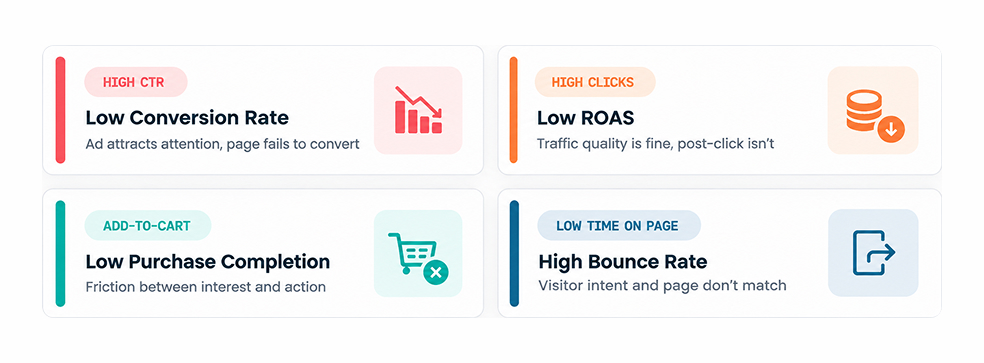
Read these four signals together, and the funnel basically diagnoses itself. High CTR with low conversion means the ad oversold what the page delivers. High clicks with low ROAS rules out a traffic problem entirely. And a high bounce rate with low time on page means visitors decided in seconds this wasn’t the page they expected.
Bottom line: the funnel already told you where it’s broken – most teams just haven’t read it yet.
How Landing Pages Influence Paid Advertising Performance
A paid campaign does not succeed at the click. The real performance test begins after visitors reach the landing page.
Agencies often see campaigns with strong CTR, steady traffic, and optimized targeting, yet conversions and revenue do not move at the same pace. In many cases, the gap is not within the ad strategy – it is in the post-click experience.
Landing pages influence whether visitors find what they expected, trust the offer, and take action. A mismatch between ad messaging and landing page experience can increase acquisition costs, reduce ROAS, and lower lead quality, even when the campaign is reaching the right audience.
| Metric Agencies Track | How Landing Pages Influence It |
| Conversion rate | Clear messaging, relevant offers, and focused CTAs help turn visitors into leads or customers. |
| Cost Per Acquisition | Better conversion efficiency reduces the cost required to generate each lead or sale. |
| ROAS | More conversions from existing traffic improve the return generated from ad spend. |
| Lead Quality | A well-structured page attracts visitors who better match the client’s goals. |
The takeaway for agencies is simple: paid media does not end when someone clicks an ad. The landing page determines whether that click becomes a measurable business outcome.
The Hidden Cost of Sending Paid Traffic to Weak Pages
Many agencies focus heavily on reducing CPC or improving CTR, but cheaper clicks do not automatically create better outcomes.
A campaign can bring qualified visitors and still underperform if the landing page creates friction. When visitors cannot quickly understand the offer, find proof, or identify the next step, the opportunity created by the ad is lost.
Common consequences include:
- Wasted ad spend: Budget continues driving traffic that fails to convert.
- Lower conversion opportunities: Interested visitors leave before completing the desired action.
- Poor customer acquisition efficiency: More budget is required to generate the same number of leads or customers.
For agencies, this is why diagnosing the full conversion journey matters. A low-performing campaign is not always a media buying problem. Sometimes the ads are creating demand – the landing page is simply not capturing it.
Landing Page Mistakes That Hurt Paid Ads Performance
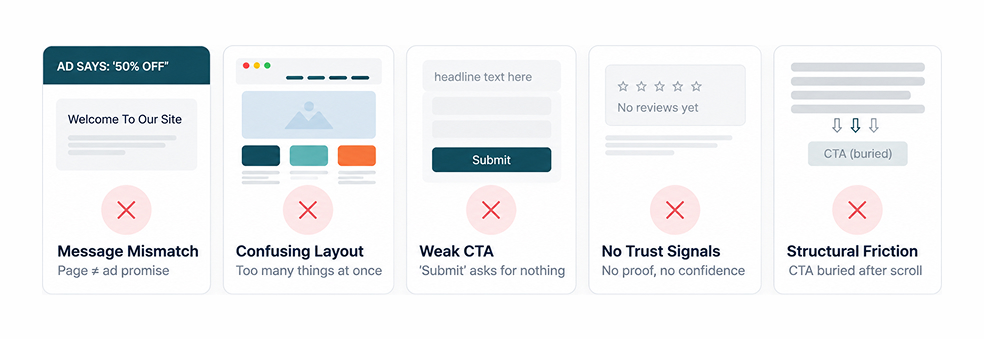
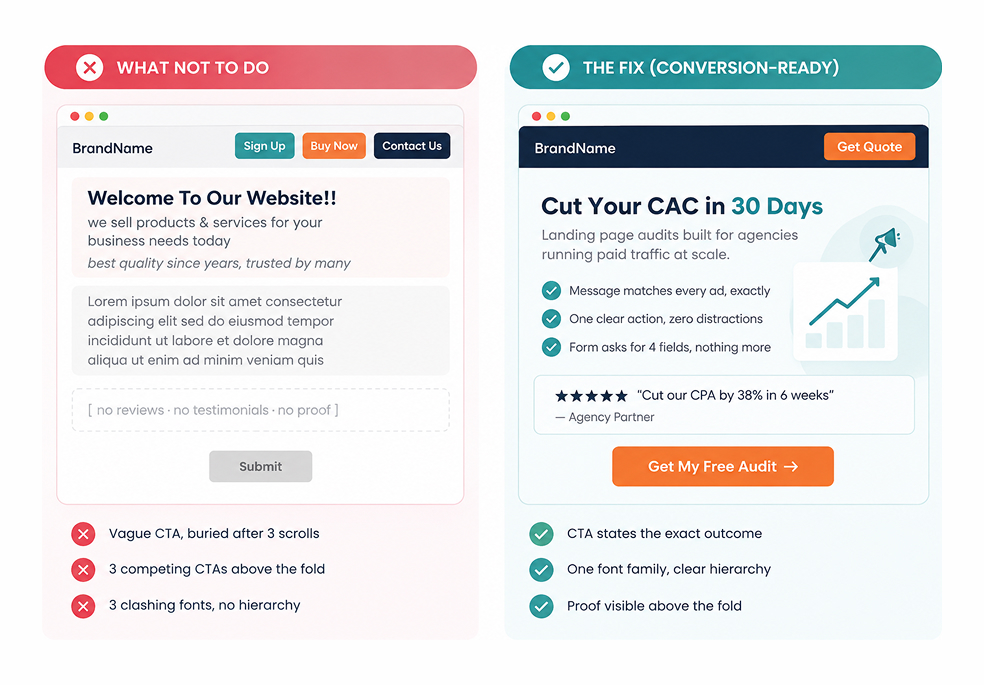
This is where most of the damage actually happens – and it’s rarely the ad’s fault. Here’s what each mistake actually looks like on a real page:
Your Landing Page Doesn't Match Your Ad Message
Message misalignment breaks visitor confidence in under two seconds. If the ad promises a specific offer and the page opens with a generic homepage, the click and the page are having two different conversations. The journey from ad to conversion needs to read like one continuous thought, not a bait-and-switch.
Your Page Creates Confusion Instead of Clarity
Too much information without clear direction forces visitors to work for understanding – and most simply won’t. Five competing offers and three CTAs don’t look thorough; they look like nobody made a decision about what matters most.
Your Calls-to-Action Don't Encourage Action
“Submit” and “Learn More” are the two most common CTA mistakes on the internet, and neither tells a visitor what happens next. CTAs need to state the outcome – “Get My Free Quote,” “Start My Trial,” “See Pricing” – matched to visitor intent.
Your Page Lacks Trust-Building Elements
No reviews, testimonials, case studies, guarantees, or credibility signals means visitors have nothing to justify the decision they’re being asked to make. In 2026, proof isn’t optional – it’s the reason someone hands over an email address instead of closing the tab.
Your Landing Page Structure Creates Friction
A weak above-the-fold experience, too many distractions, and a conversion path buried six scrolls down all add up to the same outcome: people leave before they ever reach the action you built the page for.
None of this is a design problem. It’s a “what’s standing between the click and the conversion” problem.
What Conversion-Focused Landing Pages Do Differently
A landing page does not become effective because it has better visuals, more animations, or a longer list of features. Agencies have seen this pattern repeatedly – a beautifully designed page can still fail to convert if it does not help visitors understand the value, trust the offer, and take the next step.
Conversion-focused landing pages are built around decision-making. They reduce uncertainty, remove friction, and create a clear path between visitor intent and business action.
Why Design Alone Does Not Drive Conversions
A strong design can improve the user experience, but design itself is not the reason visitors convert.
The pages that perform well usually answer three questions quickly:
- Is this relevant to my problem?
- Is this solution worth considering?
- What should I do next?
Many underperforming landing pages focus heavily on appearance while overlooking the elements that influence decisions – message clarity, offer positioning, trust, and usability.
For agencies, this distinction matters because improving a client’s landing page is not about making it look more modern. It is about improving how effectively paid traffic moves from interest to action.
The Core Elements Behind Better Conversion Rates
Clear value proposition that matches the intent. Visitors arriving from paid campaigns already have a reason for clicking. The landing page needs to continue that conversation.
A strong value proposition immediately communicates:
- What the business offers
- Who it helps
- Why it is different
- What outcome visitors can expect
When this connection is missing, agencies often see campaigns with good engagement but poor conversion performance.
Why More Design Features Do Not Always Mean More Conversions
A common assumption in landing page projects is that adding more design elements automatically creates a better-performing page. More animations, interactive sections, complex layouts, and visual effects may make a page look impressive, but they do not necessarily help visitors make decisions faster.
For paid traffic, the visitor already has a reason for arriving. The landing page’s job is not to showcase every possible capability – it is to help them quickly understand the value and take the next step.
A visually attractive page focuses on presentation.
A conversion-focused page focuses on persuasion.
The difference often comes down to three things:
- Clarity: Can visitors immediately understand what is being offered and why it matters?
- Relevance: Does the page continue the same conversation started by the advertisement?
- Trust: Does the visitor have enough confidence to move forward?
A page can have excellent visuals and still struggle if visitors cannot quickly find the answer to their most important question: “Why should I choose this?”
For agencies, this is an important distinction when reviewing client performance. A landing page redesign should not be judged only by how modern it looks. It should be measured by whether it improves visitor understanding, reduces friction, and supports conversion goals.
The Core Elements Behind Better Conversion Rates
- Strong value proposition
- Clear messaging
- Relevant offer
- Social proof
- Simple conversion path
Building Landing Pages That Convert Paid Traffic Into Customers
A landing page built for paid traffic has a different responsibility than a standard website page. Visitors arriving from ads are often making quick decisions. They already showed interest by clicking, but they still need enough clarity, confidence, and value to take the next step.
For agencies, the goal is not to add more sections or make pages longer. It is to create a landing experience that aligns with the campaign objective, visitor intent, and conversion goal.
Creating Headlines That Immediately Communicate Value
The first few seconds after a visitor lands on the page determine whether they continue exploring or leave. A strong headline does not simply describe what the business offers. It connects the visitor’s problem with the outcome they are looking for.
Effective landing page headlines usually communicate:
- The specific problem being solved
- The benefit or outcome visitors can expect
- Why the offer is relevant to them
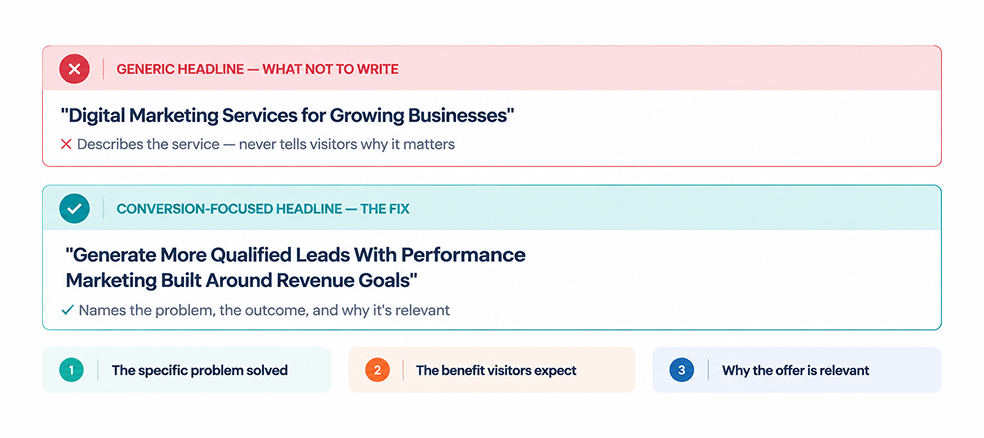
The difference is not just wording. It is helping visitors understand why they should continue. For agencies managing paid campaigns, headline optimization is especially important because it maintains continuity between the ad message and the landing page experience.
Choosing the Right Landing Page Structure for Different Business Goals
A landing page strategy cannot follow a one-size-fits-all template. The structure that works for an ecommerce brand selling a $50 product will not necessarily work for a B2B company selling a high-value service.
For agencies, this distinction is important because landing pages should be built around the visitor’s buying journey, not just the campaign objective. The same paid traffic strategy can produce very different results depending on whether visitors are ready to purchase, researching options, or evaluating a complex business decision.
The right structure helps visitors find the information they need at the stage where they are most likely to convert.
E-commerce Product Pages: Helping Visitors Move From Interest to Purchase
Ecommerce visitors often arrive with a shorter decision window. They want to quickly understand what the product offers, why it is worth buying, and whether they can trust the purchase decision.
A high-performing ecommerce landing page should focus on reducing uncertainty and increasing purchase confidence.
Highlight Product Benefits, Not Just Features
Visitors do not buy features. They buy outcomes. Instead of only explaining product specifications, effective pages communicate:
- How the product solves a problem
- What makes it different
- Why it is worth choosing over alternatives
The focus should move from “what the product has” to “what the customer gains.”
Use Reviews and Social Proof to Build Confidence
Online purchases often involve hesitation. Customer reviews, ratings, testimonials, and user-generated content help answer the question every buyer has:
“Can I trust this product?”
Social proof becomes especially important when paid ads introduce visitors to a brand for the first time.
Create Urgency Without Creating Pressure
Elements such as limited availability, seasonal offers, or time-sensitive promotions can encourage action when used appropriately. The goal is not to pressure visitors into buying. It is to give them a clear reason to act instead of postponing the decision.
Increase Purchase Confidence
Before completing a purchase, visitors want reassurance around:
- Product quality
- Shipping information
- Returns
- Payment security
- Customer support
A conversion-focused ecommerce page removes these uncertainties before they become reasons to leave.
Service-Based Lead Generation Pages
Service businesses usually have a different challenge. Visitors are not purchasing immediately; they are deciding whether the business understands their problem and can deliver the right solution. The landing page needs to build enough confidence for visitors to start a conversation.
Lead With the Customer Problem
Many service pages begin by describing the company. However, visitors are usually more interested in whether the business understands their situation.
Effective service landing pages focus on:
- The challenge customers are facing
- The impact of that challenge
- The outcome they want to achieve
When visitors feel understood, they are more likely to engage.
Position the Solution Around Outcomes
Listing services alone rarely creates strong conversions. Instead of focusing only on capabilities, landing pages should communicate:
- What changes after choosing the service
- How the process works
- Why the approach is different
The goal is to move visitors from: “Does this company provide this service?”
To: “Is this the right solution for my problem?”
Use Proof to Support the Decision
For service businesses, trust often determines whether someone submits an enquiry.
Strong proof elements include:
- Case studies
- Client results
- Testimonials
- Industry experience
- Before-and-after outcomes
A visitor may be interested in the service, but proof helps them feel confident taking action.
High-Consideration Offers
Some buying decisions require more research before conversion. Enterprise services, consulting, software solutions, and high-value B2B offerings often involve multiple stakeholders and longer decision cycles. For these offers, landing pages need to educate while gradually building confidence.
Using Hybrid Sales Pages
A hybrid sales page combines education and conversion elements. Instead of pushing visitors directly toward an enquiry, it helps them understand:
- The problem
- The available solution
- The business impact
- Why this approach works
This creates a stronger foundation before asking visitors to take action.
Educating Visitors Through Useful Content
For complex offers, visitors often need answers before they are ready to convert. Helpful content can include:
- Industry insights
- Process explanations
- Comparisons
- FAQs
- Use cases
Education reduces uncertainty and positions the business as a knowledgeable partner.
Using Social Proof, Price Anchoring, Guarantees, and Bonuses
High-value decisions often involve perceived risk. Landing pages can reduce hesitation through:
- Social Proof: Showing successful outcomes from existing customers
- Price Anchoring: Helping visitors understand the value compared to the investment
- Guarantees: Reducing perceived risk where applicable
- Bonuses: Increasing perceived value without relying only on discounts
The right landing page structure depends on what the visitor needs before making a decision. For agencies, understanding this buying journey is what turns landing page optimization from a design task into a performance strategy – one that helps paid campaigns generate better business outcomes.
Diagnosing Paid Campaign Performance Before Increasing Ad Spend
Increasing the budget is often the easiest recommendation to make and the hardest one to justify. When a campaign is not generating expected results, many agencies immediately look at targeting, creatives, or bidding strategies. While those areas matter, they are only part of the performance picture. Before scaling spend, agencies need to understand whether the problem is attracting the right audience or converting the audience that is already arriving.
Looking Beyond Clicks and Impressions
Campaign metrics can show what happened, but they do not always explain why it happened. A high CTR tells you that the ad attracted attention. It does not tell you whether visitors found the landing page relevant enough to continue.
Agencies should evaluate:
- Where visitors drop off after landing
- Whether the page matches the campaign intent
- Which sections users engage with
- Whether visitors complete the expected action
- How performance changes across devices and audiences
This deeper analysis helps separate media problems from conversion problems. A campaign with low engagement may need better targeting. A campaign with strong engagement but poor conversions may need a better landing experience.
Using Data and AI Insights to Improve Decision-Making
Modern performance marketing is becoming less dependent on assumptions and more focused on behavioural insights. AI-powered analytics and automation can help agencies identify patterns faster by analysing:
- User behaviour trends
- Conversion barriers
- Audience responses
- Content performance
- Landing page engagement
However, technology does not replace strategic thinking. AI can highlight where users are dropping off. Agencies still need the expertise to understand why it is happening and what change will create the biggest impact. The agencies delivering stronger results are not simply driving more traffic. They are improving how effectively that traffic turns into business outcomes.
How White-Label Landing Page Optimization Helps Agencies Scale
Not every agency wants to build a complete in-house team covering paid media, CRO, UX, analytics, and development. And realistically, building every specialist capability internally is not always the most efficient path. A white-label partner allows agencies to expand their service capabilities while maintaining ownership of client relationships.
Extending Existing Client Services Without Additional Overhead
Landing page optimization sits at the intersection of multiple disciplines:
- Paid advertising strategy
- User experience
- Conversion optimization
- Analytics
- Content positioning
- Technical implementation
A specialized delivery partner helps agencies bring these capabilities into client engagements without adding permanent operational complexity.
This allows agencies to support projects that require deeper conversion expertise while staying focused on strategy, communication, and growth.
Helping Agencies Have Better Performance Conversations
Clients rarely care about clicks alone. They want to understand:
- Why leads increased or decreased
- Whether marketing spend is creating value
- What can improve future performance
Instead of simply reporting: “Your campaign generated traffic but conversions are low.”
Agencies can provide a more strategic insight: “The campaign is attracting interest, but the landing experience needs optimization to improve conversion efficiency.”
That shift changes the conversation from campaign reporting to business consulting.
Maintaining Client Ownership While Expanding Capabilities
A strong white-label partnership should strengthen the agency’s position, not replace it.
The agency remains responsible for:
- Client strategy
- Communication
- Account management
- Business goals
The delivery partner supports execution with specialized expertise behind the scenes. For agencies looking to scale services without increasing internal complexity, white-label support becomes a practical way to deliver stronger outcomes.
Conclusion
Paid media success is no longer determined only by targeting the right audience or creating compelling ads. The real impact comes from how effectively the entire conversion journey works after the click.
For agencies, improving campaign outcomes requires looking beyond ad metrics and understanding the factors that influence conversions – from landing page relevance and messaging clarity to trust signals and user experience.
This is where the right delivery partner can make a difference.
With ZealousWeb‘s white-label performance marketing expertise, agencies can strengthen their capabilities with conversion-focused landing page optimization, performance insights, and scalable execution support – without the need to build every specialized function internally.
By combining campaign strategy with better post-click experiences, agencies can help clients achieve stronger ROI, improve lead quality, and create measurable business growth while keeping the client relationship fully in their control.
Improve Your Paid Ad Results With A Conversion-Focused Landing Page Strategy
Partner with ZealousWeb
FAQs
Is outsourcing more cost-effective than building an internal CRO and optimization team?
For many agencies, yes. Building an internal team requires ongoing salaries, training, and resource management. We provide flexible expertise based on project requirements without long-term overhead.
Can this help us handle more client projects without increasing our team size?
Yes. We help agencies extend delivery capacity during high-demand periods, allowing internal teams to focus on strategy, client relationships, and higher-value activities.
How does external support improve agency productivity?
We reduce the execution load on internal teams by supporting research, optimization, analysis, and implementation activities, helping agencies deliver faster without compromising quality.
Can agencies maintain healthy margins when using external specialists?
Yes. Flexible delivery support allows agencies to manage project costs more effectively while continuing to offer specialized services to clients.
How does AI automation improve landing page optimization workflows?
We use AI-assisted workflows to accelerate analysis, identify patterns, support content improvements, and improve efficiency while combining automation with strategic human decision-making.
Will we have visibility into the work being delivered?
Yes. We provide clear communication, progress updates, and reporting insights so agencies have visibility into optimization activities and outcomes.
Can this support help agencies win more client opportunities?
Yes. Adding specialized capabilities like conversion optimization and landing page expertise helps agencies strengthen proposals and offer more complete performance solutions.