


Most agencies don’t have a tools problem. They have Notion. They have ChatGPT. They have project dashboards, automation workflows, and a Slack channel for everything. The stack looks impressive. The reality doesn’t match.
Delivery is still inconsistent. Deadlines still slip. Quality still depends on who’s having a good week. The problem was never the tools. It was never the team either. It’s the absence of a system that holds everything together.
AI-led delivery isn’t about adding smarter tools to a broken process. It’s about building an execution architecture where AI, automation, and human judgment operate in the right sequence — so output is consistent, scalable, and doesn’t collapse the moment your best person is unavailable. That’s the difference between an agency that grows and one that just gets busier.
This piece is about that difference — and what it actually takes to scale agency execution with systems, not tools.
The Tools Trap: Why More AI Tools Are Making Your Delivery Worse, Not Better
Agencies aren’t struggling because they lack tools — they’re struggling because tools without systems create the illusion of progress while delivery quietly breaks underneath. Every new AI tool added to a disconnected stack doesn’t reduce operational load. It adds another layer to manage, another handoff to monitor, and another point of failure when volume increases.
The trap isn’t adoption. It’s mistaking tool accumulation for operational maturity. The agencies feeling this most aren’t the ones ignoring AI — they’re the ones who’ve adopted it fastest without building the execution architecture to support it.
The False Promise of Tool-First Thinking
Every time delivery breaks, the instinct is the same — find a better tool.
A smarter brief generator. A faster review workflow. An AI that handles reporting so the team can focus on execution. The logic feels sound. The demo looks clean. The adoption happens fast.
And three months later, delivery is still inconsistent.
Because the problem was never the tool. It was never even the team. It was the absence of a system that connects both into something that runs reliably — at volume, under pressure, without someone manually holding it together.
Tool-first thinking solves for symptoms. Systems-first thinking solves for structure. And until agencies make that distinction, every new tool is just more sophisticated chaos.
What Happens When Tools Multiply Without Systems
Here’s what growth without systems architecture actually looks like inside an agency:
| Stage | What Gets Added | What Actually Happens |
| Early growth | First AI tool adopted to solve a specific pain | Works well. The team is small. One person owns it. |
| Scaling Up | Second and third tools added for different functions | Manual bridges are built between tools. Ownership blurs. |
| Mid-scale | Automations layered on top of existing workflows | Processes work only when specific people are present |
| At Volume | Full tool stack in place across departments | Delivery depends on tribal knowledge, not architecture |
The stack grows. The system doesn’t. And that gap is where delivery quality silently erodes — not dramatically, not all at once, but consistently enough that margins shrink, timelines stretch, and client confidence quietly drops.
The Real Cost: Where Agencies Actually Bleed
This isn’t about inefficiency in the abstract. It shows up in three very specific places:
- Delivery Quality becomes person-dependent, not process-dependent. Output varies based on who’s managing the project, not what the system produces.
- Timelines stretch not because the work is hard but because handoffs are unclear, approvals are manual, and no automation is catching what falls through.
- Profitability erodes silently. Rework, delays, and firefighting consume margin that was never budgeted — because the operational cost of a broken system never appears on a proposal.
Signs Your Agency Is Tool-Heavy but System-Light
You don’t need an audit to know this is happening. These are the signals already visible inside your operation:
- Delivery quality shifts when a senior person is unavailable
- New hires take weeks to become productive because the process lives in people, not documentation
- Automations break when the person who built them isn’t around
- Client escalations are handled by a person, not a process
- Your team spends more time managing tools than managing delivery
If most of these are true, the agency isn’t under-resourced. It’s under-systematised. More tools won’t fix that. A different operating model will.
What AI-Led Delivery Actually Means
Most agencies have automation. Very few have AI-led delivery. The difference isn’t the technology — it’s the depth at which it operates. Automation as a feature handles tasks. AI-led delivery handles execution. It’s the difference between a tool that saves your team twenty minutes and a system that ensures consistent, scalable output regardless of team size, client volume, or operational pressure. Understanding that distinction is what separates agencies that grow calmly from agencies that grow chaotically — and it starts with being clear on what AI-led delivery actually is, what it runs on, and what role it plays inside a serious agency operation.
Moving From Automation as a Feature to Automation as an Execution Layer
From Automation as a Feature to Automation as an Execution Layer
Most agencies treat automation as an add-on — something that handles repetitive tasks while the real work happens elsewhere. Schedule a post. Generate a report. Trigger a notification. Useful, but cosmetic.
AI-led delivery is a different category entirely.
It’s not automation sitting on top of your process. It’s automation embedded into the execution layer itself — where every workflow, handoff, and output checkpoint runs through an intelligent system that maintains quality, velocity, and consistency without manual intervention holding it together.
The shift isn’t technical. It’s structural. And it changes what your agency is actually capable of at scale.
What AI-Led Delivery Means in an Agency Context
In an agency context, AI-led delivery means your execution doesn’t depend on who’s available — it depends on how the system is built.
It means client briefs move through a defined intelligence layer before work begins. It means quality checkpoints are built into the workflow, not bolted on at the end. It means reporting, communication, and delivery milestones run on automated architecture — not on an account manager chasing updates across five different tools.
Simply put: AI-led delivery is what happens when automation stops being a productivity hack and starts being the operating backbone of how work gets done, reviewed, and delivered — consistently, at volume, without chaos.
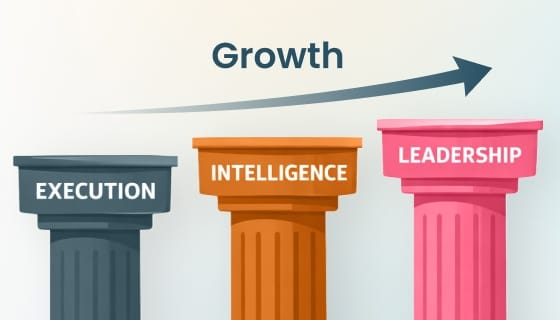
The Three Layers Every AI-Led Delivery System Runs On
| Layer | What It Does | What It Replaces |
| Execution layer | Delivery, QA, white-label operations, velocity management | Manual handoffs, person-dependent quality control |
| Intelligence layer | AI-driven decisions, data pipelines, automation architecture | Gut-feel project management, disconnected reporting |
| Leadership layer | Decision clarity, value creation frameworks, founder-level visibility | Firefighting, reactive leadership, activity-based metricsFirefighting, reactive leadership, activity-based metrics |
Each layer reinforces the other. Execution without intelligence creates busy work. Intelligence without execution creates insight with no output. Leadership without both creates founders still stuck in the weeds at scale. When all three run together — that’s when an agency stops reacting and starts operating.
How ZealousWeb Functions as a Delivery OS — Not a Vendor
This is the distinction that matters most.
A tool vendor gives you software and walks away. A delivery OS integrates into how your agency actually runs — taking ownership of the execution layer so your team focuses on growth, relationships, and decisions that move the business forward.
ZealousWeb is built as that operating system. Not as a supplier of tasks, not as a cheaper outsourcing option, but as the execution and intelligence architecture that sits behind your agency’s delivery — handling the systems, maintaining the standards, and scaling the output without scaling your operational overhead.
When agencies white-label with ZealousWeb, they’re not outsourcing work. They’re plugging into a delivery OS that was built specifically to run at scale — so their brand stays consistent, their clients stay confident, and their founders stop being the last line of quality control.
The Architecture Behind Scalable Execution
Most agencies have delivery processes. Very few have delivery systems. A process tells your team what to do. A system ensures it gets done — consistently, at the right quality, without a founder or senior lead manually holding it together. The difference between an agency that scales smoothly and one that scales chaotically almost always comes down to this: whether execution is built into the architecture or held together by the people inside it. This section breaks down what scalable execution architecture actually looks like — and what it takes to build a delivery layer that runs without you firefighting inside it.
What a Delivery System Looks Like vs. a Delivery Process
A delivery process is a checklist. A delivery system is an operating architecture.
Most agencies have processes — onboarding docs, project templates, approval flows. They work when someone is following them. They break the moment volume increases, a senior person is stretched, or a new client has requirements the template didn’t account for.
A delivery system is different. It doesn’t rely on someone remembering to follow it. It’s built into how work moves — from brief to execution to review to delivery — with defined ownership, automated checkpoints, and quality standards that don’t shift based on who’s managing the project that week.
| Delivery Process | Delivery System | |
| Depends on | People remembering | Architecture enforcing |
| Quality control | End-stage review | Built-in at every handoff |
| Scales when | Team grows | Volume grows |
| Breaks when | Key person is unavailable | Rarely-by design |
| Output consitency | Variable | Predictable |
The moment an agency moves from process to system, delivery stops being a management problem and starts being an operational output.
QA, Velocity, and Ownership Inside an AI-Led Model
These three elements — quality assurance, delivery velocity, and clear ownership — are where most agency delivery architectures silently fall apart at scale.
- QA stops being a final check and becomes a continuous layer. In an AI-led model, quality isn’t reviewed at the end of a project — it’s embedded at every stage. Briefs are validated before work begins. Outputs are checked against defined standards before they reach account managers. Revisions are tracked against root causes, not just fixed and forgotten.
- Velocity becomes a system output, not a team effort. Deadlines are met not because the team pushed harder but because the workflow was designed to move work forward without manual chasing. Bottlenecks are visible before they become delays. Handoffs are automated, not negotiated.
- Ownership is architectural, not assumed. In most agencies, ownership is informal — everyone knows who’s responsible but nothing enforces it. In an AI-led model, ownership is defined at the system level. Every task, every checkpoint, every client-facing output has a designated owner baked into the workflow — so accountability doesn’t depend on culture alone.
When QA, velocity, and ownership operate at the system level, delivery becomes something your agency does reliably — not something it heroically pulls off.
How Automation Reduces Chaos Instead of Adding It
Automation adds chaos when it’s layered on top of a broken process. It reduces chaos when it’s built into a functioning system.
The distinction matters because most agencies automate the wrong things first — notifications, scheduling, reporting — while the actual sources of chaos remain untouched. Unclear briefs still enter the workflow. Approval loops still stall mid-project. Rework still happens because quality standards weren’t defined upfront.
AI-led automation addresses chaos at the source:
- Brief validation before work begins — so execution starts clean, not corrected halfway through
- Automated handoff triggers between workflow stages — so nothing waits on a manual nudge to move forward
- Real-time delivery visibility across all active projects — so issues surface early, not at deadline
- Standardised output checkpoints at every stage — so quality is consistent regardless of who’s executing
The result isn’t a faster version of the same chaos. It’s a fundamentally quieter operation — where your team is focused on work that requires human judgment, and the system is handling everything that doesn’t.
Scaling Without Scaling Headcount
Growth is supposed to feel like progress. For most agencies, it feels like pressure. Every new client adds complexity. Every complexity adds a conversation. Every conversation adds a task. And before long, the agency isn’t scaling — it’s just absorbing more load with the same broken infrastructure underneath. The answer most agencies reach for is headcount. More people to manage more work. But headcount without systems doesn’t solve the problem — it delays it, at a higher cost. The agencies scaling calmly aren’t necessarily larger. They’re better architected. Specifically, they’ve built or plugged into a white-label execution model that runs on AI-led systems — so client load increases without operational overhead increasing at the same rate. This section breaks down exactly how that model works and what it takes to make it sustainable.
Why White-Label Partnerships Fail Without a Systems Backbone
White-label outsourcing looks simple on paper. Hand off the execution, retain the client relationship, scale without hiring. The logic is clean. The reality is messier.
Most white-label partnerships fail not because the work is poor but because there’s no system connecting the agency’s expectations to the partner’s execution. Briefs arrive incomplete. Standards are assumed, not documented. Quality varies by project. Turnaround times shift based on the partner’s internal load. And the agency ends up doing more quality management than it expected, which defeats the purpose entirely.
The failure pattern is consistent:
| Failure Point | What It Looks Like | Root Cause |
| Brief Quality | Work comes back misaligned | No standardised brief architecture |
| Output Consistency | Quality varies project to project | No defined delivery standards |
| Turnaround Reliability | Deadlines missed without warning | No velocity tracking or escalation triggers |
| Accountability | Issues surface at the client stage | No QA layer between execution and delivery |
| Scalability | Partnership breaks under volume | No system’s backbone — people holding it together |
A white-label partner without a systems backbone isn’t an extension of your agency. It’s a dependency with a deadline attached. The agencies that make white-label work at scale don’t just find a capable partner. They find one that operates on a delivery system — where standards, accountability, and quality are architectural, not aspirational.
How AI-Led Delivery Enables Agencies to Scale Client Load Without Breaking
The reason most agencies break under client load isn’t capacity. It’s architecture.
When delivery depends on people managing complexity manually — tracking projects across tools, chasing approvals, reviewing outputs before they reach the client — every new account adds a disproportionate amount of operational weight. The tenth client doesn’t cost ten times the effort of the first. It costs significantly more because the system wasn’t built to absorb volume without friction.
AI-led delivery changes that ratio.
When execution runs on an intelligent system — where briefs are validated, workflows are automated, quality is embedded, and visibility is real-time — adding a new client doesn’t add a new layer of management overhead. It adds a new instance of a system that already knows how to handle it.
Specifically, AI-led delivery enables agencies to scale by:
- Standardising onboarding so new clients enter a defined system, not a custom process built from scratch each time
- Automating workflow progression so projects move forward without manual intervention at every stage
- Maintaining output quality at volume through embedded QA — not end-stage reviews that slow delivery
- Creating real-time visibility across all active accounts so issues are caught early, not escalated by clients
- Reducing rework by catching misalignment at the brief stage rather than the delivery stage
The result is an agency that can take on more without asking more of its team — because the system is absorbing what used to be absorbed by people.
What Calm, Consistent Delivery Looks Like at Volume
Calm delivery at volume isn’t a feeling. It’s a set of operational conditions that either exist or don’t.
It looks like this:
Clients receive consistent output regardless of which team member or white-label partner is executing. Senior leads aren’t pulled into project-level firefighting because the system catches issues before they escalate. Founders have visibility across all active deliveries without being inside every project. New accounts onboard into a defined system, not a custom workflow someone builds under pressure. And when volume increases, the operation absorbs it — without an emergency all-hands, without a frantic hiring push, without delivery quality quietly dropping while the team tries to hold everything together.
This isn’t an aspirational state. It’s the operational output of an agency that has built its delivery on systems rather than on the resilience of its people. The difference between an agency that dreads growth and one that’s ready for it almost always comes down to one thing — whether execution is architectural or individual. AI-led delivery, backed by a white-label model with a genuine systems backbone, is what makes that shift possible.
The Operating System Partner Model
There’s a meaningful difference between hiring someone to do work and partnering with a system built to run it. Most agencies have experienced the former — a vendor that delivers tasks, a freelancer that fills gaps, an outsourcing partner that handles volume until it doesn’t. What they haven’t experienced is an execution OS — a partner that integrates into the delivery layer itself, bringing systems, standards, and intelligence that the agency didn’t have to build from scratch. That’s the model ZealousWeb operates on. Not as an extension of your team, but as the architecture underneath it — so delivery runs consistently, scales predictably, and doesn’t depend on your best people absorbing what the system should be handling.
Conclusion
The agencies scaling calmly right now aren’t the ones with the best tools. They’re the ones who stopped treating tools as the answer and started building the architecture that makes tools useful. AI-led delivery isn’t a product you buy or a feature you switch on. It’s an operational shift — from execution that depends on individuals to delivery that’s built into the system itself. The chaos most agencies are managing today isn’t inevitable. It’s architectural. And architecture can be fixed.
That’s precisely what ZealousWeb is built for. Not to take tasks off your plate, but to replace the missing system underneath your delivery — so execution runs consistently, scales predictably, and stops depending on your best people absorbing what the architecture should be handling. The next step isn’t another tool evaluation. It’s an honest look at whether your delivery layer is built to scale — and if it isn’t, it’s time to plug into an operating system that is.
Is Your Agency Scaling Delivery or Struggling with Fragmented Workflows?
Discover System-Led Growth with ZealousWeb
FAQs
How do we know delivery quality won't drop when we hand work over to ZealousWeb?
Quality doesn't depend on who's executing — it depends on the system behind execution. ZealousWeb operates with embedded QA checkpoints at every workflow stage, not just end-stage reviews. Standards are documented, enforced, and consistent across every project regardless of volume.
Will our clients know they're working with a white-label partner?
No. ZealousWeb operates fully under your brand — your communication, your reporting, your client relationship. We're the execution layer. You remain the agency.
How quickly can ZealousWeb integrate into our existing delivery workflow?
We don't ask you to rebuild your operation around ours. ZealousWeb plugs into your existing delivery layer, identifies the gaps, and systematises them. Most agency integrations are operational within the first two weeks.
What makes ZealousWeb different from a regular outsourcing agency?
A regular outsourcing agency takes tasks. ZealousWeb takes ownership of the system behind them. The difference shows at scale — consistent output, predictable turnarounds, and a delivery layer that doesn't break when volume increases.
How do we maintain control and visibility once delivery is handed over to ZealousWeb?
Handing over execution doesn't mean handing over visibility. ZealousWeb operates with real-time delivery transparency — you see project status, output quality, and milestone progress without needing to chase updates. You stay in control of decisions. We stay in control of delivery.