
Fraud Blocker
AI Visibility Audit

AI Search Visibility Audit: Is Your Business Missing Revenue Opportunities?

October 14, 2026Posted By: Jalpa Gajjar
AEOAI SearchB2B GrowthGEO

Your competitors are getting recommended by ChatGPT. Your business? Apparently, it didn’t make the guest list.

And here’s why that should concern you. According to Ahrefs’ February 2026 study, Google’s AI Overviews correlate with 58% fewer clicks to top-ranking pages for the informational keywords studied. Ranking well on Google no longer guarantees the traffic it once did. If potential B2B buyers are discovering competitors through AI-generated answers before visiting your website, how would you even know?

An AI search visibility audit helps uncover where your business is missing from AI recommendations and which gaps could be costing you valuable opportunities.

What Is an AI Search Visibility Audit, and Why Does Your Business Need One?

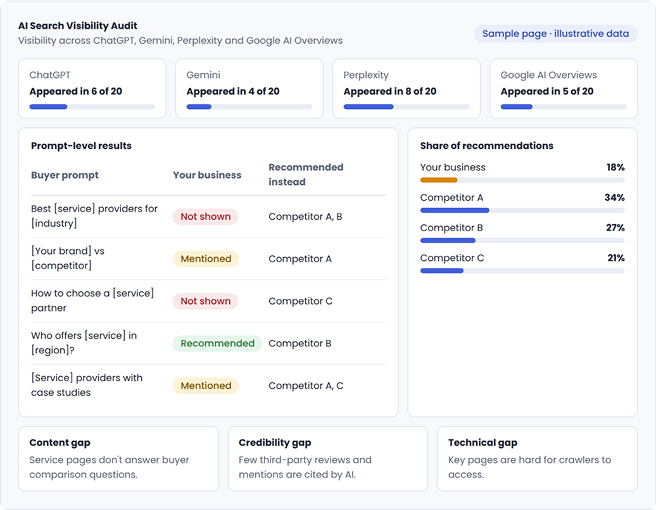
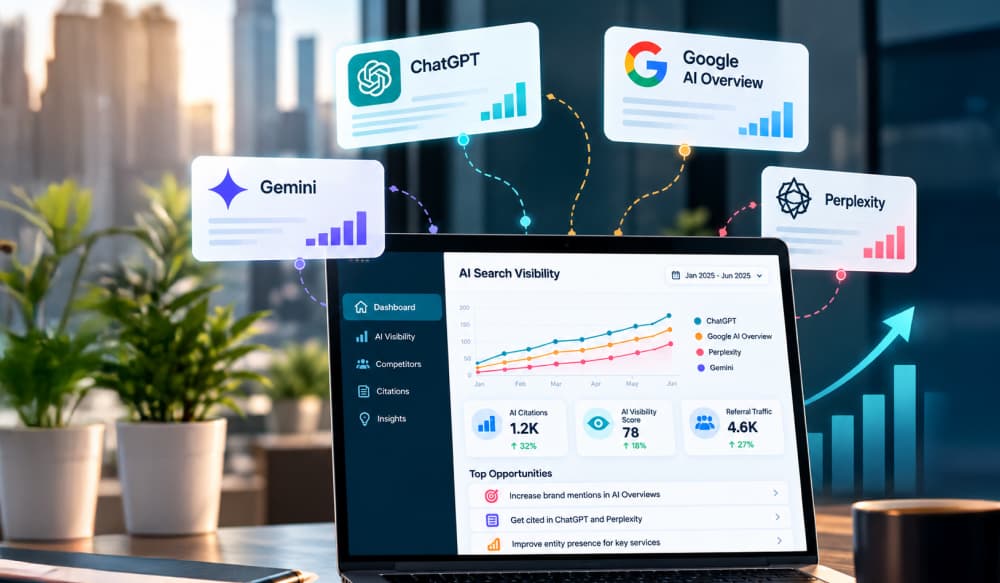
An AI search visibility audit evaluates how often your business appears, gets cited, or is recommended across ChatGPT, Gemini, Perplexity, and Google AI Overviews. It identifies why competitors may be getting recommended instead of your business by examining brand authority, content gaps, and Answer Engine Optimization (AEO) and Generative Engine Optimization (GEO) readiness.

For B2B businesses, the real value lies in uncovering missed buyer consideration opportunities, prioritizing improvements, and identifying where stronger AI search visibility could contribute to qualified leads and revenue.
AI Search Dashboard

Why Your Business May Be Missing Out on AI Search Recommendations

Your business could rank on Google’s first page and still be missing from ChatGPT recommendations. Why? Traditional search rankings and AI-generated recommendations don’t always favor the same sources. Strong SEO performance helps, but it doesn’t guarantee AI visibility.

In fact, Ahrefs’ analysis of 15,000 prompts found that only 12% of URLs cited by AI assistants also appeared in Google’s top 10 results for the same queries, on average.

So, what’s keeping your business out of the conversation?

  • Incomplete service information: Your website lists what you offer but doesn’t clearly explain capabilities, industry experience, or why buyers should choose you.
  • Weak third-party credibility: Limited independent reviews, industry references, or credible mentions make it harder to establish authority beyond your website.
  • Unclear brand positioning: AI responses may highlight competitors with stronger evidence of relevant expertise, leaving your differentiators unnoticed.

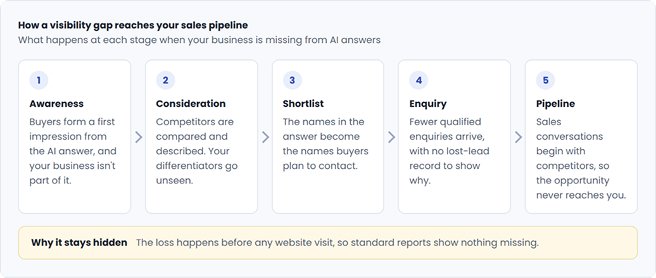
The business risk? A potential customer researching B2B service providers may shortlist your competitors without ever discovering you. An AI search visibility audit helps pinpoint these gaps before you invest in fixing them.
Revenue Impact Tracking

How to Conduct an AI Search Visibility Audit for Your Business

Your website ranks well, your services are clearly listed, and your SEO efforts seem to be working. But when a potential customer asks ChatGPT for recommendations, your competitors show up. You don’t. So, where’s the disconnect?

An AI search visibility audit helps identify where your business appears in AI-generated answers, why competitors may be getting recommended, and which gaps could be affecting qualified lead opportunities.

Here’s how to investigate it.

  • Identify 15-20 high-intent buyer questions. Think beyond your business name. What would a potential customer ask when comparing providers, evaluating solutions, or preparing to buy? Focus on service-specific, industry-related, and comparison queries.
  • Check your visibility across AI platforms. Test these questions in ChatGPT, Gemini, Perplexity, and Google AI Overviews. Record whether your business appears, how it’s described, and whether it’s recommended or simply mentioned. Repeat searches to spot recurring patterns.
  • See where competitors are getting ahead. Identify which competitors appear repeatedly and what makes their recommendations more compelling. Are their capabilities explained better? Do AI responses cite their case studies or independent industry sources?
  • Find what’s missing from your digital presence. Review service pages, customer success stories, third-party mentions, and technical accessibility. If your website explains what you do but not why a buyer should choose you, that’s a gap worth investigating.
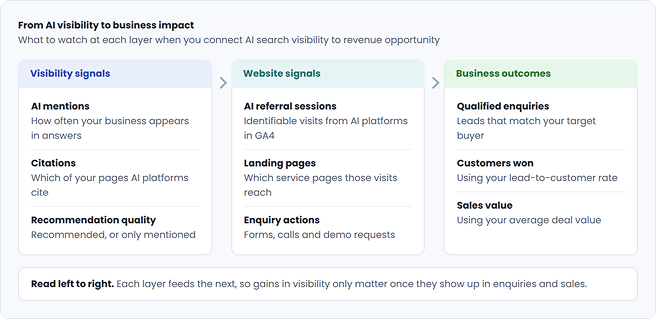
  • Connect visibility with business opportunities. Check Google Analytics 4 for identifiable AI referral traffic, enquiries, and conversions. Track recommendations separately because not every AI interaction results in a website visit.

Here’s where the real gap becomes obvious. Imagine a B2B software company appearing in ChatGPT only when buyers search its exact name, while competitors dominate queries like “best ERP implementation partners for manufacturing businesses.” The business isn’t necessarily invisible. It’s missing from the conversations happening before customers decide whom to contact.

That’s why a meaningful AI search visibility audit shouldn’t stop at counting brand mentions. It should reveal where buyer consideration is being lost and which improvements deserve attention first.

How Much Revenue Opportunity Could Your Business Be Missing?

Not appearing in AI search recommendations doesn’t come with a monthly invoice. Unfortunately, the potential business opportunities you’re missing aren’t always visible in your reports either.

ZealousWeb’s proposed AI Search Revenue Opportunity Estimator helps businesses model the revenue potentially associated with missed high-intent recommendations across ChatGPT, Gemini, Perplexity, and Google AI Overviews.

Consider a B2B business with an average deal value of $5,000 and a 20% lead-to-customer conversion rate.

Estimated monthly opportunity Conservative Moderate Higher
Additional qualified inquiries 5 10 20
Lead to customer closer rate 20% 20% 20%
Average deal value $5000 $5000 $5000
Expected additional customers 1 2 4
Potential monthly sales value $5000 $10000 $20000
Annualized sales value $60000 $1,2000 $2,40,000


*All figures are hypothetical planning assumptions, not measured AI search demand, documented losses, or guaranteed results. Annualized values assume the same opportunity every month and exclude delivery costs.

The calculation is straightforward:

Potential Revenue = Additional Qualified Enquiries × Close Rate × Average Deal Value

The difficult part is estimating those enquiries. Start with commercially valuable buyer prompts where competitors appear, then use available referral data, historical conversion rates, and clearly stated assumptions to build a realistic scenario.

The catch? These figures represent potential sales value, not revenue proven lost to competitors. AI-generated recommendations don’t always produce trackable visits, making precise attribution difficult.
AI Visibility Audit

What Should Businesses Fix After an AI Search Visibility Audit?

An AI search visibility audit is only valuable if the findings lead to meaningful improvements. Knowing that competitors appear more often is one thing. Understanding what to fix first to improve your chances of being recommended is where the real work begins.

Rather than fixing everything at once, businesses should prioritize gaps based on buyer intent, potential revenue impact, and implementation effort.

Identified gap What your business should fix Priority
Missing answers to the buyers questions Add clear answers to high-intent questions about services, capabilities, pricing factors, and provider comparisons. High
Incomplete service pages Explain who you serve, what problems you solve, and why buyers should choose your business over alternatives High
Inaccurate business information Correct outdated address, locations, company details across your website and external listings High
Weak third-party credibility Strengthen case studies, verified reviews, industry references, and 3rd party mentions that supports your expertise Medium-high
Technical accessibility issues Check indexing, crawl restrictions, page rendering and whether important content is accessible to search crawlers. High if blocking any key pages


So, where should you start?

If your business is missing from high-intent recommendations because its service pages lack essential information, address those gaps before publishing another ten generic blogs.

Likewise, fix technical barriers immediately when they prevent important pages from being discovered.

The goal isn’t to chase every AI mention. It’s to improve visibility where potential customers are actively evaluating businesses like yours.

AI Search Visibility Audit vs. SEO Audit: What Does Each Reveal?

Your SEO audit says your website is performing well. Great. But does that mean ChatGPT recommends your business when potential customers are comparing providers? Not necessarily.

An SEO audit evaluates how your website performs in traditional search, while an AI search visibility audit examines how your business appears in AI-generated answers, citations, and recommendations. Both identify different gaps that could influence customer acquisition.

Evaluation area Traditional SEO audit AI search visibility audit
Search performance Reviews rankings, organic traffic, indexing, and technical SEO issues. Measures brand mentions, citations, and recommendations across AI platforms.
Competitor visibility Identifies competitors outranking your website for target keywords. Identifies competitors recommended for high-intent buyer questions.
Content gaps Finds missing keywords, pages, and search optimization opportunities. Evaluates whether your content answers buyer questions and demonstrates relevant expertise.
Business measurements Tracks organic traffic, leads, and conversions. Examines AI referral traffic, recommendation patterns, and available conversion data.


Does your business need both?

Not necessarily as separate services. An existing SEO audit may already cover technical accessibility and content quality. However, if it doesn’t examine AI recommendations, competitor mentions, and citation patterns, you’re missing part of the picture.

The smarter approach is to extend what you’ve already assessed rather than pay to audit the same things twice.

When Does a Professional AI Search Visibility Audit Make Business Sense?

Not every business needs outside expertise to check whether ChatGPT knows it exists. But when AI search visibility starts affecting competitive positioning and potential sales opportunities, a few random prompts won’t give you the complete picture.

A professional AI search visibility audit becomes worth considering when:

  • Competitors dominate buyer searches: Your business rarely appears for commercially valuable queries, even when your services directly match the buyer’s needs.
  • Internal teams lack reliable measurement: You need consistent tracking across ChatGPT, Gemini, Perplexity, and Google AI Overviews, beyond occasional manual checks.
  • You’re entering new markets: Expanding services or targeting new regions requires understanding which businesses AI platforms already recommend.
  • You need an actionable improvement plan: Leadership wants documented findings, clear priorities, and measurable performance indicators before approving further investment.

When is an internal audit enough? If you’re testing a limited number of services and buyer questions, a basic assessment may be sufficient.

For planning purposes, allow approximately 1-3 weeks for a focused professional audit, depending on the number of services, markets, competitors, and platforms assessed. This is an illustrative planning range, not a verified industry benchmark. Expect a visibility report, competitor comparison, prioritized recommendations, and measurement plan.

How ZealousWeb Helps Businesses Identify and Close AI Search Visibility Gaps

An audit that ends with a spreadsheet full of missing brand mentions isn’t particularly useful. Businesses need to know which gaps matter commercially, what should change, and how they’ll measure progress.

That’s where ZealousWeb’s approach connects AI search visibility findings with practical SEO, AEO, and GEO improvements.

Our proposed workflow follows five stages:

  1. Assess visibility: We examine relevant buyer prompts, existing search performance, and how your business appears across AI platforms.
  2. Compare competitors: We identify which businesses receive stronger recommendations and where their supporting content or credibility differs.
  3. Prioritize opportunities: We evaluate gaps based on commercial relevance, implementation effort, and potential business impact.
  4. Implement improvements: Our team can support agreed changes to service content, technical SEO, answer-focused content, and credible brand information.
  5. Measure progress: We establish reporting around AI mentions, citations, competitor visibility, identifiable referral traffic, and conversions.

Your business provides its target markets, priority services, buyer profiles, and available performance data. Our team handles the assessment, communicates findings through a prioritized action plan, and helps coordinate the agreed improvements.

The goal isn’t simply to appear in more AI-generated answers. It’s to improve your business’s chances of being considered when potential customers are evaluating providers.

Conclusion

Your business may have the expertise customers need, but that won’t help much if AI search keeps recommending someone else. The challenge is knowing where you’re missing out and what deserves attention first.

ZealousWeb helps take that guesswork off your plate. Through AI search visibility audits and practical AEO and GEO improvements, our team identifies what’s holding your business back, prioritizes the right fixes, and helps turn findings into action.

Less time figuring out what’s wrong. More clarity on what comes next.

Get Your AI Visibility Assessed

Start a Conversation
AI Visibility Assessment

FAQs

Related Blog Posts

SEO AEO GEO Budget Guide

AEO, GEO, or SEO: Where Should Businesses Put Their Search Budget First?

October 14, 2026
AI SearchAnswer Engine Optimizationgenerative engine optimizationSEO Strategy
Technical SEO Implementation

Beyond the SEO Audit: How Agencies Can Get Technical Recommendations Implemented

September 16, 2026
Agency SEOSEO ImplementationTechnical SEOWhite Label SEO
SEO Performance

How Expert-Led Technical SEO Improves Your Google Rankings and AI Search Visibility

July 15, 2026
AI Search VisibilityGoogle AI OverviewSearch Engine OptimizationTechnical SEO
white label SEO

White-Label Technical SEO: How Agencies Scale Delivery Without Growing Their Team

June 08, 2026
Agency GrowthSEO OutsourcingTechnical SEOwhite-label SEO
technical SEO execution

Technical SEO Services That Turn Audit Recommendations Into Measurable ROI

June 04, 2026
Agency GrowthSEO AuditTechnical SEOwhite-label SEO