Fraud Blocker
Technical SEO Implementation

Beyond the SEO Audit: How Agencies Can Get Technical Recommendations Implemented

September 16, 2026Posted By: Jalpa Gajjar
Agency SEOSEO ImplementationTechnical SEOWhite Label SEO

A technical SEO audit can reveal everything wrong with a website.

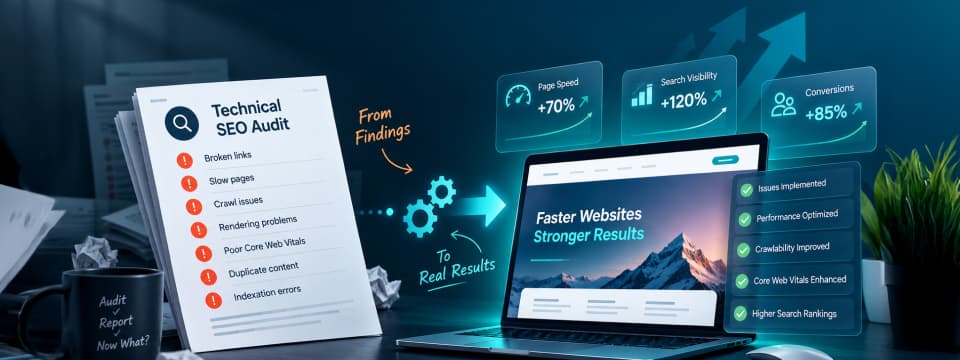
Broken links. Slow pages. Crawl issues. Rendering problems. Poor Core Web Vitals. The list is usually impressive.

The problem?

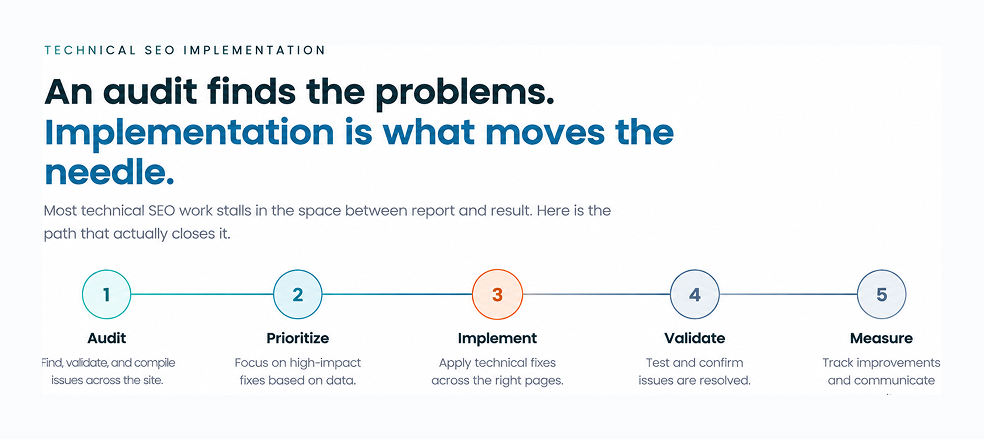
The audit report is often where the journey ends.

For agencies managing SEO, paid campaigns, website redesigns, or digital transformation projects, identifying issues is only one part of the job. Clients do not see business value because they received a 100-page audit document. They see value when those recommendations turn into faster pages, better search visibility, smoother user experiences, and improved conversions.
SEO Implementation Strategy


This is where technical SEO implementation becomes the difference between being another agency delivering recommendations and becoming a partner that helps clients achieve measurable improvements.

The reality is simple: strategy creates direction, but technical execution creates impact.

Why Technical SEO Audits Often Stop Before Results Begin

Most agencies already know how to find problems. Modern SEO platforms can identify hundreds of technical signals within minutes.

But websites are not fixed by exporting a spreadsheet.

A recommendation such as “improve JavaScript rendering” or “optimize Core Web Vitals” sounds simple until someone has to modify code, test changes, validate performance, and ensure nothing breaks.

A typical technical SEO journey looks like this:

Audit Finding What Implementation Requires
Poor core web vitals Performance optimization across code, assets, loading behaviour, and user experience elements
Crawlability issues Reviewing technical configurations, internal linking, sitemaps, and indexing signals
JavaScript rendering challenges Evaluating frontend implementation to ensure important content remains accessible to search engines
Slow page performance Optimizing images, scripts, fonts, caching, and resource delivery
Technical UX issues Improving website interactions, navigation, and conversion-focused experiences


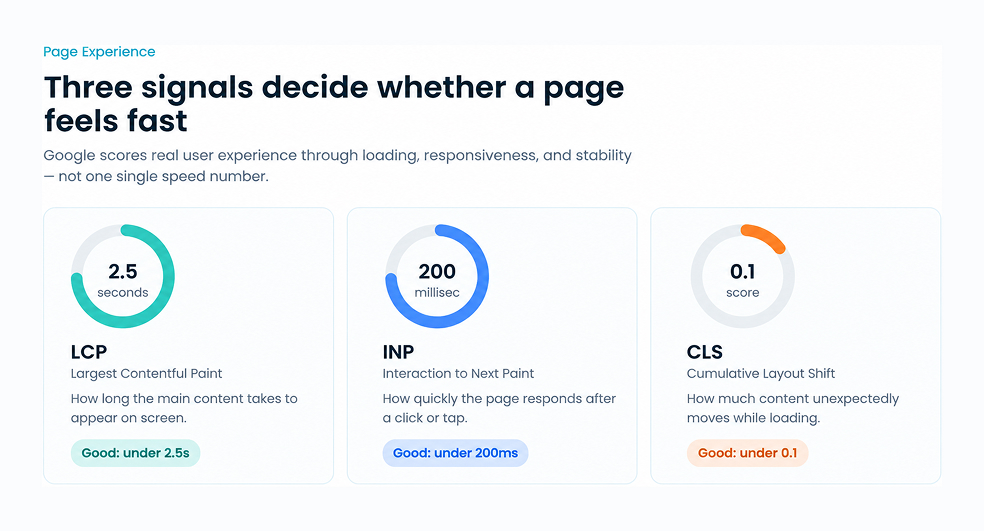
Google defines Core Web Vitals around three real-world user experience areas: loading performance, responsiveness, and visual stability. These are measured through Largest Contentful Paint (LCP), Interaction to Next Paint (INP), and Cumulative Layout Shift (CLS).

For agencies, this creates an opportunity. The value is not only finding technical problems. The value is helping clients move from diagnosis to resolution.

What Technical SEO Implementation Actually Means for Agencies

A technical SEO audit is often where agencies uncover the biggest growth opportunities – but identifying issues is only the beginning. The real value comes when those findings are converted into technical actions that improve how websites are crawled, rendered, experienced, and ultimately discovered through search.

For agencies, technical SEO implementation means bridging the gap between SEO strategy and development execution. It is where recommendations move from spreadsheets and audit reports into actual website improvements that impact rankings, user experience, Core Web Vitals, and conversions.

A successful implementation process combines SEO expertise, development understanding, performance optimization, and increasingly, AI-assisted workflows that help teams prioritize issues faster and make smarter technical decisions.

According to Google, technical elements such as page experience and Core Web Vitals help measure how users experience a website, focusing on loading performance, responsiveness, and visual stability.

For agencies managing multiple client accounts, this shift is important because clients are no longer looking only for insights. They expect execution.

An audit that says “your website has performance issues” creates awareness.

An implementation plan that says “here is what needs to change, who needs to fix it, and how we will measure the impact” creates business value.

Turning SEO Findings Into Actionable Development Tasks

One of the biggest challenges agencies face after completing technical SEO audits is moving from identifying issues to creating a clear execution path.

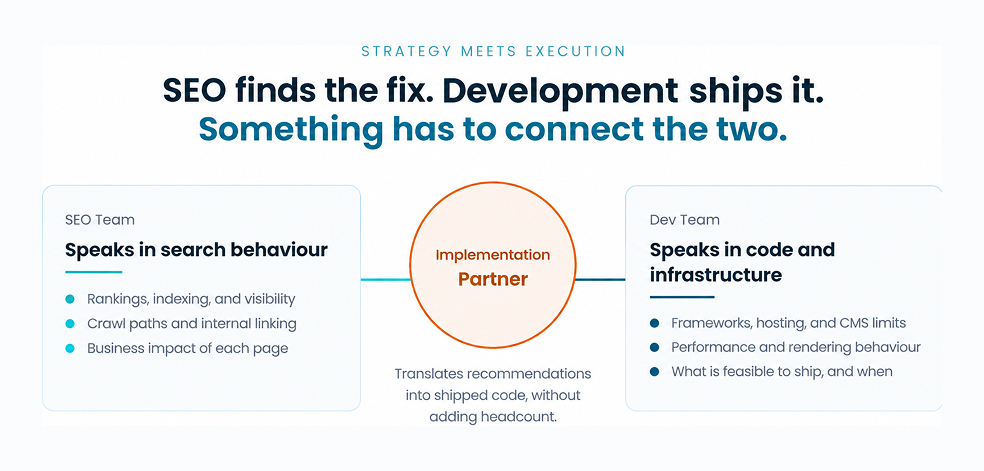
SEO specialists are trained to understand search behaviour, rankings, indexing, and website visibility. Developers think in terms of code quality, frameworks, infrastructure, performance, and technical limitations.

Both perspectives are necessary, but the gap between them can slow down implementation.

A technical SEO recommendation needs more than a problem statement. It needs context around why the issue matters, what part of the website is affected, and what outcome the improvement should achieve.

For example, a performance issue on a high-value landing page should not only be viewed as a technical concern. It should be evaluated based on how it impacts user experience, campaign efficiency, and conversion potential.

This approach helps agencies create better collaboration between SEO teams, developers, designers, and clients.

Converting SEO Recommendations Into Technical Requirements

A successful technical SEO workflow translates strategic recommendations into clear implementation priorities.

Instead of treating an audit as a collection of warnings, agencies should use it as a roadmap for improving the website’s technical foundation.

A strong technical requirement considers:

  • The business importance of the affected page or section.
  • The technical cause behind the issue.
  • The resources required for implementation.
  • The expected impact after completion.

For instance, improving website performance is rarely about one single change. It may involve evaluating page structure, asset delivery, scripts, media files, hosting environment, and frontend behaviour.

Similarly, improving crawlability may require looking beyond isolated errors and understanding how website architecture, internal linking, and content organization influence search engine discovery.

This deeper approach allows agencies to move from technical SEO reporting toward technical SEO implementation services that create measurable improvements.

For AI-driven search experiences, this type of structured problem-solving content is also valuable because AI systems can better understand and surface information that clearly explains challenges, processes, and outcomes.

Prioritizing Fixes Based on Business Impact

A technical SEO audit can uncover hundreds of issues, but agencies should not treat every recommendation with equal importance.

This is where strategic prioritization separates experienced agencies from teams that simply follow automated audit reports.

A website may have dozens of technical warnings, but only a few may have a meaningful impact on search visibility, user experience, or revenue.

Agencies should evaluate technical issues through four business-focused lenses:

Evaluation Area Why It Matters
Search Visibility Issues affecting crawling, indexing, or ranking potential can directly impact organic growth.
User Experience Performance and usability problems can create friction before visitors take action.
Revenue Impact Technical problems on important landing pages can influence leads, sales, and campaign efficiency.
Implementation Complexity Understanding technical effort helps agencies plan realistic delivery timelines.


For example, improving the performance of a service page receiving significant organic or paid traffic is often more valuable than resolving a minor technical warning on a low-priority page. The goal is not to eliminate every warning inside an SEO tool. The goal is to fix the issues that create the greatest business impact.

Creating a Practical Implementation Roadmap

Once agencies identify and prioritize technical opportunities, the next step is creating a roadmap that connects recommendations with execution.

Without a structured plan, technical improvements often compete with other website requests and remain incomplete. A roadmap creates alignment between SEO teams, developers, project managers, and clients.

A practical technical SEO implementation roadmap typically includes three focus areas:

Critical Technical Improvements

The first priority should be issues that directly affect website accessibility and search performance. This includes resolving problems related to:

  • Crawlability
  • Indexation
  • Redirects
  • Website structure
  • Search engine accessibility

These improvements establish the technical foundation required for other SEO efforts to perform effectively.

Performance and User Experience Optimization

After critical issues are addressed, agencies can focus on improving website experience through:

  • Core Web Vitals optimization
  • Page speed improvements
  • Image and font optimization
  • Mobile performance enhancements
  • Resource loading improvements

Google recommends focusing on real user experience rather than only chasing technical scores. A website that performs well for visitors is more likely to create stronger engagement and better overall experiences.

Continuous Technical Optimization With AI-Assisted Workflows

Technical SEO is not a one-time activity because websites continuously change.

New content, design updates, CMS changes, plugins, tracking tools, and marketing integrations can introduce new technical challenges.

This is where AI automation is becoming valuable for agencies. AI-assisted workflows can help teams:

  • Analyze large audit reports faster.
  • Identify recurring technical patterns.
  • Support prioritization.
  • Reduce manual reporting effort.
  • Improve monitoring workflows.

However, AI does not replace technical expertise.

It can help identify potential issues, but agencies still need experienced teams to determine the right implementation approach based on website goals, technology stack, and business priorities. The strongest technical SEO workflows combine automation for efficiency with human expertise for decision-making.

Once agencies understand how technical SEO recommendations are translated into actionable improvements, the next challenge is identifying the specific technical website issues that commonly appear during audits – from crawlability and indexing problems to architecture, rendering, and performance challenges.

The Technical Website Issues Agencies Commonly Discover in Audits

A technical SEO audit often uncovers multiple connected issues affecting search visibility, website performance, and user experience. For agencies, the challenge is not only identifying these problems but understanding which ones require implementation support to create measurable impact.

Crawlability and Indexing Issues That Limit Search Visibility

Search engines need efficient access to website content before pages can rank. Crawlability issues often remain unnoticed because the website works for users but creates barriers for search engines.

Common issues include:

  • Incorrect robots.txt configurations
  • Unintended noindex directives
  • Poor XML sitemap management
  • Orphan pages
  • Weak internal linking

For agencies, resolving crawlability issues means ensuring important pages – such as service, product, or location pages – are discoverable and properly prioritized by search engines.

Key takeaway: A page cannot generate organic visibility if search engines cannot efficiently access it.

Site Architecture Problems That Affect SEO and User Journeys

Website architecture influences both search engines and visitors. As websites grow, poor structure can make important content difficult to discover and weaken internal authority.

Common challenges include:

  • Poor content hierarchy
  • Pages buried too deeply
  • Weak internal connections
  • Complex URL structures

A well-planned architecture helps search engines understand website relationships while guiding users toward relevant information and conversion points.

Key takeaway: Strong architecture connects technical SEO with better user journeys.

Rendering and JavaScript SEO Challenges

Modern websites rely heavily on JavaScript frameworks and dynamic experiences. While these technologies improve functionality, they require careful technical implementation to maintain search accessibility.

Common challenges include:

  • Content loading only after JavaScript execution
  • Heavy scripts affecting performance
  • Search engines receiving incomplete content

Google highlights that JavaScript-heavy websites need proper crawling, rendering, and indexing considerations to ensure content remains accessible.

For agencies working with React, Vue, Angular, or headless CMS platforms, JavaScript SEO becomes an important part of technical delivery.

Key takeaway: Advanced website experiences require equally strong technical SEO planning.

Core Web Vitals and Website Performance Issues

Website performance directly affects how users experience digital experiences and how effectively campaigns convert visitors.

Google measures Core Web Vitals through:

  • LCP: Loading performance
  • INP: Interaction responsiveness
  • CLS: Visual stability

Website Performance Metrics


Google recommends achieving LCP within 2.5 seconds, INP below 200 milliseconds, and CLS below 0.1 for a good user experience. (web.dev)

Common performance issues include:

  • Large images
  • Unoptimized scripts
  • Heavy third-party tools
  • Poor mobile performance

For agencies running SEO or paid campaigns, performance issues can reduce the value of traffic already being generated.

Key takeaway: Website speed is not only a technical metric; it directly influences user experience and conversions.

Technical issues do not stop at rankings. Their impact extends into user behaviour, campaign efficiency, and conversion performance – which makes website performance a business priority, not just an SEO task.

Why Website Performance Issues Affect More Than Rankings

Website performance is often treated as a technical SEO metric, but its impact goes far beyond search visibility. For agencies, a slow or inefficient website can reduce the effectiveness of SEO campaigns, paid advertising efforts, and conversion strategies.

A website is where marketing efforts finally meet the customer. If the experience is slow, unstable, or difficult to use, even high-quality traffic can fail to create business results.

Google’s Core Web Vitals framework focuses on real user experience signals, including loading performance, responsiveness, and visual stability, because technical performance directly influences how users interact with websites.

Performance Challenge What Happens to Users Impact on Agency Campaigns Business Outcome
Slow page loading Visitors wait longer before engaging with content Paid and organic traffic becomes less efficient Lower engagement and missed conversion opportunities
Poor mobile performance Users experience difficulty navigating or interacting Mobile campaigns may underperform Reduced leads and customer actions
Slow interactions Forms, buttons, and key actions feel delayed Landing pages lose effectiveness Lower conversion potential
Layout instability Content shifts while users browse Creates frustration and reduces trust Poorer user experience
Heavy scripts and resources Pages take longer to become usable Marketing tools affect website speed Performance and functionality trade-offs


For agencies, the key consideration is not simply achieving better technical scores. It is ensuring that every technical improvement supports the larger goal – helping visitors find information faster, engage confidently, and complete meaningful actions

Why does website performance matter for SEO? Website performance matters for SEO because it affects user experience, engagement, and how effectively visitors interact with website content after arriving from search or marketing campaigns.

Why Technical SEO Recommendations Often Remain Unimplemented

A technical SEO audit can identify critical website issues, but implementation is where many agency projects slow down. The challenge is not always knowing what needs to be fixed – it is having the technical resources, client alignment, and execution capacity to complete those improvements.

For agencies, unresolved technical recommendations often happen because of a few recurring challenges:

  • The gap between SEO teams and development teams SEO teams identify opportunities around visibility, crawlability, and performance, while developers evaluate technical feasibility and implementation impact. Without proper collaboration, recommendations can remain unclear, delayed, or deprioritized.
  • Limited technical resources for complex requirements Not every agency maintains specialists for advanced technical needs such as JavaScript SEO, Core Web Vitals optimization, CMS-level improvements, or performance engineering. Access to specialized expertise becomes important when client websites require deeper technical involvement.
  • Complex website environments Modern websites often include multiple platforms, integrations, plugins, and frameworks. Implementing technical SEO improvements requires understanding the existing infrastructure, testing changes properly, and ensuring updates do not affect website functionality.

To overcome these challenges, agencies need flexible technical execution support that helps them expand delivery capabilities without increasing permanent operational overhead.

How a Technical SEO Implementation Partner Helps Agencies Scale Delivery

For agencies, technical SEO is no longer limited to identifying website issues. Clients increasingly expect solutions that improve performance, search visibility, and user experience. A technical SEO implementation partner helps agencies extend their delivery capabilities by providing specialized expertise without requiring them to build every technical function internally.
Technical SEO Partnership


This allows agencies to focus on strategy, client relationships, and growth while ensuring complex technical improvements are executed effectively.

  • Extending agency capabilities without additional hiring pressure: Agencies can access technical expertise when project requirements increase without adding permanent overhead. This flexible model helps teams handle complex SEO implementation needs while maintaining operational efficiency.
  • Supporting SEO, performance marketing, web design, and development agencies: Technical implementation support benefits agencies across different disciplines by helping them resolve website performance issues, improve Core Web Vitals, support migrations, optimize technical foundations, and deliver stronger digital experiences.
  • Providing technical resources behind the scenes: A technical SEO partner can work as an extension of the agency team, supporting implementation while allowing the agency to maintain ownership of client communication, strategy, and relationships.
  • Helping agencies deliver complete solutions to clients: By combining strategic expertise with technical execution, agencies can move beyond audit reports and provide end-to-end solutions – from identifying opportunities to implementing improvements that create measurable website outcomes.

A strong technical SEO partnership enables agencies to increase delivery confidence, support more complex projects, and create greater value for clients without expanding internal complexity.

Technical SEO Implementation Checklist for Agencies

A technical SEO checklist helps agencies ensure that audit recommendations are properly reviewed, implemented, and monitored. Instead of only identifying issues, agencies can use this framework to validate whether technical improvements are creating better search visibility, website performance, and user experiences.

Technical SEO Implementation Checklist

☐ Crawlability Review

  • Check robots.txt configuration and ensure important pages are accessible to search engines.
  • Review XML sitemaps, internal linking, and crawl paths to improve content discovery.

☐ Indexation Checks

  • Verify that valuable pages are indexed correctly.
  • Review noindex tags, canonical URLs, and duplicate page signals to prevent visibility issues.

☐ Site Architecture Evaluation

  • Review website hierarchy, navigation structure, and internal linking.
  • Ensure important pages are easy for both users and search engines to discover.

☐ Rendering Assessment

  • Evaluate how search engines access and process website content.
  • Review JavaScript rendering, dynamic content, and frontend implementation challenges.

☐ Core Web Vitals Analysis

  • Measure LCP, INP, and CLS performance.
  • Identify improvements related to loading speed, responsiveness, and visual stability.

☐ Page Speed Optimization

  • Review image sizes, scripts, fonts, caching, and resource loading.
  • Reduce unnecessary elements affecting website performance.

☐ Mobile Performance Review

  • Validate responsive behaviour and mobile usability.
  • Ensure important interactions and content remain accessible across devices.

☐ JavaScript Evaluation

  • Identify scripts affecting rendering, performance, and search accessibility.
  • Balance website functionality with technical efficiency.

☐ Technical UX Assessment

  • Review navigation, interactions, usability barriers, and conversion friction.
  • Ensure technical improvements support better user journeys.

☐ Implementation Tracking

  • Monitor completed fixes and validate technical changes after deployment.
  • Measure improvements through performance data, search visibility, and user behaviour.

A complete technical SEO process does not end with identifying issues. Agencies need a system to track implementation, measure outcomes, and continuously improve website performance.

Conclusion

Technical SEO success is not achieved by finding more issues in an audit. It comes from understanding which problems matter, implementing the right fixes, and measuring whether those improvements create better website experiences.

For agencies, the opportunity lies in moving beyond delivering recommendations and helping clients achieve real outcomes. However, executing technical improvements across different platforms, frameworks, and website environments requires the right expertise and resources.

This is where ZealousWeb helps agencies bridge the gap between SEO strategy and technical execution.

As a white-label technical implementation partner, ZealousWeb supports agencies with the development expertise needed to address complex technical SEO requirements – from Core Web Vitals and website performance optimization to crawlability improvements, rendering challenges, and technical UX enhancements.

Our team works behind the scenes, allowing agencies to maintain ownership of client relationships while expanding their delivery capabilities. Whether an agency needs support for a single technical requirement or ongoing implementation capacity, ZealousWeb helps turn audit findings into measurable website improvements.

The real value of a technical SEO audit is not identifying what is broken.

It is having the capability to fix it.

Review a Client's Technical Opportunity

Client Opportunity Review

FAQs

Related Blog Posts

SEO Performance

How Expert-Led Technical SEO Improves Your Google Rankings and AI Search Visibility

July 15, 2026
AI Search VisibilityGoogle AI OverviewSearch Engine OptimizationTechnical SEO
white label SEO

White-Label Technical SEO: How Agencies Scale Delivery Without Growing Their Team

June 08, 2026
Agency GrowthSEO OutsourcingTechnical SEOwhite-label SEO
technical SEO execution

Technical SEO Services That Turn Audit Recommendations Into Measurable ROI

June 04, 2026
Agency GrowthSEO AuditTechnical SEOwhite-label SEO
SEO Audits for Multi-Specialty Hospitals Guide

How To Ace SEO Audits For Your Multi-Specialty Hospital?

March 13, 2024
Healthcare SEOMulti-Specialty Hospital MarketingSEO Audit Guide
Comprehensive Local SEO Strategies

Top SEO Trends For 2024 To Master Local SEO Strategy

February 27, 2024
Mobile OptimizationMobile SEOSearch Engine Optimization
Local SEO strategies and tips for 2024

Essential Local SEO Strategies For Ranking Locally In 2024

February 13, 2024
Local SEO TipsRanking StrategiesSEO Techniques
The Essence of Multi-Location Local SEO

Level Up Your Local SEO Skills: How To Dominate Across Multiple Locations In 2024

October 03, 2023
Drive CustomersMultiple LocationsPower of Local SEO