

Fraud Blocker
AI Hiring Costs

The Cost of AI Talent for Agencies And Why They’re Turning to White Label AI Partners

October 13, 2026Posted By: Jalpa Gajjar
Agency GrowthAI SEOGEOWhite Label AI Services

SEO agencies are being asked to deliver more than rankings, traffic, and backlinks now.

Clients want to know why competitors are appearing in ChatGPT, how to get cited in Perplexity, whether they are visible in AI Overviews, and what they should be doing about AEO, GEO, and AI SEO.

That sounds like a service opportunity. It is. It can also become an expensive hiring problem very quickly.

Because one “AI SEO hire” rarely covers everything agencies are now being asked to deliver. Technical SEO, structured data, entity optimisation, AI visibility tracking, content strategy, prompt analysis, automation, and LLM citation work often sit across different skill sets.

And in the US, AI talent is not exactly sitting in the bargain aisle.

The bigger question is not whether agencies need these capabilities anymore. It is how many specialists they would actually need to hire to deliver them properly, and what that team really costs once salary stops being the only number on the table.

Is It More Cost-Effective for Agencies to Hire AI SEO Talent or Partner With an AI Agency?

For many agencies, partnering with a specialist white-label AI agency can be more cost-effective than building an in-house AI search team, particularly when client demand spans AI SEO, AEO, GEO, AI Overviews, technical SEO, content optimisation, and LLM visibility.

Why SEO Agencies Need AI Search Capabilities Now

The pressure is coming from clients first.

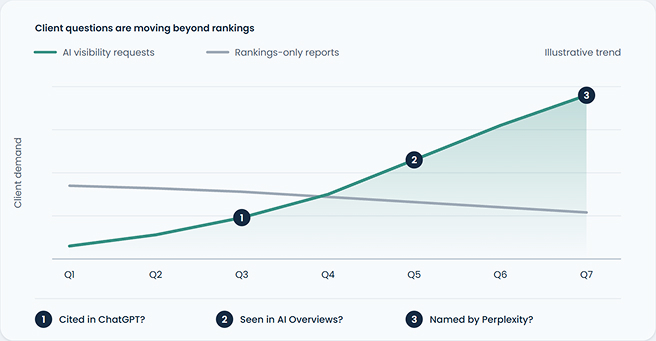
They are no longer asking only, “Are we ranking?” They also want to know why competitors are appearing in ChatGPT, whether their brand is being cited in Perplexity, how visible they are in Google AI Overviews, and what AEO, GEO, AI SEO, and AI automation should actually mean for their business.

That matters because search behaviour is already shifting. A research study found that 65% of US adults at least sometimes see AI summaries in search results, and users clicked traditional search results in only 8% of visits when an AI summary appeared, versus 15% when one did not.
AI Search Visibility

For agencies, that changes what clients expect you to deliver:

  • More than keyword rankings: clients are asking about AI mentions, LLM citations, AI Overviews, conversational queries, long-tail searches, and People Also Ask visibility.
  • More than content production: they want content that can rank, answer clearly, support entity signals, and improve the chances of being surfaced or cited in AI-generated answers.
  • More than monthly SEO reports: they increasingly want to understand where they appear across ChatGPT, Gemini, Perplexity, and Google’s AI experiences, and where competitors are getting the visibility instead.

The awkward part? Clients are already asking these questions whether your agency has officially added “AI search” to the service menu or not.

That is why SEO agencies need the capability now: not because AEO and GEO are fashionable acronyms, but because client expectations are already moving beyond traditional search.

What AI Search Roles Would an Agency Actually Need to Hire?

If clients were only asking for “SEO with a little AI,” one generalist might be enough. That is not really what is happening.

One client wants better visibility in Google AI Overviews. Another wants to know why competitors are being cited in ChatGPT or Perplexity. Another expects AEO, GEO, technical SEO, structured data, long tail content, People Also Ask coverage, AI automation, and reporting to somehow sit under the same monthly scope.

That usually means an agency needs more than one kind of expertise.

  • AI SEO / GEO Specialist: This role focuses on how brands appear across generative search and answer engines. Think AI visibility, entity optimisation, conversational and long tail queries, competitor citation analysis, prompt coverage, and improving the likelihood of being referenced in LLM generated answers.
  • Technical SEO & Structured Data Specialist: AI search still depends on machines being able to crawl, interpret, and connect information correctly. This specialist handles technical SEO, schema, site architecture, indexability, structured data, and the technical signals that support both traditional rankings and AI driven discovery. Current US salary benchmarks put technical SEO specialists at roughly $85,000 to $115,000, depending on experience and market.
  • AI Content Strategist: This person turns search demand into content that can answer real client questions instead of simply feeding another keyword calendar. The role spans topical authority, People Also Ask opportunities, answer first content, entity relationships, long tail queries, and content structured clearly enough to be useful in both search results and AI answers. Current US estimates place AI content strategist pay at about $77,000, with reported estimates ranging from roughly $53,000 to $109,000.
  • AI / Data & Automation Specialist: Once clients expect AI visibility tracking, automated reporting, workflow integrations, API connections, prompt monitoring, and faster execution, someone has to make those systems actually work. Indeed currently reports an average US automation specialist salary of $68,176, while active AI automation roles can reach $100,000 to $130,000.

And that is the reality agencies need to price into the decision: the client may buy one “AI SEO service,” but delivering it properly can require several different skill sets behind the scenes.

Hiring one person and hoping they are brilliant at GEO strategy, technical SEO, content, structured data, analytics, and AI automation is certainly one staffing plan. It is just not a particularly realistic one.

What Does AI and AI SEO Talent Cost in the US Today?

Once an agency decides to build AI search capability internally, the conversation moves quickly from “Which specialist do we need?” to “How many salaries are we actually signing up for?”

There is still no clean global salary category for titles such as GEO Specialist or AI SEO Specialist. The market is moving faster than HR naming conventions. But current SEO, machine learning, and automation salary data gives agencies a realistic benchmark for what relevant talent costs across major hiring markets.

Hiring Markets Approx. SEO / AI Search Talent Cost Approx. AI / ML Talent Cost
United States 157K/year for SEO specialists; average around $82K. 316K/year for machine learning engineers; average around $188K
Canada C90K/year for experienced SEO and search specialists C220K/year for machine learning
United Kingdom £25K-£55K/year for SEO specialists £50K-£100K+/year for AI and machine learning talent
Australia A120K/year for SEO and search specialists A180K+/year for AI and machine learning talent
Singapore S75K/year for SEO specialists S150K+/year for AI, data and machine learning roles
UAE AED 50K-120K/year for SEO and search specialists AED 80K-180K+/year for AI, automation and machine learning talent
India ₹3L-₹10L+/year for experienced SEO specialists; specialised GEO and AI SEO talent can command more ₹6L-₹20L+/year for machine learning and AI engineering roles


Approximate ranges vary by seniority, city, technical depth, and whether the role combines SEO with GEO, AEO, automation, or AI engineering.

And this is exactly where the agency maths gets uncomfortable. A client may buy one AI SEO scope, while delivering it can require talent across search strategy, technical SEO, content, data and automation. So the real hiring cost is rarely the number sitting next to a single job title.

Salary Is Only Part of the Real AI Hiring Cost

A six figure AI SEO salary can already make an agency owner look twice at the spreadsheet. Unfortunately, payroll does not stop at the number written in the offer letter.

In the US private sector, wages and salaries account for about 70% of total employee compensation, while benefits make up the remaining 30%, according to the US Bureau of Labor Statistics. For management and professional roles, employers were paying an average of $54.06 per hour in wages plus another $24.82 per hour across benefits and related compensation costs as of June 2026.

For an agency hiring people to handle AI SEO, AEO, GEO, AI Overviews, LLM citations, technical SEO, data, and automation, the real bill starts stacking up like this:

Cost Layer What Agencies Actually Pay For
Recruitment Job advertising, recruiter fees, interviews, technical assessments, leadership time, and the productivity lost while the position stays open. Specialist AI search talent can also take longer to evaluate because “knows ChatGPT” is not quite the qualification your clients are paying for.
Benefits & Payroll Costs Health insurance, paid leave, retirement contributions, payroll taxes, bonuses, and other employer costs sit on top of salary. BLS data shows benefits represent roughly 30% of private industry compensation in the US.
AI Tools & Subscriptions AI visibility platforms, SEO suites, LLM subscriptions, APIs, crawling tools, reporting software, automation platforms, and data services all become part of the delivery stack. The employee may be hired; the tool bill still arrives separately.
Training & Upscaling AEO, GEO, AI search measurement, prompt analysis, AI automation, and LLM visibility are moving fast. LinkedIn reports that 49% of learning and talent professionals say executives are concerned employees lack the skills needed to execute business strategy, showing how quickly capability gaps can become a business problem.
Management Time Someone still has to manage priorities, review output, connect AI SEO work with client strategy, and make sure automation is improving delivery rather than simply automating the wrong thing faster.
Retention & Replacement When specialist talent leaves, agencies absorb another round of recruitment, onboarding, training, and client knowledge transfer. The replacement cost is rarely just another job posting.


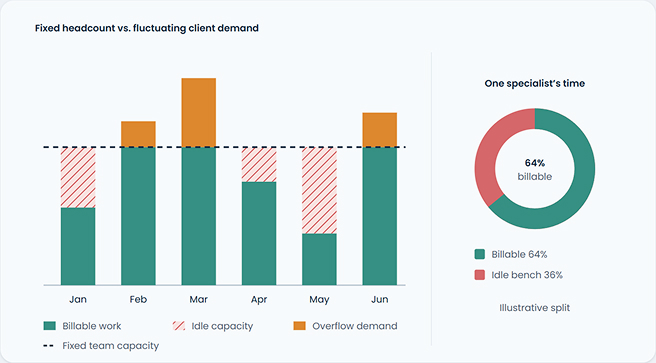
The uncomfortable part is that these costs remain even when client demand does not.

You may hire someone for GEO and AI visibility because three clients suddenly ask for it, only to find that next quarter the demand shifts toward technical SEO, AI automation, or content restructuring for AI Overviews. That is where fixed headcount starts becoming less of a hiring decision and more of a utilisation decision.

In-House AI SEO Team vs. a White Label AI Agency Partner: What Are Agencies Really Paying For?

At first glance, the comparison looks simple: hire people internally or outsource the work. In reality, agencies are comparing fixed headcount against flexible access to multiple capabilities.
In-House vs White-Label

That distinction matters when client demand moves across SEO, AEO, GEO, AI Overviews, LLM citations, technical SEO, content optimisation, and AI visibility tracking. One client may need all of it. Another may need only two pieces. Your payroll, unfortunately, does not scale down with the brief.

Factor In-house AI SEO Team White-label AI Agency Partner
Cost Fixed salaries, benefits, tools, training, and management costs. Pay for the support and capability you need without carrying multiple full-time salaries.
Breadth of Expertise Limited to the people you hire Access specialists across SEO, AEO, GEO, technical SEO, content, and AI visibility.
Scalability More client demands usually means you are hiring Capacity can scale with client accounts and project needs.
Utilization Payroll stays fixed even when demand drops Resources can be used where client demand actually exists.
Speed to Capability Hiring and Onboarding take time Existing expertise can be plugged into delivery faster.
Client Ownership Fully Internal With a white-label model, the agency keeps the client relationship.
Ongoing Learning Your team needs to keep pace with constant AI search changes The partner carries much of that learning and capability burden.


So the comparison is really about how much capability your agency needs, how consistently clients need it, and whether that demand is predictable enough to justify permanent headcount.

How ZealousWeb Helps Agencies Add AI Search Expertise Without High Costs

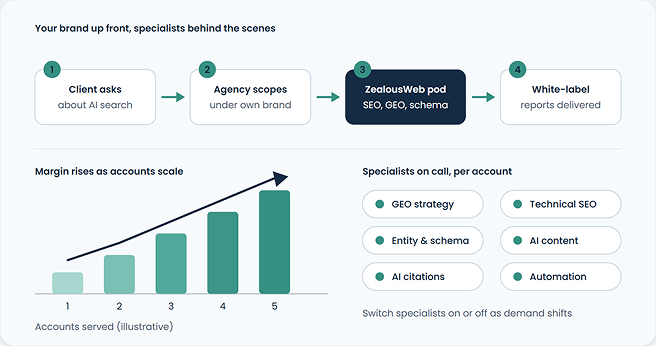
For agencies, the value of a white-label AI partner is simple: add the capabilities clients are asking for without hiring a separate specialist for every requirement. ZealousWeb works behind the scenes while your agency keeps the client relationship, service ownership, and growth conversation.
White-Label AI Services

  • AI SEO, AEO & GEO: Extend traditional SEO into AI Overviews, answer engines, generative search, and LLM visibility without building a new delivery team. BrightEdge reported AI Overviews appearing on roughly 48% of tracked queries, showing how quickly AI-led search is becoming part of everyday visibility.
  • Technical SEO, Schema & Entity Optimisation: Strengthen crawlability, structured data, entity clarity, and answer-ready page structures so client content is easier for search engines and AI systems to understand.
  • AI-Ready Content Optimisation: Restructure service pages, blogs, FAQs, comparisons, People Also Ask content, and long-tail queries around clear answers that can support both rankings and LLM citations.
  • AI Visibility & Competitor Citation Tracking: Show clients where they are mentioned, cited, or missing across ChatGPT, Gemini, Perplexity, and Google AI experiences-adding a new reporting layer beyond rankings and traffic.
  • AI Automation: Automate repetitive research, reporting, prompt monitoring, and workflow tasks where it genuinely improves delivery efficiency rather than simply adding another AI buzzword to the proposal.
  • White-Label Delivery: Agencies can sell AI SEO, AEO, and GEO under their own brand while ZealousWeb supports strategy, technical execution, content, schema, AI visibility tracking, and reporting behind the scenes. ZealousWeb’s white-label model is built around helping agencies expand AI search services without increasing fixed hiring costs.

The advantage is not access to “more services.” It is having the right specialist capability available when each client needs it without putting every capability on your payroll first.

Why Agencies Choose ZealousWeb's White Label AI SEO Services Over a Direct AI Hire

For agencies, the cost advantage goes beyond avoiding another salary. It comes down to billability, profit margins, utilization, and whether delivery costs stay aligned with client revenue.

  • Lower fixed costs: Salaries, benefits, tools, and training stay on payroll whether a specialist is fully billable or not. White-label support keeps more of the cost tied to active client work.
  • Higher billability: A full-time AI hire may not have enough specialized work across every account. With ZealousWeb, agencies can use the right expertise where it can actually be billed.
  • Protect margins: Premium AI talent can quickly eat into retainers when utilization is low. A flexible delivery model helps agencies protect margins without overstaffing ahead of revenue.
  • Scale without payroll spikes: Winning more AI SEO, AEO, or GEO work should grow revenue before it dramatically increases fixed headcount.
  • Hit deadlines faster: Recruiting, onboarding, and ramp-up can take weeks or months. White-label delivery helps agencies respond to new briefs without making clients wait for the hiring plan to catch up.
  • Use specialists as needed: One account may need GEO, another technical SEO, another AI visibility tracking. Agencies avoid paying full-time salaries for every specialization when demand is spread across different accounts.
  • Reduce bench costs: Expensive talent between projects is still expensive talent. A white-label model reduces the risk of carrying underused specialist capacity.
  • Keep delivery profitable: The goal is not simply to spend less. It is to keep delivery costs closer to client revenue, account utilization, and actual profitability.

The commercial advantage is straightforward: more of the cost stays billable, less of it sits idle, and agencies can protect margins while still meeting client deadlines.

Conclusion

AI search is creating a real opportunity for agencies, but the opportunity gets expensive quickly when every new client requirement turns into another specialist hire.

That is where ZealousWeb fits in. Instead of forcing agencies to choose between saying no to AI SEO work or carrying a larger fixed payroll, we help them add SEO, AEO, GEO, technical SEO, AI visibility tracking, content optimization, and white-label delivery behind their own brand.

The value is not simply access to more people. It is being able to keep more of your delivery cost tied to billable work, protect margins, reduce bench risk, and respond faster when client demand shifts.

For agencies, that can mean a much simpler growth model: keep the client relationship, expand the service offering, and bring in the right expertise only when the work requires it.

Your clients. Your brand. ZealousWeb behind the delivery.

Sell AI SEO, AEO, and GEO Under Your Agency Brand.

Book a 30-Min Discovery Call
Book Discovery Call

FAQs

Related Blog Posts

Technical SEO Implementation

Beyond the SEO Audit: How Agencies Can Get Technical Recommendations Implemented

September 16, 2026
Agency SEOSEO ImplementationTechnical SEOWhite Label SEO
SEO Performance

How Expert-Led Technical SEO Improves Your Google Rankings and AI Search Visibility

July 15, 2026
AI Search VisibilityGoogle AI OverviewSearch Engine OptimizationTechnical SEO
white label SEO

White-Label Technical SEO: How Agencies Scale Delivery Without Growing Their Team

June 08, 2026
Agency GrowthSEO OutsourcingTechnical SEOwhite-label SEO
technical SEO execution

Technical SEO Services That Turn Audit Recommendations Into Measurable ROI

June 04, 2026
Agency GrowthSEO AuditTechnical SEOwhite-label SEO
SEO Audits for Multi-Specialty Hospitals Guide

How To Ace SEO Audits For Your Multi-Specialty Hospital?

March 13, 2024
Healthcare SEOMulti-Specialty Hospital MarketingSEO Audit Guide