

AI SEO, Answer Engine Optimization (AEO), Generative Engine Optimization (GEO), and AI search optimization are becoming increasingly important for businesses that want visibility across Google AI Overviews, ChatGPT, Gemini, Perplexity, and other AI-powered search experiences. Search is no longer limited to earning a traditional organic ranking.
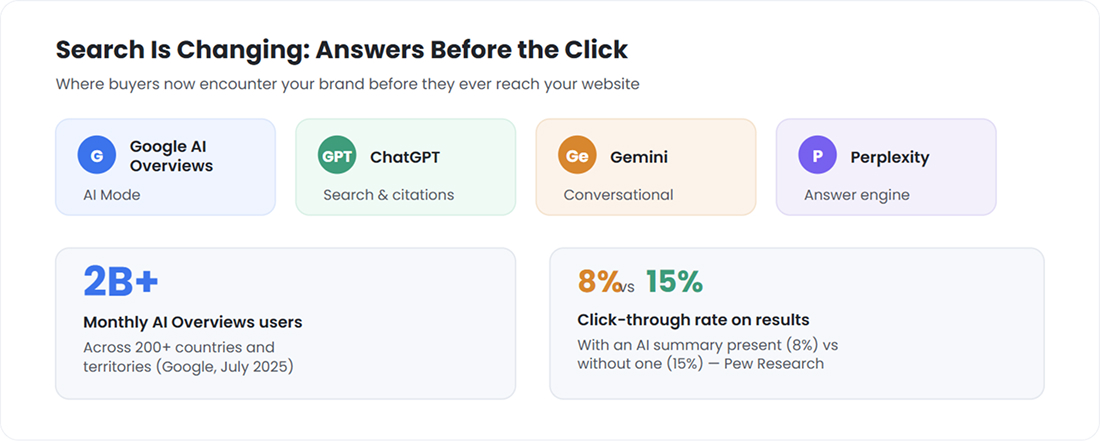
The shift is already significant. Google reported in May 2025 that AI Overviews had reached more than 1.5 billion monthly users across 200 countries and territories. At the same time, research from Pew Research Center found that when a Google AI summary appeared, users clicked a traditional search result in only 8% of visits, compared with 15% when no AI summary appeared .
For businesses, this creates a new visibility question: When potential customers ask AI about your products, services, or industry, does your brand appear, get cited, or get recommended?
This guide explains how AI SEO, AEO, and GEO work together, what businesses should expect to invest, what AI search optimization includes, and how to measure its impact on visibility, leads, and ROI.
What Are AI SEO, AEO & GEO?
AI SEO, AEO, and GEO all aim to improve how easily a business can be discovered across traditional search and AI-powered search experiences. They overlap, but each emphasizes a different part of search visibility.
| Term | What It Means | Main Focus |
| AI SEO | Optimizing content and websites for both traditional and AI-powered search | Broader search visibility |
| AEO | Structuring content so answer engines can extract clear, useful responses | Direct answers and featured responses |
| GEO | Improving the chances of being cited, referenced, or recommended by generative AI systems | AI mentions and citations |
| Traditional SEO | Optimizing websites to rank in organic search results | Rankings, traffic, and clicks |
Traditional SEO remains the foundation because crawlability, content quality, authority, and relevance still influence whether search engines can find and trust your content. AI SEO, AEO, and GEO extend that foundation by helping businesses compete for visibility inside AI-generated answers, summaries, and recommendations.
The goal is no longer only to rank. It is to make your brand easier for both search engines and AI systems to find, understand, trust, and reference.
Why AI Search Visibility Matters for Businesses
A first-page Google ranking is still valuable, but it no longer represents the full picture of search visibility. AI Overviews, ChatGPT, Gemini, and Perplexity can answer research and comparison questions before a buyer reaches a website, making AI citations, brand mentions, and recommendation visibility increasingly important alongside rankings and organic traffic.
Visibility Can Now Happen Without the Click
Google reported that AI Overviews exceeded 2 billion monthly users across more than 200 countries and territories by July 2025. More importantly for businesses, Pew Research Center found that users clicked a traditional Google result in only 8% of visits when an AI summary appeared, compared with 15% when one did not; links within the AI summary itself received clicks in just 1% of visits.
This changes what businesses need to measure. AEO and GEO extend SEO beyond rankings into AI search visibility: whether your brand is mentioned, which pages earn citations, how often competitors appear for high-intent questions, and whether AI-driven discovery contributes to traffic or conversions. AI automation can support this monitoring at scale, but the business objective remains visibility where customers are actually researching.
The commercial question is therefore no longer just “Where do we rank?” It is also “When buyers ask AI about our category, does it find, cite, and consider us?”
How Do AI SEO, AEO & GEO Benefit Businesses?
Search behavior is expanding beyond traditional results pages. Buyers now use AI-powered search to compare providers, understand products, research solutions, and shortlist companies before they ever reach a website. For businesses, this creates a new competitive layer: being visible not only in search rankings, but also in the answers, citations, comparisons, and recommendations AI systems generate during the buying journey.
What Businesses Gain - And What They Risk Missing
| Business Benefits | What Happens Without AI Search Optimization |
| Broader search visibility | The business may rank organically but remain absent from ChatGPT, AI Overviews, Gemini, or Perplexity responses |
| Stronger presence during buyer research | Competitors may become the brands buyers encounter first during comparison and consideration |
| More opportunities for AI citations and mentions | Valuable pages may never be referenced when AI systems answer category-related questions |
| Better coverage of buyer search intent | Conversational, long-tail, comparison, and decision-stage questions may remain unanswered |
| Stronger brand and entity signals | AI platforms may have incomplete or inconsistent information about what the business offers |
| Greater competitive intelligence | Teams may not know which competitors dominate AI citations or which prompts expose visibility gaps |
| Additional referral and assisted discovery | Marketing remains dependent primarily on traditional organic clicks |
| Earlier adaptation to changing search behavior | The business reacts only after traffic, visibility, or competitor positioning has already shifted |
The Business Advantage Goes Beyond Rankings
The commercial value is not simply “ranking in AI.” Effective AI SEO, AEO, and GEO services help businesses increase the number of places where prospects can discover and validate them-from traditional search results and Google AI Overviews to LLM-generated answers and third-party sources that influence those answers.
Without that visibility layer, a business may continue performing well in traditional SEO while competitors gain greater exposure during AI-assisted research. The opportunity is therefore not to replace SEO, but to ensure the brand remains discoverable, understandable, credible, and competitive wherever buyers search next.
How Do Businesses Get Found in ChatGPT, AI Overviews & Other AI Search Engines?
Getting found in ChatGPT, Google AI Overviews, AI Mode, Gemini, Perplexity, and other AI search experiences is not about inserting more GEO or AEO keywords into existing pages. Businesses need a search foundation that helps AI systems discover reliable information, understand what the brand represents, retrieve useful answers, and validate those answers through credible sources.
Crawlability & Indexing Come First
AI systems cannot reliably surface content they cannot access. Google states that pages must be indexed and eligible to appear in Search with a snippet to qualify as supporting links in AI Overviews or AI Mode; there are no additional technical requirements specifically for those AI features.
ChatGPT has a similar discovery requirement. OpenAI advises publishers not to block OAI-SearchBot if they want their content to be discoverable, summarized, cited, and linked in ChatGPT Search.
Businesses should therefore audit robots.txt, indexing directives, JavaScript rendering, canonicalization, internal links, XML sitemaps, and CDN or firewall rules before investing heavily in GEO tactics.
Make Your Business and Expertise Unambiguous
AI search needs to understand who you are, what you offer, who you serve, and why your information is relevant. Keep company, service, product, author, location, and expertise information consistent across important pages and use appropriate structured data such as Organization, Product, or LocalBusiness markup where applicable.
Structured data does not guarantee an AI citation, and Google specifically says there is no special schema required for generative AI search. It should support a wider SEO and entity-clarity strategy rather than become an isolated “AI optimization” tactic.
Build Answer-First Content Around Real Buyer Questions
People are becoming more conversational in search. Google reported in May 2026 that the average AI Mode query was three times the length of a traditional Search query, reflecting more detailed questions around comparisons, recommendations, planning, and decision-making.
Use People Also Ask, related searches, long-tail commercial queries, sales questions, customer-support conversations, and prompt research to identify what buyers genuinely want answered. Then provide the answer early, followed by evidence, examples, comparisons, or data.
That does not mean creating thin pages for every keyword variation. Google’s current guidance explicitly advises against producing separate content simply to capture every long-tail or AI fan-out query.
Build Topical and Third-Party Authority
A website saying it is an expert is not the same as demonstrating expertise. Publish original research, first-hand insights, case studies, expert commentary, useful comparisons, and data that add something competitors cannot easily reproduce.
At the same time, credible reviews, industry publications, expert references, digital PR, and relevant third-party mentions can strengthen the wider information ecosystem around a brand. The objective of GEO should be genuine authority and corroboration, not manufactured mentions created solely to influence LLM-generated answers.
Track AI Visibility, Not Just Rankings
AI visibility should be monitored through brand mentions, citations, cited URLs, prompt visibility, competitor share of voice, AI referral traffic, and conversions. AI automation can help repeatedly test priority prompts and identify where competitors are being recommended or cited instead.
Google rolled its dedicated Generative AI performance reports in Search Console to websites worldwide by August 31, 2026, giving businesses first-party visibility data for AI features such as AI Overviews and AI Mode. OpenAI also adds utm_source=chatgpt.com to ChatGPT referral URLs, allowing inbound ChatGPT Search traffic to be identified in analytics platforms such as Google Analytics.
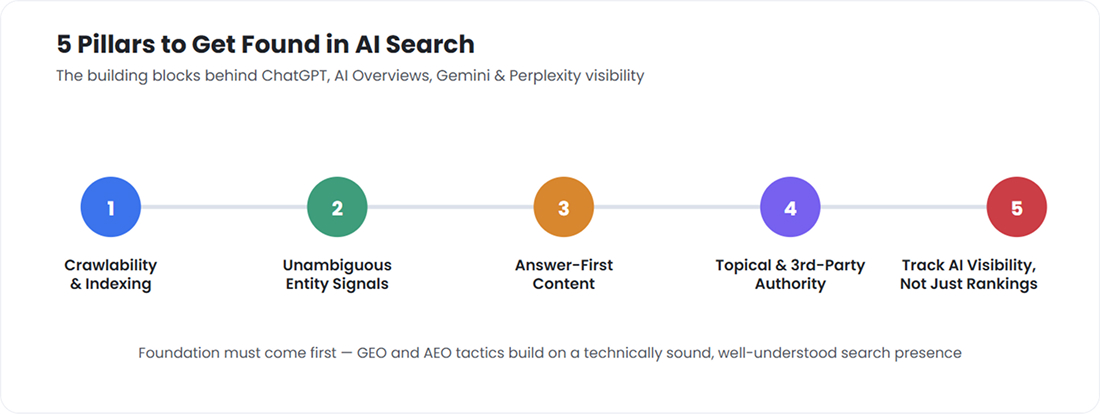
Ultimately, effective AI SEO, AEO, and GEO are less about finding a shortcut into an LLM and more about creating a technically accessible, clearly understood, genuinely authoritative source that AI-powered search systems have a reason to retrieve, reference, and cite.
AI SEO vs Traditional SEO: What Actually Changes?
Search visibility is no longer measured only by where a webpage ranks or how much organic traffic it receives. Businesses now also need to understand whether their brand is being mentioned, cited, compared, or recommended inside AI-generated answers.
This does not make traditional SEO obsolete. Google confirms that its generative AI search features rely on core Search ranking and quality systems, while Ahrefs found that 76.1% of pages cited in Google AI Overviews also ranked in the organic top 10.
What Changes From SEO to AI Search?
| Traditional SEO | AI SEO/AEO/GEO |
| Organic Rankings | Mentions, citations and recommendations |
| Keywords | Search intent, questions, topics and prompts |
| Organic Traffic | Visibility, referrals and assisted discovery |
| Backlinks | Links plus broader authority signals |
| SERP Position | AI share of voice and citation presence |
| Website Optimization | Website plus external-source visibility |
Long-tail searches, People Also Ask, related searches, and conversational queries remain valuable because they reveal what buyers actually want to understand. However, they should guide comprehensive content rather than create separate pages for every keyword variation.
The practical shift is simple: SEO helps establish discoverability and authority, while AEO and GEO extend that foundation into AI Overviews, LLM citations, and conversational search experiences. The objective is not to replace SEO, but to expand where and how a business can be discovered.
How Much Does AI SEO, AEO & GEO Cost?
There is no standard price for improving visibility in ChatGPT, Google AI Overviews, Gemini, Perplexity, and other AI search experiences. The cost depends less on the acronym-SEO, AEO, or GEO-and more on how much work is required to improve a business’s existing search foundation, answer coverage, entity signals, authority, and AI visibility.
Current market benchmarks illustrate the range. WebFX lists SEO for AI search at $2,500-$7,500 per month and separately publishes a GEO service starting at $3,000 per month. These are provider-specific benchmarks rather than universal industry rates, but they show how AI-search optimization is increasingly being commercialized as an ongoing search program.
What Actually Changes The Cost?
| Pricing Factor | Why It Changes the Investment? |
| Website and business size | More pages, products, services, and entities require broader analysis |
| Existing SEO Strength | Weak crawlability, indexing, content, or authority creates foundational work |
| Markets Required | Multi-country and multilingual visibility increases research and optimization scope |
| Search Competition | Competitive categories require deeper content and authority development |
| Content Requirements | Buyer questions, long-tail queries, People Also Ask, and topic gaps may require new or updated assets |
| Technical Requirements | Schema, architecture, internal linking, rendering, and indexability may need development support |
| AI visibility monitoring | Buyer questions, long-tail queries, People Also Ask, and topic gaps may require new or updated assets |
| Technical requirements | Schema, architecture, internal linking, rendering, and indexability may need development support |
| AI visibility monitoring | Tracking prompts, LLM citations, mentions, competitors, and AI share of voice adds ongoing analysis |
| External Authority | Digital PR, credible mentions, reviews, and third-party citation opportunities expand off-site work |
How Are AI Search Engagements Usually Structured?
| Engagement | Typical Business Need |
| AI Visibility Audit | Establish where the brand appears, which competitors are cited, and where visibility gaps exist |
| Optimization Project | Improve priority pages, answer coverage, technical signals, entities, and citation opportunities |
| Ongoing AI Search Program | Continuously optimize content, monitor prompts and AI Overviews, strengthen authority, and measure results |
Does Location Affect AI SEO and GEO Pricing?
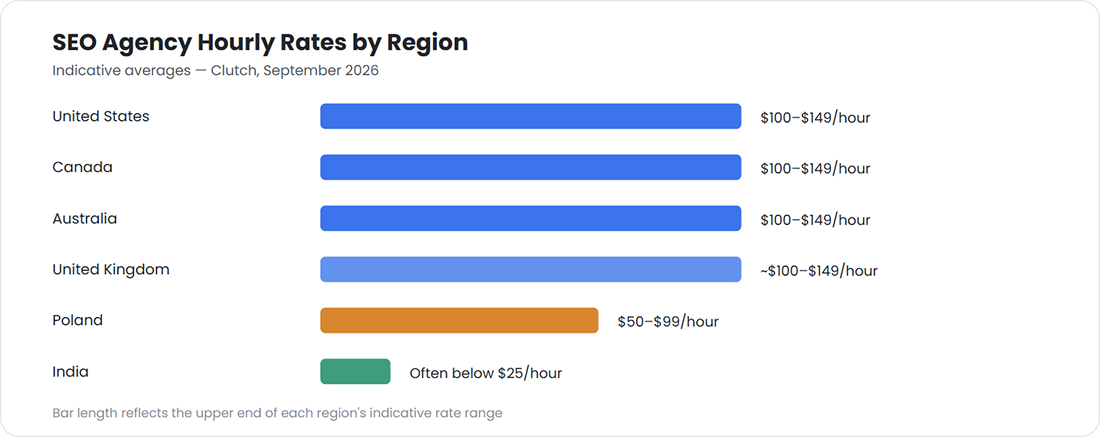
Yes. Provider location can materially affect labor rates, although location alone does not determine expertise. Clutch’s September 2026 pricing data, based on more than 65,000 SEO companies and client reviews, reports that most SEO agencies overall charge $100-$149 per hour, with considerable geographic differences.
| Provider Market | Indicative Avg. SEO Agency Rate |
| United States | $100-$149/hour |
| Canada | $100-$149/hour |
| Australia | $100-$149/hour |
| United Kingdom | Many established listed agencies fall around $100-$149/hour |
| Poland | $50-$99/hour |
| India | Often below $25/hour |

The figures above are SEO agency location benchmarks, not standardized AEO/GEO rates. AI-search programs can cost more when they include specialized prompt research, AI automation, citation tracking, content optimization, technical work, and external authority building. Clutch’s current UK listings, for example, show several established SEO specialists charging $100-$149 or more per hour.
For businesses, the better buying question is therefore not simply “How much does GEO cost?” but “What work is included, which AI-search opportunities are being measured, and how will that investment connect to visibility, leads, and revenue?”
What Should an AI Search Optimization Service Include?
Businesses should not pay for an AI search program that only produces another visibility dashboard. A credible service should identify where the brand is missing from buyer conversations, explain why competitors are being surfaced, and turn those gaps into actions that improve discoverability across search and AI-generated answers.
What Are You Actually Paying For?
| Service Area | What It Delivers For Businesses |
| AI Visibility Baseline | Establish current brand mentions, citations, prompt visibility, and AI share of voice |
| Buyer Query & Prompt Research | Identify high-intent questions, conversational searches, and topics prospects use during research |
| Competitor Citation Analysis | Reveal which competitors and third-party sources AI platforms reference more frequently |
| Content Optimization | Improve priority pages around search intent, long-tail queries, answer-first content, comparisons, and buyer questions |
| Technical & Entity Improvements | Strengthen crawlability, indexability, internal linking, brand/entity clarity, and structured data where appropriate |
| Third-Party Authority Building | Identify credible publications, reviews, industry sources, and external citation opportunities |
| AI Visibility Tracking | Monitor citations, mentions, priority prompts, competitor movement, and AI share of voice over time |
| Business Reporting | Connect AI-search visibility with referral traffic, leads, assisted conversions, and other measurable outcomes |
A strong AI SEO, AEO, and GEO service should therefore move beyond tracking where a business appears. It should turn visibility gaps into clear priorities for content, technical optimization, authority building, and ongoing measurement.
Ultimately, businesses are paying for a structured way to become easier to discover, understand, reference, and trust when potential customers research solutions through traditional and AI-powered search.
How Do You Measure AI Search Visibility & ROI?
AI search performance should be measured across two levels: whether your brand is visible in AI-generated answers and whether that visibility contributes to business outcomes. Rankings and referral traffic still matter, but they do not capture the full influence of AI-assisted discovery.
Google confirms that AI Overviews and AI Mode activity is included in Search Console performance reporting, while OpenAI automatically adds utm_source=chatg
Which AI Search Metrics Should Businesses Track?
| Visibility metrics | Business metrics |
| AI mentioned citations | AI referral traffic |
| Prompt visibility | Qualified leads |
| AI share of voice | Assisted conversions |
| Cited pages | Pipeline influence |
| Competitor visibility | Revenue where attribution is available |
Tracking should also examine which prompts surface the brand, which competitors appear instead, which pages earn citations, and how that visibility changes over time. AI automation can help monitor these patterns consistently across ChatGPT, Gemini, Perplexity, and Google AI search experiences.
The important nuance is that not every AI interaction generates a click. A buyer may discover or validate a brand in an AI answer and convert later through another channel. For that reason, AI search ROI should combine visibility, referrals, assisted conversions, pipeline contribution, and revenue attribution rather than relying on direct traffic alone.
Does Your Business Need AI SEO, AEO or GEO?
You should evaluate AI search optimization if your competitors appear in ChatGPT, Google AI Overviews, Gemini, or Perplexity while your brand does not, or if buyers increasingly use AI tools to research providers and compare solutions.
Other warning signs include declining organic clicks despite stable rankings, AI Overviews dominating important searches, inaccurate brand information appearing in AI-generated answers, or having no way to measure AI mentions, citations, prompt visibility, or share of voice.
In these situations, the issue is not necessarily weak SEO. It may be a growing visibility gap across AI-powered discovery.
If your business is unsure where those gaps exist, start by assessing your current AI search visibility, competitor presence, and citation opportunities before deciding what level of AEO, GEO, or AI SEO support is needed.
Conclusion
AI-powered search is changing how businesses are discovered, compared, and considered. Ranking well on Google still matters, but businesses also need to understand whether they are being surfaced in AI Overviews, ChatGPT, Gemini, Perplexity, and other AI-generated search experiences.
ZealousWeb helps businesses build that visibility through a connected AI SEO, AEO, and GEO strategy-combining technical search readiness, answer-first content, entity optimization, competitor citation analysis, authority building, and AI visibility tracking.
The focus is not simply on chasing AI mentions. It is on helping your business become easier to discover, understand, cite, and trust across both traditional and AI-powered search.
If your competitors are already appearing in AI-generated answers while your brand is missing, ZealousWeb can help identify the visibility gaps and build a practical roadmap to strengthen your presence across the evolving search landscape.
Improve Your AI Search Visibility With ZealousWeb
Get Started
FAQs
Do we need to replace our existing SEO strategy?
Usually, no. We build AEO and GEO on top of a strong SEO foundation, extending your visibility from traditional search rankings into AI Overviews, conversational search, citations, and LLM-generated answers.
Can ZealousWeb work alongside our existing marketing or SEO team?
Yes. Our team can work as a specialist extension of your existing setup, supporting the areas where additional AI search, AEO, GEO, technical, content, or measurement expertise is required.
What happens if our competitors are already appearing in AI answers?
We first identify which prompts, topics, pages, and third-party sources are helping competitors gain visibility. We then prioritize the content, technical, entity, and authority gaps your business can realistically address instead of simply trying to copy competitor activity.
How much do AI SEO, AEO, and GEO services cost?
Pricing depends on your website size, competition, target markets, existing SEO strength, content requirements, and AI visibility goals. We assess the scope first and recommend an engagement based on the work actually required, rather than applying a fixed package to every business.
What exactly will my business be billed for?
Our scope can include AI visibility analysis, prompt and query research, competitor citation analysis, content optimization, technical improvements, entity optimization, authority building, AI citation tracking, and reporting. We define the deliverables and billing structure before the engagement begins.
Can you guarantee that my business will appear in ChatGPT or Google AI Overviews?
No credible provider can guarantee placement or citations in a specific AI-generated answer. We focus on improving the signals businesses can control-technical accessibility, content quality, entity clarity, authority, relevance, and citation opportunities.
How soon can ZealousWeb start working on my AI search visibility?
Once the scope, access, and priorities are finalized, our team establishes the visibility baseline and identifies the highest-priority opportunities. We then create a phased roadmap covering technical, content, authority, and measurement requirements.