



You landed the client. Then another one. Then three more. The pitch deck worked. The referrals came in. The revenue number looked good on paper. And for a moment — maybe a quarter, maybe two — it felt like the agency was finally scaling.
Then something shifted.
Delivery started slipping. The team that once moved fast began dropping balls. Account managers were firefighting instead of growing accounts. You’re hired to fix it. The chaos just got more expensive.
Sound familiar? The frustrating part is — you did everything right. You grew. You hired. You invested in tools. And yet the agency feels harder to run at $3M than it did at $1M. Harder to control at 20 clients than it was at 8. The problem isn’t your team. It isn’t your clients. It isn’t even your market. The problem is something most agency owners never think to fix — until it’s already costing them.
Don't Have a Growth Problem, You Have a Systems Problem
The Hidden Tax of Unsystematic Growth
Most agency owners measure growth by revenue. New clients added. Team size expanded. Services launched. And on the surface, the numbers look right. But underneath every fast-growing agency without a system, there is a parallel ledger that never gets reviewed — one that tracks what growth is actually costing you.
This is the hidden tax. It doesn’t show up as a line item. It shows up as the extra hour you spend re-explaining a brief that should have been templated. The revision round that eats into a fixed-fee project. The client who churns not because the work was bad, but because the experience felt inconsistent. The senior hire who quits six months in because the environment felt too chaotic to do good work.
None of this feels like a financial loss in the moment. But it compounds — quietly, consistently, and faster than your revenue grows.
Here is where most agencies are actually losing margin without realising it:
| Hidden cost areas | What it looks like | What its actually costing |
| Rework & revisions | Briefs misunderstood, outputs redone | 15-25% of billable hours per project |
| Re-onboarding | Every new client starts from scratch | 8–12 hours of unbillable setup per client |
| Scope creep | No clear boundaries | 10–20% margin erosion per retainer |
| Knowledge dependency | One person holds all the context | Single point of failure on every account |
| Reporting rebuilt monthly | No standardised templates or data flow | 4–6 hours wasted per client per month |
| Reactive hiring | Headcount added to solve process problems | Salary cost without output improvement |
| Leadership bottlenecks | Founder approves everything | Decisions delayed, team momentum lost |
The pattern here is consistent. Every row in that table is not a people problem. It is not a talent problem. It is a systems problem dressed up as an operational headache. And the more clients you add without fixing it, the more each one of these costs scales with you. Growth without a system doesn’t just slow you down. It makes every new client more expensive to serve than the last.
Why More Tools Make the Problem Worse
Every agency reaches a point where the answer to chaos feels obvious — get a better tool. And so the stack grows. Monday sits next to Asana. Slack runs alongside email. The dashboard that was supposed to bring clarity now needs its own onboarding doc. But tools don’t create systems. They amplify whatever operating structure already exists. If your process is broken, a better tool gives you a faster, more organised version of broken. The agencies that scale cleanly build the process first and choose tools to support it — not the other way around.
The 3 Ceilings Agencies Hit Before They Break Through
Growth doesn’t stall randomly. It stalls at predictable points — and for predictable reasons. Almost every agency, regardless of niche or size, hits the same three ceilings. Each one feels like a different problem. Each one has the same root cause.
- Ceiling 1: The Delivery Ceiling
Somewhere between 8 and 15 clients, the delivery starts breaking down. Not because the team is incompetent, but because there is no system holding the quality standard. Output depends on who is on the account. Experience varies from client to client. The agency has grown past what founder oversight can cover, but hasn’t built the process infrastructure to replace it.
- Ceiling 2: The Decision Ceiling
Every pricing call, every scope dispute, every strategic question routes back to one person. The team is capable but under-empowered. They wait for approval instead of acting on judgment. The agency moves at the speed of the founder’s availability — which is never fast enough. This doesn’t just slow growth. It exhausts leadership and signals to the team that autonomy isn’t real.
- Ceiling 3: The Margin Ceiling
Revenue is growing. The team is busy. But margins are compressing with every new account. The business looks healthy from the outside and is slowly hollowing out from within. This ceiling is the most dangerous because it arrives without warning — and by the time it’s visible, it’s already expensive.
All three ceilings share the same diagnosis — the agency outgrew its operating structure. And the only way through is to build the system underneath the growth. That is exactly what Part II is about.
The Three Operating Layers Every Agency Needs
Most agencies are built on talent and relationships. A founder who can sell. A team that can deliver. Clients who trust them enough to stay. And for a while, that is enough. But talent and relationships are not a system. They are the raw material. The system is what turns that raw material into something repeatable, scalable, and independent of any single person showing up on their best day.
Every agency that scales without breaking does so by building three operating layers — not simultaneously, but deliberately. Each layer solves a different problem. Together, they form the infrastructure that makes calm growth possible.
Image content:
Building Your Execution System
The execution system governs how work gets done — from the moment a brief arrives to the moment output is delivered. Most agencies have pieces of this in place but pieces are not a system. A real execution system means:
- Every project follows a defined path, not a person’s memory
- Briefs are structured, ownership is assigned, quality gates exist before work reaches the client
- White-label delivery runs to the same standard as in-house work
- The output doesn’t vary based on who is managing the account that week
When the execution system works, the agency stops firefighting. Margins improve because rework drops. The team operates with clarity — because the system holds the standard, not the person.
Building Your Intelligence System
The intelligence system turns data into decisions — not just client-facing reporting, but internal operating insight. Most agencies are flying partially blind. They find out a retainer is unprofitable six months after signing it. They discover a delivery bottleneck when a deadline is missed, not before. An intelligence system changes this by giving leaders:
- Visibility into which accounts are profitable and which are silently draining margin
- Early signals on delivery risk before a client escalates
- Capacity and pipeline data that reflects reality, not optimism
- A single operating picture that connects performance, delivery, and financials
AI and automation are not an intelligence system. They are inputs into it. The system is the structure that makes the data usable.
Building Your Leadership System
The leadership system determines how decisions get made and how the agency moves without everything routing through the founder. Most agency leadership is informal — the founder sets the tone, senior hires absorb it, everyone else figures it out. This works at ten people. It breaks at twenty. A leadership system replaces heroics with structure by:
- Defining who owns what decisions, at what level, and with what information
- Creating an operating rhythm that keeps the team aligned without constant intervention
- Turning the founder from the person holding everything together into the person setting the direction
- Making the agency less dependent on any single person — including the founder
These three systems — execution, intelligence, and leadership — are not separate projects to tackle one day. They are the operating infrastructure that sits underneath everything the agency does. Without them, growth is just more weight on a structure that was never built to hold it.
What Calm, Scalable Execution Actually Looks Like
Most agencies associate scaling with speed — more output, more clients, more revenue, moving faster. But the agencies that actually sustain growth associate scaling with calm. Not the absence of challenge, but the presence of structure that makes challenges manageable. Calm is not a personality trait. It is what happens when the operating systems are working.
The White-Label Delivery Blueprint
White-label delivery is where most agency growth strategies either gain traction or quietly fall apart. The model makes sense on paper — extend capacity, protect margins, serve more clients without proportional headcount growth. But without a delivery blueprint, white-label partnerships create more complexity than they solve.
A white-label delivery blueprint means:
- Scoping is standardized, so every engagement starts with shared clarity, not assumption
- Onboarding is structured so external partners produce to your quality standard from day one
- QA gates exist at defined checkpoints, not just at final delivery
- Handoff protocols protect the client experience regardless of who did the work
- Output is client-ready, brand-consistent, and traceable back to a repeatable process
The goal is simple — the client should never be able to tell where in-house ends and white-label begins. That consistency is not achieved through oversight. It is achieved through a system.
Turning Data Into Operating Clarity
Data is only useful when it tells you something you can act on. Most agencies have more data than they know what to do with — campaign reports, delivery trackers, financial summaries, utilization sheets — all living in separate places, owned by separate people, reviewed at separate times. The result is not clarity. It is organized noise.
Turning data into operating clarity means:
- Connecting performance data, delivery data, and financial data into one operating view
- Knowing in real time which clients are profitable, which are at risk, and which are scaling
- Identifying delivery bottlenecks before they become client escalations
- Making capacity and hiring decisions based on actual numbers, not gut feel
- Reviewing the right metrics at the right cadence — weekly for operations, monthly for health, quarterly for direction
When data flows into decisions instead of into reports, the agency stops reacting and starts leading.
Systemizing Client Retention
Retention is treated as a relationship problem in most agencies. Keep the client happy, stay close, deliver good work, and they will stay. And while relationships matter, they are not a retention system. Relationships are what clients remember. Systems are what keep them.
A client retention system means:
- Structured review cadences that surface value before the client goes looking for it elsewhere
- Escalation paths that catch dissatisfaction early, not at renewal
- Value delivery signals built into every reporting cycle — not just results, but progress against the client’s actual business goals
- Expansion conversations that happen as part of the operating rhythm, not as a reactive save
- Offboarding protocols that protect the relationship even when a client leaves
Retention built on systems outlasts retention built on relationships. People change. Processes don’t.
Operating Patterns From Agencies That Crossed the Chaos Threshold
There is a version of every agency that exists on the other side of the chaos threshold. Not perfect. Not without problems. But operating with a rhythm that makes growth feel manageable instead of threatening. The agencies that get there don’t stumble into it — they make a deliberate decision to stop patching the operation and start building it.
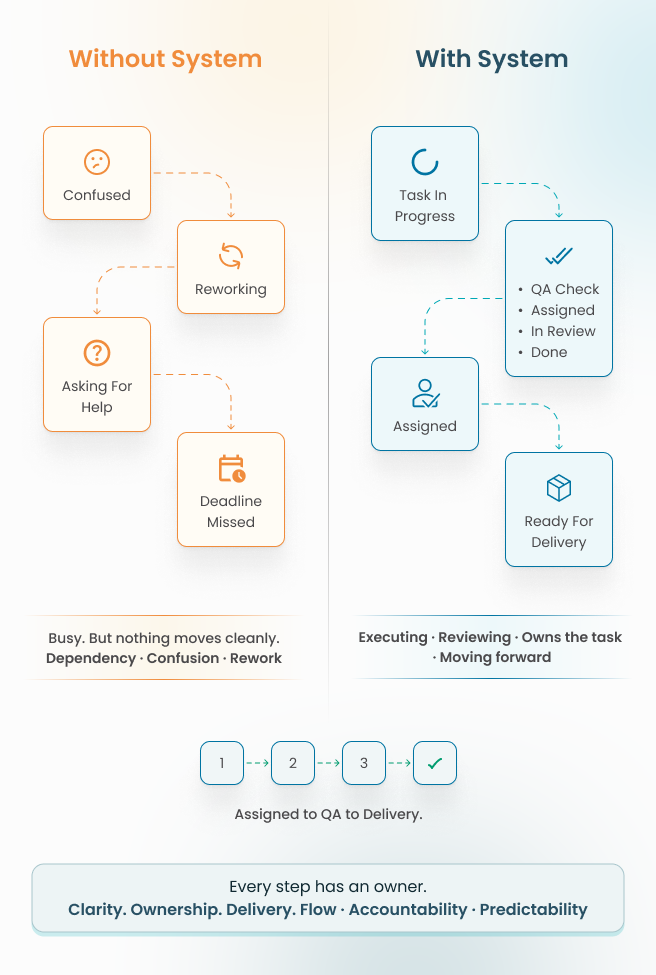
From Reactive to Rhythmic
A reactive agency is always responding to client requests, delivery gaps, team confusion, and the crisis that wasn’t there last night. Everything feels urgent because nothing has a defined place in the operating structure. The shift from reactive to rhythmic happens when agencies commit to:
- A defined operating cadence that replaces ad hoc communication with structured alignment
- Ownership clarity at every level, so problems are resolved by the right person, not escalated to the loudest voice
- Documented processes that hold the standard when the best people are unavailable or gone
- Proactive client communication is built into the delivery rhythm, not triggered by something going wrong
The difference between a reactive agency and a rhythmic one is not talent or intention. It is the presence of a structure that the team can trust.
The SaaS–Agency Partnership Model
SaaS platforms between Seed and Series B consistently face the same problem — they need agency-level execution but aren’t ready to build those functions in-house. Hiring a full team is too slow. Freelancers are too inconsistent. The traditional agency model is too rigid. The partnership model works when:
- The agency embeds into the platform’s operating rhythm rather than working at arm’s length
- Delivery is structured around the platform’s growth stage, not a fixed retainer scope
- Reporting connects to business metrics — activation, retention, revenue — not just campaign performance
- The engagement scales with the platform’s needs without requiring a new contract every time
For SaaS platforms, this removes the build-vs-buy dilemma entirely. For agencies, it creates long-term partnerships that compound in value in a way that project-based work never does.
From Insight to Action: Your Next Operating Move
Reading about systems is the easy part. Most agency owners can diagnose the problem clearly — they have been living inside it long enough. The harder part is knowing where to start when the operation is already running at full capacity, and there is no obvious window to stop and rebuild.
This section is about closing that gap between knowing and doing.
Audit Your Own Operating System
Before building anything, you need to know exactly where the gaps are. Not where they feel like they are — where they actually are. Most agencies assume their biggest problem is delivery when it is actually decision-making. Or they focus on hiring when the real issue is that there is no process for the new hire to plug into.
An honest operating audit looks at three things:
- Execution — Does your delivery produce consistent output regardless of who is on the account? Do you have documented processes, QA checkpoints, and onboarding standards that work without you?
- Intelligence — Can you see in real time which clients are profitable, which are at risk, and where delivery is breaking? Or are you finding out after the fact?
- Leadership — Are decisions being made at the right level by the right people? Or does everything still route back to the founder?
The answers will tell you which layer to fix first. Most agencies need to start with execution — because without a stable delivery foundation, better data and clearer leadership have nothing reliable to operate on.
What an Operating System Partner Actually Does
An operating system partner is not a vendor. Not a task executor. Not an outsourced team you manage from a distance. It is a partner that comes in at the system level — helping design, build, and run the operating infrastructure that the agency needs to scale without breaking.
In practice, that means:
- Designing the execution layer — SOPs, delivery frameworks, QA systems, and white-label infrastructure that runs to a consistent standard
- Building the intelligence layer — connecting data across performance, delivery, and financials so leadership has real visibility, not lagging reports
- Strengthening the leadership layer — creating the decision frameworks, operating rhythms, and clarity structures that let the agency move without the founder in every conversation
The right partner doesn’t create dependency. They build capability. The goal is an agency that runs better because the systems are in place — not because the partner is always in the room.
Conclusion
Scaling without a system has a price. It shows up in the margins that quietly compress with every new client. In the senior hire who leaves because the environment is too chaotic. In the retainer that churns not because the work was bad, but because the experience was inconsistent. None of it looks like a crisis in the moment. All of it adds up to an agency that is working harder and growing slower than it should be.
The delivery ceiling, the decision bottleneck, the tool overload — these are not isolated problems. They are the compounding cost of an agency that outgrew its operating infrastructure without replacing it. The fix is not another hire or another platform. It is a system — one that holds the standard, distributes decisions, and gives leadership the clarity to move with confidence.
The agencies that scale without breaking made one deliberate decision — to build the operating layer underneath the work before the cost of not having it became too high to ignore. Some build it internally. Others bring in a partner that operates at the system level, not the task level. ZealousWeb exists for exactly that moment.
The operating system your agency needs already has a blueprint. This was it.
Turn Rising Delivery Costs into Controlled Execution
Explore What’s Driving the Gap
FAQs
How do we know if a white-label agency will maintain our quality standards with our clients?
Quality consistency starts before the first deliverable. At ZealousWeb, every engagement begins with a structured onboarding process that aligns on your brand standards, output expectations, and QA checkpoints — so what reaches your client looks and feels like your work, every time.
Will our clients know we are using a white-label partner?
No. ZealousWeb operates fully under your brand — no footprints, no separate communication, no attribution. Your client relationship stays yours. We stay invisible by design.
How quickly can a white-label partner get up to speed on our existing accounts?
With the right onboarding structure, faster than most agencies expect. ZealousWeb uses a defined account intake process that captures client context, preferences, and delivery history upfront — reducing the ramp time significantly and eliminating the re-briefing loops that slow most handoffs down.
What happens if the quality of white-label output doesn't meet our expectations?
There are QA gates built into every delivery cycle — not just at the end. Issues are caught internally before work reaches you. If something doesn't meet the mark, it gets resolved before it becomes your problem.
How do we manage communication and accountability across an external delivery partner?
Through a structured operating rhythm — not ad hoc check-ins. ZealousWeb integrates into your existing workflows with clear ownership, defined escalation paths, and regular delivery reviews so nothing falls through the gap between your team and ours.
Can a white-label partner scale with us as our client base grows?
Yes — and that flexibility is exactly what makes the model work. ZealousWeb is built to scale alongside your agency, adding capacity where you need it without the hiring risk, onboarding lag, or fixed overhead that comes with growing an in-house team.
How is working with ZealousWeb different from hiring a typical outsourcing agency?
Most outsourcing relationships are transactional — you send work, they deliver output. ZealousWeb operates as a system-level partner. We don't just execute tasks. We help build the delivery infrastructure, quality standards, and operating structure that make your agency scalable — so the value compounds over time, not just per project.