

AI has compressed timelines, automated reporting, and handed operators more data than any previous generation ever had access to. By every measure, the infrastructure for scalable growth has never been more accessible. And yet — agencies are still missing deadlines, SaaS teams are drowning in tools they can’t operationalize, and founders are still firefighting instead of building. The technology has advanced. The struggle didn’t. Which raises one question worth asking: if the tools are better than ever, why are so many smart operators still stuck? To understand where the real breakdown happens, let’s look at it through an example. A mid-sized performance agency — 40+ clients, a sharp team, and a tech stack most operators would envy — was running Asana, HubSpot, an AI reporting layer, and a white-label delivery partner. Every tool was in place. And yet the operation was fracturing quietly — deadline by deadline, client by client. What they had built was not a system. It was a collection of tools held together by human effort and good intentions.
And that distinction — between a tool stack and an operating system — is the exact fault line where most agencies and SaaS teams stop scaling and start surviving. This piece is a framework for understanding why execution, data, and decisions must function as one integrated system — and what it takes to build that architecture deliberately.
The Real Problem Isn't Tools
Most agencies and SaaS teams aren’t under-tooled. They’re under-systemed.
There is a pattern that shows up consistently across agencies and SaaS teams operating at growth stage. They have invested heavily in the right tools — project management, CRM, analytics, automation, AI layers. Their team is capable. Their clients are real. Their revenue is moving. And yet, something keeps breaking. Delivery slips. Reporting lags. Decisions get delayed because nobody is quite sure which number to trust. The instinct is always the same: add another tool, hire another person, run another process audit. But the problem was never the tools. The problem is that the tools were never connected to a system.
The Distinction That Changes Everything
A tool solves a task. A system solves a pattern. When you adopt a project management platform, you solve task visibility — for that moment, for that team. But when delivery breaks at scale, it’s rarely because the tool failed. It’s because there was no architecture defining how execution feeds into data, how data informs decisions, and how decisions loop back to upgrade execution. That architecture — the connective tissue between doing, knowing, and deciding — is what separates teams that scale calmly from teams that scale chaotically.
| What Teams Invest In | What Teams Actually Need | What Breaks Without It |
| Project management tools | Delivery architectures | Timelines, accountability, client trust |
| AI writing & content tools | Intelligence layer with decision logic | Reactive reporting, inconsistent output quality |
| CRM & sales automation | Revenue operation systems | Pipeline visibility, forecasting accuracy |
| Analytics dashboards | Data -> decision feedback loop | Strategy based on gut, not signal |
| Automation workflows | Cross-functional process ownership | Workflows that solve tasks but break at handoffs |
| Outsourcing partners | White-label execution system | Delivery quality, brand consistency at scale |
| Weekly team meetings | Leadership decision framework | Firefighting disguised as alignment |
Why Most Teams Stay Stuck at the Tool Layer
The tool layer is comfortable. Tools are purchasable, demonstrable, and easy to justify in a board meeting. Systems, on the other hand, require something harder — deliberate design, cross-functional ownership, and the discipline to ask: does this connect to everything else, or does it just solve its own isolated problem? Most teams never ask that question. Not because they lack intelligence, but because the pressure to deliver never creates the space to architect. So they keep adding tools to a foundation that was never designed to hold them — and wonder why growth feels heavier the further they go.
The Shift That Unlocks Scale
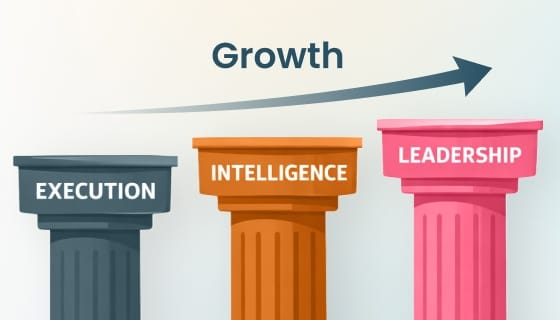
Scalable growth doesn’t come from having better tools. It comes from building an operating system — one where execution, intelligence, and leadership decisions function as one integrated layer, not three separate departments running in parallel. That is the framework this piece is built around. And it starts by understanding the three layers every scalable operation runs on.
The Three Layers Every Scalable Operation Runs On
Every scalable operation — regardless of size, model, or market — runs on three fundamental layers. Not three departments. Not three software categories. Three interdependent systems that must function as one coherent architecture. When they do, growth compounds. When they don’t, growth creates friction — and friction, at scale, becomes chaos.
The Three Layers
- Layer 1 — Execution Systems: This is where work happens. Delivery, quality, velocity, ownership — the operational engine that determines whether what was promised gets built, shipped, and maintained at standard. Most teams have execution. Very few have an execution system — one with defined architecture, clear ownership, and the structural capacity to absorb growth without breaking.
- Layer 2 — Intelligence Systems: This is where signals become decisions. Data, AI, automation, reporting — the layer that transforms operational activity into actionable insight. Most teams have dashboards. Very few have an intelligence system — one where data flows continuously, AI reduces noise rather than adding to it, and every metric connects directly to a decision that matters.
- Layer 3 — Leadership Systems: This is where decisions get made — consistently, clearly, and without constant escalation. Frameworks, priorities, decision rights, value creation logic — the layer that determines whether leadership is building the business or managing its symptoms. Most founders make decisions. Very few operate from a leadership system — one that creates compounding clarity instead of compounding complexity.
Why They Must Function as One
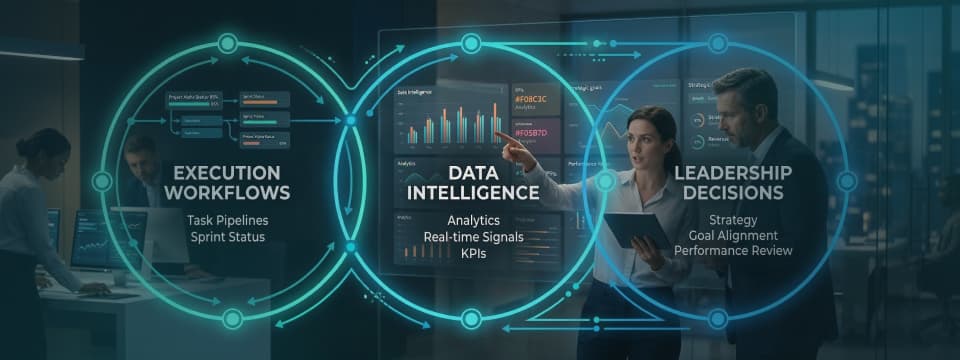
Here is where most frameworks stop — at the list. Three layers, three boxes, three teams assigned. But the architecture only works when the layers are integrated, not parallel. Execution without Intelligence means teams are working hard in the wrong direction. Intelligence without Leadership means data gets reviewed but never acted on. Leadership without Execution means decisions get made with no operational system capable of carrying them out. The breakdown is rarely within a single layer. It is always at the seams — the handoffs between doing, knowing, and deciding.
Think of it as a feedback loop, not a hierarchy. Execution feeds Intelligence with real operational data. Intelligence sharpens Leadership with clear, trustworthy signals. Leadership upgrades Execution with better decisions, tighter priorities, and a clearer operating model. Each layer improves the next. Each layer depends on the previous. Remove one, and the loop breaks. The following three sections go deep into each layer — what it looks like when it works, what it looks like when it doesn’t, and what it takes to build it deliberately.
What Each Layer Makes Possible
Each layer in a scalable operating system doesn’t just perform a function — it creates the conditions for the next layer to operate at a higher standard. This is not a linear process. It is a compounding one. Execution consistency gives Intelligence something reliable to measure. Intelligence clarity gives Leadership something trustworthy to decide from. Leadership precision gives Execution the direction it needs to deliver at standard. The moment any one layer operates below standard, the entire system compensates — and compensation, over time, is what exhaustion looks like at an organizational level.
| Layer | When it works | It unlocks |
| Execution system | Delivery is consistent, ownership is clear, capacity scales without breaking | Reliable data that Intelligence can actually trust and act on |
| Intelligence system | Data flows in real time, AI reduces noise, every metric connects to a decision | Leadership that decides with confidence instead of assumption |
| Leadership systems | Decisions are clear, priorities are set, value creation drives the agenda | An execution engine that knows exactly what to build and why |
The compounding effect here is intentional. A team with strong execution but weak intelligence is working hard without knowing if it’s working right. A team with strong intelligence but weak leadership is drowning in insight it never converts into direction. A team with strong leadership but weak execution is making excellent decisions that never fully land. The goal is not to perfect each layer independently. The goal is to build the connective tissue between them — so that strength in one layer actively elevates the others.
The Role Each Layer Plays in Scalable Growth
Scalable growth doesn’t break because a team lacks ambition or capability. It breaks because the layers responsible for sustaining that growth don’t know their job — or worse, are doing each other’s job to compensate. Every layer in an integrated operating system carries a distinct responsibility. When each one owns its role completely, the system runs. When one layer bleeds into another, the system strains.
Execution Holds the Integrity of Everything Promised
Execution is not just delivery. It is the organizational commitment to doing what was agreed, at the quality that was set, within the timeline that was defined — repeatedly, at scale, without requiring heroics. Its role in scalable growth is to create the one thing every growing operation desperately needs but rarely has: predictability. When execution operates as a system, it delivers:
- Consistent output that clients can rely on without micromanagement
- Operational data that Intelligence can actually trust and measure
- Delivery capacity that absorbs growth without breaking at the seams
- Clear ownership models that remove the founder from every critical path
Intelligence Drives the Confidence to Decide
Data without a decision layer is just overhead. The role of Intelligence in a scalable system is not to report what happened — it is to surface what it means and what should happen next. When the intelligence layer is functioning correctly, leadership is never surprised by a number. Trends are visible before they become problems. AI is not being used to generate content or automate tasks in isolation — it is operating as a signal filter that actively reduces noise between what is happening and what actually requires a decision. A functioning intelligence layer produces:
- Real-time visibility into delivery performance and client health
- AI-driven signal filtering that separates noise from decisions
- Dashboards that connect every metric to a specific action or owner
- Automated reporting that frees senior capacity for strategic thinking
Leadership Creates the Conditions for Calm Growth
The role of leadership in a scalable system is not to solve problems. It is to design an environment where problems are solved at the right level, by the right people, with the right information. When leadership operates as a system — with clear decision frameworks, defined priorities, and value creation as the north star — the organization stops escalating everything upward. Founders stop firefighting. Teams stop waiting for direction. Growth stops feeling like pressure and starts functioning like a process. A leadership system in practice looks like:
- Decision frameworks that remove ambiguity from recurring choices
- Priority structures that protect senior bandwidth for high-value work
- Value creation metrics that replace activity-based performance measures
- A compounding clarity that gets stronger — not harder — as the team scales
When every layer knows its role — and plays it without bleeding into the next — the operating system stops being something you manage and starts being something that works for you. That is the foundation on which scalable growth is built. And it is exactly where most teams discover the gaps they never knew were costing them.
The Business Advantages of Running All Three Layers as One System
There is a compounding effect that happens when execution, intelligence, and leadership stop operating as separate functions and start functioning as one integrated system. It doesn’t announce itself dramatically. It shows up quietly — in fewer escalations, in cleaner client conversations, in leadership that finally has the bandwidth to think forward instead of backward. The advantage is not in any single layer. It is in the architecture that connects them.
Delivery Becomes a Competitive Advantage
When execution runs as a system, delivery stops being a source of anxiety and becomes a point of differentiation. Agencies that operate with structured delivery architecture — clear ownership, defined QA layers, scalable white-label capacity — don’t just meet deadlines. They build the kind of operational reliability that retains clients without constant relationship management. The business advantage here is direct:
- Client retention increases because predictability builds trust faster than quality alone
- Senior capacity is freed from delivery oversight and redirected toward growth
- White-label operations scale without the founder becoming the quality control layer
- New client onboarding accelerates because the delivery system already knows how to absorb it
Decision-Making Stops Being a Bottleneck
When intelligence operates as a system, decisions stop waiting on data. The business no longer runs on gut feel dressed up as strategy. Leaders at every level have access to the right signals at the right time — and the confidence to act on them without escalating upward. For agencies and SaaS teams, this translates directly into:
- Faster client reporting cycles that strengthen account relationships
- AI-driven insights that surface retention risks before they become churn
- Automation that eliminates low-value analytical work and compounds senior thinking time
- A data culture where every team member understands which numbers drive which decisions
Leadership Bandwidth Compounds Over Time
When leadership operates as a system, the most valuable resource in any growing business — the founder’s or operator’s focused attention — stops being consumed by firefighting and starts being invested in value creation. This is where the compounding advantage becomes most visible. Teams that build leadership systems don’t just make better decisions today. They build an organizational capacity to make better decisions consistently, at every stage of growth:
- Decision frameworks reduce the cognitive load of recurring choices
- Defined priorities protect leadership from being pulled into execution-level problems
- Value creation metrics replace activity metrics — shifting the entire culture from busy to effective
- Clarity compounds: the cleaner the leadership system, the faster the organization moves beneath it
The Integrated Advantage
Individually, each of these benefits is meaningful. Together, they create something most agencies and SaaS teams spend years chasing but rarely name correctly: operational leverage. The ability to grow revenue, expand capacity, and increase client value — without a proportional increase in complexity, cost, or founder involvement. That is what an integrated operating system produces. Not just efficiency. Not just better tools. A fundamentally different relationship between effort and outcome.
The difference between a tool stack and an operating system is not sophistication. It is intentionality — and the compounding returns that intentionality produces over time. Most teams don’t lack the ambition to build this. They lack the model. The next section is the model.
The Partner That Becomes Part of Your System
Most agency partnerships add capacity. A team absorbs the overflow, delivers the work, and hands it back. What they rarely add is architecture — the kind that makes your entire operation more coherent, not just less overloaded. ZealousWeb is built around a different premise. The value isn’t just in the work delivered — it’s in how that work is delivered: through structured execution systems, clear ownership models, and an operational discipline that integrates with the way your business already runs. When your execution layer is handled by a partner who thinks in systems, it doesn’t just free your team’s capacity. It strengthens the intelligence your business runs on and sharpens the decisions your leadership makes. That is the distinction between a partner that fulfills and a partner that elevates — and for agencies and SaaS teams serious about scaling without chaos, that distinction is everything.
Conclusion
The agencies and SaaS teams that scale without chaos don’t have better tools than everyone else. They have better architecture. They have made a deliberate decision to stop treating execution, intelligence, and leadership as three separate concerns — and start building them as one integrated system. That shift doesn’t happen overnight. It happens decision by decision, layer by layer, until the business stops running on human effort and good intentions and starts running on something more durable: a functioning operating system. The tools were never the problem. They were never going to be the solution either. The operating system is. And the teams that build it — intentionally, structurally, with the right partners — are the ones that wake up on a Tuesday morning and find that the standup actually lasted fifteen minutes.
Turn fragmented execution into structured delivery
Explore the Next Step
FAQs
We already have delivery partners. What makes working with ZealousWeb different?
Most delivery partners fulfill tasks. ZealousWeb's team integrates into your execution layer — bringing system-level thinking, clear ownership models, and operational discipline that makes your entire operation more predictable.
We're already using AI and automation tools. Do we still need a systems partner?
Having tools and running a system are two different things. ZealousWeb helps connect your existing tools into a coherent architecture — so your AI and automation investments actually compound instead of adding more complexity.
How quickly can ZealousWeb's team plug into our existing operation?
The integration is designed to work with how your agency already runs — not replace it. Most teams see delivery clarity and operational consistency within the first engagement cycle.
We've tried outsourcing before and it created more work. Why would this be different?
Outsourcing fails when it adds capacity without structure. ZealousWeb brings execution systems — defined processes, QA ownership, and delivery architecture — so the partnership reduces your load, not adds to it.
Is ZealousWeb the right fit for a scaling SaaS team or only agencies?
Both. Whether you're an agency managing client delivery or a SaaS team scaling product operations, ZealousWeb's systems-oriented approach is built for teams that have outgrown task-level outsourcing.