

ZealousWeb
SEO Performance

How Expert-Led Technical SEO Improves Your Google Rankings and AI Search Visibility

July 15, 2026Posted By: Jalpa Gajjar
AI Search VisibilityGoogle AI OverviewSearch Engine OptimizationTechnical SEO

Your rankings could be climbing, and your visibility could still be shrinking. That’s not a contradiction anymore – it’s just how search works in 2026. Google now answers a growing share of queries directly inside AI Overview, before a single blue link ever loads. ChatGPT, Perplexity, and Gemini are doing the same thing from the other direction – sending people straight to an answer instead of a search results page. A business can hold its ranking and still lose the moment that used to come right after it.

Why Google Rankings No Longer Tell the Whole Visibility Story

A business owner checks their position for a key term, sees they’re sitting at #3, and assumes the work is done. Then a customer mentions they asked ChatGPT the same question and never saw that business come up at all.

Google’s AI Overview now answers a huge share of searches directly on the results page, before anyone scrolls down to the traditional listings. ChatGPT, Perplexity, and Gemini are doing the same thing inside their own products – reading the web, then serving a synthesized answer instead of a list of sites to click through. A #3 ranking still matters. It just isn’t the finish line it used to be.

When AI Overview and AI Search Platforms Started Answering Directly

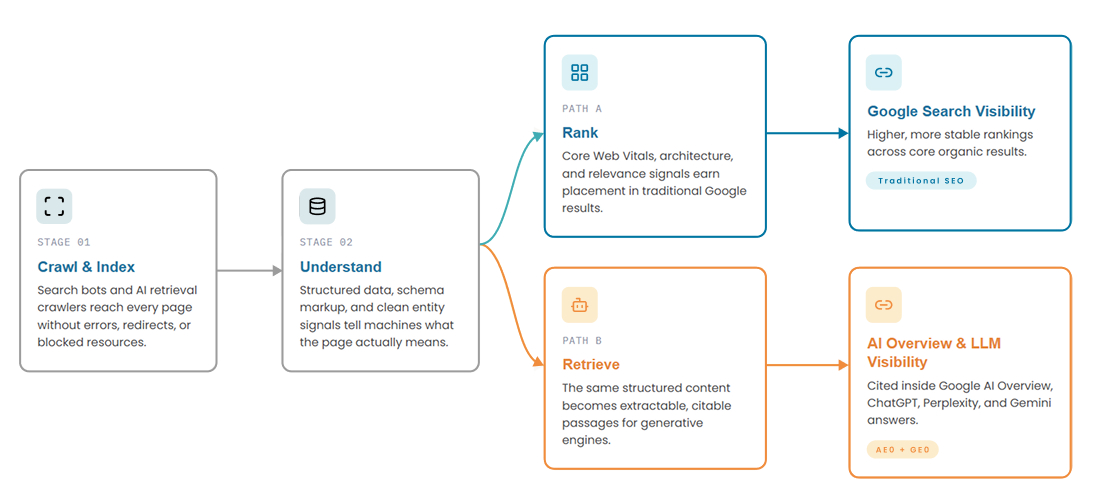
The shift is structural, not cosmetic. Traditional search returns a ranked list and lets the searcher do the comparing. AI Overview and generative search compress that into a single answer, pulled from a handful of sources the model trusts enough to cite. Getting ranked and getting cited are now two different jobs – and only one of them is optional.
AI Search Workflow

Both jobs start in the same place – whether a page can be accessed, read, and trusted at all. That’s the layer this comes down to.

Why Technical SEO Is the Foundation Every Ranking and AI Visibility Signal Is Built On

Content earns attention. Links earn trust. Technical SEO earns access – and without access, neither of the other two gets a chance to work. A brilliant page that Google can’t crawl properly, or that loads too slowly to hold a mobile visitor, never gets far enough to prove itself.

Content strategy determines which topics, questions, and search intents the website should address. Link building strengthens authority by earning relevant external signals from other credible websites. Technical SEO ensures that search engines and AI systems can access, interpret, index, and retrieve all of that information correctly.

This includes resolving crawl errors, improving site architecture, managing canonical tags, strengthening internal linking, optimizing JavaScript rendering, implementing structured data, and ensuring important pages are not blocked, duplicated, or buried too deeply within the website.

Without that technical foundation, valuable content may remain unindexed, authority from backlinks may flow to the wrong URLs, and search engines may struggle to identify the preferred version of a page. AI retrieval systems may also miss, misinterpret, or overlook the content when generating answers.

Content gives the website relevance. Links strengthen credibility. Technical SEO connects both by making every important page crawlable, indexable, understandable, and easier to surface across Google Search, AI Overviews, and large language model-driven discovery.

Why Google and AI Search Engines Reward Technically Sound Websites First

Before a page can rank in Google or be considered for an AI-generated response, it must first be discovered, crawled, rendered, understood, and indexed correctly. Technical issues at any stage of this process can prevent even high-quality content from reaching its full visibility potential.

A technically sound website helps search engines identify important pages, understand relationships between topics, interpret structured data, and distinguish original content from duplicate or outdated versions. Fast loading speeds, mobile usability, clean code, accurate canonical signals, and logical internal linking also reduce unnecessary friction during crawling and indexing.

These signals become increasingly important for AI search visibility. AI systems need clear, accessible, and reliable information that can be retrieved confidently and connected to the correct brand, service, product, or entity. When content is hidden behind rendering issues, distributed across conflicting URLs, or supported by unclear site architecture, retrieval becomes less reliable.

Expert-led technical SEO removes that ambiguity. It creates a website that Google can rank more confidently and that AI platforms can retrieve, understand, and reference more accurately-improving the likelihood of visibility in organic search results, Google AI Overviews, and other AI-generated answers.

Technical SEO is what allows every other SEO effort to perform. When a website is fast, crawlable, indexable, and clearly structured, search engines can rank it with confidence and AI platforms can retrieve and cite its content accurately-strengthening visibility across the entire search journey.

How Technical SEO Signals Feed Directly Into AI Overview and Generative Search Results

AI Overviews and generative search systems do not evaluate content in isolation. They rely on the same technical foundation that helps search engines discover, crawl, render, understand, and index a page correctly before deciding whether it is reliable enough to retrieve or cite.

Signals such as clean site architecture, accurate canonical tags, structured data, fast page performance, mobile usability, internal linking, and clear entity relationships help AI systems understand what a page is about, how it connects to the wider website, and whether the information belongs to the right brand, service, or topic.

When these signals are consistent, content becomes easier to retrieve for relevant queries and more likely to appear in Google AI Overviews, generative search results, and LLM-generated answers. When they conflict, even strong content can be ignored, misinterpreted, or replaced by a technically clearer competitor.

Why Crawlability and Indexing Decide Whether Your Business Gets Seen At All

Before a page can rank in Google, appear in an AI Overview, or be retrieved for a generative search response, search engines must first be able to discover, crawl, render, and index it correctly. If any part of that process fails, even well-written and highly relevant content may remain invisible.

Broken internal links, incorrect robots.txt directives, noindex tags, redirect chains, JavaScript rendering issues, duplicate URLs, and orphaned pages can all prevent important content from entering the search index. Poor crawl prioritization can also cause search engines to spend time on parameter URLs, filtered pages, or outdated versions while commercially important service and product pages remain under-crawled.

Expert-led technical SEO identifies where this process is breaking down through crawl data, server logs, Google Search Console, index coverage reports, and internal linking analysis. The goal is not simply to make pages accessible, but to ensure that the right pages are discovered frequently, indexed under the correct URL, and connected clearly to the queries and topics they are intended to serve.

When crawlability and indexing are managed properly, the business becomes easier to find across organic search, Google AI Overviews, and other AI-assisted discovery experiences.

How Structured Data and Schema Markup Help AI Engines Understand Your Business

Structured data gives search engines machine-readable context about the information on a page. It can clarify whether the content represents a product, service, organization, local business, article, review, event, job opening, or another identifiable entity.

This matters because search engines and AI systems must connect page content with the correct business, offering, location, author, or topic. Schema markup reduces ambiguity by defining those relationships clearly and consistently across the website.

For example, Organization and LocalBusiness schema can reinforce brand and location details, Product schema can clarify pricing and availability, and Article schema can identify the author, publisher, and publication date. When implemented correctly, these signals support better content interpretation, richer search features, stronger entity recognition, and more reliable retrieval.

Schema markup alone does not guarantee an AI citation or AI Overview placement. However, when combined with crawlable content, accurate business information, strong internal linking, and credible supporting signals, it makes the website easier for search and AI systems to understand and reference with confidence.

Where AEO and GEO Fit Into Your Technical Foundation

Answer Engine Optimization (AEO) and Generative Engine Optimization (GEO) aren’t separate disciplines bolted on top of SEO – they’re what SEO becomes once the audience includes AI models as well as people. AEO structures content so it can be lifted as a direct answer. GEO makes sure a brand shows up accurately inside what an AI model generates, even when no click happens at all. Both still depend on the same crawlable, structured, technically clean foundation SEO always needed.

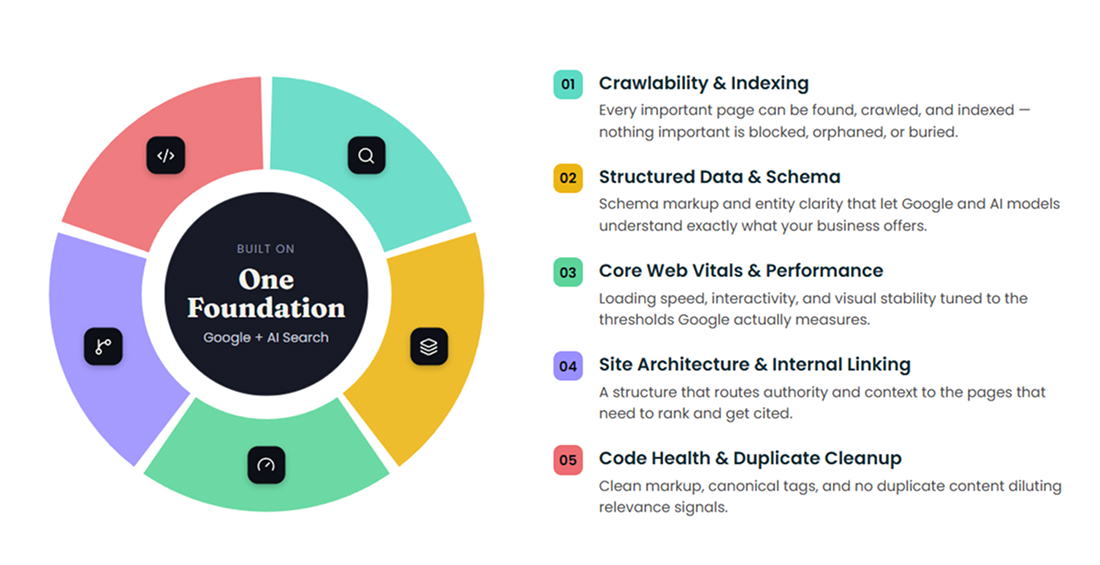
Every audit, fix, and recommendation an expert-led engagement delivers falls under one of five pillars – each one a signal both Google and AI search platforms read directly.
Technical SEO Pillars

AI visibility is not created by adding AEO or GEO tactics to a technically weak website. It begins with a foundation that allows search engines and AI systems to consistently access, interpret, trust, and retrieve the right information about your business.

The Technical Elements Expert-Led SEO Gets Right That Generic Fixes Miss

Real SEO performance depends on more than surface-level optimizations. Search engines and AI platforms evaluate how quickly a site loads, how clearly its pages are connected, and how accurately its technical signals communicate which content should be indexed, trusted, and retrieved.

Expert-led technical SEO brings these elements together, removing the hidden issues that restrict rankings, AI Overview visibility, and conversions.

Generic fixes may improve individual elements, but expert execution ensures the entire website works as one clear, crawlable, and reliable source. When performance, architecture, and code are aligned, search engines can rank the site more confidently, AI platforms can retrieve its content more accurately, and users can move towards conversion without unnecessary friction.
Core Web Vitals

Core Web Vitals, Site Speed, and Mobile Experience

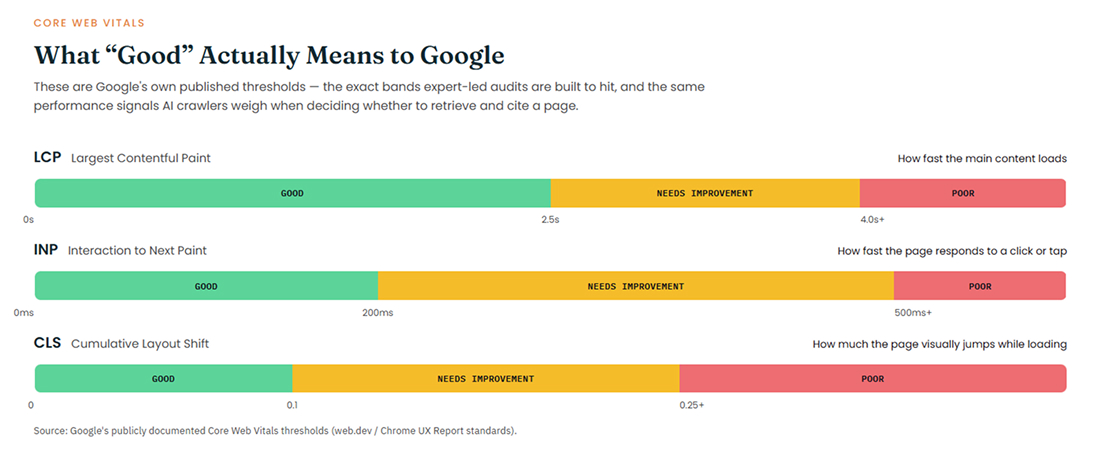
Google measures loading speed, responsiveness, and visual stability against specific, published thresholds – not a vague impression of “fast enough.” Falling outside them costs rankings on both fronts: traditional search, and the performance signals AI crawlers weigh when deciding what’s even worth retrieving.

Site Architecture and Internal Linking Built for Machines to Read

A logical structure – one where authority and context flow deliberately from category pages down to specific ones – tells search engines and AI models which pages matter and how they relate. Flat, disorganized architecture leaves that job to guesswork, and guesswork rarely favors the business being guessed about.

Clean Code, Canonical Tags, and Duplicate Content Cleanup

Every duplicate page, unresolved canonical, or bloated script is a small tax on how efficiently a site gets crawled and understood. Individually, they’re minor. Across a full site, they add up to exactly the kind of ambiguity AI models are least willing to work through before moving on to a cleaner source.

When these technical elements work together, the website becomes easier to crawl, understand, index, and retrieve across both traditional and AI-driven search. That clarity strengthens rankings, improves AI visibility, and creates a smoother path from discovery to conversion.

Why DIY Plugins and Generic SEO Checklists Cannot Deliver Real AI Visibility

A plugin can add a meta tag. It can’t tell you why your product pages aren’t showing up in AI Overview while a competitor’s are. A generic checklist can confirm a sitemap exists. It can’t explain why Google keeps crawling the wrong version of a page, or why an AI model is confidently citing outdated information about your business.

This is the gap that shows up quietly, month after month: rankings that plateau for no obvious reason, traffic that holds steady while inquiries dry up, a website that looks fine and performs like it isn’t there. Generic fixes treat every site the same. Real technical SEO starts by figuring out what’s actually happening on yours.

Generic SEO Fixes vs Expert-Led Technical SEO

Generic /DIY Fixes Expert-led Technical SEO
Patches symptoms with plugins Fixes the root cause in the site’s architecture
Runs the same checklist for every client Diagnoses your site’s actual crawl and index data
Optimizes for Google alone Optimizes for Google, AI Overview, and LLM retrieval together
Stops once the page is “Live” Confirms this page is indexed, understood, and citable
Reports rankings only Reports rankings, AI citation, and qualified leads together


AI visibility is not achieved by installing more plugins or completing another checklist. It comes from expert-led technical SEO that fixes how your site is crawled, understood, indexed, and cited-turning stronger search visibility into qualified leads and measurable business growth.

What Changes in Rankings, Leads, and Brand Authority When Execution Is Done Right

SEO recommendations create value only when they are implemented correctly. When technical fixes, content optimization, structured data, and AI search readiness work together, businesses can improve organic rankings, earn greater visibility in AI-generated answers, and turn search traffic into qualified leads.

From Crawl Errors to Qualified Leads

A technical SEO audit is a diagnosis, not a cure. Business outcomes begin to change when crawl errors are resolved, important pages are indexed, internal links are improved, and schema markup is implemented correctly.

These fixes make it easier for Google and AI search platforms to understand, rank, and surface your content. The result is stronger organic search visibility, better user journeys, and more opportunities to convert relevant traffic into qualified leads.

The difference is execution: not simply identifying what is affecting performance, but fixing the issues that prevent customers from discovering and engaging with the business.

Why Rankings, AI Citations, and Brand Authority Now Move Together

Traditional rankings, AI Overview visibility, and brand authority are increasingly connected. Pages that demonstrate technical quality, clear expertise, relevant answers, structured data, and strong entity signals are better positioned to rank in Google and be referenced in AI-generated responses.

When a brand is consistently cited across Google AI Overviews, ChatGPT, Gemini, and other AI search platforms, it gains more than visibility. It builds recognition, trust, and topical authority throughout the customer’s research journey.

Strong SEO helps a page get discovered. AI search optimization helps the brand become a trusted source that search engines and answer engines are more confident recommending.

A Quick Way to Tell If Your Website Is Actually Ready for AI Search Visibility

Most businesses have never actually checked. Not the “ranked page one” kind of check – the kind that looks at whether the site is actually built for how Google and AI platforms read it now. Run through these five honestly, not the way you’d answer if a salesperson were asking.

Is Your Website Actually Ready for AI Search Visibility

Rankings, AI citations, and brand authority now move together – but only if the technical foundation underneath them holds up. Run through these five questions to see whether your site’s crawlability, structured data, and Core Web Vitals are actually built for how AI search platforms and large language models read the web today.

.
Can search engines crawl and index every important page without errors? Blocked resources, broken redirects, and orphaned pages quietly remove you from consideration before an AI model ever sees your content.
Does your site use structured data and schema markup that AI engines can read? Without it, Google AI Overview, ChatGPT, and Gemini are left guessing what your business actually offers.
Do your Core Web Vitals fall in the “Good” range on mobile? Slow, unstable pages get deprioritized in traditional rankings and skipped over in AI retrieval.
Is your content organized so both readers and AI models can pull a direct answer from it? Answer-shaped content gets cited in AI Overview and generative search. Buried content gets skipped.
Are canonical tags and duplicate content cleaned up sitewide? Duplicate signals dilute relevance and leave both Google and AI engines unsure which version to cite.


Choosing a Technical SEO Partner Who Understands Google and AI Search Together

The technical SEO conversation has split in two, whether businesses realize it yet or not. One track still treats it as a one-time cleanup – fix the sitemap, compress some images, call it done. The other treats it as ongoing infrastructure, built once but maintained as Google and AI platforms keep changing what “readable” means.

Look for a partner who can show you the second kind of work: real audits translated into shipped fixes, structured data that’s actually implemented rather than recommended, and reporting that includes AI citations alongside rankings. A partner still only measuring the first isn’t measuring the whole job anymore.

That’s the model ZealousWeb builds engagements around – technical SEO expert-led enough to move rankings, and structured enough to earn a place inside the AI answers customers are already asking for.

Conclusion

Google rankings and AI Overview visibility used to be judged by two different rulebooks. In 2026, they run on the same one: can a search engine, and increasingly a language model, crawl your site, understand it without friction, and trust what it finds. That’s the premise this entire piece has been building toward – technical SEO isn’t a line item anymore. It’s the infrastructure everything else stands on.

Businesses that treat it as a one-time fix will keep watching rankings plateau and inquiries dry up for reasons a plugin can never explain. Businesses that treat it as the ongoing foundation it actually is will keep showing up – in Google’s results, inside AI Overview, and cited by name in the ChatGPT, Perplexity, and Gemini answers their customers are already asking for.

ZealousWeb builds technical SEO around exactly that standard. Every engagement runs through the same five pillars covered here – crawlability, structured data, Core Web Vitals, site architecture, and code health – audited by people who know the difference between a page that’s live and a page that’s actually working, then followed through until the fixes ship, not just get flagged.

If your rankings look fine but your visibility doesn’t seem to match, that gap is almost always technical, not creative. ZealousWeb’s technical SEO services are built to close it – for Google, for AI Overview, and for whatever search looks like next.

See What's Keeping Your Business Out of AI Overview

Reveal My Gaps

AI Overview Audit

FAQs

Related Blog Posts

white label SEO

White-Label Technical SEO: How Agencies Scale Delivery Without Growing Their Team

June 08, 2026
Agency GrowthSEO OutsourcingTechnical SEOwhite-label SEO
technical SEO execution

Technical SEO Services That Turn Audit Recommendations Into Measurable ROI

June 04, 2026
Agency GrowthSEO AuditTechnical SEOwhite-label SEO
SEO Audits for Multi-Specialty Hospitals Guide

How To Ace SEO Audits For Your Multi-Specialty Hospital?

March 13, 2024
Healthcare SEOMulti-Specialty Hospital MarketingSEO Audit Guide
Comprehensive Local SEO Strategies

Top SEO Trends For 2024 To Master Local SEO Strategy

February 27, 2024
Mobile OptimizationMobile SEOSearch Engine Optimization
Local SEO strategies and tips for 2024

Essential Local SEO Strategies For Ranking Locally In 2024

February 13, 2024
Local SEO TipsRanking StrategiesSEO Techniques
The Essence of Multi-Location Local SEO

Level Up Your Local SEO Skills: How To Dominate Across Multiple Locations In 2024

October 03, 2023
Drive CustomersMultiple LocationsPower of Local SEO
GSC Guidelines

Mastering GSC Guidelines: Google Search Console Insights For 2024

September 26, 2023
GSC GuidelinesSEO InsightsSEO Mastery