



The numbers do not lie — they just sting a little. Digital agencies averaged just 5% growth in 2024, and those that made no changes to their model grew at a near-flat 1.1%, according to a digital agency industry report. And yet, 89% of agencies are already running AI for efficiency — but fewer than half managed to grow revenue by 25% or more. More tools. More adoption. Same ceiling.
The agencies actually breaking through are not the ones with the most sophisticated stack or the most polished brand story. They are the ones who stopped layering fixes on top of a broken foundation and started redesigning how the whole thing runs. That is not a rebrand. That is not a rebuild. That is a reset.
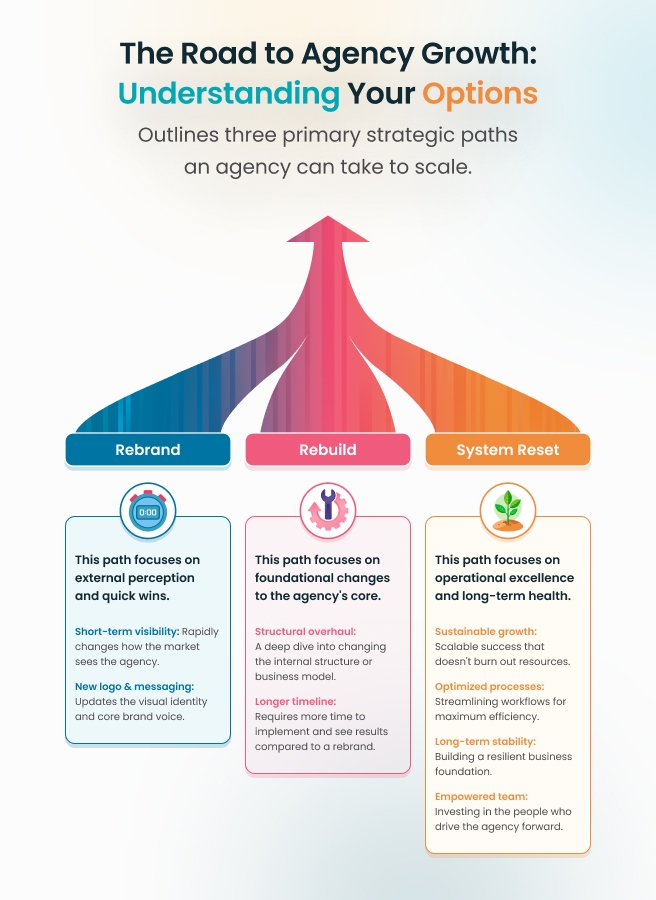
And knowing which one you actually need? That is what separates agencies that scale from agencies that stay stuck in the same loop — just with a better logo.
Same Problem, Three Different Fixes — Know What You Are Choosing
Most agencies have attempted at least one of these. Some have tried all three — often in the wrong order. Before you can choose the right move, you need to know what each one actually is, what it touches, and, more importantly, what it does not. Here is what each move means when you strip away the consultant-speak.
| Rebrand | Rebuild | System Reset | |
| What It Is | Changing how you look and sound | Restructuring your offer, team, or tech | Redesigning how work flows, decides, and delivers |
| What It Touches | Logo, messaging, positioning, website, deck | Service lines, org structure, hiring, toolstack | Delivery architecture, decision layers, execution systems |
| What It Does Not Touch | How work gets done | How decisions get made | Nothing — this is the operating layer |
| Who Initiates It | Marketing lead or founder feeling underrepresented | Ops lead or founder hitting a structural ceiling | Founder or leadership team tired of firefighting |
| Timeline | 6–12 weeks | 6–18 months | 30–90 days to first impact |
| Feels Like | Progress | Investment | Clarity |
| Risk If Wrong | Expensive cosmetics | Expensive delay | — |
| Right When | Your positioning no longer reflects your actual value | Your structure can’t support where you’re going | Your systems were never built for where you are |
Most agencies do not fail because they chose badly. They fail because they chose fast — reaching for the most familiar fix without understanding what layer the problem actually lives on. The next sections break that down, one move at a time.
Why Agencies Default to Rebrand (And Why It Rarely Works)
When growth stalls and pressure builds, agencies do not sit still. They move. And the first move almost always looks the same, a new website, a sharper deck, a repositioned narrative. Not because it is the right fix, but because it is the most visible one. A rebrand feels like leadership. It feels like a decision was made. The problem is, rebranding failures rarely happen because of the wrong logo or color palette — they happen because the rebrand never touched the underlying layer that was actually broken.
Here is the psychology behind why agencies keep reaching for it anyway:
- It creates immediate proof of action — A new brand is something you can show your team, your clients, and yourself. It signals that leadership is responding. In a period of stagnation, visible movement feels better than admitting the problem is deeper.
- It is easier to sell internally — Telling your team “we’re rebuilding our systems” is a hard conversation. Telling them “we’re relaunching the brand” gets excitement, not resistance.
- It targets the symptom that is easiest to see — Leads dropping? Must be the positioning. Clients not renewing? Must be the messaging. The brand becomes a convenient explanation for problems that actually live in delivery, decision-making, and execution.
- It carries the illusion of transformation — New leadership especially tends to reach for rebranding as visible proof of transformation — while creative agencies push dramatic concepts for portfolio impact — neither of which addresses what is operationally broken.
- It does not require confronting the real conversation — A system reset means admitting your operations were never built to scale. A rebrand lets you sidestep that entirely and call it strategy.
The result? Rebranding without repositioning produces a prettier version of the same problem — because brand equity starts with positioning, not pixels. And for agencies, it goes one level deeper than that. Brand equity starts with delivery. With ownership. With a system that runs without the founder holding it together. A rebrand cannot fix what it cannot see. And what is broken in most scaling agencies is invisible on the surface — which is exactly why the surface keeps getting repainted.
When Rebuilding Is the Right Call — And When It's Just Expensive Delay
Rebuilding is not a bad move. It is just a frequently mistimed one. The problem is that structural issues and systemic issues look almost identical from the inside — and agencies consistently confuse the two. One costs you 3 months. The other costs you 18.
Here is the fastest way to tell them apart:
| If the problem is | It’s structural – Rebuild | Its systematic- Reset |
| Delivery breaking down | Not enough people or clear ownership | People exist but no one knows who decides what |
| Clients churning | Offer no longer matches market needs | Offer is right, execution is inconsistent |
| Margins shrinking | Pricing model is outdated | Scope creep and rework are eating the margin |
| Founder is the bottleneck | No second leadership layer exists | Leadership exists but has no decision framework |
| Team is overwhelmed | Wrong structure for current scale | Right structure, no operating rhythm |
Fix the structure but change nothing about how work flows and decisions get made — does the problem disappear? If yes, rebuild. If no, you have a systems problem, and a rebuild will not reach it.
The agencies that stop rebuilding every cycle did not find a better structure. They fixed the operating layer underneath it. That is what a System Reset does — and that is exactly what the next section is about.
The System Reset: What It Is and Who Actually Needs It
A System Reset is more than a quick fix — it’s a fundamental shift from reactive execution to a cohesive, designed system where delivery, intelligence, and leadership work in sync. This is ZealousWeb’s core strength: transforming how agencies operate for sustainable, scalable growth.
Agencies often struggle not due to a lack of talent or tools, but because their operating system is broken. Without a clear structure, they fall into cycles of firefighting and temporary fixes. A System Reset replaces this chaos with intentional workflows, clear decision-making, and aligned leadership.
Here’s what it involves:
- Redesigning delivery — Streamlining workflows from planning to execution.
- Clarifying decision-making — Establishing ownership and accountability at every level.
- Aligning leadership — Connecting strategic decisions to real-time feedback.
Who needs it?
- Agencies stuck at a growth plateau where more resources or tools don’t solve the core issues.
- Agencies with inconsistent processes that lead to missed deadlines and poor client satisfaction.
- Agencies struggling to scale without clear systems to support growth.
For these agencies, a system reset isn’t optional — it’s essential. It’s not about rebranding or restructuring; it’s about fundamentally redesigning how work flows, decisions are made, and teams collaborate. This reset empowers agencies to move from chaos to clarity, enabling predictable growth and smoother operations.
The Diagnostic: Three Questions That Tell You Which Move to Make
This isn’t a quiz — it’s a decision framework that helps agencies identify their real challenges and decide the right move. By focusing on delivery breakdowns, decision bottlenecks, and where chaos resides, these three questions pinpoint the root cause of stagnation and reveal the path forward.
- Where are the delivery breakdowns happening? If your projects consistently miss deadlines or lose quality, it’s a sign your delivery system needs redesigning.
- What decisions are slowing you down? Identifying decision bottlenecks reveals where ownership is unclear or where the process stalls — crucial for pinpointing inefficiencies.
- Where does the chaos live? Understanding the source of operational friction helps prioritize where a System Reset is needed to restore clarity and flow.
These questions cut through the noise and give agencies a clear roadmap for overcoming obstacles. Rather than applying temporary fixes, this framework helps agencies diagnose their core challenges and take decisive, meaningful action to improve how work gets done.
What a System Reset Actually Looks Like in Practice
A system reset isn’t just about outcomes or features — it’s about the actual moves that transform how an agency operates. It’s the tangible shifts that agencies make to move from chaos to clarity. Here’s what that looks like in the first 30–90 days:
- Redesigning Delivery
- Streamlining workflows to ensure every task is aligned with the desired outcome. This includes restructuring the steps from planning to execution, eliminating unnecessary processes, and ensuring smooth handoffs between teams.
- Clearing Decision Bottlenecks
- Clarifying roles and responsibilities so that decision-making isn’t delayed. Establishing clear ownership at every level ensures that decisions are made quickly and accurately, without waiting for approval from the top.
- Aligning Leadership and Teams
- Ensuring leadership is aligned with operational needs and that teams have the support and guidance they need. Establishing regular check-ins and feedback loops to monitor progress and resolve issues before they escalate.
In the first 30–90 days, these changes are designed to create an operational foundation that empowers the agency to scale. The system reset is concrete and actionable, designed for agencies to self-identify whether they need these changes or if their existing systems can be salvaged. It’s about making changes that impact how the agency functions on a daily basis, enabling growth without the chaos.
What Changes After the Reset
After a system reset, the transformation goes beyond immediate outcomes; it’s about establishing a stable foundation for continuous growth. Here’s what really changes:
- Streamlined Delivery
- Workflows become efficient and predictable. Deadlines are met, quality is consistent, and tasks are executed without constant firefighting. Teams move from reacting to planning.
- Clear Ownership and Accountability
- Decision-making is faster, clearer, and more decentralized. Every team member knows their role and is empowered to make decisions, eliminating bottlenecks and ensuring smoother operations.
- Aligned Leadership and Teams
- Leadership teams are in sync with operations, providing real-time feedback that drives continuous improvement. Decisions are informed, aligned with the agency’s goals, and actionable without delay.
- Sustainable Growth and Scalability
- With streamlined processes and a clear decision-making framework, agencies now have the ability to scale without the operational chaos that used to hold them back.
The system reset doesn’t just change how things look; it transforms how they operate. The changes are practical, making everyday work smoother, more efficient, and more predictable. When the operating layer is aligned, everything else — from client satisfaction to team morale — falls into place. This is what real growth looks like.
How ZealousWeb Works as a System Reset Partner
We’ve seen firsthand that agencies don’t struggle due to a lack of talent, but because their delivery isn’t systematized. We understand agency realities from both direct client delivery and white-label partnerships, and we’ve built our expertise around this dual perspective.
We operate with a system-first approach: DoD, QA gates, and SOPs to ensure that ownership is clear, processes are streamlined, and quality is enforced. This structure allows remote scaling to be calmer, more predictable, and far less chaotic.
Our Unique Value Proposition:
- Hands-on experience in both client-facing and white-label agency work.
- A system-first framework with clear DoD, QA gates, and SOPs for consistent, high-quality delivery.
- Proven ability to scale agencies smoothly, ensuring predictable and efficient operations.
- Expertise in addressing both operational and strategic challenges for growing agencies.
With ZealousWeb as your partner, you can trust that your agency will move from chaos to clarity, laying the groundwork for sustainable, scalable success. Let’s work together to redesign your operations and unlock the growth potential that’s been waiting all along.
Conclusion
Agencies often face challenges not because their people lack capability, but because their operations aren’t built to scale. Without a clear structure and efficient processes, growth becomes chaotic. If your agency feels stuck — with missed deadlines, unclear decision-making, or poor execution — the solution isn’t simply hiring more staff or rebranding; it’s about redesigning your internal systems to function efficiently and at scale.
At ZealousWeb, we help agencies create this clarity. By focusing on improving your workflows, decision-making, and leadership alignment, we ensure that your agency isn’t just surviving but thriving. If you’re ready to move from reactive to proactive, and from chaos to clarity, let’s work together to build an operating system that supports sustainable growth.
Unlock Your Agency’s Potential with a Tailored System Overhaul
Book a Strategic Discovery Call
FAQs
How do we identify the bottlenecks in our agency’s workflow?
Identifying bottlenecks starts with evaluating where delays or breakdowns occur most frequently. We look at decision-making processes, communication gaps, and task dependencies to pinpoint where inefficiencies exist.
Can we continue to take on new clients during this transformation?
Yes, the goal is to streamline and stabilize your operations without disrupting current workflows. The adjustments made during this process are designed to ensure smoother handling of new projects and clients.
Will this affect my current team structure?
The focus is on improving how your team collaborates and makes decisions, not necessarily on changing team roles. However, clear ownership and accountability may lead to slight restructuring to align with more efficient workflows.
How do we ensure long-term sustainability after the reset is complete?
We implement ongoing feedback loops, performance metrics, and clear decision frameworks to ensure continuous improvement. The reset is designed to establish systems that adapt to future needs, keeping growth sustainable.
Is this process suitable for both small and large agencies?
Absolutely. Whether you're a small boutique or a large-scale operation, the approach is adaptable. We tailor the reset to your agency's unique size, structure, and growth challenges.
What does the first 30–90 days of the transformation look like?
In the initial phase, we focus on diagnosing existing pain points, redesigning workflows, and clarifying decision-making structures. You'll start to see quicker decision-making, smoother project execution, and clearer leadership alignment within the first three months.