


ZealousWeb
delivery execution system

Stop Hiring to Fix Delays — Build the Execution System That Makes Delivery Predictable

April 06, 2026Posted By: Jalpa Gajjar
Agency Scalingdelivery systemproject deliveryQA process

Every agency hits the same wall.

A deadline slips. A client escalates. The instinct is immediate — hire faster, add more people, push harder. It feels like the right fix. It rarely is.

According to McKinsey’s large-scale IT project research, large projects run an average of 45% over budget and 7% over schedule, while delivering 56% less value than originally predicted. These aren’t outliers. This is the default state for agencies scaling without a delivery architecture in place.

PMI’s Pulse of the Profession 2024 reinforces the same pattern — the average project performance rate across organizations sits at just 73.8%. The gap between high-performing teams and struggling ones is not talent or team size. It is the systems and operational capabilities built around them.

Here’s the pattern most agency founders never see clearly: the model that got you to your first ten clients was never built to carry fifty. Scaling doesn’t break agencies because of bad hires or wrong clients — it breaks them because the operational layer underneath was built for a smaller machine. And instead of fixing the machine, most founders keep adding more hands to it.

Must read: The Cost of Scaling Without a System: The Hidden Breakdown Every Growing Agency Hits — and How to Get Past It

That’s the trap. And it costs agencies far more than a few missed deadlines.

This article breaks down why headcount is the wrong answer to a delivery problem, what an execution system actually looks like, and how agencies that make this shift stop firefighting — and start delivering with calm, predictable control.

Your Team Is Delivering. Your System Is Failing Them — Here's Where It Actually Breaks

You hired the right people. You invested in tools. You ran the retrospectives. And yet — deadlines still slip, clients still escalate, and your best people are burning out trying to hold everything together.

The problem was never your team. The problem is that your team has no control over the delivery system they’re operating inside. At a certain point, every scaling agency hits a ceiling that no new hire can break through. Because the ceiling isn’t about capacity. It’s about the absence of a system underneath your capacity.

When agencies scale without the right operational layer, the same five gaps surface — every time, across every team size. Here’s what they look like in practice:

System Gap What It Looks Like In Your Agency Why It Breaks At Scale
No ownership architecture Everyone is responsible for delivery — so no one truly is Accountability diffuses as team size grows and delays become no one’s fault
Missing QA Layer Quality checks happen at the end, not throughout One missed review cascades into client-facing errors and rework cycles
No velocity Work moves on gut feel and status calls, not data You can’t predict timelines you’ve never measured
Unclear definition of done Each team member interprets “complete” differently Handoffs break, revisions multiply, and delivery stalls at the finish line
Reactive Communication Model Clients hear from you when something goes wrong Trust erodes fast when updates are driven by problems, not progress


These aren’t symptoms of a bad team. They’re symptoms of an agency that outgrew its delivery model — and hasn’t built a new one yet.

The Hiring Trap — Why More People Don't Mean More Predictability

Here’s a pattern almost every scaling agency repeats.

A project slips. A client complains. The founder looks at the team and thinks — We just need more hands. So they hire. And for a few weeks, it feels like it’s working. Then another deadline slips. Another escalation lands. And now you have a bigger team with the same broken delivery model — just more expensive.

This is the hiring trap. And it’s not a people problem — it’s a perception problem. Most agencies mistake a system’s failure for a capacity shortage. The real issue isn’t that you don’t have enough people. It’s that the people you have are operating without the structure that makes their work predictable, measurable, and scalable.

Hiring into a broken system doesn’t fix the system. It amplifies the chaos.

Here’s how to know if your agency has fallen into the hiring trap:

The Hiring Trap Checklist:

  • You’ve hired for a role more than once in 12 months to solve the same delivery problem
  • Onboarding new team members takes longer each time — and still doesn’t fix output quality
  • Senior people are spending more time on coordination than actual delivery
  • You can’t confidently tell a client when a project will be done without checking with five people first
  • Deadlines are estimated on experience and gut feel — not tracked velocity or historical data
  • New hires inherit the same broken handoffs, unclear briefs, and last-minute reviews as everyone before them
  • Your team is growing, but your delivery confidence is shrinking


If three or more of these are true, you don’t have a capacity problem. You have a systems problem — and no amount of hiring will fix it until the system underneath is rebuilt.

What a Real Execution System Looks Like — And Why Most Agencies Don't Have One

Most agencies have pieces of a delivery system. A project management tool here. A QA checklist is there. A weekly standup that sometimes happens. But pieces are not a system. A system is what connects those pieces into a predictable, repeatable delivery engine — one that works regardless of who is on the project or how complex the brief is.

This is the distinction most agencies never make. And it’s exactly why delivery feels chaotic even when the team is capable.

Here is what a real execution system is built on:

Ownership That's Built In, Not Assumed

In most agencies, ownership lives in someone’s head — not in the system. Everyone broadly knows what they’re working on, but nobody owns the outcome end-to-end. When something slips, it falls into the gap between roles.

A real execution system maps ownership explicitly — not just to a person, but to a stage, a deliverable, and a deadline. Every task has one owner. Every handoff has a defined trigger. Every stage has a clear exit condition. When ownership is architectural, accountability stops being a conversation and starts being a default.

QA as a Continuous Gate, Not a Final Check

Most agencies treat QA as the last step before delivery. That’s not quality control — that’s damage control. By the time a problem surfaces at the end, it has already compounded through every stage before it.

A real execution system embeds QA at every stage of delivery — not just at the finish line. Each phase has defined quality gates that the work must pass before it moves forward. This means:

  • Briefs are reviewed before work begins — not after
  • Deliverables are checked at handoff — not on submission
  • Client-facing outputs go through a structured review layer — not a quick skim
  • Errors are caught early — when they cost minutes to fix, not days

Velocity Tracking Over Gut Feel

When a client asks, “When will this be ready?” — most agency teams check in with four people before answering. That’s not a timeline. That’s a guess with consensus.

Velocity tracking changes this entirely. When agencies measure how long tasks actually take across project types, team members, and complexity levels, delivery stops being an estimate and starts being a calculation. Over time, this data becomes your most valuable delivery asset. It tells you exactly how long things take, where bottlenecks consistently appear, and when to flag risk before it becomes a delay. Agencies that track velocity don’t just deliver faster. They deliver with confidence — and that confidence is visible to clients.

A Shared Definition of Done

This is the most underrated gap in agency delivery. When ten people on a team have ten different interpretations of what “done” means, handoffs break, revisions multiply, and delivery stalls at the exact moment it should be accelerating.

A shared Definition of Done is a non-negotiable agreement across the entire team. It answers three questions for every deliverable:

  • What does complete look like — specifically?
  • Who signs off before it moves to the next stage?
  • What does the client need to see before this is closed?

When this agreement exists at the system level — not just in someone’s head — delivery becomes consistent, handoffs become clean, and “almost done” stops being a project status.

What Shifts When Agencies Stop Managing People and Start Running Delivery Systems

There’s a before and after moment every agency founder remembers.

Before — every week is a series of check-ins, follow-ups, and status calls just to understand where things stand. After — the system tells you. The difference isn’t a new hire or a new tool. It’s the shift from managing people to running a delivery system that manages itself. Here’s exactly what that shift looks like in practice.
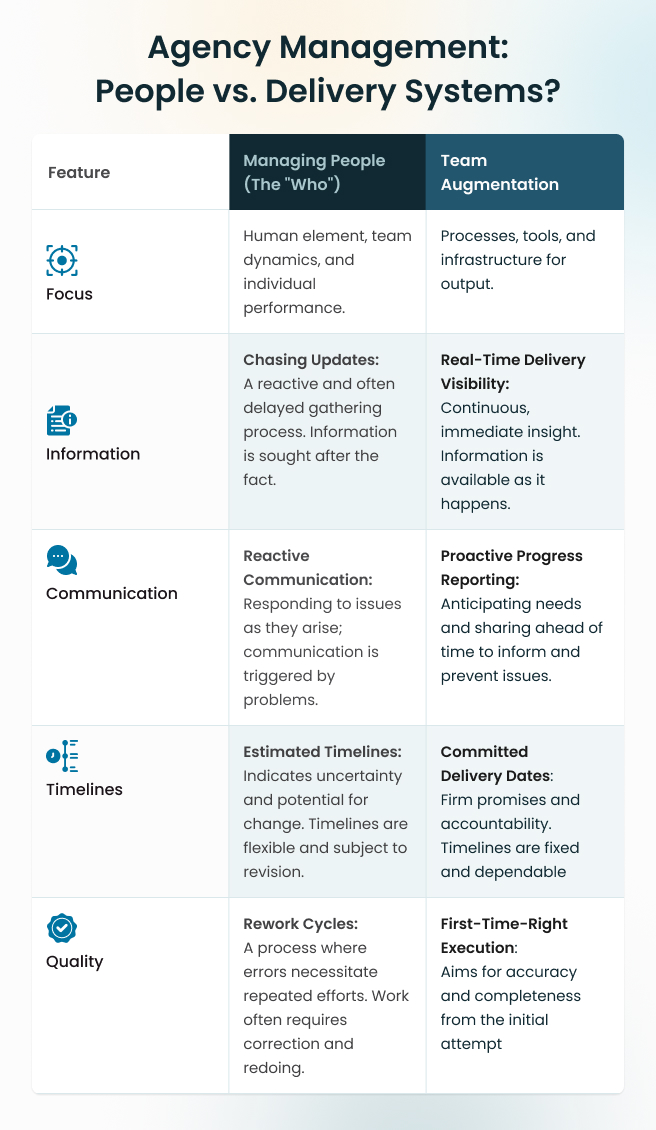
Agency management

When that shift happens, four things change fundamentally:

From Chasing Updates to Real-Time Delivery Visibility

When delivery runs on people, visibility depends on who’s available to report it. When delivery runs on systems, visibility is built into the workflow itself. Agency leaders stop asking “where are we?” because the answer is always in front of them — tracked, timestamped, and actionable. Decisions get faster. Escalations get fewer. And the founder gets their time back.

From Reactive Client Communication to Proactive Progress Reporting

Most agency-client relationships break not because of bad work, but because of bad communication timing. Clients hear from you when something goes wrong. A delivery system flips this entirely. Updates go out before clients ask. Progress is reported on a rhythm, not on a crisis. Trust compounds over time because clients feel informed, not managed.

From Estimated Timelines to Committed Delivery Dates

Estimates are guesses dressed up as plans. Committed delivery dates are what systems make possible. When velocity is tracked, when ownership is clear, and when QA is built into the workflow, timelines stop being aspirational and start being reliable. Agencies that run on systems don’t just tell clients when something will be done. They show them — and they’re right.

From Rework Cycles to First-Time-Right Execution

Rework is the silent killer of agency profitability. It doesn’t show up on a P&L — it shows up in burnt team hours, delayed launches, and clients who quietly start looking elsewhere. A delivery system with clear briefs, defined checkpoints, and a shared definition of done eliminates the ambiguity that creates rework in the first place. Work gets done right the first time — not because the team got better, but because the system stopped leaving room for error.

What Changes When ZealousWeb Runs the Delivery Layer

Most agencies don’t fail because they lack talent. They fail because they’re running a growing business on a delivery model that was never designed to scale — and they keep trying to solve that with more people instead of better architecture.

ZealousWeb exists at exactly this intersection.

As a white-label delivery partner, ZealousWeb doesn’t just take work off your plate — it plugs a fully operational execution layer into your agency. One that comes with the ownership architecture, QA gates, velocity tracking, and delivery rhythms already built in. Are the systems your team has been trying to improvise from scratch? They’re the foundation ZealousWeb operates from by default.

This is the calm control advantage — and it’s what separates agencies that scale with confidence from those that scale into chaos.

When you partner with ZealousWeb, three things happen that no new hire can replicate:

  • Your delivery capacity scales without your overhead scaling with it. You take on more clients, more complex projects, more ambitious timelines — without rebuilding your internal team every six months to keep up.
  • Your clients experience consistency, not heroics. Delivery isn’t held together by your best people working late. It runs on a system — which means the quality your clients experience on project one is the same quality they experience on project twenty.
  • Your leadership team gets out of delivery and back into growth. When execution is handled by a partner running a real delivery system, founders and senior leads stop spending their week in status calls and start spending it where it matters — strategy, relationships, and the next level of the business.

White-label partnership is not outsourcing. It’s not handing work to a vendor and hoping for the best. It’s adding an execution system to your agency

Conclusion

The agencies that scale well aren’t the ones with the biggest teams. They’re the ones that stopped confusing capacity with capability — and built the execution layer that makes delivery predictable, regardless of project size or team headcount.

The pattern is always the same. A deadline slips. A hire gets made. The deadline slips again. At some point, the most important decision a growing agency can make isn’t who to bring on next — it’s whether the system underneath is actually built to carry the weight being placed on it.

That shift doesn’t happen overnight. But it starts with one honest question: are you solving a delivery problem, or are you just adding more people to a system that was never designed to scale?

The agencies that answer that question clearly — and act on it — stop firefighting. They stop losing margin to rework. They stop losing clients to communication gaps. And they stop losing their best people to the burnout that comes from holding a broken system together by hand.

Predictable delivery isn’t a function of talent. It’s a function of architecture. And for agencies that don’t want to spend the next two years building that architecture from scratch, the faster path is partnering with someone who already runs it — invisibly, reliably, and at scale.

That’s exactly what ZealousWeb is built to be.

Growth Doesn't Wait for Better Guesses

Book a Discovery Call

Execution System

FAQs

Related Blog Posts

agency operational system

From Overloaded to Operationally Calm: One Agency’s Shift to System-Led Growth

April 07, 2026
Agency OperationsDelivery Systemssystem-led growthWorkflow Automation
agency systems assessment

From Tools to Intelligence: A Systems Assessment for SaaS & Agency Leaders

April 01, 2026
Agency GrowthAI readinessExecution Systemssystems assessment
Automate client reporting with AI

How to Automate Client Reporting and Retention with AI Content Personalizer for WP

March 30, 2026
AI reportingclient retentionlead trackingMarketing Automation
execution data decision system

Why Execution, Data, and Decisions Must Work as One System for Scalable Growth

March 25, 2026
Execution Systemsintelligence systemsleadership systemsscalable growth
ZealousWeb

The Calm Delivery Systems Playbook: How Agencies Build Scalable Execution Without Chaos

March 25, 2026
agency executionDelivery Systemsscalable operationsworkflow systems
AI-led delivery for agencies

AI-Led Delivery & Automation: Scaling Agency Execution with Systems, Not Tools

March 24, 2026
agency automationAI-led deliverydelivery operationsExecution Systems
AI & Automation

AI, Automation & Data Tools We Trust: Building Intelligence Systems for Scalable Growth

March 23, 2026
Agency Growth SystemsAI for AgenciesAutomation SystemsData Intelligence
AI automation use cases

Use Cases: How Agencies & SaaS Companies Use AI and Automation to Improve Operations

March 13, 2026
AI AutomationAI OperationsBusiness Process AutomationWorkflow Automation