


Most full-service digital agencies don’t fail because of bad work. They fail because good work, delivered inconsistently, through a team held together by effort rather than infrastructure, eventually runs out of runway. You’ve built something real — clients, retainers, a capable team, a stack of tools that covers every channel. But if delivery still depends on who’s available, if reporting still looks different depending on who built it, if onboarding still lives inside someone’s head — you don’t have an agency operating system. You have a talented group of people working around the absence of one.
This assessment exists to show you exactly where that gap is — and what it’s costing you.
It covers three layers: how your delivery actually runs, how your data and AI infrastructure actually support decisions, and how clearly you, as a leader, are operating versus reacting. Score it for your median week — not your best one. What surfaces will be specific, occasionally uncomfortable, and worth knowing.
The Tools Trap: Why Busy ≠ Built
There is a particular kind of agency confidence that comes from having a tool for everything. A project management platform. A reporting dashboard. An AI writing assistant. A CRM. A time tracker. A Slack workspace with forty-three channels. From the outside — and on a pitch deck — it looks like infrastructure. From the inside, it’s usually organised chaos with better branding.
The trap isn’t the tools. The trap is mistaking the presence of tools for the presence of a system. A system has logic, ownership, and continuity. A tool stack has subscriptions. The difference only becomes visible when something breaks — a key person leaves, a client escalates, a project runs across three teams — and suddenly the tools that were supposed to hold everything together are just tabs nobody’s looking at.
This section names the three places where that gap shows up most clearly in full-service agencies.
| Signal | What It Looks Like In Practice |
| Your stack is a collection, not a system | Every tool was adopted to solve a specific problem in a specific moment. Nothing was designed to work together. Data lives in five places, and reconciling it requires a human. Processes exist inside individual accounts, not across the agency. When someone new joins, the “system” they inherit is whatever the last person left behind. |
| Delivery breaks at the handoff, not the tool | The brief leaves the strategist’s head intact. By the time it reaches the designer or developer, it has lost context, nuance, and half its constraints. Nobody flagged it. The tool logged the task, but no tool owns the transfer of understanding. This is where quality variance comes from. Not bad work. Bad handoffs. |
| The hidden cost of “we have something for that” | Every time a process question is answered with a tool recommendation, the agency adds complexity without adding clarity. The tool gets adopted, half-used, and quietly abandoned — but the subscription stays. More critically, the underlying process problem that prompted the tool purchase remains completely unsolved. You now have a new tab and the same old gap. |
Where Agencies Actually Break
These three blocks form the diagnostic core of this assessment. Each targets a distinct layer of how your agency actually operates — not how it’s designed to, but how it runs right now. Score for the median week. The signal at the end of each block is only as useful as the honesty you bring to it.
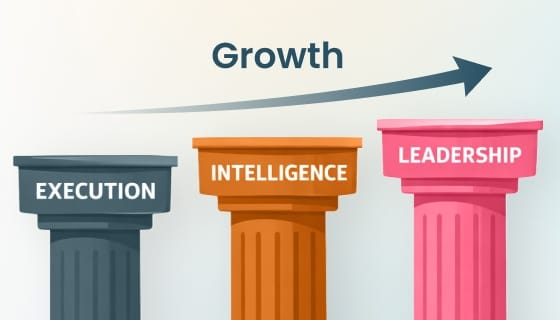
Assessment Block 1: Your Execution Layer
| Diagnostic | What You’re Actually Measuring |
| Delivery Velocity: Can You Ship Without Heroics? | If hitting a deadline consistently requires someone to work late, skip process steps, or personally intervene, your velocity is person-dependent, not system-dependent. |
| QA Ownership: Who Catches Errors Before the Client Does? | If your honest answer to “who owns quality on this deliverable” is a name rather than a role or process — your QA layer is a person, not a system. People leave. Systems don’t. |
| Handoff Integrity: What Breaks When Someone Leaves or Scales? | If the answer to “what would break if your best account manager left tomorrow” is longer than two sentences — your agency is built on individuals, not infrastructure. |
| Execution Score | 7–9: functioning layer. 4–6: person-dependent, will crack under scale. 1–3: running entirely on effort — and effort has a ceiling. |
Assessment Block 2: Your Intelligence Layer
| Diagnostic | What Your’re Actually Measuring |
| Data You Collect vs. Data You Actually Decide From | If you know your clients’ conversion rates but not your own delivery margin — your data layer is pointed outward when it needs to face inward too. |
| Automation Audit: Does It Reduce Chaos or Just Reduce Effort? | The test: after the automation runs, does someone still need to interpret, chase, or correct? If yes, the chaos is still there. You’ve just made a broken process slightly faster. |
| AI Readiness: Are You Using AI or Wearing It? | If removing your AI tools tomorrow wouldn’t meaningfully change how your agency operates, you’re wearing it. |
| Intelligence Score | 7–9: intelligence informs operations. 4–6: data and AI are present but decorative. 1–3: operating on instinct with no systemic intelligence underneath. |
Assessment Block 3: Your Leadership Layer
| Diagnostic | What You’re Actually Measuring |
| How Often Are You Deciding vs. Reacting? | If the majority of your leadership time is reactive — triggered by escalations, missed deadlines, team conflicts — you are not running your agency. Your agency is running you. |
| What Your Calendar Says About Your Operating Model | Your calendar is an honest document. If it is filled with client calls and delivery check-ins, you are a senior executor. If it contains strategic thinking time and decision reviews, you are a leader. Most agency founders have the calendar of the former and the ambition of the latter. |
| Are You Running a Business or Running Inside One? | If your agency’s output quality is meaningfully dependent on your personal involvement, you are an employee of your own business. A highly paid one, but an employee nonetheless. |
| Leadership Score | 7–9: operating above the delivery layer with strategic clarity. 4–6: leadership frequently pulled into execution — a warning sign at scale. 1–3: founder-dependent at the operational level — the single most common reason agencies plateau and stay there. |
Your Systems Readiness Score: Read the Map
Your three block scores combine into a single picture. This isn’t a grade. It’s a map — and maps are only useful if you’re honest about where you’re standing, not where you wish you were. Add your scores from all three blocks. The composite tells you which of four operating profiles your agency is currently running on.
The Four Operating Profiles
| Profile | Composite Score | What It Means |
| Tool stack | 3–9 | Tools exist. Systems don’t. Delivery runs on individuals, not infrastructure. You’re maintaining an agency, not building one. |
| Partial system | 10–16 | One or two layers work. The rest run on effort and institutional knowledge. Functional, but one departure away from regression. |
| Functioning OS | 17–22 | Delivery is mostly consistent. Data informs some decisions. Leadership operates above the day-to-day more often than not. The risk here isn’t collapse — it’s plateau. |
| Calm control | 23–27 | Delivery runs without heroics. Decisions are data-informed. Leadership time goes to growth, not firefighting. The infrastructure absorbs problems rather than becoming them. |
Where You Sit — and What It Costs to Stay There
Most full-service agencies land in the Partial System band. That’s not a comfortable middle ground — it’s the most dangerous position on the map. Far enough along to feel like things are working. Not far enough to have infrastructure that makes working feel effortless. The gaps are invisible until they cost you a client, a key hire, or a quarter of margin.
| Profile | The Real Cost Of Staying |
| Tool stack | You are the system. The cost is your time, your energy, and eventually your ceiling. |
| Partial system | You scale in bursts and retreat. Inconsistent delivery, eroding margin, and a team that’s permanently slightly overloaded. |
| Functioning OS | Every new client costs more to service than it should. Stable but not compounding. |
| Calm Control | Complacency. Systems that stop evolving quietly become the layer below. |
The One Layer to Fix First (Not Three)
Fixing everything simultaneously produces incremental improvement across the board — which is the same as no meaningful improvement anywhere. Every agency has one constraint layer. Strengthen that first. The sequence matters more than the effort.
| If Your Lowest Score Is | Fix This First |
| Execution | Nothing else compounds until delivery is consistent. Start here. Always. |
| Intelligence | Your execution works, but decisions run on instinct. Connect what you collect to the decisions that actually matter. |
| Leadership | The infrastructure exists, but you’re still operating inside it. This is a leverage problem — and it’s behavioural before it is structural. |
Fix the constraint. Let the other layers respond. Then reassess.
What a Systems Partner Actually Does
Most agencies don’t lack tools — they lack someone who knows how to make those tools work together as a coherent operating system. A systems partner isn’t a software vendor or a consultant who hands you a deck. They sit inside your constraint layer, understand how your delivery actually runs, and build infrastructure around that reality — not around an idealised version of it. The relationship doesn’t end at go-live. It evolves as your agency does.
| Vendor | System Partner | |
| Goal | Tool adoption | Operational outcomes |
| Engagement needs | At go-live | When the system compounds |
| Measures success by | Features delivered | Margin, consistency, leadership time |
| Response to failure | Raises a support ticket | Asks what’s broken upstream |
| Starting point | Product demo | Diagnostic conversation |
| Builds around | Their roadmap | Your constraint layer |
| Automates | Whatever you asks | Only what’s already clean |
| Stay in the room? | Rarely | Always |
Conclusion
No version of agency growth doesn’t eventually demand a reckoning with infrastructure. The founders who figure this out early build agencies that compound. The ones who don’t build agencies that plateau — sometimes profitably, always frustratingly — held at a ceiling they can feel but can’t quite name.
The ceiling has a name. It’s called operating without a system.
What gets built when a systems-first approach is applied with genuine depth — not as a consultancy that sells a framework and leaves, but as an embedded partner that understands the specific pressure points of full-service digital delivery — is the difference between an agency that survives its own growth and one that scales because of it.
That’s what ZealousWeb is built to do. Not to add to your tool stack. Not to audit what you already have and hand you a slide deck of recommendations. But to work inside the constraint layer with you — designing the delivery infrastructure, connecting the intelligence systems, and creating the operational conditions that let leadership actually lead. Agencies that have gone through this process don’t describe it as a project. They describe it as the thing that made everything else possible.
The assessment told you where the gap is. The question now is what you decide to do with that information.
You've Seen the Gap. Now Close It.
Book a Systems Fit Conversation
FAQs
How quickly can you onboard and start delivering?
Most partners are operational within a week. We don't need a lengthy discovery phase to begin — we need a clear brief and an aligned scope.
Do we need to send a high volume of work to get started?
No. We work with agencies at different stages. Start with one project. Scale when it makes sense for you.
What if our client has very specific quality expectations?
Good. So do we. Bring the brief, the benchmark, and the feedback loop. We'll build to it.
What services can we white-label through ZealousWeb?
Web design and development, SEO, paid media, content, branding, and AI-assisted workflows. Full-service or individual channels — whichever your gap requires.
How do revisions and feedback work?
Directly through your account manager. One point of contact, structured revision rounds, no ambiguity about who owns what.
What makes ZealousWeb different from other white-label agencies?
We don't just execute tasks — we operate as a delivery system. Consistent process, documented handoffs, and reporting that makes you look good to your client without extra effort on your end.