

You closed the client. Delivered the audit. Presented the findings. The client was impressed maybe genuinely, maybe politely. Either way, they signed off, and your team moved to the next priority.
Three months later, half those recommendations are still sitting in a Google Doc.
Not because anyone dropped the ball. Not because the strategy was wrong. But because technical SEO services at the implementation level — actual crawl fixes, JavaScript rendering decisions, Core Web Vitals remediation, redirect mapping, hreflang logic — require a depth and consistency of execution that most agencies were never structurally built to deliver. The agency was built to win clients, develop a strategy, and report results. The gap in the middle — where SEO audit implementation stalls — gets covered by whoever is available, whenever they’re available, at whatever quality the sprint allows.
That gap is where client trust quietly erodes. It’s where ROI disappears before it ever gets a chance to show up in a report. And it’s where retention conversations become harder than they should be, because the client isn’t measuring your strategy — they’re measuring what actually changed on their site.
This article is written for agency owners, SEO heads, account managers, and delivery leads who feel that gap every month and are done pretending it’s manageable. It’s also the honest case for what white-label technical SEO partnership actually looks like when it’s done right — not as a vendor you call when something breaks, but as the execution backbone that ensures it doesn’t.
Measurable ROI Isn't a Reporting Problem It's an Execution Problem
Most agencies respond to client dissatisfaction the same way: better dashboards, cleaner reports, more visually compelling monthly decks. It feels productive. It looks professional. And it completely misses the problem.
Technical SEO ROI isn’t something you report your way into. It’s something you execute your way into. The gap between what your audit recommended and what actually got implemented — that gap is the number your client is looking at every time they open Google Search Console and wonder why organic traffic hasn’t moved.
No dashboard fixes that. Only technical SEO execution does.
| Topic | Insight | Implications |
| The reporting trap | Dashboards visualize the problem — they don’t solve it. | Better reports make the execution gap more visible, not smaller. |
| The execution gap | Distance between recommended and implemented is the real technical SEO ROI killer. | Audit completion rate predicts retention more than rankings do. |
| What clients are reading | Clients track flat traffic back to unresolved audit items — not strategy gaps. | Their scorecard is built on visible site changes, not decks. |
| The compounding costs | Unimplemented recommendations deepen crawl issues, drift CWV scores, widen indexing gaps. | Technical debt on a client’s site is agency retention debt. |
| What strong SEO partnerships fix | Dedicated SEO partnerships close the recommendation-to-implementation gap faster. | It changes the ratio between what you promise and what you deliver. |
The agencies winning on retention aren’t out-strategizing anyone. They’re out-executing everyone. And the ones who figured that out earliest stopped treating technical SEO execution as an internal capacity problem and started treating it as a structural decision worth making before a client forces the conversation.
The Technical SEO Skills Gap — And What It Costs Globally to Close It
Most agencies built their SEO teams around strategy, content, and account management — and that made sense. But technical SEO has moved into territory generalist teams were never designed to cover. Core Web Vitals remediation, JavaScript SEO, log file analysis, hreflang implementation, migration architecture — these aren’t advanced SEO tasks. They are separate specializations, each requiring a distinct mix of SEO knowledge, development fluency, and tooling depth that takes years to build.
The gap stays invisible until it isn’t. One high-value client hits a technical crisis — a botched migration, a JavaScript indexing failure, a hreflang conflict — and suddenly every other account feels the bandwidth drain. Timelines slip, quality dips, and the team that was already stretched gets stretched further.
That ripple starts long before the crisis — in the quiet accumulation of technical debt that technical SEO services for agencies were supposed to prevent.
| Technical SEO Skills | What If Actually Requires | Global Presence Rate | In-house Hire (Global Avg) | White-label Partner Cost |
| Core web vitals remediations | Frontend dev + SEO hybrid | $75–$150/hr | $4,000–$8,000/mo | Included in retainer |
| JavaScript SEO | Senior technical SEO + JS fluency | $100–$200/hr | $5,000–$10,000/mo | Included in retainer |
| Long file Analysis | SEO analyst + data tooling | $60–$120/hr | $3,500–$7,000/mo | Included in retainer |
| Hreflang Implementation | Technical SEO + markup specialist | $70–$130/hr | $4,000–$8,000/mo | Included in retainer |
| Migration Architecture | Senior SEO + dev coordination | $100–$250/hr | $6,000–$14,000/mo | Included in retainer |
| Crawl Architecture Auditing | Technical SEO + crawler tooling | $60–$130/hr | $4,000–$8,000/mo | Included in retainer |
| Schema & Structured Data | Technical SEO + markup specialist | $50–$100/hr | $3,000–$6,000/mo | Included in retainer |
For an agency carrying 15 to 20 clients, assembling this skillset in-house means either hiring a team that costs more than most retainers justify — or accepting that some of this work will always be done at half-depth by people wearing too many hats. Neither is a sustainable answer.
White label SEO services exist precisely because this math doesn’t work at the agency level. A dedicated white label SEO company absorbs the entire technical delivery layer — every skill in that table, across every client, under your brand — at a fraction of what building it internally would cost. That’s not a vendor relationship. That’s a structural fix.
What Clients Are Actually Measuring When They Decide Whether to Stay
Clients rarely tell you they’re leaving because of execution gaps. They tell you the results aren’t there. They tell you they’re going in a different direction. They tell you they want to explore other options. But underneath every one of those conversations is the same thing — they stopped seeing change on their site, and they ran out of patience waiting for it.
Rankings Are a Lagging Signal. Velocity Is What Clients Feel.
Rankings are a lagging signal. Reports are a formatted version of the past. What clients are actually tracking — consciously or not — is velocity. How fast are things moving? What’s different this month compared to last? Is the site visibly better than it was 90 days ago? That’s the scorecard they’re running in the background, every single month, whether they share it with you or not.
The Scorecard Your Clients Are Running in the Background
The agencies that retain clients longest aren’t the ones with the best strategy decks. They’re the ones whose clients can feel the work happening — in faster load times, in crawl errors that disappear, in new content that actually gets indexed, in technical fixes that stop reappearing on audit reports. Site speed improvements, crawl error resolution, indexing velocity, audit item closure rates — these are the signals clients notice. Not because they’re technical. Because they’re visible.
Why the Implementation Layer Determines Retention
A client who sees technical SEO services delivering consistent, visible change every month doesn’t shop around. A client who receives polished reports describing work that hasn’t moved stops reading them and starts taking calls from competing agencies. Retention is won or lost in the implementation layer — not the strategy layer. That’s the part most agencies underinvest in, and the part clients weight most heavily when they decide whether to stay.
What Structurally Strong Delivery Actually Looks Like
Every recommendation has an owner. Every fix has a timeline. Every client account has a measurable implementation rate your team can stand behind. That’s what best white label SEO services built around delivery velocity looks like in practice. And that’s what white label SEO services for digital agencies was always supposed to mean — not more capacity bolted onto a stretched team, but a different delivery architecture entirely.
From Recognizing the Gap to Closing It
The proposal looked flawless. The onboarding call went well. And then, somewhere between week three and month two, the client started going quiet.
Not because the work was bad. But because the experience of the work — the communication, the visibility, the sense that someone was thinking ahead — didn’t match what was promised in the room.
That’s the gap. And most agencies don’t even know it exists until they’re already losing the account.
The ones that close it aren’t necessarily doing better work. They’re delivering it in a way that feels like better work — proactively, consistently, with the kind of clarity that makes a client think they chose the right partner, not just the right vendor. Because retention was never really about output. It was always about confidence. The client’s confidence that you see what they see, want what they want, and are three steps ahead on what comes next.
That’s not a service problem. That’s a trust architecture problem. And the agencies that solve it stop thinking about accounts and start thinking about relationships that compound.
The Case for Bringing in a Full White-Label Technical SEO Partner Before You Need One
Scaling technical SEO is rarely about adding more tools or hiring faster—it’s about timing and foresight. Agencies that plan know that capacity crunches, missed deadlines, and overworked teams quietly erode client trust long before they become visible. The real advantage comes from integrating the right partner before these pressures hit.
Case Study: A Mid-Sized Agency Managing High-Value Clients
Anticipating a major site migration, the agency onboarded a white-label technical SEO partner operating fully under their brand. The results were immediate and measurable:
- Operational Efficiency: The partner handled site audits, schema fixes, and crawl optimizations, freeing the internal team to focus on strategy and client communication.
- Client Confidence: Campaigns ran smoothly, deadlines were consistently met, and clients experienced seamless execution without knowing an external team was involved.
- Financial Predictability: Costs became consistent and manageable, improving margins compared to reactive hiring or overtime.
This example highlights why early engagement with a white label SEO reseller or white label SEO agency in India is not just a convenience—it is a strategic move that safeguards operations, finances, and client trust.
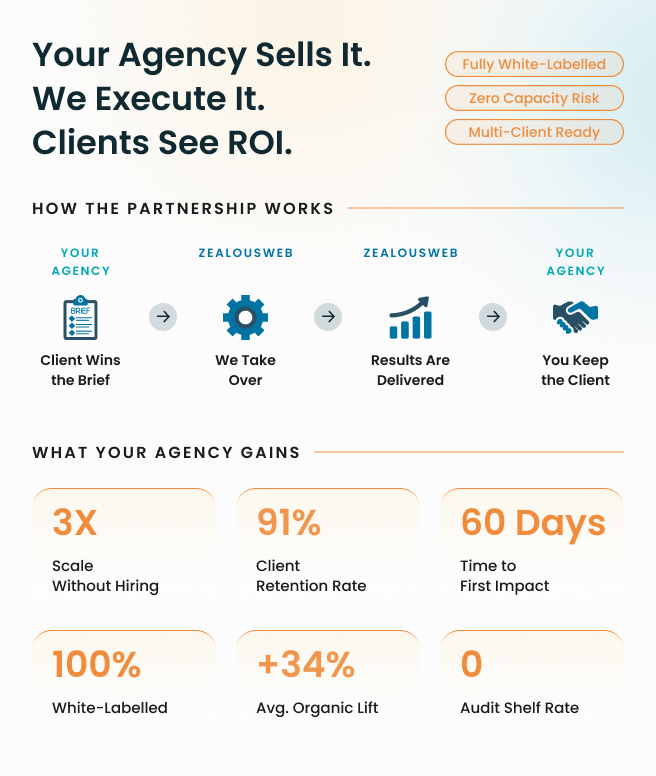
ZealousWeb Doesn't Fill a Gap. It Becomes the Execution Backbone Your Agency Was Missing
Technical SEO isn’t just recommendations—it’s consistent execution. Many agencies have strong audits but struggle to turn insights into measurable results under client pressure. ZealousWeb plugs directly into your workflow, handling the execution layer so your internal team stays focused on strategy, client relationships, and growth.
From crawl architecture to Core Web Vitals, schema, hreflang, JavaScript SEO, site migrations, redirect mapping, and log file analysis, ZealousWeb ensures that every technical fix translates into outcomes your clients can see and trust—all under your brand.
The result is scalable, controlled delivery: faster implementations, fewer review bottlenecks, consistent QA, and operational clarity even when client volume spikes. This isn’t outsourcing—it’s strengthening your agency’s backbone so growth doesn’t compromise quality or timelines.
Conclusion
Execution is where client trust is earned, and where measurable ROI is truly delivered. Agencies can craft perfect audits and strategy decks, but if recommendations stall in implementation, client confidence quietly erodes, and retention suffers.
ZealousWeb doesn’t just fill a temporary gap. It becomes the execution backbone your agency was missing — integrating seamlessly with your workflows, handling the full spectrum of technical SEO tasks, and ensuring every recommendation is turned into visible, client-facing results.
The agencies that thrive aren’t the ones who out-strategize their competitors—they’re the ones who out-execute them consistently. With ZealousWeb, your agency maintains brand ownership, strengthens delivery systems, scales without chaos, and gives clients the confidence that their SEO is moving forward every month.
This isn’t outsourcing—it’s structured operational empowerment for agencies serious about measurable growth, predictable results, and long-term client relationships.
Stop Losing Clients to Execution Gaps
Explore White-label Support

FAQs
Why should we hire a white-label SEO partner instead of scaling internally?
Internal teams often lack the depth and bandwidth for specialized technical SEO execution. ZealousWeb strengthens your delivery layer under your brand, ensuring consistent results without overloading your team.
How does ZealousWeb integrate with our existing workflows?
We plug directly into your processes — approvals, revisions, reporting — ensuring seamless execution while your internal team retains control over strategy and client relationships.
Will our clients know ZealousWeb is involved?
No. All work is delivered under your agency brand. Clients see results, velocity, and improvement, not the team behind it.
How does this partnership improve client retention?
By closing the gap between recommendations and implementation, clients experience consistent, visible progress on their sites. This velocity builds confidence and loyalty, reducing churn