



There’s a point most growing agencies reach where everything looks fine on the surface — the clients are coming in, the team is working hard, the revenue is moving. But underneath that, something feels permanently stretched. Deadlines get tighter. Delivery gets harder to manage. The founder ends up inside the work instead of above it. More people get hired, better tools get added — and yet the strain doesn’t really go away. It just changes shape. The interesting part? It’s rarely a talent problem. It’s rarely even a capacity problem. It almost always comes back to one thing — and it’s worth understanding what that actually is before assuming the usual fixes will work.
What Fast-Growing Agencies Are Actually Struggling With
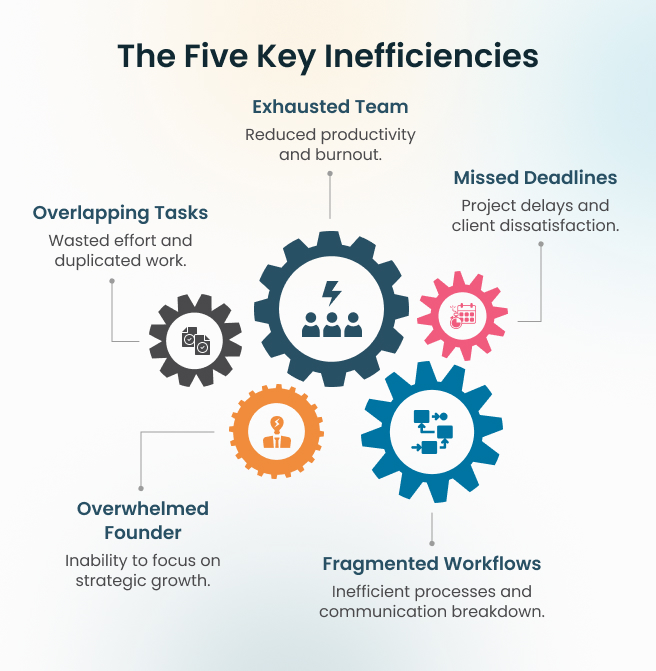
When you actually slow down and look at it honestly, the struggle isn’t one thing — it’s several things happening at the same time.
- Clients are signing faster than the delivery side can comfortably absorb them
- The quality of work shifts depending on who’s on the account that week — not because of a system, but because of the person
- New services get added to the deck because a client asked for them — not because the agency was set up to deliver them well
- Most of the leadership day goes into managing delivery instead of making decisions that move the business forward
- Hiring decisions get made months after they were actually needed — and by the time someone is up to speed, the gap has already grown
- Retainers get sold with confidence — and then quietly become the most operationally demanding accounts to hold
Growth is happening. That part is real. But the way the agency is operating hasn’t caught up with the pace of it, and that gap is where most of the friction lives.
The Shift — From Task Outsourcing to Execution Systems
Most agencies that try white-label outsourcing don’t get it wrong because they chose the wrong partner. They get it wrong because of how they approached it in the first place.
It usually goes like this — a task gets too heavy to handle internally, so it gets handed to an external team with a brief and a deadline. The external team delivers something. It gets reviewed, sent back, revised, and reviewed again. The back and forth takes longer than expected. The output doesn’t quite match the agency’s standard. Someone internally ends up reworking it anyway. And after a few rounds of this, the conclusion becomes: outsourcing doesn’t really work for us.
But that’s not an outsourcing problem. That’s a setup problem.
The brief was the system. The vendor was the system. And when there’s no real process underneath it — no clear standards, no defined handoff structure, no quality layer — the result depends entirely on whoever is available that day. That’s not a delivery model. That’s a gamble.
When white-label execution is structured right, it looks completely different. There’s a defined operating layer sitting between your agency and the client — one that runs on process, not people. Briefs go in clean. Work comes back consistent. Your brand stays intact. Your team stays focused on the client relationship. And the external partner is effectively invisible — not because they’re hidden, but because the integration is tight enough that there’s no visible gap.
That’s the difference between hiring a vendor for a task and building a delivery layer for your agency. One solves a short-term capacity problem. The other changes how your agency is able to grow.
To make that tangible, let’s walk through a few hypothetical scenarios — the kind of situations ZealousWeb regularly sees across growing agencies — and look at what the shift actually looks like when it’s made deliberately.
Use Case 01 — The Agency at Capacity
Let’s take a hypothetical but very familiar scenario. An agency where, on paper, everything looks fine. Proposals are getting signed, revenue is climbing, the team is working hard. But internally, the operation is already at its edge. And every new client that comes in starts to feel less like a win and more like a weight.
What Broke First
- Deliverables started going out late — not by much, but enough to notice
- Briefs stopped getting the attention they needed because three other things were always due the same week
- Account managers were working harder but producing thinner work
- The founder was back inside delivery, covering gaps instead of leading
How the Execution Layer Was Structured
- A white-label team was brought in to absorb specific, repeatable delivery work — not everything, just the predictable parts
- Clear briefs and defined turnaround standards were set before a single task moved
- A QA step was placed between the white-label team and the client output
- The internal team shifted from doing the work to managing the outcome
What Stabilized — And How Fast
- Within the first few weeks, the internal team had breathing room for the first time in months
- Delivery timelines held consistently across accounts
- Client communication improved because account managers weren’t buried in production
When the next client signed, it felt like a process to run — not a problem to solve
Use Case 02 — The Agency Expanding Service Lines
Now assume a different scenario — one that actually feels flattering at first. Existing clients start asking for more — a different service, a capability the agency hasn’t formally offered, something adjacent to what’s already being delivered. It feels like trust. And it is. But it also puts the agency in a position it hasn’t quite planned for — do you build the capability internally, or do you find another way to deliver it without the risk of doing it poorly under your own name?
The Build-vs-Partner Decision
- Building internally means hiring, training, and waiting — often six to nine months before the capability is actually reliable
- Saying no to the client means leaving revenue on the table and occasionally leaving the door open for a competitor
- Saying yes without a plan means delivering something the agency isn’t operationally ready for — and that risk sits entirely with the client relationship
- Partnering through a white-label model offered a middle path — the service gets delivered, the brand stays intact, and the agency doesn’t carry the operational weight of a new practice
How White-Label Was Deployed Without Diluting Quality or Brand
- The white-label team operated entirely under the agency’s brand — no external names, no visible seams
- Delivery standards were defined upfront and matched to what the agency’s existing clients already expected
- The internal team stayed as the client-facing layer — managing communication, context, and relationship
- Quality checkpoints were built into the workflow before anything reached the client
Revenue Unlocked Without Headcount Added
- New service lines started generating revenue within weeks, not quarters
- The agency’s existing client relationships deepened — more scope, longer retainers, higher trust
- No new hires were needed to support the expanded offering
- The model proved scalable — as demand for the new service grew, the white-label layer absorbed it without internal restructuring
Use Case 03 — The Agency With a Quality Consistency Problem
Here’s a third scenario — and this one is harder to spot. Assume an agency where, on the surface, everything is functioning. Work is going out, clients are being served, nothing is visibly on fire. But look a little closer and a pattern starts to emerge — some accounts are running smoothly, others feel like a constant negotiation, and the difference has very little to do with the client. It has to do with who internally is managing them. That’s not a people problem. That’s a systems problem.
Where the Inconsistency Was Actually Coming From
- Different account managers were interpreting briefs differently, with no shared standard to anchor against
- Institutional knowledge lived in people’s heads, not in documented processes
- Onboarding new team members meant a dip in quality that clients could feel before anyone internally noticed
- Senior team members were spending time fixing work rather than moving forward — and that cost was invisible on any report
How a White-Label Execution System Introduced Process Standardization
- The white-label partnership forced the agency to define what good actually looked like — brief formats, output standards, review criteria
- Those standards didn’t just apply to the white-label team — they became the agency’s internal operating baseline
- A consistent handoff structure meant that delivery no longer depended on who was available or how experienced they were
- Quality reviews became part of the workflow, not a reaction to something going wrong
What the Client Experience Looked Like After
- Clients stopped feeling the difference between accounts — the experience became predictably consistent
- Fewer revision rounds because the brief and output standards were aligned from the start
- Account managers spent less time apologizing and more time adding value to the relationship
- Retention improved — not because the agency won any dramatic moments, but because nothing quietly slipped anymore
What Every One of These Scenarios Is Really Pointing To
Three hypothetical agencies. Three different pain points. One at capacity, one expanding service lines, one struggling with delivery consistency. On the surface they look like separate problems — a bandwidth issue, a hiring decision, a quality gap.
But underneath each one is the same structural reality.
The agency had outgrown the way it was delivering work — and hadn’t yet built the execution infrastructure to match where the business had grown to. That gap is where most agency scaling problems actually live. Not in:
- The team
- The pricing
- The service offering
- But in the delivery architecture underneath all of it
This is also where most agency leaders spend the least amount of time — because when the business is growing, there’s rarely a quiet moment to step back and look at how work actually moves through the operation. What gets attention and what gets neglected usually breaks down like this:
- Pipeline conversations — always
- Client relationships — consistently
- Delivery systems, handoff standards, quality controls — reactively, when something goes wrong
What white-label execution actually does, when structured properly, is force that intentionality. It requires the agency to define:
- What good output looks like
- How work gets briefed and handed off
- Where quality gets checked
- Who owns what at every stage
Those aren’t just outsourcing decisions — they’re the foundations of a scalable agency delivery model. The agencies that scale without burning out their teams or diluting their client experience aren’t necessarily the ones with the most talent or the biggest budgets. They’re the ones that built an operating model their growth could actually run on.
That’s what these three scenarios are really pointing to. And it’s exactly what the right white-label execution partnership is designed to support.
How ZealousWeb Functions as an Execution Partner
Most agencies that reach out to ZealousWeb aren’t looking for more vendors. They’ve had vendors. What they’re looking for — even if they don’t articulate it this way — is an execution layer that works quietly in the background while they stay focused on what actually grows the business.
That’s exactly how ZealousWeb is built to function.
Not as a task list that needs constant supervision. Not as a freelance team that requires heavy briefing every single time. But as a structured delivery layer that sits underneath your agency — white-labeled, quality-controlled, and integrated tightly enough that your clients never feel the join.
Here’s what that looks like in practice:
- White-Label Delivery — Work goes out under your brand, your voice, your standards. ZealousWeb stays completely invisible to your clients
- Defined Execution Standards — Every engagement starts with a clear operating framework — brief formats, turnaround expectations, revision protocols, and quality benchmarks
- Built-In QA — Quality review is part of the process, not an afterthought. Work gets checked before it reaches your team, not after
- Flexible Capacity — The model scales with your pipeline. Busy periods get absorbed without emergency hiring. Slower periods don’t carry unnecessary overhead
- Single Point of Coordination — Your team works with one dedicated contact who understands your accounts, your standards, and your clients
The result is an agency that can take on more, deliver consistently, and grow without the operational strain that usually comes with it.
Conclusion
Growth doesn’t slow down while an agency figures out its delivery model — and the agencies that scale well are usually the ones that stopped trying to build everything from scratch internally. The right execution partner doesn’t add complexity. It quietly removes it. For agencies that are serious about scaling delivery without compromising what their clients experience, ZealousWeb works as that layer — structured, white-labeled, and built to fit inside what the agency has already built. The work stays yours. The systems just get stronger.
Ready to Stop Being the Bottleneck in Your Own Agency's Growth?
Show Me How It Works
FAQs
We already have processes. Won't adding a white-label layer just complicate them?
Good processes make white-label easier, not harder. ZealousWeb plugs into what already works — the only thing that changes is who executes the repeatable parts of it.
What's stopping a white-label partner from eventually pitching our clients directly?
Nothing contractual can replace trust — but ZealousWeb's entire business model depends on agency partnerships, not end clients. Poaching an agency's client would be commercially self-destructive. That's a stronger protection than any NDA clause.
We've tried outsourcing before and it damaged a client relationship. Why would this be different?
Because what damaged the relationship wasn't outsourcing — it was the absence of a handoff structure and quality standard. That's exactly what ZealousWeb builds before work begins, not after something goes wrong.
Can a white-label partner actually understand our niche well enough to deliver credibly?
Niche knowledge lives with your team. Execution excellence lives with ours. The model works because both sides stay in their lane — you own the strategy and client context, ZealousWeb owns the delivery infrastructure.
What if our agency grows to a point where we want to bring everything in-house?
That's a good problem to have. ZealousWeb documents everything — processes, standards, workflows — so if the time comes to transition in-house, you're not starting from scratch. You're inheriting a system.
Does working with a white-label partner affect how we position our agency to investors or acquirers?
It strengthens it. Scalable delivery infrastructure with documented systems and consistent output quality is exactly what investors and acquirers want to see — it signals the business isn't dependent on specific people.