
Fraud Blocker
ChatGPT Ads Cost Breakdown Guide

ChatGPT Ads Cost Breakdown for Businesses: Pricing, Budgets, CPC & ROI

November 12, 2026Posted By: Jalpa Gajjar
Advertising BudgetChatGPT AdsDigital AdvertisingPaid Advertising

ChatGPT Ads are opening a new advertising channel for businesses, but the real question isn’t whether you can advertise on ChatGPT. It’s whether the clicks, leads, and customers you acquire will justify the investment.

With conversation-driven ad placements, businesses can reach potential customers while they research products, compare services, and evaluate solutions. However, without understanding the pricing structure, bidding competition, and conversion potential, it’s easy to allocate a budget without knowing what returns to expect.

How Much Do ChatGPT Ads Cost for Businesses?

ChatGPT Ads require a minimum daily budget of $25 for USD accounts, with OpenAI recommending starting maximum CPC bids of 3–5. Businesses can choose CPC, CPM, or conversion-optimized pricing. At an assumed $5 average CPC, a $3,000 monthly budget could generate 600 clicks. With a 5% lead conversion rate, that’s 30 leads at $100 per lead. These are illustrative estimates, not guaranteed results.

The real cost of ChatGPT advertising goes beyond clicks and impressions. It depends on lead quality, customer acquisition costs, and the revenue those customers generate.

This guide breaks down ChatGPT Ads pricing, CPC and CPM benchmarks, minimum budgets, industry-specific costs, and ROI calculations, helping businesses determine how much to spend, what results to expect, and whether the investment makes financial sense.

How Much Do ChatGPT Ads Cost?

ChatGPT Ads have recommended starting maximum CPC bids of $ $5 , while third-party estimates suggest CPM costs of $25-$60 per 1,000 impressions . Actual costs depend on auction competition, ad relevance, and campaign objectives. These ranges are bidding guidance and indicative market estimates, not guaranteed advertising rates. OpenAI does not publish a fixed rate card or industry-wide average. Actual costs depend on advertiser competition, bid limits, and how relevant an ad is to a user’s conversation. For businesses, the more important question is how much qualified traffic those costs can produce.

Average CPC and CPM Benchmarks

ChatGPT advertising costs vary by campaign and industry. While OpenAI’s 5 recommendation provides a starting point for CPC bidding, reported CPM rates and actual click costs differ across advertisers.

Cost metric Reported pricing Business implication
Standard CPC $5 starting maximum bid Use as an initial bidding reference, not a guaranteed click cost
Competitive CPC $18 estimated Specialized B2B and financial services may require higher bids
CPM 60 reported Useful for estimating the cost of brand exposure
Actual CPC/CPM Auction-dependent Evaluate against qualified leads and customer acquisition costs


Consider two businesses paying $5 per click. A B2B software provider generating $8,000 in revenue from a new customer may comfortably absorb higher acquisition costs. An online retailer selling $30 products with thin margins has far less room to spend.

The same CPC can be profitable for one business and unsustainable for another. That is why ChatGPT Ads pricing should be evaluated against customer value, conversion rates, and acquisition economics rather than platform averages alone.

What Affects ChatGPT Advertising Costs?

ChatGPT Ads use a relevance-weighted, second-price auction. Advertisers compete for eligible placements, but the highest bid does not automatically win. OpenAI considers both bid competitiveness and expected ad relevance.

Four factors influence advertising efficiency:

  • Auction Competition: Advertisers targeting similar customer needs compete for placements. Stronger competition can increase the bids needed to achieve sufficient ad delivery.
  • Conversational Relevance: Ads aligned with a user’s research or purchase intent may compete more effectively. Poorly matched context hints can limit useful exposure.
  • Industry and Customer Value: Businesses selling high-value services may justify higher click costs because a single acquired customer can generate substantial revenue.
  • Ad and Landing Page Alignment: ChatGPT considers ad content and landing-page relevance. A disconnect between the user’s question, the advertisement, and the destination page can weaken relevance and reduce conversion potential.
Ad and Landing Page Alignment: ChatGPT considers ad content and landing-page relevance. A disconnect between the user’s question, the advertisement, and the destination page can weaken relevance and reduce conversion potential.

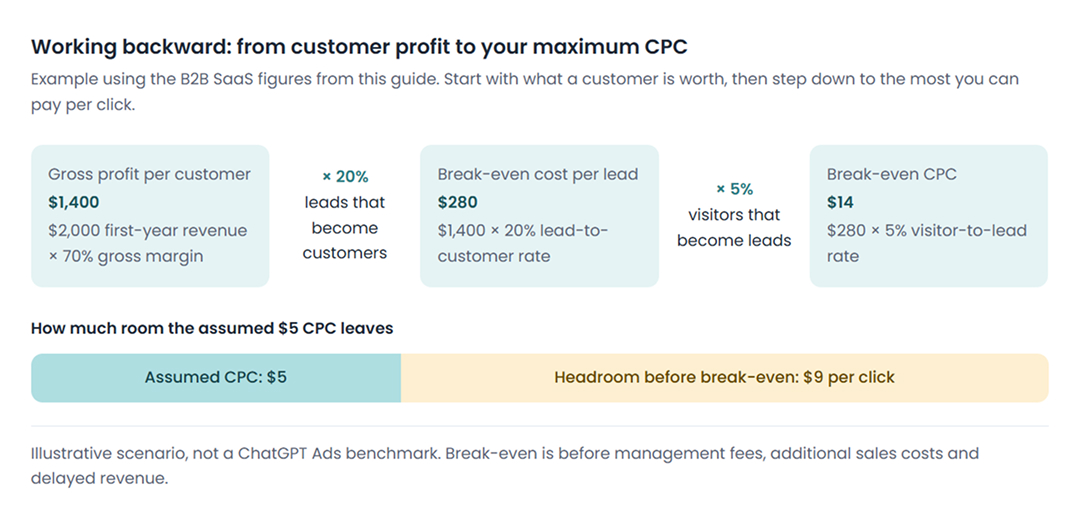
Break-Even CPC Calculation

What should businesses prioritize? Start with the maximum cost you can afford to acquire a profitable customer, then work backward to an acceptable cost per lead and CPC. This establishes a commercial bidding limit instead of treating the lowest available click price as the goal.

ChatGPT Ads Pricing Models Explained for Business

ChatGPT Ads offer four billing options: CPC, CPM, oCPC, and oCPM, across three campaign objectives: Clicks, Views, and Conversions. Businesses pay for valid clicks or impressions, not completed sales or leads. Choosing the right pricing model depends on whether the priority is brand visibility, website traffic, or customer acquisition.

CPC, CPM, oCPC and oCPM

According to OpenAI’s campaign pricing guidelines, each pricing model supports a different advertising objective.

Pricing Model How Business Pay Best Business Use
CPC (Cost per Click) Per valid click Driving product page visits, service inquiries, and website traffic
CPM (Cost per 1,000 Impressions) Per 1,000 impressions Building awareness for new products or entering new markets
oCPC (Optimized CPC) Per valid click, with conversion-focused delivery Generating qualified leads, demo requests and purchases
oCPC (Optimized CRM) Per 1,000 impressions, with conversion-focused delivery Reaching potential customers who may convert after viewing an ad.


For a B2B software company, oCPC may be more suitable than standard CPC when the objective is generating demo requests rather than attracting visitors. However, conversion optimization requires proper tracking and a supported standard conversion event.

The distinction: oCPC and oCPM optimize toward conversions but do not charge per conversion. Businesses still need to measure their actual cost per qualified lead or customer to determine profitability.

How the ChatGPT Ads Auction Works

ChatGPT Ads use a relevance-weighted, second-price auction. This means the highest bidder does not automatically win an ad placement. OpenAI evaluates bid competitiveness alongside how closely an advertisement matches the user’s conversational intent.

Consider two accounting software companies competing for users exploring invoice automation. One offers a higher bid but sends visitors to a generic homepage. The other offers a competitive bid with messaging and a landing page specifically addressing invoice automation.

The second advertiser may compete more effectively because its ad is better aligned with the conversation. However, relevance does not guarantee a lower price or placement.

What this means for your business: Increasing bids is not the only way to compete. Align your context hints, ad messaging, and landing pages with specific customer problems. Then evaluate whether the resulting clicks produce qualified leads at an acceptable acquisition cost.

What Is the Minimum ChatGPT Ads Budget for Businesses

The minimum ChatGPT Ads budget is $25 per day for USD accounts, equivalent to approximately $750 over 30 days at full daily-budget delivery. However, meeting the minimum spend requirement doesn’t guarantee enough traffic or conversions to evaluate profitability. Businesses testing lead generation should consider a larger budget based on their target cost per lead, conversion rate, and customer acquisition goals.

Daily vs Total Campaign Budgets

OpenAI offers two campaign budget options, each providing different levels of spending control.

Budget Type How It Works Business Consideration
Daily budget Averages spending over seven days, with individual days reaching up to 2× the daily amount Suitable for ongoing campaigns and gradual optimization
Campaign-Total budget Limits spending to a fixed amount over the campaign duration Suitable for controlled tests, launches, and fixed marketing allocations.


A business setting a $100 daily budget could spend up to $200 on a particular day, but no more than $700 over the applicable seven-day period, assuming the budget remains unchanged.

Why this matters: A daily budget controls average spending, not daily cash outflow. Businesses working with fixed campaign allocations should choose the budget type that matches their financial limits.

Monthly Budget Examples for Businesses

How much should your business spend on ChatGPT Ads? The answer depends on the volume of qualified leads needed to evaluate performance.

The following scenarios assume a $5 average CPC and a 5% visitor-to-lead conversion rate.

Monthly AD Budget Estimated Clicks Estimated Leads Cost Per Leads
$750 100 7-8 ~$100
$1500 300 15 $100
$3000 600 30 $100
$5000 1000 50 $100


Illustrative projections based on fixed CPC and conversion-rate assumptions, not guaranteed ChatGPT Ads benchmarks.

For a B2B business with a 20% lead-to-customer conversion rate, a $3,000 campaign generating 30 leads could produce six customers at a $500 advertising cost per acquisition. Whether that is profitable depends on gross profit per customer, fulfillment costs, and any additional sales or management expenses.

The business takeaway: Don’t select a ChatGPT advertising budget simply because it’s affordable. Estimate how many leads you need, what you can profitably pay to acquire a customer, and whether the budget provides enough data to make an informed investment decision.

ChatGPT Ads Cost Breakdown by Industry

ChatGPT advertising costs vary across industries because customer value, competition, and purchasing behavior differ. A $10 click may be profitable for a SaaS company selling annual subscriptions but difficult to justify for a retailer selling $25 products. Since OpenAI does not publish verified industry-wide CPC averages, businesses should evaluate advertising costs against conversion potential, profit margins, and customer lifetime value.

B2B, SaaS and Professional Services Businesses

For B2B and service-based businesses, cost per qualified lead matters more than cost per click. A SaaS provider may acquire fewer leads than an ecommerce retailer, but one enterprise contract can justify a considerably higher customer acquisition cost.

ChatGPT’s conversation-based ad matching can help businesses reach users researching specific operational challenges, software capabilities, or professional services.

Business Type Potential Customer Intent Priority Metric
B2B SaaS Comparing CRM or automation platforms. Cost per sales-qualified leads
Professional Services Evaluating consultants or service providers. Cost per booked consultation
Enterprise Solutions Researching software implementation. Customer acquisition cost


Consider a SaaS company paying an assumed $10 CPC. If 100 clicks generate five qualified demo requests, its advertising cost per qualified lead is $200. If one becomes a customer, the advertising acquisition cost is $1,000.

The critical question is whether the customer’s expected gross profit justifies that investment, particularly when sales cycles involve multiple stakeholders and delayed conversions.

E-commerce and Consumer Business

E-commerce businesses face a different challenge: the cost of acquiring a customer must leave enough margin after product, shipping, fulfillment, and advertising expenses.

ChatGPT Ads may be relevant when shoppers compare product specifications, assess alternatives, or research purchases requiring more consideration.

Business Type Potential Customer Intent Priority Metric
Electronics Comparing product specifications ROAS and purchase conversion rates
Home & Furniture Researching features and suitability Cost per acquisition
Fashion & Accessories Exploring products and alternatives Contribution margin per order


A retailer earning $20 in contribution margin before advertising cannot sustainably spend $25 to acquire a single-purchase customer unless repeat purchases or additional customer value offset that loss.

This makes average order value, conversion rate, and repeat purchase behavior essential when assessing ChatGPT Ads ROI.

For both B2B and consumer businesses, the strongest starting point is not an industry-wide CPC estimate. It is knowing how much the business can afford to pay for a customer while preserving profitability.
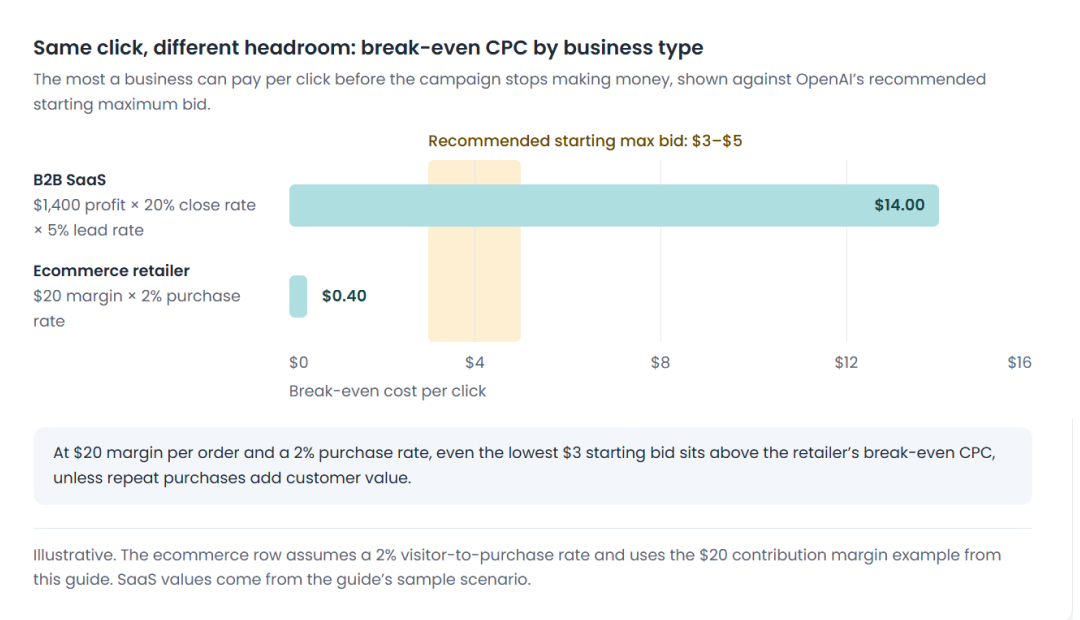
E-commerce CPC Comparison

How Does ChatGPT Ads Targeting Affect Your Costs?

ChatGPT Ads targeting can influence cost per qualified lead, even when CPC remains at $5. At that click cost, a 2% landing-page conversion rate produces leads at $250 each, while a 5% conversion rate reduces the cost to $100. The difference is whether your ads reach users with needs your business can actually fulfill.
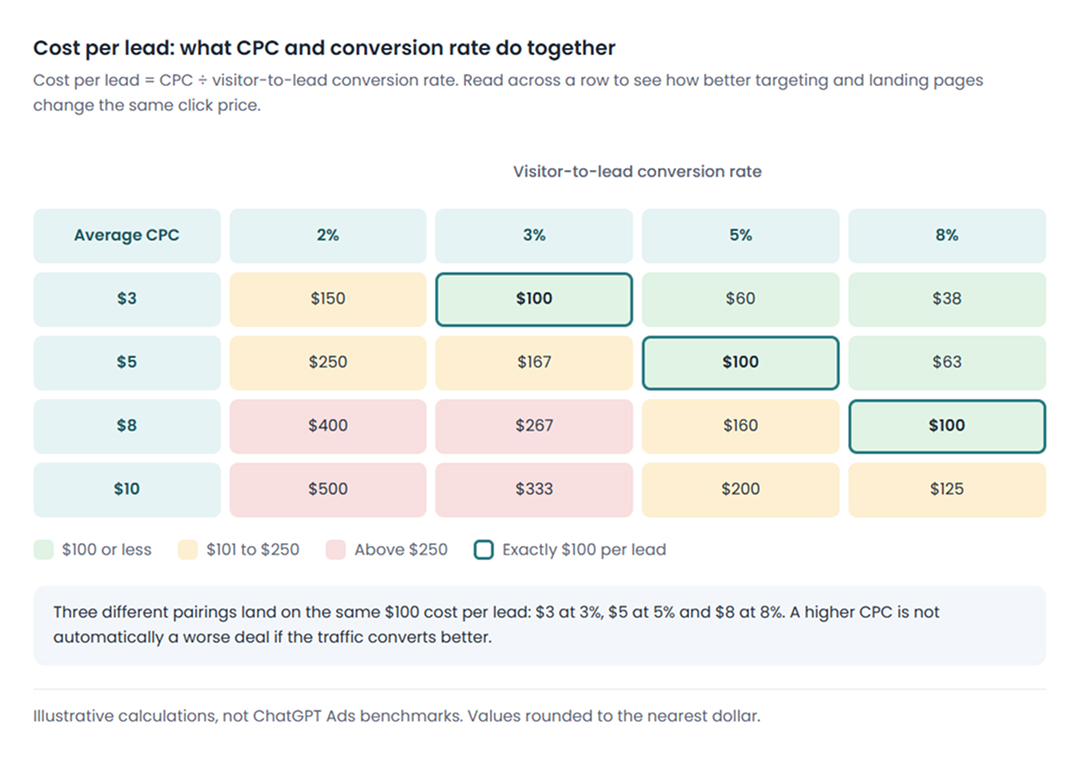
ChatGPT Ads Cost Comparison

Conversational Intent and Context Hints

Unlike Google Search’s keyword-driven targeting, ChatGPT Ads consider conversational context to identify relevant advertising opportunities. Businesses can provide context hints describing their products, ideal customer needs, and situations where their services are useful.

Consider a SaaS company selling inventory management software:

Broad Content Hint Business-Specific Context Hint
Inventory software Inventory management for multichannel retailers struggling with stock discrepancies
Business automation Software for retailers automating inventory updates across online and physical stores


The more specific descriptions clarify which customer problems the software addresses. This can improve matching relevance, although it does not guarantee cheaper clicks or placements.

OpenAI recommends organizing ad groups around distinct customer needs. For businesses, separating use cases also makes it easier to identify which customer problems generate valuable inquiries.

Geographic and Audience Targeting

ChatGPT Ads allow businesses to select eligible geographic markets, but minimum advertising budgets depend on account billing currency, not the country being targeted. Businesses should also consider local customer demand, campaign eligibility, and market restrictions before allocating advertising spend.

Country/ Market Minimum Daily Budget 30-Day Budget Equivalent Key Business Consideration
United States $25 USD $750 Regional targeting can support local and national campaigns
United Kingdom £15 £450 Consider regional demand and customer acquisition costs
Canada C$25 C$750 Seperate regional campaigns, where customer demands differs
Australia A$25 A$750 Focus spending on markets the business can serve
Germany €15 €450 EEA AD Personalization restrictions affect audience options
India ₹725 ₹21,750 Assess leads quality and conversions, economics by market
United Arab Emirates AED 65 AED 1,950 Verify market eligibility before committing budget


Figures reflect OpenAI’s published minimum daily budgets by billing currency , not guaranteed country-specific advertising rates. The 30-day figures are calculated budget equivalents, not mandatory monthly spend.

For businesses advertising internationally, market availability is as important as budget. Some new self-service accounts must complete verification and meet home-market spending requirements before advertising in additional supported countries.

Geographic targeting also does not guarantee lower CPC. Businesses should compare qualified leads and customer acquisition costs across markets before increasing their budgets.

How to Calculate ChatGPT Ads ROI

A business spending $3,000 on ChatGPT Ads and generating $12,000 in attributable revenue achieves a 300% return on ad spend (ROAS), but not necessarily a 300% ROI. Actual profitability depends on customer acquisition costs, product or service margins, and campaign expenses. Businesses should measure revenue and profit against advertising investment rather than judging performance by clicks alone.

CPC, CPL, CPA and ROAS Formulas

Four metrics help businesses understand whether ChatGPT advertising is generating profitable results:

  • Cost Per Click (CPC): Total ad spend ÷ Total clicks. Measures the cost of attracting website visitors.
  • Cost Per Lead (CPL): Total ad spend ÷ Leads generated. Shows how much the business pays for each inquiry or lead.
  • Cost Per Acquisition (CPA): Total ad spend ÷ Customers acquired. Measures advertising cost per paying customer.
  • Return on Ad Spend (ROAS): Revenue attributed to ads ÷ Ad spend. Shows how much revenue each advertising dollar generates.

To calculate ChatGPT Ads ROI, subtract the total campaign-related costs from the attributable profit before those costs, divide by the total campaign-related costs, and multiply by 100. A strong ROAS can still produce a negative ROI if fulfillment costs, sales expenses, and advertising management fees consume the revenue generated.

Sample ROI Calculation for a Business:

Consider a B2B SaaS company investing $3,000 in ChatGPT Ads to generate software demo requests. At an assumed average CPC of $5, the campaign generates 600 website visits. If 5% of visitors request a demo, the business receives 30 leads at a $100 CPL.

Suppose the sales team converts 20% of those leads into paying customers. That produces six customers at a $500 advertising CPA.

If each customer generates $2,000 in first-year revenue, total attributable revenue reaches $12,000, delivering 4× ROAS. Now assume the company retains 70% of that revenue as gross profit before advertising, or $8,400. After subtracting the $3,000 ad spend, the campaign generates $5,400 in contribution profit, equivalent to 180% ROI on advertising spend.

This is an illustrative scenario, assuming all six customers and their first-year revenue are attributable to the campaign. Management fees, additional sales costs, and delayed revenue recognition would change the final ROI.
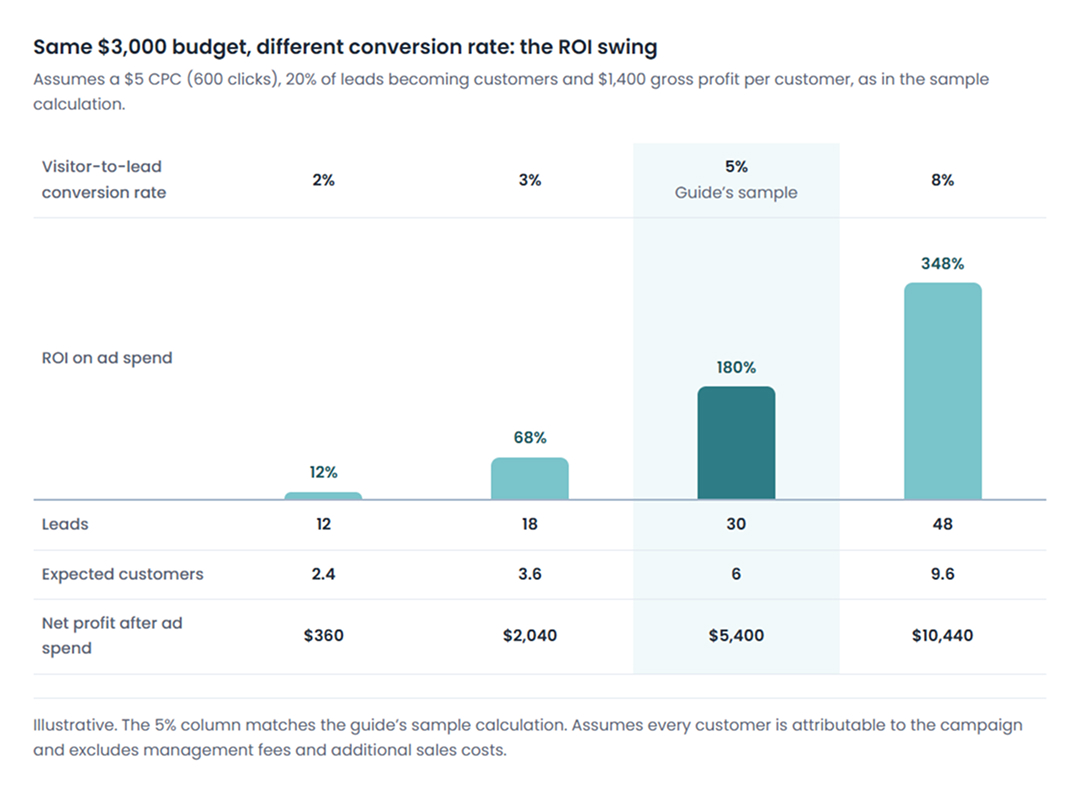
ChatGPT Ads ROI Calculation

The business takeaway: A campaign isn’t profitable simply because it generates leads. Track which inquiries become customers, how much revenue they produce, and whether the resulting profit exceeds the full cost of acquiring them. OpenAI’s conversion tracking guidance provides the foundation for measuring conversion events, but businesses must connect that data with their CRM and sales records to evaluate actual returns.

ChatGPT Ads vs Google Ads vs Meta Ads: Cost Comparison

At an assumed $5 CPC, a $3,000 ChatGPT Ads budget could generate 600 clicks, but cheaper traffic does not necessarily mean better ROI. Google Ads captures active search demand, Meta Ads reaches audiences through interest and behavioral signals, while ChatGPT Ads matches advertisements with conversational intent. For businesses comparing advertising costs, the deciding metric should be cost per qualified customer, not cost per click alone.

Comparison Factor ChatGPT Ads Google Ads Meta Ads
Pricing models CPC, CPM, oCPC, oCPM CPC, CPM, and conversion-focused bidding Primarily impression-based, with other billing options
CPC Benchmark 5 recommended starting maximum bids Auction-dependent CPC Varies by audience, placement, and competition
Targeting Approach Conversational intent and context hint Search keywords and audience signals Interests, behavior, and audience signals
Business Advantage Researching problems and comparing solutions Actively searching for products or services Discovering products or responding to promotions
Primary ROI Metric Reaches users exploring relevant needs Captures existing purchase intent Builds demand and supports remarketing
Primary ROI Metric Qualified CPL and CPA CPA and ROAS CPA and ROAS


Consider a B2B company spending $3,000 on each platform. At an assumed $5 CPC, ChatGPT Ads generate 600 clicks. If 3% convert into qualified leads, that’s 18 leads at approximately $167 each. Meanwhile, Google Ads at an assumed $8 CPC delivers 375 clicks. If 8% convert, it generates 30 leads at $100 each.

These are illustrative scenarios, not actual platform benchmarks. They demonstrate why a higher CPC can produce a lower cost per qualified lead when traffic converts more effectively.

For businesses already generating profitable results through Google or Meta, ChatGPT Ads should initially complement those channels rather than replace them. Compare lead quality, sales conversion rates, and customer acquisition costs before reallocating substantial budgets.

Are ChatGPT Ads Worth It for Your Business?

ChatGPT Ads may be worth testing if your business can turn a 200 qualified lead into a profitable customer. At an assumed $5 CPC and a 5% lead conversion rate, acquiring 20 leads costs $2,000. If two become customers, your advertising cost per acquisition is $1,000. Whether that investment makes sense depends on customer margins, sales cycles, and lifetime value-not the number of clicks generated.

Businesses Most Likely to Benefit

ChatGPT Ads can be particularly relevant to businesses selling products or services that require research, comparison, or consultation before purchase.

  • B2B and SaaS: Companies offering CRM, automation, cybersecurity, or enterprise software can reach users researching operational problems and evaluating solutions
  • Professional Services: Consulting, legal, and financial service providers may benefit from attracting prospects investigating complex service requirements, subject to applicable advertising policies
  • High-Consideration Ecommerce: Businesses selling electronics, furniture, or specialized equipment can reach shoppers comparing specifications, suitability, and alternatives

These opportunities align with OpenAI’s conversation-based advertising approach, which considers user intent and advertisement relevance when selecting placements.

The advantage is not guaranteed higher conversion rates. It’s the opportunity to connect advertising with specific customer needs during the research process.

When ChatGPT Ads May Not Be Cost-Effective

ChatGPT advertising may be difficult to justify when customer acquisition costs exceed the profit a business can generate.

  • Low-Margin Products: A retailer earning $15 in contribution margin per order cannot profitably sustain a $50 acquisition cost without sufficient repeat purchases
  • Impulse-Driven Purchases: Products relying heavily on spontaneous visual discovery may benefit more from channels designed around browsing and product inspiration
  • Unproven Conversion Funnels: Businesses without effective landing pages, lead qualification, or sales follow-up risk paying for traffic they cannot convert
  • Limited Measurement: Without conversion tracking, businesses cannot reliably assess which advertising interactions produce valuable actions

The deciding factor: ChatGPT Ads are worth testing when your business has sufficient customer value, a clear acquisition goal, and the ability to measure outcomes. If those fundamentals are missing, increasing advertising spend will only make the underlying problems more expensive.

How to Plan a Cost-Effective ChatGPT Ads Campaign

A $3,000 ChatGPT Ads test budget could generate 600 clicks at an assumed $5 CPC, but the real objective is identifying which clicks become qualified customers. Businesses should start with one measurable conversion goal, build campaigns around specific customer needs, and establish an acceptable acquisition cost before scaling. Otherwise, higher spending may simply increase unqualified traffic.

Follow these five steps to build a cost-effective ChatGPT advertising strategy:

  • Set a Customer Acquisition Target: Determine your maximum acceptable cost per customer using expected gross profit, sales conversion rates, and acquisition expenses. This gives your campaign a financial benchmark beyond CPC.
  • Organize Campaigns by Customer Need: Create separate ad groups and context hints for distinct use cases. A CRM provider, for instance, should differentiate between businesses struggling with lead follow-ups and those needing sales pipeline reporting.
  • Match Ad Messaging to Landing Pages: Explain the specific problem your solution addresses. A prospect researching automated lead nurturing should reach a page demonstrating that capability, not a generic software homepage.
  • Track Conversions Before Scaling: Implement the OpenAI Pixel or Conversions API to measure relevant actions. Connect those results with CRM records to identify which inquiries become sales-qualified leads and paying customers.
  • Optimize Using Business Results: Review CPC, qualified CPL, conversion rates, and acquisition costs. Shift spending toward customer needs and ad variations producing stronger commercial outcomes, rather than increasing budgets solely because ads generate clicks.

OpenAI’s campaign reporting tools provide visibility into impressions, clicks, spending, and tracked conversions. However, businesses still need their own sales data to evaluate lead quality and profitability.

The goal isn’t to spend the entire advertising budget. It’s to establish a repeatable acquisition process where every additional dollar has a measurable opportunity to generate profitable business.

Plan Your ChatGPT Advertising Budget With ZealousWeb

A $3,000 ChatGPT Ads budget could generate 600 clicks at an assumed $5 CPC, but clicks alone won’t determine profitability. The real challenge for businesses is identifying which conversations attract qualified buyers, how much those customers cost to acquire, and when advertising spend deserves to scale.

ZealousWeb brings strategic planning, paid advertising expertise, and conversion-focused execution together to turn ChatGPT advertising into a measurable customer acquisition opportunity. From evaluating budget feasibility and identifying high-intent audiences to developing relevant campaigns, optimizing landing pages, and tracking conversions, every decision is tied to commercial outcomes.

Whether you’re exploring ChatGPT Ads or comparing their potential against established Google and Meta campaigns, ZealousWeb helps you make informed investment decisions backed by acquisition economics, not assumptions.

Make every advertising dollar accountable to your business goals.

Conclusion

ChatGPT Ads start at $25 per day for USD accounts, with recommended maximum CPC bids of 5, but profitable advertising requires more than competitive click costs. The right investment depends on your industry, customer lifetime value, conversion rates, and ability to turn conversational intent into qualified leads.

For businesses, the opportunity isn’t simply to advertise on another platform. It’s to reach potential customers as they evaluate solutions and make purchasing decisions. The challenge is knowing which conversations are commercially valuable, how much to bid, and whether the resulting customers justify the spend.

ZealousWeb connects ChatGPT Ads strategy, budget planning, audience relevance, and conversion optimization with measurable business outcomes. Build your next advertising investment around acquisition economics, not assumptions.

Get Your ChatGPT Ads Budget Assessment

Talk to Our Experts
AI Marketing Growth

FAQs

Related Blog Posts

Landing page optimization for paid ads performance

Landing Page Mistakes Hurting Your Paid Ads? How to Fix Them

September 22, 2026
conversion rate optimizationLanding Page OptimizationPaid AdvertisingPerformance Marketing
White Label PPC

Why White-Label PPC Can Cost 40% Less Than Hiring In-House

September 22, 2026
Agency GrowthPaid Media ServicesPPC OutsourcingWhite-Label PPC
Diagnosing Ad Performance Drop

How to Diagnose a 30% Drop in Client Ad Performance in 15 Minutes

September 17, 2026
Campaign PerformanceGoogle AdsMeta AdsPaid Media
delivery systems for agencies

Why Good Workflows Fail at Scale and How Agencies Can Build Delivery Stability

May 20, 2026
Delivery Managementexecution systemwhite-label agencyworkflow clarity
ChatGPT for SEO

ChatGPT For SEO: The Future Of Optimized Content In Digital Marketing

January 23, 2024
AI ImpactContent WritingSEO Strategies
ChatGPT’s AI Impact on SEO Content Writing

ChatGPT’s Impact On SEO Content Writing In 2024

January 09, 2024
AI ImpactContent WritingSEO Strategies
LinkedIn for Business Growth

9 Reasons LinkedIn Is Essential For Business Growth In 2024

December 27, 2023
Growth HackingLinkedIn StrategiesNetworking Tips
Google Lead Form Extension

How Do Google Lead Form Extensions Supercharge PPC Campaigns In 2024?

December 13, 2023
Campaign AnalyticsConversion TipsLead Forms Benefits