


ChatGPT Ads allow businesses to advertise alongside relevant AI conversations through sponsored placements. To advertise on ChatGPT, create an Ads Manager account, choose your campaign objective and budget, define conversational context hints, and launch relevant ads. Advertisers can use CPC or CPM pricing and measure performance through clicks, impressions, conversions, and other campaign metrics.
Key Summary: What You’ll Learn
- How ChatGPT Ads Work: Understand sponsored placements, conversational targeting, and how ads differ from traditional search advertising.
- Advertising Costs & Eligibility: Learn who can advertise, where ChatGPT Ads are available, and how CPC, CPM, and campaign budgets work.
- Campaign Setup & Ad Examples: Explore how to launch campaigns, write relevant ads, and use context hints to reach potential customers.
- Performance & Optimization: Learn which metrics matter, how to track qualified leads, and how to improve campaign results.
- ChatGPT Ads vs Google & Meta Ads: Understand where each platform fits and how to allocate advertising budgets.
- Business & Agency Opportunities: Identify suitable industries, potential revenue streams, and ways to test ChatGPT Ads over 90 days.
- ChatGPT Ads & GEO: Understand how paid advertising and organic AI visibility work together without influencing each other’s placements.
What Are ChatGPT Ads and Why Do They Matter?
ChatGPT Ads are paid placements that help businesses reach potential customers as they research products, compare services, and make decisions through AI conversations. According to OpenAI’s October 21, 2026 announcement, ChatGPT had 1.2 billion weekly users, more than 100,000 advertisers had run campaigns, and advertising availability had expanded to 89 countries. For businesses, this creates another way to reach buyers before they choose whom to contact or buy from.
How Does Advertising on ChatGPT Work?
Traditional search advertising often starts with a keyword. ChatGPT advertising can use the broader context of a conversation to understand what someone is trying to accomplish.
Consider a business selling accounting software.
On Google, a potential customer might search “accounting software.” That tells the advertiser what product interests them, but not necessarily what problem they need to solve.
On ChatGPT, the same person might ask:
“I run a small business with 15 employees. Our accountant spends hours reconciling invoices every month. What accounting software could help us automate this?”
That conversation reveals more than product interest. It provides the business size, an operational problem, and a reason to consider purchasing software.
ChatGPT’s advertising system uses conversational intent alongside signals such as ad copy, landing pages, and advertiser-provided context hints to determine which sponsored placements may be relevant.
The opportunity isn’t simply reaching someone interested in accounting software. It’s reaching someone who has already explained the business problem the software could solve.
That distinction matters when businesses are spending money to generate qualified leads rather than traffic alone.
What Do ChatGPT Ads Look Like? Ad Formats and Placements
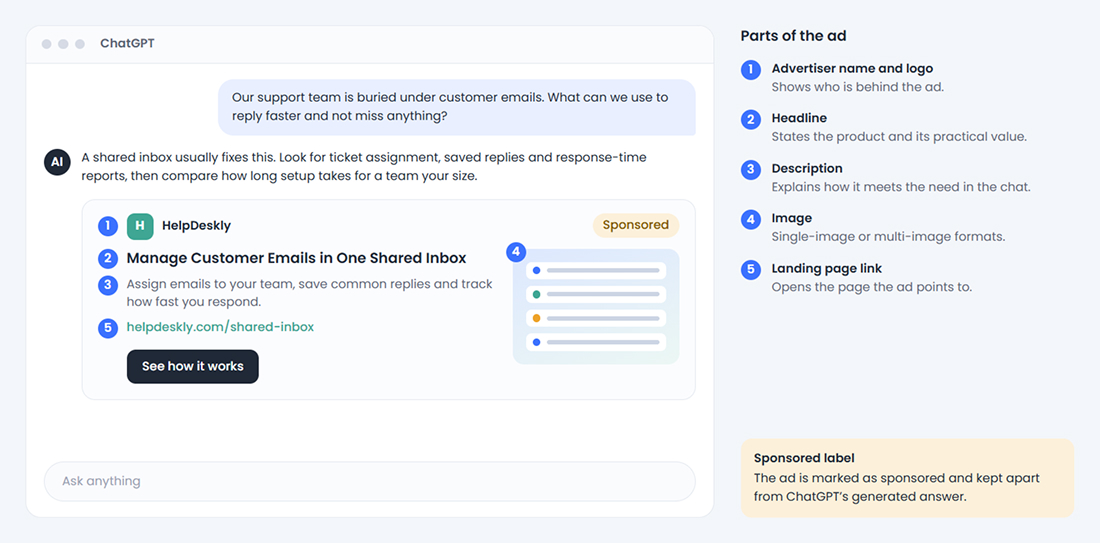
ChatGPT Ads appear separately from AI-generated answers and are clearly identified as sponsored content.
According to OpenAI’s advertising documentation, a standard ad can contain an advertiser name, logo, headline, description, image, and landing page link.
The platform also supports single-image and multi-image creative formats, depending on the campaign setup. Unlike an organic ChatGPT answer, an advertisement is a paid placement. Paying for an ad does not influence which businesses ChatGPT recommends in its generated response. For advertisers, this creates two distinct visibility opportunities: appearing through paid advertising and being discovered organically through relevant AI-generated answers.
Why Advertise on ChatGPT?
A business can spend thousands attracting website visitors and still struggle to generate enquiries because the traffic does not reflect a strong buying need. The problem is not always visibility. Sometimes it is reaching people before they have clearly identified what they need, or continuing to advertise to audiences who are not ready to act.
ChatGPT Ads offer another way to approach this challenge.
Consider three everyday business situations:
| Business | Potential ChatGPT Conversations | Advertising Opportunity |
| Accounting software company | How can I reduce the time my team spends processing invoices? | Reach businesses researching invoice automation |
| Hotel booking platform | Where should I stay in London with two children, close to public transport? | Show relevant family accommodation options |
| Digital marketing agency | “We get website traffic from Google Ads, but very few leads. What should we fix?” | Reach businesses evaluating conversion and marketing support |
These examples illustrate potential advertising opportunities, not guaranteed ad placements. The business value comes from matching the advertisement to an expressed need. A relevant message, followed by a useful landing page, can give someone a clearer next step.
For companies managing paid advertising, ChatGPT Ads are not necessarily a replacement for Google Ads or Meta Ads. They offer an additional opportunity to reach potential customers during research and evaluation, when the customer may still be deciding which solution makes sense.
The question is no longer only “How do we attract more traffic?” It is also “Are we reaching people when they’re explaining the problem our business can solve?”
Where Are ChatGPT Ads Available and Who Can Advertise?
ChatGPT advertising is now accessible across major international markets, allowing businesses and agencies to explore campaigns beyond their home countries. However, advertiser location, industry eligibility, and the countries a campaign can target are three separate considerations. Understanding these differences matters before committing an advertising budget.
Where Are ChatGPT Ads Available Worldwide?
ChatGPT Ads are available across North America, Europe, Asia-Pacific, the Middle East, Latin America, and Africa. Businesses in supported countries can access OpenAI’s Ads Manager, while some markets also offer advertising support through approved partners.
Here are some of the significant markets where self-service Ads Manager is available:
| Regions | Significant Markets | Minimum Daily Budgets | What Advertisers Should Know |
| North America | USA, Canada, Mexico | USD 25 / CAD 25 / MXN 150 | Businesses targeting multiple countries should verify whether international targeting is enabled. |
| Europe | UK, Germany, France, Italy, Spain, Netherlands, Switzerland | GBP 15 / EUR 15 / CHF 20 | Advertisers should consider country-specific policies, languages, and audience preferences. |
| Asia-pacific | India, Australia, Japan, Singapore, South Korea, Malaysia, Indonesia | INR 725 / AUD 25 / JPY 2,500 / SGD 25 | Market-specific messaging and landing pages matter when advertising across different languages and buyer needs. |
| Middle East | UAE, Saudi Arabia, Qatar, Bahrain, Kuwait, Oman | AED 65 / SAR 50 / QAR 60 | Advertisers should check local industry restrictions and use appropriate English or Arabic messaging. |
| Latin America | Brazil, Argentina, Chile, Colombia, Peru, Uruguay | BRL 40 / CLP 3,750 / COP 10,000 | Spanish- or Portuguese-language campaigns may be more relevant depending on the target market. |
| Africa | South Africa, Nigeria, Kenya, Egypt, Morocco | ZAR 83 / NGN 3,250 | Advertisers should confirm available billing currencies, geographic targeting, and eligible industries. |
Minimum budgets are based on the advertising account’s billing currency, not automatically on the country being targeted. Only selected supported currencies are shown. Figures come from OpenAI’s official campaign setup documentation . These are platform minimums, not recommended budgets or estimates of actual campaign costs
Can Businesses Advertise Outside Their Home Country?
Yes, subject to account eligibility. For example, an Indian SaaS company may want to reach US customers, but some new self-service accounts can initially advertise only in their home country. International targeting may become available as the account establishes its history. OpenAI explains these limitations in its geographic targeting guidelines.
For businesses expanding internationally, the decision is not just where ChatGPT Ads are available. It is whether their account can reach the intended market, whether their industry is eligible, and whether their campaign budget supports meaningful testing.
How Does ChatGPT Ad Targeting Work?
ChatGPT Ad targeting matches sponsored placements to conversational intent rather than relying only on individual search keywords. In an SE Ranking study of over 50,000 commercial prompts across 20 industries, ads appeared in 25.94% of prompts, although 14.35% of observed ads were considered irrelevant. For advertisers, accurate context hints, relevant creatives, and landing pages matter because ad visibility alone doesn’t guarantee qualified traffic.
Conversational Context vs Traditional Keyword Targeting
A customer searching for a product doesn’t always explain why they need it. That’s where conversational targeting offers a different way for advertisers to understand purchasing intent.
Google Search Ads largely work around search terms, keywords, and bidding signals. ChatGPT Ads consider what someone is trying to accomplish throughout a conversation, even when they never mention a specific product or brand.
Consider a company selling CRM software.
On Google, a business owner might search: “Best CRM software.”
On ChatGPT, the same business owner might ask:
“We have a sales team of 12 people. Leads come in through our website, but follow-ups are getting missed, and we’re losing track of who contacted whom. What’s the easiest way to fix this?”
Both searches suggest potential interest in CRM software. However, the ChatGPT conversation reveals why the business needs it: missed follow-ups, poor lead management, and a sales team struggling to stay organized.
A CRM advertiser can use this information to develop messaging around lead tracking and automated follow-ups rather than promoting a generic list of software features.
This is an important distinction for businesses spending money on paid advertising. A customer describing a problem may be closer to evaluating a solution than someone merely searching for a product category. That doesn’t make every conversational ad impression high-intent, but it offers a different signal for matching advertisements to customer needs.
Here’s how the targeting approaches compare:
| Targeting Factor | Google Search Ads | ChatGPT Ads |
| Primary relevance signal | Search query, keywords, and other auction signals | Conversation context, user intent, and ad relevance signals |
| Customer expression | Often a short phrase | Questions, explanations, and follow-up conversations |
| Advertiser input | Keywords, match types, audience signals, and bidding | Context hints, ad copy, landing pages, targeting controls, and bidding |
| Intent interpretation | Search teams and supporting signals help identify intent | Context can reveal the problem, requirements, and evolving goal |
| AD matching | Keyword- and auction-based eligibility and ranking | Contextual relevance, eligibility checks, predicted outcomes, and auction |
| Main challenge | Competing for relevant searches and managing keyword efficiency | Describing relevant use cases accurately and improving contextual relevance |
OpenAI’s technical explanation of its ChatGPT advertising system confirms that the platform evaluates conversational relevance, campaign eligibility, predicted engagement, and auction signals when selecting ads.
Unlike a conventional keyword-triggered system, the matching process can account for how a user’s needs develop over several messages.
For advertisers, this changes how campaign research should begin. Instead of asking only, “Which keywords should we target?” they also need to ask, “What problems are our customers describing before they start searching for our product?”
How Do Prompts, Conversation History, and Context Hints Influence Ad Matching?
ChatGPT doesn’t select an advertisement simply because a user mentions a particular word. Its ad matching system evaluates several signals to determine whether an advertiser’s offering is relevant to the conversation.
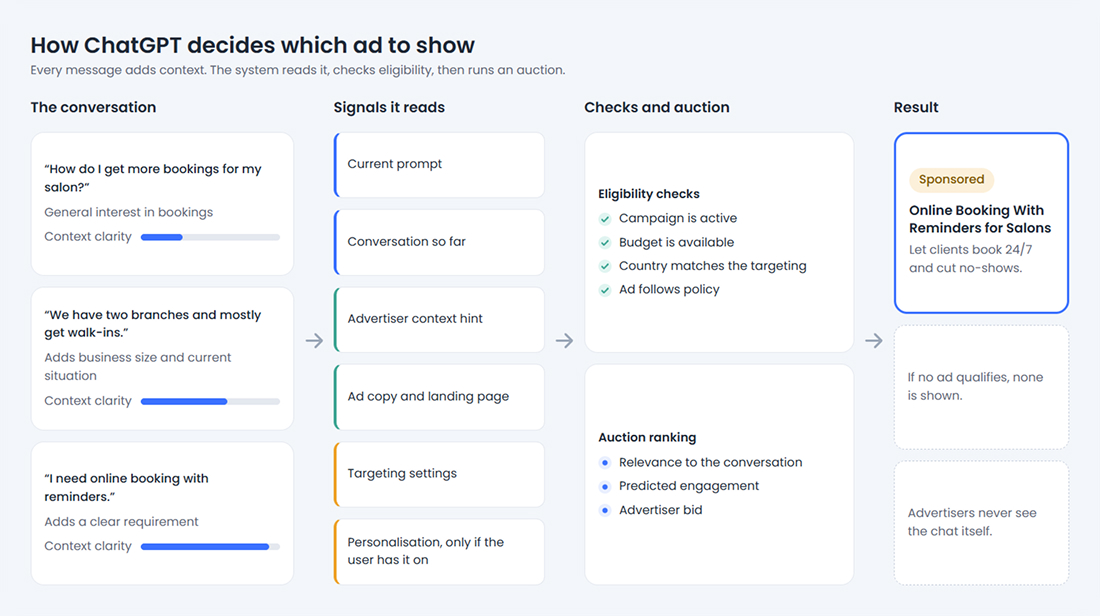
These include the user’s current question, the conversation’s developing context, advertiser-provided hints, ad messaging, landing page information, targeting settings, and eligible personalization signals.
1. Current prompts and conversation context
A single question can reveal general interest, while follow-up messages may reveal a more specific need.
Consider someone researching payroll software.
- Initial question: “How do I manage employee payroll?”
- Follow-up: “We have 25 employees working across three locations.”
- Further clarification: “I need something that calculates attendance, leave, and monthly salaries automatically.”
The conversation has moved from general payroll advice to a more defined software requirement.
A payroll platform offering attendance integration and salary automation may be more relevant to that developed need than a product offering only basic payslip generation.
However, relevance does not guarantee that an ad will appear. The advertiser’s campaign must also satisfy eligibility, budget, targeting, and delivery requirements.
2. Conversation history and personalization
When a user enables ad personalization, ChatGPT may consider selected signals from their broader ChatGPT experience, including past chats and relevant memories, where permitted.
For example, someone who previously discussed opening an online store might later ask about managing inventory. That broader context could help the system assess which business software advertisements may be relevant.
If the user disables ad personalization, ChatGPT can still match ads to the current conversation, but it won’t use other chat threads, advertising history, or related personalization signals for ad selection.
Importantly, advertisers cannot read users’ conversations, chat history, memories, or personal information. OpenAI provides aggregated advertising performance data rather than access to private chats.
These distinctions are explained in OpenAI’s advertising and privacy FAQs.
3. Advertiser-provided context hints
Context hints are descriptions advertisers add to their ad groups to explain when their products or services might be relevant.
For example, a business selling inventory management software could provide a hint such as:
“Inventory software for retailers struggling to track stock across multiple stores and online sales channels.”
This communicates a specific business problem and the type of customer the product serves.
Compare that with a broad hint such as “inventory software, retail software, stock management.” The broader version identifies a category but gives the matching system less information about the actual use case.
OpenAI’s context hint guidance recommends describing what the product offers, who it helps, and when it becomes useful.
Context hints are not exact-match keywords. They do not force an ad to appear for a particular prompt, and they cannot replace geographic targeting or other campaign controls.
4. Relevance, bidding, and campaign eligibility
Even when an advertisement matches the conversation, it must compete with other eligible advertisements.
OpenAI’s ad delivery system evaluates factors such as campaign status, budget availability, geographic eligibility, policy compliance, relevance, predicted engagement, and advertiser bids.
This is why an advertiser cannot simply write a context hint mentioning a popular conversation and expect guaranteed placement.
The ad must genuinely fit the user’s need, and the campaign must be eligible to serve.
For businesses, the practical challenge is connecting four things: the customer problem, the offering, the ad message, and the landing page.
A mismatch between them can mean paying to reach people who are unlikely to find the advertisement useful.
Which Topics and User Prompts Are More Likely to Trigger ChatGPT Ads?
Commercial conversations that involve planning, comparing alternatives, researching products, or finding service providers can create opportunities for relevant advertising.
But there is no official list of keywords or prompts that automatically trigger ChatGPT Ads. In a WIRED experiment involving 500 ChatGPT questions, travel-related questions were among the most frequent situations in which the journalist observed sponsored placements. The findings are useful for understanding early advertising patterns, but they represent a limited test, not a guarantee that travel queries always produce ads.
Other commercial situations may also be relevant.
| Topic | What a User Might Ask ChatGPT | Potential Addressing Opportunity |
| Travel and hotels | “I’m visiting London with my family. Which hotels are close to major attractions without being too expensive?” | Hotel booking platforms and eligible accommodation providers |
| Ecommerce and shopping | “I need a lightweight laptop for graphic design under $1,200. What should I compare?” | Electronic retailers and laptop brands |
| Product comparisons | “Which project management tools are better for a remote team of 20?” | SaaS platforms offering team collaboration tools |
| Education | “I work full-time and want to learn data analytics. Which online courses can fit around my schedule?” | Online learning platforms and eligible training providers |
| Freelance and gig work | “How do I find legitimate freelance design projects as a beginner?” | Eligible freelance marketplaces and professional training services |
| B2B services | “Our Google Ads bring traffic, but our landing pages aren’t generating enough leads. What should we change?” | Conversion optimization and digital marketing service providers |
| Local services | “How do I find a reliable plumber for an urgent leak in Austin?” | Eligible local plumbing companies and service marketplaces |
These are illustrative commercial prompts and possible advertiser matches, not confirmed live ad triggers.
The most useful observation is that customers often describe their circumstances before naming the service they need.
Someone asking why their advertising campaigns generate traffic but few leads may not know they need conversion rate optimization. Yet the problem they describe may be directly relevant to a CRO provider. Similarly, a retailer asking how to prevent overselling products across online marketplaces may be looking for inventory management software without using that term. Businesses that research these problem-based conversations can develop more relevant advertising strategies than those relying solely on broad product categories.
What about healthcare, financial services, and other sensitive topics? These categories require a different approach.
The SE Ranking study reported ads on 28.69% of the healthcare-related prompts in its test. However, that historical observation should not be interpreted as permission to advertise medical procedures or target sensitive personal-health discussions.
Under OpenAI’s current advertising rules, ads are not eligible to appear alongside sensitive personal-health, mental-health, or political conversations. Healthcare and financial advertisers also face category-specific eligibility restrictions.
A company offering financial software, for instance, may be eligible to advertise in supported markets, while a lender promoting regulated credit products may require special approval or be prohibited in certain countries. The distinction matters because a conversation can be commercially relevant without being suitable for advertising.
For advertisers, researching prompt categories is only the starting point. The real work is identifying conversations that reflect a genuine customer need, fall within platform policies, and connect naturally to a product or service the business can deliver.
How to Advertise on ChatGPT: Step-by-Step Campaign Setup
You can launch ChatGPT Ads in three steps: create an advertiser account, configure your campaign, and submit your ads for approval. Here’s how to get started through OpenAI Ads Manager.
Step 1: Create Your ChatGPT Ads Manager Account and Set Up Billing
Visit ads.openai.com and sign in or create an OpenAI account.
- Set up your advertiser profile: Enter your business details, legal name, and brand information.
- Configure billing: Add your payment method, billing address, and applicable tax details.
- Complete verification: Finish any required account checks and invite team members if needed.
Refer to OpenAI’s account setup guide for registration requirements.
Step 2: Choose Campaign Objectives, Target Locations, Budgets, and Context Hints
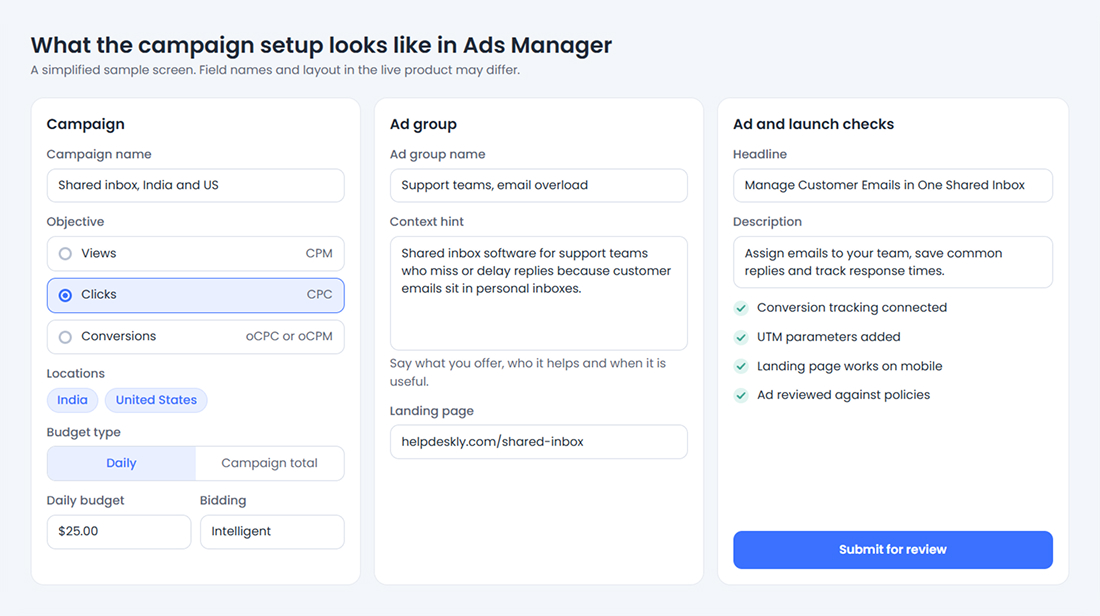
Select Create → Create Campaign in Ads Manager.
- Objective: Choose Views (CPM), Clicks (CPC), or Conversions based on your campaign goal and eligibility.
- Locations: Select the supported countries or regions you want to target.
- Budget: Set your spending limit. OpenAI lists minimum daily budgets, including $25 for USD-billed accounts and ₹725 for INR-billed accounts.
- Context hints: Describe the customer problems or conversations relevant to your offering.
For example, a CRM provider might use: “Small businesses looking to automate sales follow-ups and manage incoming leads.”
Step 3: Create Your Campaign, Configure Tracking, and Submit Ads for Review
- Create your ad: Add a headline, description, brand assets, and relevant landing page.
- Set up tracking: Configure conversion tracking and UTM parameters to measure campaign results.
- Check compliance: Review your ad against OpenAI’s advertising policies.
- Submit for approval: Publish your campaign and monitor its review status.
Once approved and active, verify that your ads are receiving impressions and generating relevant clicks or conversions before increasing your budget.
How to Write ChatGPT Ads That Match User Intent (With Examples)
Effective ChatGPT Ads connect three things: the customer’s problem, a relevant solution, and a clear next step. Rather than relying on promotional slogans, advertisers should explain how their offering helps someone accomplish what they’re already researching. According to OpenAI’s ad creative guidelines, clear, specific, benefit-focused messaging helps advertisements match relevant conversations.
How to Write Effective ChatGPT Ad Headlines, Descriptions, and CTAs
A ChatGPT user may have already spent several messages explaining a problem, comparing solutions, or narrowing down requirements. Your advertisement should help them move forward, not force them to start their research again.
When writing ChatGPT Ad copy, focus on:
- Headline: State the product or service and its practical value. Replace vague claims with a specific benefit.
- Description: Explain how your offering addresses the customer’s need, using information they would find useful when making a decision.
- Call to action: Suggest a relevant next step, such as comparing plans, exploring available options, or booking a consultation.
- Landing page: Direct visitors to the specific product, service, or resource mentioned in the ad rather than a generic homepage.
For example, a project management software company could replace:
Weak: “The Ultimate Project Management Solution for Your Business!”
Better: “Keep Projects, Deadlines, and Team Updates in One Place”
The second version tells a business owner what the software helps them manage, rather than making a broad claim.
OpenAI also recommends creating distinct ad variations for different customer needs instead of repeatedly using the same message.
How to Write ChatGPT Ad Context Hints (With Examples)
Context hints help OpenAI understand when an advertiser’s offering may be relevant. They are added at the ad group level and should describe a genuine product benefit, customer need, or situation.
According to OpenAI’s official context hint guidance, advertisers should consider three questions:
- What does your product or service offer? Identify the specific function or benefit.
- Who is it useful for? Describe the customer or business need it addresses.
- When is it relevant? Explain the circumstances that make someone consider the offering.
For example, a payroll software provider might write:
Generic hint: “Payroll software, HR software, employee management.”
Specific hint: “Payroll software for small businesses that need to calculate salaries, track attendance, and manage employee leave.”
The second hint connects the product to recognizable workplace problems. It provides useful matching context without attempting to control when or where the advertisement appears.
Remember: Context hints guide relevance; they do not guarantee placement. Geographic restrictions and other delivery settings must be configured through the appropriate campaign controls.
ChatGPT Ad Copy Examples for Different Industries
The following five examples show how a business can connect a user’s ChatGPT question with a relevant context hint, advertisement, and landing page.
These are illustrative examples, not actual ChatGPT Ads or confirmed ad triggers. The sample CTAs describe the intended next action rather than guaranteed platform button options.
Example 1: Ecommerce – Product Comparison
What a user might ask ChatGPT:
“I’m looking for a lightweight laptop under $1,200 for graphic design. Which models should I compare?”
Context hint: Laptops suitable for graphic design, with portable designs and options for buyers comparing performance within a $1,200 budget.
Sample ad headline: Compare Laptops for Graphic Design
Ad description: Explore portable laptops with display, memory, and performance specifications to help you choose the right model.
CTA: Compare Models
Landing page: A filtered laptop comparison page showing relevant models, specifications, prices, and availability.
Example 2: B2B SaaS – Lead Management
What a user might ask ChatGPT:
“Our sales team keeps missing follow-ups because customer inquiries are spread across email and spreadsheets. What can we use to manage everything?”
Context hint: CRM software for small sales teams managing leads across spreadsheets and email, with automated follow-up reminders.
Sample ad headline: Keep Sales Leads and Follow-Ups Organized
Ad description: Bring customer inquiries, sales activity, and follow-up reminders into one CRM workspace.
CTA: Explore CRM Features
Landing page: A CRM feature page covering lead tracking, reminders, and sales pipeline management.
Example 3: Travel – Family Accommodation
What a user might ask ChatGPT:
“We’re traveling to London with two kids. Where can we stay that’s close to public transport but doesn’t cost too much?”
Context hint: Family-friendly London accommodation for travelers comparing room options, transport access, and hotel prices.
Sample ad headline: Find Family-Friendly Hotels in London
Ad description: Compare family rooms, nearby transport connections, and hotel prices for your London trip.
CTA: Explore Hotels
Landing page: A London accommodation results page with family room, budget, and location filters.
Example 4: Education – Professional Upskilling
What a user might ask ChatGPT:
“I work full-time but want to learn data analytics. Are there online courses I can take in the evenings?”
Context hint: Online data analytics courses for working professionals seeking flexible schedules and practical beginner-level training.
Sample ad headline: Learn Data Analytics Around Your Work Schedule
Ad description: Explore flexible online courses covering Excel, SQL, and data visualization, with options for beginners.
CTA: View Courses
Landing page: A data analytics course page listing syllabus, duration, schedule, fees, and enrollment requirements.
Example 5: Local Services – Home Repairs
What a user might ask ChatGPT:
“My kitchen sink is leaking, and I need a plumber in Chicago who can come today. How do I find someone reliable?”
Context hint: Residential plumbing services in Chicago for urgent sink leaks, pipe repairs, and same-day appointments when available.
Sample ad headline: Need a Plumber for a Kitchen Leak?
Ad description: Check local plumbing services, repair options, and available appointment times in Chicago.
CTA: Check Availability
Landing page: A kitchen plumbing repair page with Chicago service areas, contact details, fees, and appointment availability.
These examples follow the same principle: the ad should answer the need behind the question, not simply repeat the product category.
A customer asking how to manage missed sales follow-ups doesn’t need another advertisement claiming to offer the “best CRM.” They need to understand whether the software can solve their follow-up problem and what it would take to get started.
The closer the ad copy, context hint, and landing page align with that need, the easier it becomes for a potential customer to evaluate the offering.
Before publishing, advertisers should also review OpenAI’s advertising policies and confirm that all product features, prices, service areas, and availability claims are accurate.
How Much Do ChatGPT Ads Cost?
ChatGPT Ads use auction-based pricing, with CPC and CPM billing options and bidding strategies designed around clicks, impressions, or conversions. According to OpenAI’s pricing documentation, advertisers control their budgets, but actual costs depend on auction competition, relevance, and campaign objectives. The more useful measure is how much it costs to acquire a qualified lead or customer-not simply a click.
ChatGPT Ads Pricing: CPC, CPM, and Bidding Models
Unlike a fixed advertising package, ChatGPT Ads pricing depends on how your campaign is configured and how your ads perform in the auction.
OpenAI supports three primary campaign objectives:
- Cost Per Click (CPC): Advertisers pay for valid clicks. This model suits campaigns focused on website visits, product inquiries, or lead generation.
- Cost Per Mille (CPM): Advertisers pay for every 1,000 impressions. This is generally used for awareness and visibility campaigns.
- Conversion Optimization: Campaigns optimize toward actions such as purchases or lead submissions, using click-based (oCPC) or impression-based (oCPM) billing. Advertisers do not pay a fixed amount per conversion.
Advertisers can use Intelligent Bidding, Target CPC, or Target CPA, depending on the campaign objective and available settings.
For example, a SaaS company setting a Target CPA of $60 is asking the platform to work toward an average acquisition cost of $60. It does not guarantee that every conversion will cost that amount.
OpenAI explains these options in its ChatGPT Ads bidding guide .
What Determines ChatGPT Advertising Costs and Campaign Budgets?
Two businesses with similar products and budgets may pay different amounts because their campaigns compete for different advertising opportunities.
Several factors influence costs:
- Auction competition: Multiple advertisers competing for similar audiences and conversations can affect the price of eligible placements.
- Ad relevance: How closely an advertisement matches the user’s needs influences its suitability for delivery.
- Bidding strategy: Campaign objectives and target costs determine how the system approaches individual auctions.
- Geographic targeting: Audience availability, competition, and advertising opportunities vary across markets.
- Campaign performance: Click-through rates, conversion rates, and lead quality determine whether the spending produces worthwhile results.
Budget controls matter just as much as bidding.
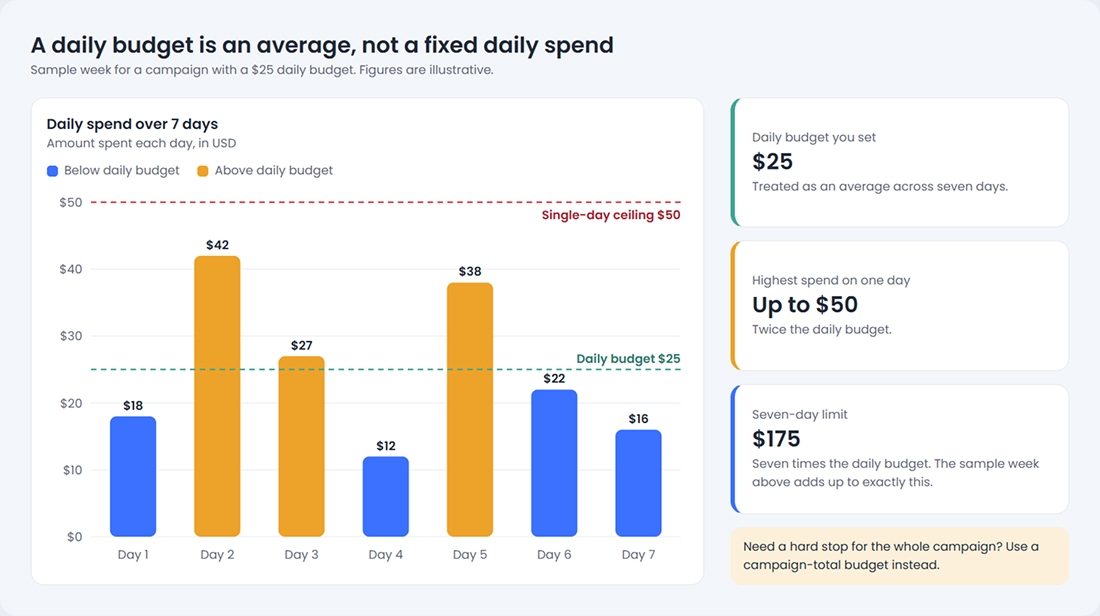
Under OpenAI’s daily budget rules, daily budgets represent an average over seven days. Spending may reach twice the selected daily budget on an individual day, while the applicable seven-day limit is seven times the daily amount, assuming the budget remains unchanged.
Businesses that need a defined spending ceiling for an entire campaign can use a campaign-total budget.
How to Calculate Your ChatGPT Ads Budget and Expected ROI
Before deciding how much to spend, businesses should understand what a qualified lead or customer is worth.
Consider a B2B software company planning a $1,500 ChatGPT Ads test. The following example uses hypothetical figures to demonstrate the calculation, not actual ChatGPT advertising benchmarks.
| Metric | Illustrative Calculation |
| Advertising budget | $1500 |
| Average CPC | $5 |
| Estimated website clicks | 300 |
| Lead conversion rates | 5% |
| Leads generated | 15 |
| Cost per lead | $100 |
| Lead-to-customer conversion rate | 20% |
| Customers acquired | 3 |
| Advertising cost per customer | $500 |
The calculations are straightforward:
Estimated Clicks = Advertising Budget ÷ Average CPC
Cost Per Lead (CPL) = Advertising Spend ÷ Leads Generated
Customer Acquisition Cost (CAC) = Advertising Spend ÷ Customers Acquired
In this example, the business spends $500 in advertising for each customer acquired.
Whether that is profitable depends on the customer’s value, gross margin, retention, and additional acquisition expenses.
A company earning $2,000 in gross profit from each new customer has a different economic outlook from one earning only $200.
Don’t forget the costs beyond media spending. Campaign management, creative development, landing page improvements, and tracking setup can increase the total investment. Agencies evaluating profitability should account for these delivery costs rather than treating advertising spend as the entire campaign expense.
For an initial test, businesses should use their existing conversion data and acceptable customer acquisition costs to estimate a workable budget. If reliable data is unavailable, the test should focus on learning what the channel can deliver before committing to aggressive ROI targets.
The cheapest clicks are not necessarily the most profitable. A campaign generating fewer visitors but more qualified customers can deliver better business results than one producing large amounts of low-intent traffic.
ChatGPT Ads Best Practices: How to Improve Campaign Performance
Improving ChatGPT Ads performance comes down to three priorities: matching campaigns to customer needs, tracking meaningful conversions, and testing what produces qualified leads or sales. OpenAI’s advertising guidelines identify relevance, creative quality, landing page experience, and campaign setup as important performance factors. Advertisers should optimize for business results rather than clicks alone.
Structure Campaigns Around User Intent and Relevant Landing Pages
A common advertising problem is attracting visitors who are interested in a topic but not necessarily interested in buying your solution.
Consider a project management software company. A business owner struggling with missed deadlines has different priorities from a finance manager trying to control project costs. Combining both needs into one broad ad group makes it harder to evaluate which use case attracts potential customers.
To improve campaign relevance:
- Separate customer needs: Build ad groups around distinct problems or use cases, not just product categories.
- Match the landing page: Direct visitors to the specific solution they were researching rather than a generic homepage.
- Remove conversion barriers: Make pricing, features, product limitations, and next steps easy to find.
- Check technical accessibility: Ensure landing pages work on mobile and don’t block OpenAI’s advertising crawlers.
For example, someone researching project budget overruns should reach a page explaining cost tracking, budget alerts, and financial reporting-not a general project management overview. OpenAI recommends separating different customer use cases when they require distinct messaging or landing pages in its ad group guidance. The objective is simple: once someone clicks your ad, your landing page should continue answering the question that brought them there.
Set Up Conversion Tracking, UTMs, and Performance Measurement
A campaign receiving clicks may look encouraging in Ads Manager. But if the sales team reports that none of those visitors became qualified prospects, the numbers tell a different story.
Before increasing spending, connect advertising performance to actual customer actions.
- Track conversions: Use the OpenAI Pixel or Conversions API to measure eligible actions such as purchases, registrations, or lead submissions.
- Add UTM parameters: Identify ChatGPT advertising traffic separately in Google Analytics 4 and other analytics platforms.
- Review campaign data: Monitor spend, impressions, clicks, CTR, CPC, and conversions through Ads Manager reporting.
- Evaluate lead quality: Connect form submissions and inquiries with CRM data to see which become qualified opportunities or customers.
For example, a landing page URL could use:
?utm_source=chatgpt&utm_medium=paid&utm_campaign=crm_leads
One important detail: OpenAI Ads Manager and GA4 may report different conversion totals because their attribution windows, consent settings, and tracking methods can differ. These differences should be investigated rather than automatically treated as tracking errors. For businesses managing multiple advertising channels, consistent measurement makes it easier to see which campaigns are generating revenue opportunities and which are simply generating visits.
Test, Optimize, and Avoid Common ChatGPT Advertising Mistakes
ChatGPT Ads are still developing as an advertising channel. OpenAI notes in its advertiser FAQs that performance varies with campaign objectives, relevance, creative quality, and landing page experience.
Rather than judging a campaign after a few days, advertisers should look for patterns supported by sufficient data.
Five practices can help:
- Test distinct variables. Compare customer use cases, landing pages, or creative approaches without changing everything simultaneously.
- Give campaigns a reasonable learning period. Consider your budget, conversion volume, and typical sales cycle before drawing conclusions. There is no universal number of days that guarantees reliable results.
- Diagnose performance problems separately. Low impressions, poor CTR, and clicks without conversions point to different issues. Each needs a different response.
- Keep creatives useful and focused. Avoid cluttered visuals and repetitive variations. OpenAI’s creative recommendations favor clear, relevant ads that accurately represent the offering.
- Scale based on qualified results. Increase investment when campaigns demonstrate useful outcomes, not simply because they generate inexpensive clicks.
For example, a digital marketing agency may receive 30 inquiries through a ChatGPT Ads campaign, but discover that only four relate to the ongoing conversion optimization services it actually wants to sell.
The campaign generated interest, but the volume alone doesn’t establish success. The agency needs to understand why the other inquiries were poorly matched and whether changes to its campaign structure or landing page could improve lead quality.
The same challenge applies to SaaS companies tracking demo requests, ecommerce stores measuring purchases, and local businesses evaluating booked appointments. The goal isn’t to keep generating more traffic. It’s to identify which advertising decisions consistently bring the right customers closer to purchasing.
ChatGPT Ads vs Google Ads vs Meta Ads: What's the Difference?
ChatGPT Ads, Google Ads, and Meta Ads reach customers at different stages of their buying journey. Google Search Ads capture existing search demand, Meta Ads help businesses create demand and engage audiences, while ChatGPT Ads reach users researching problems and evaluating solutions through AI conversations. The right choice depends on customer intent, advertising costs, and conversion goals.
How Targeting, User Intent, and Ad Placements Compare
| Comparison Factor | ChatGPT Ads | Google Search Ads | Meta Ads |
| User behavior | Asks questions, explains problems, compares solutions | Searches for products, services, or information | Browses content, discovers products, engages with brands |
| Targeting approach | Conversational context, context hints, relevance signals | Keywords, search intent, audience signals | Audience signals, interests, behaviors, AI-powered targeting |
| Customer intent | Research, consideration, and purchase evaluation | Often active search or purchase intent | Discovery, awareness, consideration, and purchase |
| Ad placement | Sponsored placements alongside ChatGPT responses | Google search results | Facebook, Instagram, Reels, Stories |
| Primary advantage | Connects offerings to problems discussed in conversations | Captures customers actively searching for solutions | Reaches audiences before they actively search |
| Key limitation | Limited to eligible ad-supported users and supported conversations | Dependent on search demand and auction competition | Audience interest doesn’t always indicate immediate buying intent |
ChatGPT Ads vs Google Ads vs Meta Ads: Costs, Performance, and Conversion Opportunities
| Factor | ChatGPT Ads | Google Search Ads | Meta Ads |
| Pricing | CPC, CPM, and conversion-optimized bidding | Primarily CPC for Search, with automated bidding options | Auction-based, generally impression billing with objective-based optimization |
| Budget requirements | Published minimums vary by billing currency | Advertiser-controlled budgets | Advertiser-controlled budgets, subject to campaign requirements |
| Lead generation | Potential customers researching relevant problems and solutions | Users actively searching for specific offerings | Audiences reached through targeting, discovery, and retargeting |
| Conversion opportunities | Website inquiries, registrations, purchases | Inquiries, calls, purchases, bookings | Leads, purchases, messages, app actions |
| Performance measurement | Impressions, clicks, CTR, CPC, CPM, attributed conversions | Clicks, impressions, conversions, CPA, ROAS | Build awareness, generate demand, and retarget interested audiences |
| Performance considerations | Emerging channel with limited established benchmarks | Performance varies by keywords, competition, and conversion quality | Users may not be actively researching the advertised product |
ChatGPT Ads vs Google Ads vs Meta Ads: Costs, Performance, and Conversion Opportunities
A lower advertising cost doesn’t necessarily mean better performance. A campaign’s value depends on whether the people it reaches are likely to become customers.
Google Search Ads can work particularly well when customers already know what they need. Someone searching “accounting software pricing” has expressed a specific interest that an advertiser can address with a relevant product or pricing page.
Meta Ads can help when the customer isn’t actively searching. A furniture retailer, for example, can introduce a new product collection through visual advertisements and later retarget people who visited its website.
ChatGPT Ads offer another approach. A furniture retailer may reach someone discussing how to furnish a small apartment, compare space-saving desks, or choose furniture within a budget. The advertiser can connect its products to the requirements expressed in that conversation.
The important performance considerations differ:
- Cost efficiency: Compare CPC, CPM, and cost per acquisition within each platform. These figures aren’t directly interchangeable because buying models, placement environments, and audience behavior differ.
- Conversion intent: A search for a specific product price may indicate immediate purchase interest, while a broader ChatGPT conversation may involve comparing possible solutions.
- Sales cycle: Businesses selling high-consideration services may need multiple interactions before a prospect converts. One platform may introduce the offering while another captures the eventual inquiry.
- Measurement: Compare qualified leads, purchases, customer acquisition cost, and revenue rather than relying only on impressions or clicks.
OpenAI’s Ads Manager reporting documentation confirms that advertisers can measure impressions, clicks, spend, CTR, average CPC, average CPM, and attributed conversions when measurement is configured.
However, there is no reliable universal benchmark proving that ChatGPT Ads deliver cheaper leads or higher ROI than Google Ads or Meta Ads across industries.
For businesses evaluating a new advertising channel, the more useful comparison is how much each platform contributes to qualified opportunities and eventual sales.
When Should You Use ChatGPT Ads Alongside Google and Meta Advertising?
Businesses don’t necessarily need to replace an existing advertising channel to test ChatGPT Ads. The better decision is to identify where potential customers are being reached effectively and where gaps remain.
Consider a B2B cybersecurity company.
Its marketing team may already run Google Ads for searches such as “endpoint security software” and Meta campaigns promoting security awareness content.
However, potential customers may also use ChatGPT to ask:
“Our company has 80 employees working remotely. What should we look for in endpoint security software that doesn’t require a large IT team?”
This conversation introduces requirements the business can address through relevant advertising, provided the campaign and audience are eligible.
A practical way to combine these channels is to assign each a clear responsibility:
- Use Google Ads to capture established demand: Prioritize searches indicating product interest, service requirements, or purchasing intent.
- Use Meta Ads to reach and re-engage relevant audiences: Introduce offerings, demonstrate their value, and encourage consideration through suitable creative formats.
- Use ChatGPT Ads to test conversational demand: Reach eligible users researching problems, comparing approaches, or evaluating products and services.
For businesses already generating profitable leads through Google or Meta, moving the entire budget into ChatGPT Ads would introduce unnecessary risk. Instead, allocate a controlled test budget, establish consistent conversion tracking, and compare the quality of inquiries and customers generated.
Agencies managing several advertising channels should also consider whether ChatGPT Ads reach additional customers or simply create another paid touchpoint for people already familiar with the brand. The right advertising mix isn’t about appearing on every platform. It’s about understanding where customers discover a need, evaluate solutions, and decide to buy-and investing where advertising contributes measurable value.
Which Businesses Are Best Suited for ChatGPT Advertising?
ChatGPT Ads are well suited to businesses whose customers research problems, compare options, and seek recommendations before making a purchase. Ecommerce, travel, education, B2B, SaaS, and eligible local service businesses can benefit from reaching users during these conversations. However, actual advertising potential depends on customer intent, industry eligibility, and the ability to convert interest into qualified leads or sales.
- Ecommerce & Retail: Shoppers often compare products based on price, features, and suitability before purchasing. ChatGPT Ads can help retailers reach customers researching specific requirements, such as finding a laptop within a particular budget.
- Travel & Hospitality: Travelers use ChatGPT to plan trips, compare destinations, and find accommodations suited to their budgets and preferences. Relevant ads can introduce hotels, booking platforms, and travel services while users evaluate their options.
- Education & Online Learning: People researching courses often have specific goals, schedules, and budget constraints. Eligible education providers can reach prospective students comparing programs, professional certifications, or flexible learning options.
- B2B & SaaS: Business buyers frequently research operational challenges before identifying software vendors. ChatGPT Ads can help relevant providers connect with companies exploring solutions for CRM, automation, project management, or other business needs.
- Professional Services: Businesses seeking accounting, consulting, or marketing support may use ChatGPT to understand their challenges before approaching a provider. Eligible service firms can reach potential clients during this research and evaluation process.
- Local Services: Customers looking for plumbers, home repairs, cleaning services, or other local providers often specify their location, urgency, and requirements. Eligible businesses can connect with users researching relevant services in supported geographic markets.
Not every eligible business is necessarily a good fit for ChatGPT Ads. Before investing, consider whether customers regularly research your offering through AI conversations, whether your industry meets OpenAI’s advertising policies, and whether your landing page gives interested users a clear next step.
The strongest opportunity exists when the conversation reveals a genuine customer need that your business is equipped to address.
How Are ChatGPT Ads Performing, and What Metrics Can Advertisers Track?
ChatGPT advertising is attracting investment, but early performance results are mixed. A November 2026 AdClarity analysis reported 228% growth in estimated ChatGPT ad spending over seven months. However, growing ad spend doesn’t necessarily mean advertisers are generating profitable leads or sales. Businesses need to assess clicks, conversions, acquisition costs, and actual revenue before judging campaign performance.
Key ChatGPT Ads Metrics: Impressions, CTR, CPC, CPM, Conversions, and ROI
OpenAI Ads Manager provides reporting for impressions, clicks, spend, CTR, average CPC, average CPM, and attributed conversions when measurement is configured.
| Metric | What It Tells Advertisers |
| Impressions & CTR | How often ads appear when users engage with them |
| CPC & CPM | How much advertisers pay for clicks or every 1000 impressions |
| Conversions | How many tracked actions, such as purchases or form submissions, are attributed to ads. |
| Cost Per Lead (CPL) | How much advertising spend is required to generate a lead. |
| ROI & ROAS | Whether advertising generates enough financial return to justify its cost. |
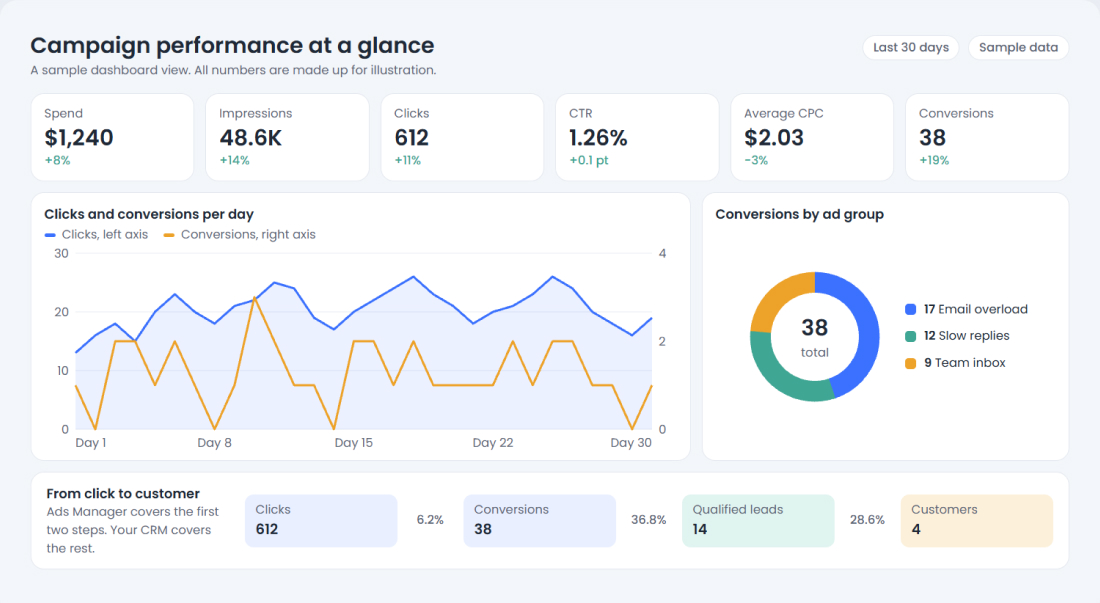
While Ads Manager reports advertising activity, businesses may need CRM and revenue data to calculate their actual ROI. A campaign generating affordable clicks isn’t necessarily successful if those visitors never become customers.
How to Measure Lead Quality, Attribution, and Campaign Effectiveness
Suppose a B2B company generates 50 inquiries through ChatGPT Ads, but only eight meet its sales team’s qualification criteria. Reporting 50 leads without examining their quality could make the campaign appear more successful than it is.
| What to Measure | How to Evaluate It |
| Lead quality | Track which inquiries become qualified sales opportunities. |
| Cost per qualified lead | Divide advertising spend by the number of qualified leads. |
| Customer acquisition costs | Compare total attributable acquisition expenses with customers acquired. |
| Attribution | Review which conversions are credited to advertising and over what period. |
| Revenue contribution | Connect conversions with actual purchases, closed deals, or customer value. |
Advertisers can use the OpenAI Pixel or Conversions API to measure conversion events. Ads Manager also supports 7-, 14-, and 30-day click-through attribution windows, with an optional one-day view-through window.
Since Ads Manager, Google Analytics, and CRM systems may attribute conversions differently, their reporting totals will not always match.
For businesses and agencies, the strongest performance indicator is not how many leads ChatGPT Ads generate, but how many turn into customers at an acceptable acquisition cost.
How Can Agencies Turn ChatGPT Ads Into a Profitable Service?
Agencies can generate revenue from ChatGPT Ads through campaign management, paid media retainers, consulting, conversion optimization, and white-label services. For agencies already managing Google Ads or Meta Ads, ChatGPT advertising offers an opportunity to expand client accounts, attract new business, and introduce additional services without necessarily building a separate team.
Here’s how agencies can monetize ChatGPT advertising:
- ChatGPT Ads Setup Services: Charge a one-time fee for advertiser onboarding, campaign strategy, targeting configuration, and tracking setup.
- Monthly Campaign Management: Offer recurring retainers for monitoring, testing, optimization, and performance reporting.
- Paid Media Upselling: Add ChatGPT Ads to existing Google Ads and Meta Ads packages to increase revenue from current clients.
- AI Advertising Audits: Assess a client’s suitability for ChatGPT advertising, including industry eligibility, customer intent, budget, and campaign opportunities.
- Ad Creative & Landing Page Services: Generate additional project revenue through ad creative development, landing page design, and conversion rate optimization (CRO).
- Analytics & Attribution Services: Offer conversion tracking, CRM integration, attribution analysis, and customized reporting.
- ChatGPT Ads Consulting & Training: Help businesses with in-house marketing teams develop campaign strategies, train employees, and review performance.
- White-Label ChatGPT Ads Management: Deliver campaigns for other agencies under their brand, creating B2B fulfillment revenue.
- Integrated AI Visibility Packages: Offer ChatGPT Ads management alongside SEO, AEO, and GEO services, with separate paid and organic performance goals.
Profitability depends on how efficiently these services are delivered. For example, an agency charging $1,000 monthly for campaign management with $600 in direct delivery costs earns a 40% gross margin before overhead and taxes. This is an illustrative calculation, not a market pricing benchmark. The opportunity is to build services that clients have a reason to continue paying for, while keeping delivery costs, workloads, and profit margins sustainable.
How to Test ChatGPT Ads: A Practical 90-Day Advertising Plan
A 90-day ChatGPT Ads test gives businesses a structured way to assess audience relevance, conversion performance, and advertising costs before increasing investment. Rather than expecting immediate ROI, use the first 30 days to establish a baseline, the next 30 to identify improvements, and the final 30 to evaluate whether the channel deserves a larger budget.
Days 1-30: Research, Campaign Setup, and Tracking
Start with a specific business goal, such as generating demo requests, product purchases, or qualified inquiries.
- Assess campaign suitability: Confirm industry eligibility, target markets, and customer problems worth advertising against.
- Set a test budget: Define an affordable spending limit and acceptable cost per lead or acquisition.
- Launch focused campaigns: Begin with a small number of distinct customer-intent groups rather than testing everything at once.
- Verify measurement: Check that conversion events, UTMs, and CRM attribution are recording the intended actions.
First milestone: Establish baseline impressions, clicks, costs, and initial conversion data.
Days 31-60: Context Testing, Ad Optimization, and Landing Page Improvements
Use the initial campaign data to understand where customers engage and where they drop off.
- Refine targeting relevance: Compare performance across customer needs and context hints.
- Test ad variations: Evaluate different messages and creatives without changing every variable simultaneously.
- Improve landing pages: Address gaps between the advertised solution and the information visitors need before converting.
- Review lead quality: Identify which campaigns attract genuine prospects rather than inquiries unlikely to become customers.
Second milestone: Identify which combinations of customer intent, ads, and landing pages generate the most promising results.
Days 61-90: Performance Review, Budget Decisions, and Campaign Scaling
By this stage, businesses should have a clearer picture of campaign delivery and early customer response, provided sufficient data has accumulated.
- Evaluate acquisition costs: Compare cost per qualified lead, customer acquisition cost, and available revenue data against business targets.
- Identify promising campaigns: Prioritize ad groups demonstrating stronger conversion quality and commercial relevance.
- Adjust spending carefully: Consider increasing budgets where results justify it, while reducing investment in consistently underperforming campaigns.
- Decide the next step: Continue testing, scale selectively, or reconsider the channel based on evidence.
Final milestone: Make a budget decision supported by campaign performance rather than assumptions about ChatGPT advertising.
For example, a SaaS company may find that ChatGPT Ads generate fewer demo requests than Google Ads but attract prospects with a better fit for its product. That could justify further testing, even if the initial lead volume is lower. Ninety days is a practical testing framework, not a guaranteed optimization period. Businesses with longer sales cycles or limited conversion volumes may need more time to assess profitability. The goal is to learn whether ChatGPT Ads can contribute qualified customers at a sustainable cost-not simply to complete a 90-day campaign.
ChatGPT Ads and GEO: Do You Need Both Paid and Organic AI Visibility?
ChatGPT Ads and Generative Engine Optimization (GEO) serve two different purposes: paid advertising creates sponsored visibility, while GEO aims to improve how brands appear in organic AI-generated answers. OpenAI confirms that advertisements do not influence ChatGPT’s responses. Businesses need separate strategies for both if they want to reach customers through sponsored placements and earn visibility in AI-driven research.
ChatGPT Ads vs SEO, AEO, and GEO: What's the Difference?
A business can advertise on ChatGPT without appearing in its organic recommendations. Similarly, a brand may be mentioned in an AI-generated answer without paying for advertising. The difference comes down to how visibility is earned and what each approach helps accomplish.
| Strategy | Primary Purpose | How it Works |
| ChatGPT Ads | Paid visibility | Places eligible sponsored advertisements alongside relevant ChatGPT conversations. |
| SEO (Search Engine Optimization) | Organic search visibility | Improves a website’s discoverability in traditional search results through content, technical optimization, and authority signals. |
| AEO (Answer Engine Optimization) | Answer visibility | Structures useful, direct answers to questions people ask search engines, voice assistants, and AI tools. |
| GEO (Generative Engine Optimization) | Organic AI visibility | Improves content clarity, credibility, and discoverability to increase the opportunity for brands to be referenced or cited in AI-generated responses |
These approaches overlap, particularly SEO, AEO, and GEO. Google’s guidance for AI search features confirms that foundational SEO practices remain relevant to AI Overviews and AI Mode. For businesses, the distinction matters because buying advertising exposure and building organic visibility require different investments, timelines, and success metrics.
Can ChatGPT Ads Influence Organic AI Answers and Brand Recommendations?
No. Running ChatGPT Ads does not improve your chances of being recommended in ChatGPT’s organic answers.
OpenAI states that its advertising system operates separately from answer generation. Advertisers cannot pay to change how ChatGPT ranks, mentions, or recommends businesses.
Consider a company selling project management software.
If someone asks ChatGPT, “Which project management tools are suitable for a small remote team?”, the response may discuss relevant software options based on the user’s question.
A sponsored advertisement for another project management platform may appear separately. However, paying for that placement does not make ChatGPT include the advertiser in its answer.
This creates an important distinction for businesses investing in AI visibility. An ad can help someone discover your brand. It cannot buy your brand a place in ChatGPT’s recommendations.
Organic AI visibility requires separate work to make your business, products, expertise, and supporting information easier to discover and understand. Even then, no SEO, AEO, or GEO strategy can guarantee a brand mention or citation.
How to Combine ChatGPT Advertising With an AI Search Visibility Strategy
Businesses already investing in paid media and SEO don’t need to treat ChatGPT Ads and GEO as competing priorities. Each can address a different visibility gap. Consider a B2B cybersecurity company that wants to reach businesses researching endpoint protection.
Its ChatGPT Ads strategy could focus on eligible conversations about endpoint security requirements, software comparisons, and remote workforce protection. Its organic AI visibility strategy would focus on creating resources that genuinely help potential buyers evaluate those needs.
A practical combined approach involves:
- Identify customer questions: Research what potential customers ask before choosing a product or service, including problems, alternatives, pricing, and comparisons.
- Build useful, credible content: Publish product documentation, comparison guides, implementation information, and expert-backed explanations that answer those questions.
- Strengthen AI discoverability: Maintain crawlable pages, accurate business information, consistent product details, and credible third-party references.
- Run relevant paid campaigns: Use ChatGPT Ads to reach eligible audiences while they research related needs, without expecting those ads to influence organic answers.
- Measure both separately: Track advertising conversions and acquisition costs alongside organic search traffic, AI referrals, brand mentions, and citations where measurable.
For example, the cybersecurity company may publish a detailed guide explaining how businesses with 50-100 remote employees can evaluate endpoint security software. That content serves customers researching a purchase, whether they discover it through traditional search or an AI-powered experience.
A relevant paid campaign can provide another way for eligible customers to encounter the company’s offering during that research.
The business opportunity is broader than simply getting an ad in front of someone. It’s about making the brand useful and discoverable while customers are deciding what to buy. ChatGPT Ads can support paid reach. SEO, AEO, and GEO can strengthen organic discoverability and credibility. Their results should be evaluated independently, even when they contribute to the same customer journey.
Conclusion
ChatGPT Ads are changing how businesses can reach customers during research, comparison, and purchase decisions. But running ads on a new platform is one thing. Turning that visibility into qualified leads, customers, and measurable returns is another.
Success requires more than campaign setup. Businesses need to understand conversational intent, control advertising costs, improve landing page conversions, and measure which interactions contribute to revenue.
ZealousWeb brings paid media expertise, conversion optimization, and AI search strategies together to help businesses and agencies navigate this shift. From ChatGPT advertising opportunities to SEO, AEO, and GEO, the focus is on connecting visibility with meaningful business outcomes.
Want to Launch Your ChatGPT Ad Campaign?
Talk to Ad Specialist
FAQs
Can you run ads on ChatGPT?
Yes. Businesses can create campaigns through ChatGPT Ads Manager, subject to account eligibility. We recommend treating ChatGPT Ads as an additional advertising channel to reach people while they research, compare options, and consider purchases.
Are ChatGPT Ads available in India and other countries?
Yes. ChatGPT Ads are available in India, the US, the UK, and numerous other markets. ZealousWeb recommends checking country eligibility and targeting restrictions before planning campaigns, especially for businesses advertising internationally.
How much does it cost to advertise on ChatGPT?
ChatGPT Ads support impression-based, click-based, and conversion-focused advertising. Actual costs depend on bidding, competition, and campaign objectives. We recommend evaluating cost per qualified lead and customer acquisition rather than focusing on clicks alone.
Is there a minimum budget for ChatGPT Ads?
Yes. Minimum daily budgets vary by billing currency, including ₹725 for INR campaigns and $25 for USD campaigns. Our approach is to start with a controlled testing budget, measure meaningful conversions, and increase spending based on performance.
How does ChatGPT decide which ads to show?
ChatGPT considers conversational intent, ad relevance, landing page content, targeting settings, and permitted personalization signals. We recommend aligning ads with the questions customers are asking rather than relying on broad promotional messages.
Can advertisers target specific keywords on ChatGPT?
ChatGPT Ads are not built around traditional keyword bidding like Google Search Ads. Instead, advertisers can provide contextual guidance to improve relevance. We focus on customer intent, use cases, and decision-stage questions to develop more relevant campaigns.
How do you write effective ChatGPT Ads?
Effective ChatGPT Ads communicate a specific benefit, address a relevant customer need, and offer a clear next step. Our approach combines concise messaging, distinct creative variations, and landing pages that directly support the advertised offer.
Can small businesses advertise on ChatGPT?
Yes. Eligible small businesses can use ChatGPT Ads without enterprise-level advertising budgets. We recommend starting with a focused product, service, or audience segment before expanding into additional campaigns.
Are ChatGPT Ads better than Google Ads?
Both platforms serve different customer behaviors. Google Ads captures intent through searches, while ChatGPT Ads can reach users during conversational research and evaluation. We recommend testing both and comparing lead quality, acquisition costs, and conversions before reallocating budgets.
Can advertisers track leads and conversions from ChatGPT Ads?
Yes. ChatGPT Ads support conversion measurement through the OpenAI Pixel, Conversions API, and campaign reporting. We recommend combining these tools with UTM tracking and CRM data to understand which campaigns generate qualified leads and revenue.


