Fraud Blocker
AI Search Lead Generation Strategies

How Can Businesses Generate Leads When AI Answers Customer Questions Before They Click?

November 13, 2026Posted By: Jalpa Gajjar
AI SearchAnswer Engine Optimizationgenerative engine optimizationLead Generation

88% of commercial keywords in a tracked U.S. sample triggered Google AI Overviews in August 2026, according to a Semrush study reported by Search Engine Land. Meanwhile, Pew Research Center found that users clicked traditional search results in just 8% of visits with AI summaries, compared to 15% without them.

Now, think about what that means for your business.

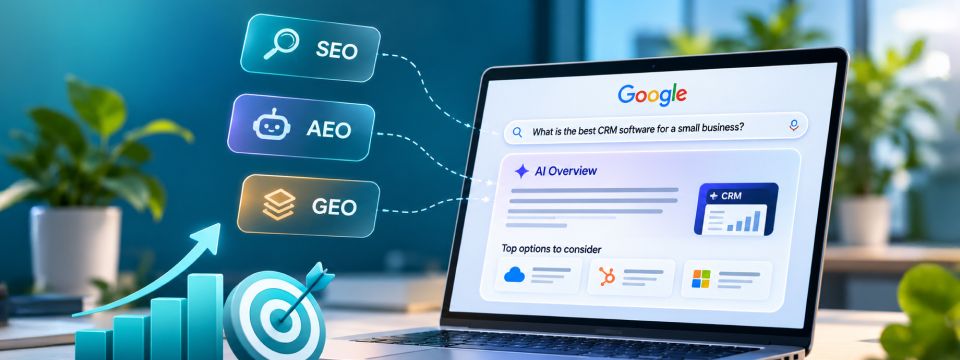
Say a potential customer searches Google for “What is the best CRM software for a small business?” Earlier, they might have visited three or four websites, compared features, checked pricing, and requested a demo.

Today, an AI Overview can do much of that research for them. It can summarize competing solutions, compare features, and help buyers build a shortlist before they ever visit a provider’s website.

Your business could still rank on Google’s first page and miss an opportunity to influence that buying decision.

That’s the concern for businesses investing in SEO, content marketing, and lead generation. You’re spending money to attract potential customers, but some of those customers are now evaluating their options without visiting your website. And if competitors appear in AI-generated recommendations while your brand is missing, they may gain attention before you get the chance to make your case.

How Can Businesses Generate Leads When AI Search Reduces Clicks?

Businesses can protect and grow lead opportunities by combining SEO with Answer Engine Optimization (AEO), Generative Engine Optimization (GEO), and conversion-focused content. Strengthening E-E-A-T, publishing original insights, improving AI citation opportunities, and targeting high-intent searches can help businesses earn visibility during customer research and convert interested prospects into qualified leads.

The goal isn’t to publish more content just to keep traffic coming. It’s to make your business easier to discover, more credible to evaluate, and worth contacting when customers are ready to act. Google’s AI search optimization guidance reinforces the value of expert-led, original content built on strong SEO fundamentals.
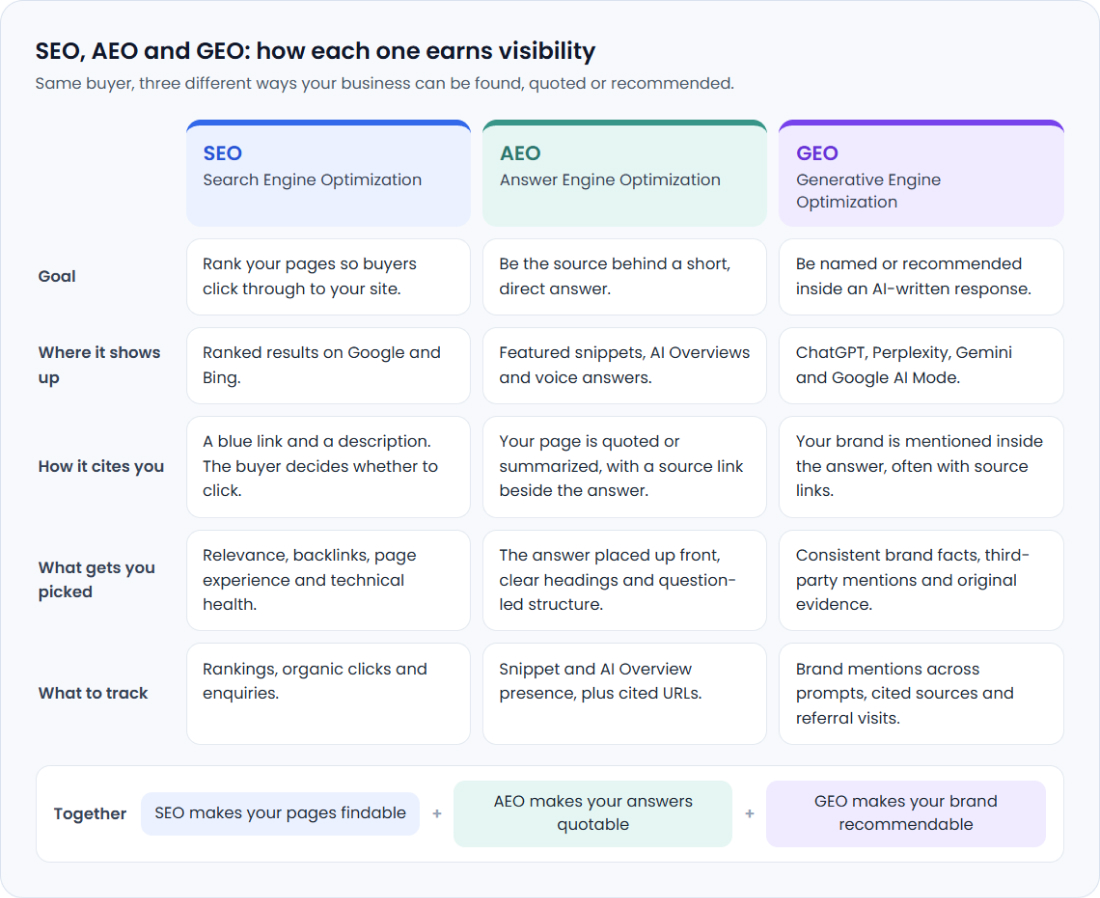
SEO AEO GEO comparison

Why Are AI Overviews Changing Website Traffic and Lead Generation?

Google users clicked traditional search results in 8% of visits featuring AI summaries, compared with 15% without them, according to Pew Research Center. The same study found that just 1% of visits involving an AI summary resulted in a click on a link within it. For businesses, this means fewer opportunities to earn website visits from some searches, even when their content remains visible.

The bigger change is happening earlier in the buying journey.

Customers Are Comparing Businesses Before Visiting Their Websites

Take a business offering accounting software. A potential customer searches for “best accounting software for a small business.”

Instead of opening several websites, the buyer may see an AI Overview comparing software features, pricing, integrations, and suitability. By the time they visit a provider’s website, they may already have two or three options in mind.

This matters because AI-generated answers are increasingly appearing in searches with commercial intent. A 2026 Semrush study found AI Overviews on 96.12% of its tracked “best X for Y” keywords.

Your business isn’t just competing for a position in search results anymore. It’s also competing to be considered when customers are building their shortlists.

Your Google Rankings May Stay Stable While Clicks Decline

A first-page ranking doesn’t guarantee the same website traffic it once did.

AI Overviews can answer informational and comparison-based queries before users reach traditional organic listings. As a result, a page may retain its ranking but receive fewer clicks when the search results satisfy more of the customer’s immediate needs.

For instance, a commercial HVAC company may rank for “commercial HVAC maintenance cost.” If Google’s AI Overview summarizes typical pricing, service inclusions, and cost factors, some searchers may no longer need to open an introductory pricing article.

But someone looking for a quote based on their building size, equipment condition, and maintenance requirements still needs information specific to their situation.

That’s where the content strategy needs to change: businesses should offer information customers cannot get from a generic AI summary, including detailed service comparisons, transparent pricing factors, documented expertise, and solutions to specific customer problems.

AI Overview Citations Can Put Your Brand in Front of Potential Buyers

Appearing in an AI Overview creates an opportunity to reach customers while they’re researching solutions, even if they don’t immediately visit your website.
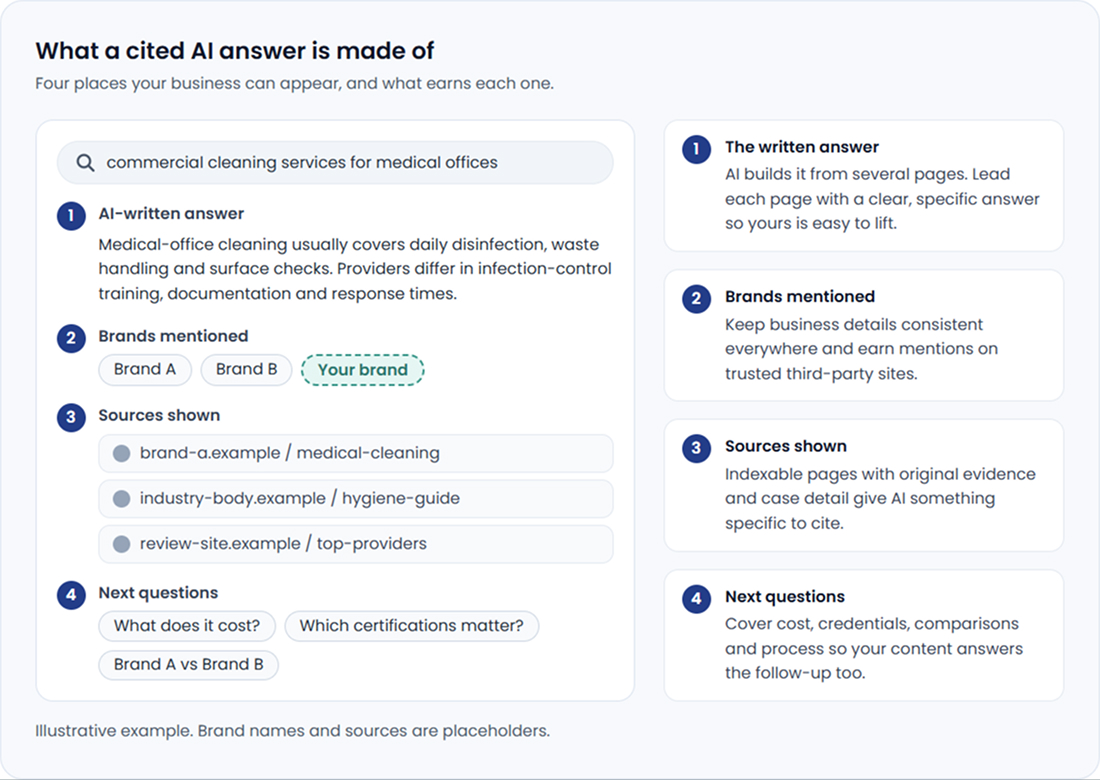
AI Overview citations

The potential business benefits include:

  • Brand discovery: Your business may appear alongside established competitors when customers explore relevant products or services.
  • Early buying influence: Useful, accurately attributed information can help potential customers understand where your offering fits their needs.
  • Qualified traffic opportunities: Customers who need deeper information, a consultation, or a quote may follow a cited source to learn more.
  • Competitive visibility: Relevant citations can help your business participate in conversations that might otherwise feature only competing providers.

However, an AI citation isn’t the same as a qualified lead. Google’s AI search guidance explains that AI features help people explore information and discover relevant websites, but placement alone doesn’t guarantee clicks or conversions.

For businesses investing in SEO, Answer Engine Optimization (AEO), and Generative Engine Optimization (GEO), the priority should be clear: earn visibility in the answers customers trust, then give those customers a compelling reason to choose your business when they’re ready to act.

What Content Strategies Should Businesses Stop Investing In?

Publishing more content doesn’t necessarily mean attracting more customers. If your website repeats information that Google AI Overviews can already summarize, you’re investing in content that gives potential buyers little reason to visit. The shift is from producing content for rankings to creating content that earns AI visibility, demonstrates real expertise, and supports buying decisions.

The comparison below shows where businesses should reconsider their content investments and what to prioritize for SEO, Answer Engine Optimization (AEO), and Generative Engine Optimization (GEO).

Stop Investing In Replace With Business Example
Generic, repetitive content Original insights, research and real experience Benefits of CRM” → “5 CRM Challenges Found Across 30 Client Projects
Keyword stuff content Direct answers aligned with search intent Commercial HVAC Services” → “What Does HVAC Maintenance Cost?
High volume publishing Quality content focused on leads and conversions 15 generic blogs/month → 4 high-intent resources with tracked leads
Broad informational topics Comparisons, use cases, and buying guides What Is Marketing Automation?” → “HubSpot vs. ActiveCampaign for Small Businesses
Unsupported marketing claims Verified results, case studies and expert insights We’re the Best SEO Agency” → “How We Increased Demo Requests by 28%


Note: Examples involving client counts and performance results are illustrative and should only be published with verified supporting evidence.

Google’s helpful content guidance emphasizes original information, substantial value, first-hand expertise, and content created primarily for people rather than search rankings. These principles also support a stronger foundation for AI search discoverability.

The business takeaway: Don’t abandon informational content altogether. Reassess content that duplicates widely available answers without contributing distinctive expertise, solving a customer problem, or supporting a measurable business objective. That is where a stronger SEO, AEO, and GEO content strategy begins.

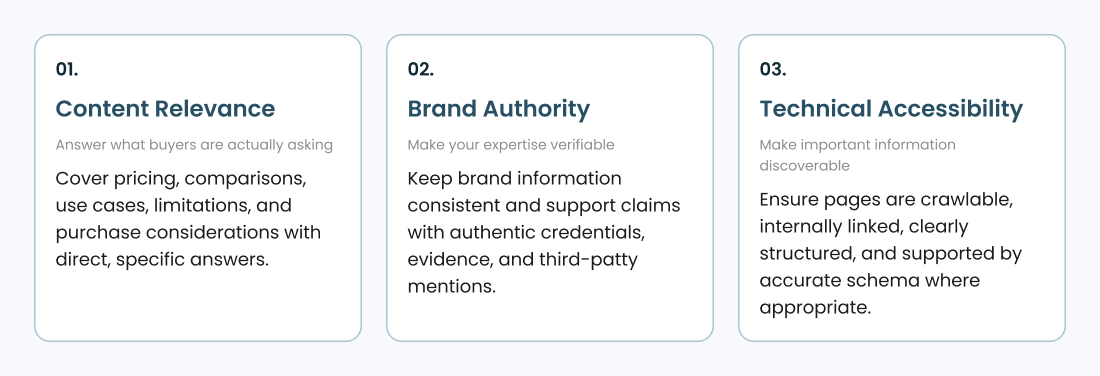
Businesses can improve their chances of earning AI search citations by focusing on three areas: content relevance, brand authority, and technical accessibility. Answering high-intent customer questions, maintaining consistent business information, earning credible third-party mentions, and implementing accurate schema markup can help search engines discover, understand, and evaluate their content.

AI search optimization pillars

A Business Example That Connects All Three

Suppose a cybersecurity company wants to appear when potential customers search:

“Best cybersecurity services for small healthcare businesses.”

Pillar What the Business Needs Why It Matters
Content relevance Explain healthcare security requirements, service inclusions, pricing factors, and suitability Answers the buyer’s actual evaluation questions
Brand Authority Publish verifiable certifications, expert credentials, and relevant client case studies Helps establish why the provider is credible
Technical Accessibility Maintain indexable service pages, relevant internal links, and accurate Organization/Service structured data Helps search engines discover and interpret the information


This approach is more useful than simply adding AI-related keywords to existing service pages. Google’s official guidance on AI features confirms that established SEO fundamentals remain relevant. It also clarifies that no special schema markup is required for AI Overviews, and meeting technical requirements does not guarantee citation.

Getting cited in AI search isn’t about adding more content or implementing schema alone. Businesses need content that matches buyer intent, evidence that supports their credibility, and a website that search engines can reliably access. These three foundations also prepare the ground for the next challenge: demonstrating E-E-A-T throughout the customer journey.

This structure keeps the section concise, avoids duplicating the previous Stop vs. Replace table, and gives decision-makers a clear understanding of where an SEO, AEO, or GEO service provider adds value.

E-E-A-T (Experience, Expertise, Authoritativeness, and Trustworthiness) helps businesses demonstrate why their content deserves attention and trust. By supporting claims with first-hand experience, qualified insights, credible recognition, and verifiable information, businesses can strengthen content quality and build a foundation for AI search visibility.

Before vs. After: Applying E-E-A-T to Business Content

Consider a cybersecurity company promoting its security assessment services.

Content Element Before: Generic Content After: E-E-A-T Focused Content
Introduction “We offer the best cybersecurity solutions.” “Worried about security gaps across your business? Understand where your systems may be exposed before those risks disrupt operations.”
Body Content “Our experts deliver advanced security assessments.” “Our security assessments examine network vulnerabilities, access controls, and system configurations, with findings documented for your IT team.”
CTA Banner “Contact Us for the Best Security Services.” “Know Where Your Business Is Exposed. Request a Security Assessment.”
Conclusion “Choose us for reliable cybersecurity solutions.” “A documented assessment helps your team identify security gaps, prioritize corrective actions, and make informed decisions about risk.”


Why this matters: Businesses don’t earn customer confidence by repeatedly calling themselves experienced or reliable. They build it by showing how they solve problems, who is responsible for the work, and what evidence supports their claims.

Google’s guidance on creating helpful, reliable, people-first content emphasizes first-hand expertise, clear sourcing, and trustworthy information. E-E-A-T is not a direct ranking factor or a guarantee of AI citations, but it is a useful framework for improving the substance and credibility of business content.

Business takeaway: Strong E-E-A-T turns generic marketing copy into credible information that helps potential customers evaluate your business. For SEO, AEO, and GEO strategies, that means supporting every major claim with genuine expertise, relevant evidence, and clear business value-not simply adding more keywords.

Why Are Competitors Getting AI Citations While Your Business Is Missing?

Your competitors may appear in AI-generated answers because their content addresses specific buyer questions, their expertise is supported by credible sources, or their brand information is easier to discover. The real concern isn’t just missing an AI citation. It’s losing visibility when potential customers are comparing providers.

How Can Businesses Identify and Close AI Citation Gaps?

A competitor AI visibility audit helps identify which brands are being recommended, what sources support those recommendations, and where your business has opportunities to stand out.

What to analyze What to look for Business opportunity
AI brand mentions Which competitors appear for high-intent queries across Google AI Overviews, ChatGPT, and Perplexity? Identify buying questions where your brand is missing.
Third-party citation Are competitors referenced in industry publications, review sites, or credible directories? Strengthen digital PR, reviews, and industry authority.
Content gaps Do competitors answer pricing, comparisons, or industry-specific questions better? Develop content addressing overlooked buyer concerns.
Information gain Do competitors provide original research, case studies, or first-hand insights? Differentiate your brand with evidence competitors cannot easily replicate.


For instance, suppose two accounting firms offer outsourced bookkeeping services. A buyer asks ChatGPT, “Which accounting firms help ecommerce businesses manage Shopify and QuickBooks?”

One firm has a generic bookkeeping page. The other explains its ecommerce accounting experience, supported integrations, service scope, and documented client examples. The second firm provides more specific information relevant to that buyer’s needs, giving AI systems and prospective customers stronger evidence to evaluate its suitability.

Tools such as Semrush’s AI Visibility Toolkit can help businesses compare competitor mentions, identify missing prompts, and examine cited sources. Because AI responses can change between searches, these findings should be monitored over time rather than judged from a single query.
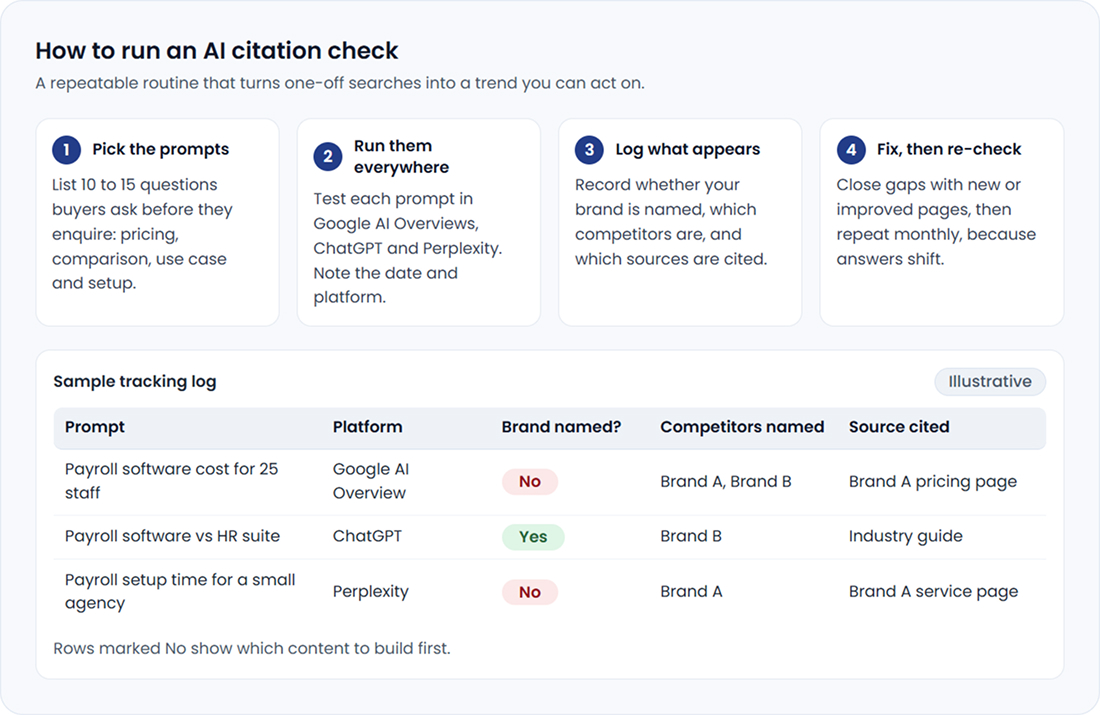
AI citation tracking

Google’s helpful content guidance also emphasizes original research, first-hand experience, and substantial value over content that merely repeats existing information.

Business takeaway: Don’t replicate a competitor’s content simply because AI cites it. Identify what makes that competitor relevant, credible, and useful to buyers, then close those gaps with your own verified expertise and differentiated value. That’s how an AI citation audit becomes a business growth strategy rather than another visibility report.

How Can Businesses Turn AI Search Visibility Into Qualified Leads?

Getting cited in AI search is only the first step. Businesses need to connect that visibility with high-intent content, conversion-focused service pages, and clear enquiry pathways. Google’s AI search guidance emphasizes valuable, original content that helps users make informed decisions. For businesses, the objective is to turn that visibility into prospects who are ready to compare, enquire, or buy.

Focus on Buying Intent, Not Just Search Volume

Someone searching “What is CRM software?” is learning. Someone asking “Which CRM integrates with QuickBooks for a 20-person sales team?” is evaluating a solution.

Both searches have value, but the second presents a more immediate commercial opportunity.

Businesses should prioritize content addressing:

  • Pricing and costs: What will the solution cost for my business?
  • Comparisons: Which provider or product best fits my requirements?
  • Use cases: Will this solution work for my industry or business size?
  • Implementation: How long will setup take, and what’s involved?

These questions create opportunities for SEO, AEO, and GEO strategies to reach buyers closer to a purchasing decision.
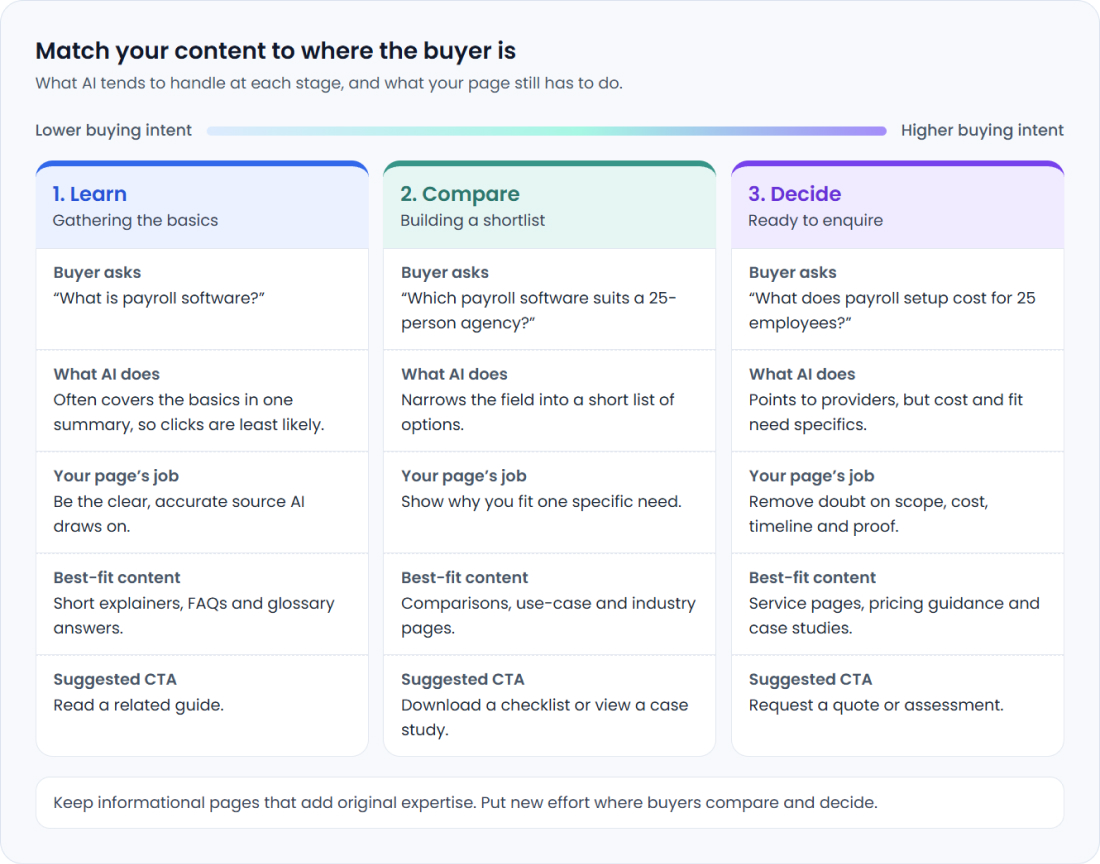
AI search buyer journey

Connect AI Citations With Pages That Convert

An AI citation may introduce your brand, but your website must give visitors a reason to act.

Consider a business offering CRM implementation services:

Customer journey What the business should provide
AI discovery A clear answer explaining CRM implementation costs and requirements
Website visit A detailed service page with integrations, timelines, and relevant case studies
Trust Building Verified client results, specialist credentials, and a transparent process
Lead conversion A relevant CTA such as “Request a CRM Implementation Assessment”


The opportunity is to connect helpful information with the next logical buying decision-not send every visitor to a generic Contact Us page.

Make It Easier for Qualified Prospects to Inquire

If a potential customer arrives after comparing providers through AI, they may already understand the basics. Forcing them through another generic explanation adds friction.

Your landing pages should answer the questions that remain: Can you solve my specific problem? Have you done it before? What will it cost? What happens after I contact you?

Clear service scope, industry-specific evidence, realistic pricing guidance, and relevant CTAs help address those concerns.

A Practical Business Scenario

Suppose a CRM consulting company receives 200 monthly visits from AI search referrals after improving its visibility for implementation and integration queries.

If 5% of those visitors submit a qualified enquiry, that produces 10 qualified leads. If 20% become customers, the business gains 2 new clients.

These are illustrative figures, not industry benchmarks or guaranteed results. They demonstrate why businesses should evaluate AI search performance through lead quality and customer acquisition-not citation counts alone.

Business takeaway: AI visibility creates the opportunity to be discovered. Relevant content, credible expertise, and conversion-focused experiences determine whether that attention has a chance to become revenue. The priority is building a connected SEO, AEO, and GEO strategy that supports the customer’s journey from research to enquiry.

Staying competitive in AI search requires more than improving rankings or earning occasional citations. ZealousWeb connects SEO, AEO, GEO, content authority, and conversion optimization to help businesses strengthen AI visibility and turn customer interest into measurable growth.

Strategic Priority How ZealousWeb Adds Value
AI visibility & content audits Identify missing AI citations, underperforming content, and high-intent search opportunities.
E-E-A-T Content authority Strengthen content with verified expertise, original insights, and credible evidence.
Competitor & technical analysis Uncover competitor citation gaps, improve crawlability, and implement relevant structured data.
Conversion optimization Align service pages, messaging, and CTAs with customer buying intent to improve lead opportunities.
AI Search measurements Track AI visibility, citations, qualified traffic, and conversions to guide ongoing improvements.


As AI search changes how customers research and compare businesses, maintaining visibility is only part of the challenge. ZealousWeb helps connect that visibility with credible content, stronger buying journeys, and conversion opportunities-so your business is better positioned to turn AI-driven discovery into qualified leads.

Conclusion

AI search visibility takes more than optimised content or technical improvements. It requires a connected strategy that brings SEO, GEO, content expertise, brand authority, and continuous measurement together.

From understanding buyer prompts and competitor presence to strengthening credibility across markets, every effort should contribute to how AI platforms discover, interpret, and recommend your brand.

ZealousWeb brings the strategy, expertise, and execution together to help businesses turn AI search visibility into measurable growth

Turn AI Search Visibility Into Measurable Business Growth

Book a Consultation
AI search growth consultation

FAQs

Related Blog Posts

AEO & GEO Service Cost

How Much Do AEO & GEO Services Cost? A Service-by-Service Breakdown

October 26, 2026
AEO ServicesAI Search OptimizationDigital Marketing ServicesGEO Services
White-Label Agency Partner

White-Label Partner vs. White-Label Service: How Each Impacts Growth, Margins, and Delivery

October 14, 2026
Agency Profit MarginsDigital Agency GrowthSEO and GEOwhite-label agency
CRO model for digital agencies

From Project Revenue to Recurring Value: A Practical CRO Model for Digital Agencies

September 17, 2026
CRODigital AgenciesRecurring RevenueWebsite Optimization
Branding Services Cost Guide

How Much Do Branding Services Cost in 2026? Pricing, Packages, and ROI

September 17, 2026
Brand ROIBrand StrategyBranding CostsBranding Services
Digital Agency CRM Automation

The Lead Came In. What Happens Next? A CRM & Automation Guide for Digital Agencies

September 16, 2026
CRM AutomationDigital AgenciesLead ManagementMarketing Automation
AI Website Personalization for Agencies

What AI Website Personalization Could Actually Look Like for Your Agency’s Clients

September 16, 2026
AI PersonalizationConversion OptimizationDigital AgenciesWebsite Personalization
White-label analytics support for agencies

Why Good Campaigns Still Underperform: The Conversion Gap Agencies Can Help Fix

September 16, 2026
Conversion OptimizationCRODigital Marketing AgenciesLanding Page Optimization
Grow Existing Client Accounts

How Digital Agencies Can Grow Existing Client Accounts Without Building Every Capability In-House

September 16, 2026
Agency PartnershipsClient Account GrowthDigital AgenciesWhite-Label Services