

Fraud Blocker
White-label analytics support for agencies

Why Good Campaigns Still Underperform: The Conversion Gap Agencies Can Help Fix

September 16, 2026Posted By: Jalpa Gajjar
Conversion OptimizationCRODigital Marketing AgenciesLanding Page Optimization

Traffic is up. Impressions look healthy. CTR is moving in the right direction. The lead total has made it into another monthly deck.

Useful? Yes.

Enough to explain client performance? Not always.

For paid media, SEO, social, creative, web design, performance marketing, and full-service agencies, the bigger question is what happens after the traffic arrives.

Did visitors find what they expected? Did they understand the offer? Where did they hesitate? Did mobile users behave differently? Did they start the form and disappear? Were the leads actually qualified?

That is the gap conversion rate optimization (CRO) addresses.

Unbounce’s benchmark analysis of 464 million landing-page visits, 41,000 pages, and 57 million conversions found a median landing-page conversion rate of 6.6% across industries. It is not a universal target, but it shows how much visitor activity never becomes a conversion.

For agencies, the objective should therefore move beyond reporting traffic, clicks, impressions, and lead totals toward understanding the complete conversion journey:

Traffic → Landing Experience → Visitor Behaviour → Friction → Hypothesis → Improvement → Testing → Measurement → Iteration

Because “traffic but no conversions” is not solved by making the traffic graph taller.
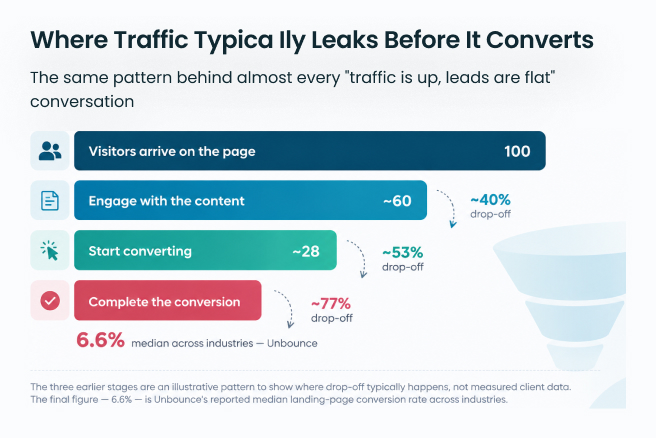
Conversion Funnel


🚀 Beyond the Click: When the opportunity sits in the post-click journey, ZealousWeb can work behind your agency with CRO, UX, analytics, and landing-page expertise-helping turn existing traffic into stronger client outcomes without expanding your in-house team.

Why Your Client Campaigns Underperform Even When Traffic Is Increasing

This is one of the most important questions an agency can investigate before recommending more budget, more content, or another campaign.

Higher traffic creates more conversion opportunities. It does not guarantee those opportunities become enquiries, bookings, purchases, or qualified leads.

Is It a Traffic Problem or a Landing Page Problem?

Look for signals such as:

  • Paid clicks increasing while enquiries remain flat
  • Organic traffic growing without qualified leads
  • Strong CTR but weak landing-page conversion
  • Visitors starting forms but abandoning them
  • Mobile visitors converting far below desktop users
  • High engagement with little progression toward commercial actions

Google notes that landing-page experience considers factors including relevance, usefulness, navigation, and whether the experience meets expectations created by the ad. It also contributes to Quality Score.

That makes ad-to-landing-page message match, conversion intent, and UX part of paid media performance -not somebody else’s website problem.

🎯 Fix the Right Problem: If the issue sits beyond the campaign, ZealousWeb can support your agency with CRO, UX, analytics, and landing-page optimization-so you can improve conversion performance before simply increasing acquisition spend.

What Should Agencies Measure Beyond Clicks and Impressions?

Clicks tell agencies that somebody arrived. They do not explain what happened next.

Visitor journey analysis connects acquisition data with user behavior across pages, forms, funnels, and conversion points.

Google Analytics’ Traffic Acquisition report can show where sessions originate across organic, paid, Google, and third-party traffic sources. The next layer is understanding how those visitors behave once they arrive.

Build a Full-Funnel View

Instead of stopping at:

Channel → Click → Lead

Look at:

Source → Landing Page → Engagement → Friction → Conversion → Lead Quality → Revenue

Useful signals can come from:

  • GA4 events and funnels
  • Heatmaps and scroll depth
  • Session recordings
  • Form analytics
  • CRM outcomes
  • Offline conversion data
  • Revenue attribution
  • First-party customer data

This gives agencies conversion intelligence, not just channel reporting.

📊 From Reporting to Revenue: When your agency has the data but needs deeper analytics, CRO, or implementation support, ZealousWeb can work behind your team to connect visitor behavior with conversion opportunities and measurable business outcomes.

What Does Visitor Behaviour Reveal That Analytics Alone Cannot?

Analytics can show where users exit. Behavioral analytics helps explain what they experienced before they left.

That is where heatmaps, session recordings, rage clicks, dead clicks, scroll behavior, funnel analysis, and AI-assisted session summaries become useful. Microsoft Clarity, for example, combines heatmaps, recordings, smart events, and behavioral insights to help teams understand how visitors interact with digital journeys.

The value becomes clearer when those signals lead to measurable UX improvements.

Vehicle-leasing platform instacar used Clarity across its website and mobile app to investigate friction in car discovery, mobile journeys, forms, document uploads, and other conversion-critical interactions. After making targeted UX and performance improvements, Microsoft reported a 49% increase in post-quote form completion, a 14% reduction in mobile session abandonment, and an overall 7% increase in conversions.

For agencies, the lesson is not “install a heatmap and conversions magically appear.”

Quantitative analytics tells you where performance changes. Behavioral analytics can help explain why-giving paid media, SEO, UX, and CRO teams stronger evidence for what to investigate next.

AI automation can accelerate that process by summarizing large volumes of sessions, clustering repeated behavior patterns, and surfacing anomalies faster. Human judgment still decides which findings matter commercially.

🔍 From Signals to Solutions: When your agency can see the behavior but needs deeper CRO, UX, analytics, or implementation expertise, ZealousWeb can step in behind your team to turn those signals into prioritized improvements-while you retain ownership of the client relationship.

How Should Agencies Analyze an Underperforming Landing Page?

Landing page optimization should begin with visitor intent, conversion data, and user behavior-not design opinion.

When agencies ask, “Why is this landing page getting traffic but not converting?”, the answer usually sits somewhere between message match, UX friction, mobile usability, trust, CTA clarity, and the conversion path itself.

A strong landing page CRO analysis should look at both quantitative signals and behavioral insights before recommending changes. That means combining GA4 data, heatmaps, session recordings, form performance, and AI-assisted behavioral analysis to understand what visitors expected, where they hesitated, and why they may have dropped off.

For agencies, this matters because an underperforming landing page can quietly weaken PPC performance, SEO conversions, lead quality, cost per acquisition, and overall campaign ROI.

The useful question is not:

“Do we like this landing page?”

It is:

“Does this page make the next decision easy for the visitor we worked so hard to acquire?”

Six Signals Worth Reviewing

Conversion Area What Agencies Should Ask
Message Watch Does the page continue the promise made before the click?
Value Proposition Is the business value immediately understandable?
CTA Effectiveness Is the desired next action obvious and relevant?
Trust Is there enough proof to reduce hesitation?
Mobile Experience Can users complete the journey without unnecessary effort?
Forms/Checkout Are avoidable fields or steps creating abandonment?


This approach also supports searches such as “why is my landing page not converting?”, “how to improve landing page conversion rate”, and “what causes low conversion rates?” because the answer is rarely one isolated design element.

Usually, several small disconnects compound.

Agency takeaway: Diagnose the experience before proposing a redesign. Otherwise, the agency may simply rebuild the same conversion problem with nicer typography.

Which UX Friction Points Are Most Likely to Hurt Conversions?

UX friction is anything that makes the desired action unnecessarily confusing, slow, difficult, or risky. And no, it is not always dramatic enough to appear in a dashboard wearing a warning sign.

Common Conversion Barriers

  • Unclear value proposition: Visitors understand the service but not why it matters to them.
  • Weak CTA hierarchy: Too many competing actions dilute the intended next step.
  • Form fatigue: The page asks for more information than the business actually needs.
  • Mobile friction: Navigation, buttons, content, or forms are harder to use on smaller screens.
  • Trust gaps: Claims appear without enough evidence, reassurance, credentials, or proof.
  • Checkout complexity: Baymard currently places average documented ecommerce cart abandonment at roughly 70%, with factors including extra costs, trust concerns, forced account creation, and complicated checkout flows contributing to abandonment.

That is why CRO should examine the entire path to action rather than obsessing over one button.
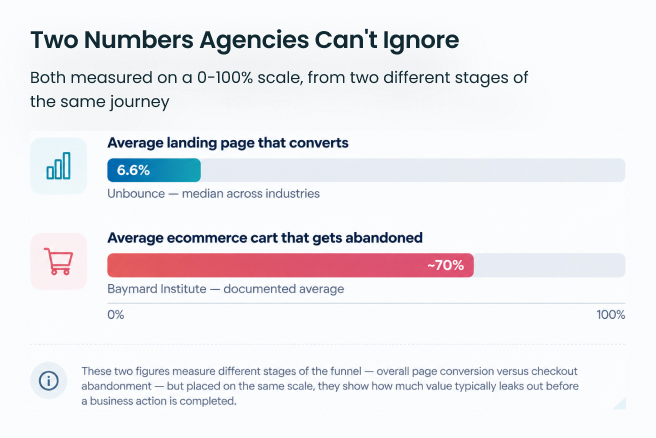
UX Friction


🧭 Friction Into Opportunity: When UX issues start limiting campaign performance, ZealousWeb can support your agency with UX analysis, CRO, design, and development-helping remove conversion friction without adding specialist overhead in-house.

How Do Agencies Turn Visitor Insights Into CRO Hypotheses?

CRO becomes valuable when observations turn into structured decisions. “We should shorten the form” is an opinion. Mobile users frequently abandon after reaching step two, so removing non-essential fields may increase completed enquiries” is a hypothesis.

A Useful Conversion Hypothesis Answers:

  • What is happening? Identify the behavioral pattern.
  • Why might it be happening? Connect the pattern with probable friction.
  • What change could improve it? Define an intervention tied to a measurable outcome.

Agencies can also build a hypothesis backlog, prioritizing opportunities based on potential business impact, supporting evidence, implementation effort, and confidence. AI-assisted CRO can help summarize behavioral patterns, cluster issues, and surface anomalies faster. But predictive insights still need to be interpreted against campaign intent and client economics. Otherwise, congratulations-you have automated the guessing.

🧠 From Insight to Action: When your agency has the data but not the specialist CRO capacity, ZealousWeb can help turn those signals into prioritized hypotheses, tested improvements, and measurable client outcomes.

Should Agencies Optimize Landing Pages Before Increasing Ad Spend?

When qualified traffic already exists but conversion efficiency is weak, improving the post-click experience can be more commercially sensible than immediately increasing acquisition spend.

That applies differently across agency disciplines.

Where the Opportunity Sits

  • Paid Media Agencies Improve message match, offers, CTAs, forms, and PPC landing page conversion.
  • SEO Agencies Connect growing organic traffic with commercial journeys, internal paths, and conversion actions.
  • Social and Creative Agencies Ensure the promise that generated the click survives when the visitor reaches the website.
  • Web Design Agencies Connect visual quality with usability, behavioral data, and measurable conversion outcomes.
  • Full-Service Agencies Combine acquisition, CRO, UX, analytics, development, CRM, and revenue attribution into a connected growth system.

This is increasingly where full-funnel optimization becomes more commercially useful than channel-by-channel reporting.

🤝 Extend the Opportunity

When the conversion opportunity sits outside your agency’s in-house capability, a white-label partner like ZealousWeb can help you optimize the post-click experience without handing over the client relationship.

When Should Agencies Use A/B Testing?

A/B testing is one method for validating a CRO hypothesis. It is not the definition of CRO. Testing makes sense when there is meaningful uncertainty worth resolving.

Consider A/B Testing When:

  • The page has sufficient relevant traffic
  • A clear conversion event exists
  • There is a defined hypothesis
  • Variations are meaningfully different
  • The potential business impact justifies the experiment

Fix Without Testing When:

  • The form is broken
  • Mobile interactions do not work
  • Critical information is inaccessible
  • An obvious usability or accessibility problem exists

Running Version A against “Version B where the form actually works” is not sophisticated experimentation. Testing should reduce uncertainty-not delay common sense.

⚖️ Test With Purpose: A/B testing adds value when it helps your agency make a better decision-not when it is used to validate the obvious. Test where uncertainty exists; fix clear usability issues immediately.

How Should Agencies Measure Whether CRO Actually Worked?

A higher conversion rate looks good in a report. A higher conversion rate that creates low-quality leads may not look nearly as impressive to sales.

That means CRO measurement needs to connect page-level improvements with downstream business outcomes.

Measure What Matters to the Client

Depending on the business model:

  • Qualified leads
  • Form completion
  • Appointment or demo bookings
  • Sales opportunities
  • Purchases
  • Revenue per visitor
  • Cost per acquisition
  • Lead-to-sale conversion
  • Checkout completion

Where possible, connect web analytics with CRM, offline conversion, sales, and revenue data.

This creates stronger closed-loop attribution and helps agencies answer a much better question than “Did clicks increase?”

Did the improvement produce more valuable business actions?

📈 Proof That Matters: When CRO connects to lead quality, sales, and revenue-not just clicks-your agency has a far stronger performance story to take back to the client.

How Can Agencies Turn CRO Into an Ongoing Client Growth Capability?

Conversion optimization is not a one-time audit. Visitor behavior, campaigns, offers, technology, and customer expectations continue to change.
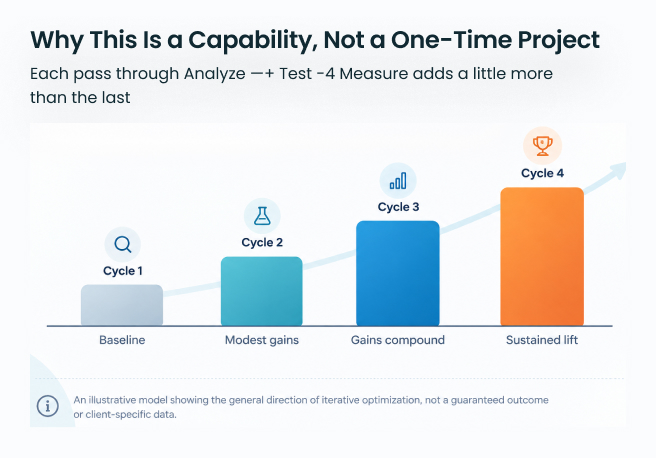
CRO Growth


A practical CRO cycle looks like:

Analyze → Identify → Hypothesize → Improve → Test → Measure → Iterate

AI-powered behavioral analytics, automated anomaly detection, session summarization, first-party data, and conversion intelligence can make this cycle faster and reduce manual analysis.

But agencies do not need every CRO, UX, analytics, development, and experimentation capability permanently in-house.

A white-label CRO partner can support:

  • Landing-page and visitor journey reviews
  • UX and conversion optimization
  • Landing page design and development
  • Behavioral analytics and AI-assisted insights
  • Form and checkout optimization
  • A/B testing implementation
  • Technical performance improvements
  • Continuous CRO support

ZealousWeb works behind your agency as an extension of your delivery team while you retain ownership of the client relationship.

🧩 CRO Delivery Advantage: With ZealousWeb supporting CRO, UX, analytics, development, testing, and AI-assisted optimization, your agency can move from finding conversion gaps to fixing them-without building every capability in-house. That means stronger client outcomes and more value from existing accounts.

Conclusion

Agencies should absolutely report traffic, clicks, impressions, and leads. But the stronger client conversation starts when you can explain what happened after the click, where the journey lost momentum, and what should change next.

That is where conversion intelligence becomes commercially valuable.

A weak landing experience can quietly limit the performance of paid media, SEO, social, creative, and every other channel feeding it. Identifying that gap allows agencies to improve outcomes without automatically increasing acquisition spend.

And when your team spots the opportunity but does not have the CRO, UX, analytics, development, or testing capability in-house, ZealousWeb can step in behind your agency as a white-label delivery partner.

We help agencies investigate the visitor journey, uncover conversion friction, prioritize improvements, implement changes, and support ongoing optimization-while your agency keeps ownership of the client relationship.

Because sometimes the next growth opportunity is not another campaign. It is getting more value from the traffic you already worked hard to win.

Review a Client Landing Page

Conversion Review

FAQs

Related Blog Posts

Digital Agency CRM Automation

The Lead Came In. What Happens Next? A CRM & Automation Guide for Digital Agencies

September 16, 2026
CRM AutomationDigital AgenciesLead ManagementMarketing Automation
AI Website Personalization for Agencies

What AI Website Personalization Could Actually Look Like for Your Agency’s Clients

September 16, 2026
AI PersonalizationConversion OptimizationDigital AgenciesWebsite Personalization
Grow Existing Client Accounts

How Digital Agencies Can Grow Existing Client Accounts Without Building Every Capability In-House

September 16, 2026
Agency PartnershipsClient Account GrowthDigital AgenciesWhite-Label Services
performance marketing budget allocation

Which Performance Marketing Channel Deserves More of Your Budget?

September 10, 2026
Digital MarketingMarketing BudgetPaid MediaPerformance Marketing
Cheap Leads in Lead Generation

Why Cheap Leads Can Become Your Most Expensive Lead Generation Mistake

September 09, 2026
Google AdsLead GenerationLead QualityPerformance Marketing
AI performance marketing

How AI Is Transforming Performance Marketing From Ad Spend to Revenue

August 24, 2026
AI marketingArtificial IntelligenceDigital MarketingPerformance Marketing
AI email marketing automation

How AI Is Reshaping Email Marketing Through Automation and Hyper-Personalization

August 21, 2026
AI Email MarketingDigital MarketingEmail Marketing AutomationHyper-Personalization
brand refresh vs rebrand

Brand Refresh vs. Complete Rebrand: What Does Your Business Need?

August 18, 2026
Brand RefreshBrand StrategyBrandingRebranding