

A website launch is often treated as the finish line of a digital project. The design is approved, development is completed, and the website moves into maintenance mode.
But businesses rarely judge websites by whether they launched successfully. They judge them by whether they continue improving customer journeys, generating engagement, and supporting growth.
McKinsey research on experience-led growth found that companies focused on improving customer experiences can achieve significant growth advantages, with customer experience leaders delivering more than double the revenue growth of experience laggards in its analysis.
For digital agencies, this creates an opportunity beyond website delivery. By combining conversion rate optimization (CRO), analytics, AI-powered insights, personalization, and experimentation, agencies can help clients continuously improve digital performance.
This article explores how agencies can turn post-launch optimization into a recurring growth model.
Why Website Projects Often Stop Creating Value After Launch
Most agencies know this cycle well: discovery calls happen, designs get approved, development gets completed, the website goes live, and everyone celebrates the launch.
Then comes the familiar phase – “Let’s keep an eye on it.”
The problem? Websites rarely improve by simply existing. A launch gives businesses a functional digital presence, but it does not automatically reveal whether visitors understand the message, trust the brand, or complete the desired action. Users interact with digital experiences in ways that are often unpredictable, making behavioral data critical for understanding what actually works after launch.
For agencies, this is where the post-launch opportunity begins.
The Traditional Agency Project Lifecycle
The typical agency delivery model follows a straightforward path:
| Project Stage | Agency Focus | Business Outcome |
| Discovery | Understanding goals, audience, and requirements | Project direction |
| Design | Creating layouts and experiences | Visual representation |
| Development | Building the website | Functional product |
| Launch | Making the website live | Digital presence |
| Support | Fixing issues and maintaining stability | Operational continuity |
This model works well for delivering projects. However, it often creates a natural revenue ceiling because the relationship is tied to completion milestones. The website is considered “done” when it launches, even though the business results are only beginning to appear.
The reality is that a website launch is based largely on research, experience, and assumptions. Once real users arrive, agencies finally get access to what matters most – actual visitor behavior.
The Gap Between Launch and Business Growth
A website can look perfect during approval meetings and still struggle when exposed to real users.
Visitors may ignore important CTAs, abandon forms, fail to find key information, or leave because the experience does not match their expectations. These insights usually appear only after launch through analytics, user behavior tracking, heatmaps, and conversion data.
According to Baymard Institute Ecommerce UX Research, poor user experience and friction during digital journeys contribute significantly to lost conversions, showing why optimization cannot stop at launch.
The challenge is that customer expectations, competitors, technology, and buying behavior continue changing. A website that performs well today may need improvements six months later.
For agencies, continuous optimization creates a way to stay involved where the real business impact happens – improving how effectively a website attracts, engages, and converts visitors.
The Opportunity Hidden After Delivery
The post-launch phase gives agencies something they did not have during development: performance data.
Instead of rebuilding websites every few years, agencies can identify targeted improvements through:
- Conversion rate optimization (CRO)
- Analytics-driven insights
- User journey analysis
- Landing page optimization
- A/B testing
- AI-powered personalization
Modern AI automation is also changing how agencies approach optimization. AI-assisted analytics can help identify behavioral patterns, generate testing ideas, and accelerate decision-making without relying only on manual reviews. This allows agencies to move from being viewed as a project delivery partner to becoming a long-term digital growth partner.
The website was never the final product. It was the starting point where continuous improvement begins.
What Continuous Website Optimization Means for Digital Agencies
A website does not stop creating business value after launch, but many agency relationships do. Once a website is live, the conversation often shifts toward updates, fixes, and keeping things running – important tasks, but not the activities that improve performance.
Website maintenance keeps a digital asset healthy. Continuous website optimization focuses on making that asset work harder. It uses real visitor behavior, conversion data, and business goals to identify what can be improved and where opportunities are being missed.
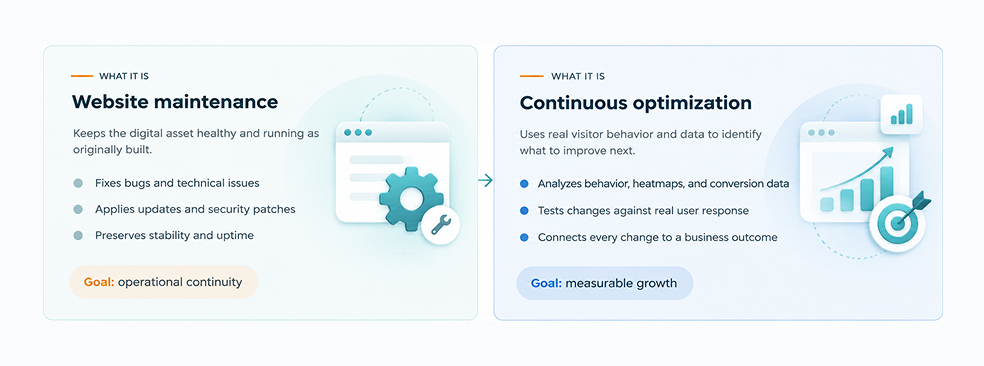
Understanding user interactions and measuring digital performance helps businesses make data-informed decisions instead of relying only on assumptions.
For agencies, this creates a shift from delivering websites to building continuous growth partnerships where every improvement is connected to measurable outcomes.
The Continuous Improvement Framework Agencies Can Apply
Continuous optimization is not about randomly changing headlines, redesigning pages, or running tests without direction. A successful CRO process follows a structured improvement cycle:
Measure → Analyse → Prioritize → Improve → Test → Learn → Repeat
| Stage | Purpose |
| Measure | Understand website performance and visitor behavior |
| Analyze | Identify friction points and conversion opportunities |
| Prioritize | Focus on improvements with the highest business impact |
| Improve | Enhance UX, messaging, and conversion paths |
| Test & Learn | Validate changes and apply insights |
This approach helps agencies replace assumptions with evidence. Instead of recommending changes based only on experience, teams can use analytics, heatmaps, conversion data, and AI-assisted insights to understand what users actually need.
How CRO Fits Into the Website Growth Journey
Conversion rate optimization (CRO) brings structure to continuous website improvement by connecting user experience changes with measurable business goals.
Modern CRO is not limited to A/B testing button colors or changing page layouts. It combines:
- User journey analysis
- Landing page optimization
- UX improvements
- Conversion tracking
- Personalization
- AI-powered insights
With AI automation becoming part of modern CRO workflows, agencies can analyze behavioral patterns faster, identify optimization opportunities, and create more relevant website experiences.
For agencies, CRO creates a practical path to extend client relationships beyond project delivery. Instead of rebuilding websites every few years, businesses can continuously improve existing digital assets based on real performance data.
The website launch creates the foundation. Continuous optimization is what helps it grow.
How CRO Creates a Recurring Revenue Opportunity for Agencies
A website project usually ends when the launch is complete, the client approves the final delivery, and the team moves on to the next build. But the website’s real performance story starts after launch – when actual visitors begin interacting with it.
Businesses do not always need another website redesign. They need their existing digital experiences to continuously improve as customer expectations and the market Improving customer experiences remains a priority for organizations because digital interactions increasingly influence business outcomes.
For agencies, this creates a recurring opportunity through conversion rate optimization (CRO) – helping clients improve website performance through data, experimentation, and continuous enhancements.
Turning Completed Projects Into Ongoing Engagements
The post-launch phase gives agencies access to something they did not have during development: real user behavior.
Analytics can reveal where visitors drop off, which pages create engagement, where users hesitate, and what prevents conversions. These insights allow agencies to identify practical improvements instead of relying only on assumptions made during the initial project.
Continuous optimization helps agencies stay involved after delivery by creating ongoing improvement cycles focused on measurable business outcomes.
CRO Services Agencies Can Offer After Launch
CRO does not always require major redesigns. Often, small improvements backed by data can create meaningful performance gains.
Agencies can build ongoing optimization services around:
| CRO Activity | Value Created |
| Conversion audits | Identify growth opportunities |
| Analytics analysis | Understand visitor behavior |
| Landing page optimization | Improve campaign performance |
| UX improvements | Reduce user friction |
| A/B Testing | Validate changes with data |
| Personalization | Create relevant experiences |
With AI automation becoming part of modern CRO workflows, agencies can analyze behavioral patterns faster, identify optimization opportunities, and support smarter experimentation.
AI does not replace strategic thinking. It helps agencies spend less time finding signals and more time turning insights into improvements.
Building a Website Growth Retainer Model
A CRO retainer is not about making random website updates every month. It is about creating a structured optimization roadmap connected to business goals.
Agencies can offer recurring activities such as performance reviews, conversion analysis, testing plans, UX recommendations, and optimization reporting.
The value comes from continuously improving what already exists – helping clients generate more from their current digital investments while creating a predictable service model for agencies.
For agencies, CRO transforms the website from a completed deliverable into an ongoing growth opportunity.
The Role of Data, Analytics, and AI in Modern CRO
For years, website optimization was often driven by experience, opinions, and stakeholder feedback. Teams made changes based on what they believed users wanted – then waited to see if performance improved.
Modern CRO removes much of that guesswork.
Today, agencies can combine behavioral analytics, conversion data, AI automation, and experimentation frameworks to understand how visitors actually interact with websites and identify where improvements can create business impact.
For agencies, this creates a stronger advantage. Optimization recommendations are no longer based only on assumptions or past experience – they are supported by real visitor behavior, performance signals, and continuous learning.
Using Data Instead of Assumptions
A website can receive traffic and still fail to generate meaningful outcomes. The challenge is often not attracting visitors – it is understanding what happens after they arrive.
Data helps agencies identify patterns that are easy to miss, such as pages where users lose interest, steps where visitors abandon their journey, or content that fails to support decision-making.
By analyzing visitor behavior, conversion paths, engagement signals, and performance data, agencies can identify high-impact improvements instead of recommending changes based on opinions.
This creates a more strategic CRO approach where every improvement has a purpose – whether it is reducing friction, improving user experience, or increasing conversions.
How AI Is Changing Conversion Optimization
AI is making CRO workflows faster and more intelligent. Instead of spending significant time manually reviewing large amounts of data, agencies can use AI-assisted tools to identify patterns, generate insights, and support optimization decisions.
AI can help agencies with:
- Analyzing visitor behavior patterns at scale
- Identifying potential conversion opportunities
- Supporting testing ideas and optimization hypotheses
- Accelerating experimentation cycles
According to the McKinsey Global Survey on AI, organizations are increasingly adopting AI to improve productivity and decision-making across business functions. For agencies, AI acts as an accelerator. It helps teams spend less time collecting signals and more time applying strategic thinking to improve digital experiences.
Creating Smarter Website Experiences With AI
The next stage of CRO is not just improving websites based on past behavior. It is creating experiences that can adapt to different visitor needs.
AI-powered optimization enables agencies to explore:
- Personalized website experiences based on visitor intent
- Dynamic content recommendations
- More relevant messaging across customer journeys
- Automated optimization workflows
A returning visitor, a first-time prospect, and a visitor arriving from a specific campaign may all have different expectations. AI helps agencies create experiences that better match those moments. For digital agencies, this opens a bigger opportunity: building websites that continue learning, adapting, and improving instead of remaining static after launch.
A Practical CRO Workflow Agencies Can Use With Clients
A successful CRO program is not built around random website changes. It follows a structured process where agencies use data, user behavior insights, experimentation, and AI-assisted analysis to identify opportunities and improve performance over time. This workflow helps agencies create a repeatable optimization model that connects website improvements with measurable business outcomes.
The Measure → Analyse → Improve → Test → Learn Framework
| CRO Stage | What Agencies Do | Business Value |
| Measure | Review analytics, conversion tracking, and visitor behavior to understand current website performance. | Creates a clear baseline and identifies performance gaps. |
| Analyse | Study user journeys, landing page experiences, and friction points that prevent visitors from taking action. | Reveals where users struggle and where improvements are needed. |
| Prioritize | Evaluate opportunities based on business impact, effort required, and conversion potential. | Ensures teams focus on changes that can create meaningful results. |
| Improve & Test | Implement UX improvements, messaging updates, CTA enhancements, and landing page experiments. | Validates ideas using real user responses instead of assumptions. |
| Learn & Repeat | Measure results, document insights, and build the next optimization cycle. | Creates continuous website improvement instead of one-time fixes. |
Common Challenges Agencies Face When Adding CRO Services
Adding CRO to an agency’s service offering sounds straightforward until execution begins. Agencies already manage deadlines, client expectations, delivery teams, and multiple service lines – so introducing a new optimization model requires more than simply adding another item to the capabilities page.
The common challenges are usually not about understanding CRO. They are about integrating it into existing agency workflows, proving value, and creating a scalable delivery model.
Challenges Agencies Need to Solve Before Scaling CRO
- Moving Beyond One-Time Website Delivery Many agencies are experienced in building websites but have limited processes for post-launch optimization. The challenge is creating ongoing value after delivery through data analysis, experimentation, and continuous improvements.
- Proving CRO Impact to Clients Clients want to understand how optimization efforts influence business results. Agencies need to connect CRO activities with meaningful metrics such as conversions, lead quality, engagement, and revenue impact rather than reporting only website changes.
- Building CRO Expertise Without Increasing Fixed Costs Creating an internal CRO team requires specialists across analytics, UX, testing, and strategy. Agencies need a flexible approach to access expertise based on project requirements without adding unnecessary overhead.
- Managing CRO Alongside Existing Client Work Optimization requires continuous analysis, testing, and reporting. Without structured workflows, automation, and the right expertise, CRO can become another task competing for already limited team bandwidth.
Organizations are increasingly focus on customer experience improvements because digital interactions directly influence customer relationships and business outcomes. For agencies, solving these challenges creates an opportunity to build scalable CRO services, AI-assisted optimization workflows, and long-term client partnerships instead of relying only on new website projects.
How Agencies Can Build a Stronger Post-Launch Growth Partnership
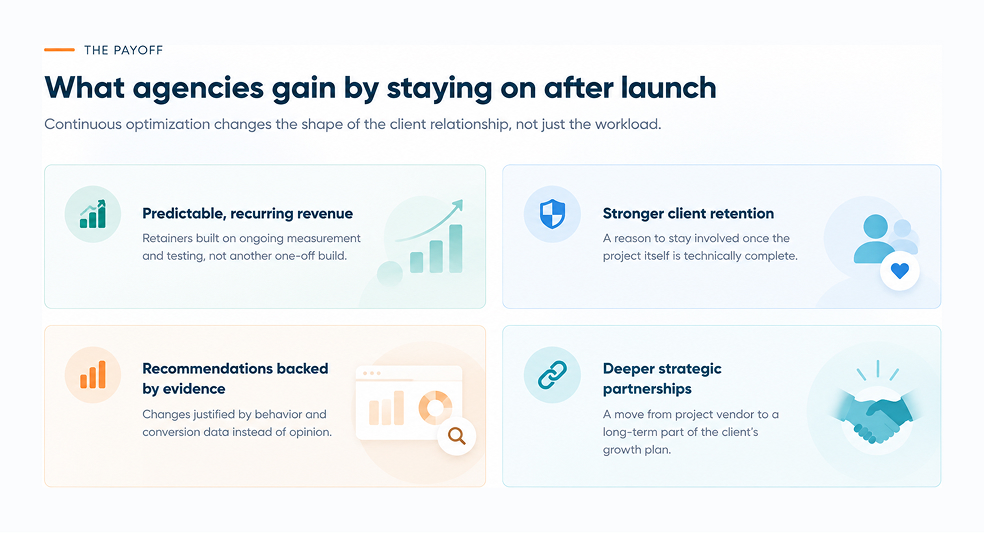
A website launch creates an entry point, but long-term client relationships are built through continuous improvement. Agencies that stay involved after launch can help clients adapt to changing user behavior, improve digital performance, and make better decisions using real data.
From Vendor Relationship to Strategic Partnership
Continuous optimization allows agencies to become more than a project delivery partner. By analyzing performance, identifying opportunities, and recommending improvements, agencies can become part of their clients’ ongoing digital growth initiatives.
Combining CRO With Existing Digital Services
CRO becomes more powerful when connected with other agency capabilities, including:
- SEO: Improving organic traffic quality and conversion paths
- Paid Media: Optimizing landing experiences and campaign performance
- UX/UI: Reducing friction across user journeys
- Analytics: Turning performance data into actionable insights
- Development: Implementing technical and experience improvements
- AI Personalization: Creating more relevant visitor experiences
This integrated approach helps agencies deliver stronger outcomes without treating CRO as a standalone service.
Creating More Predictable Agency Revenue
Relying only on new website projects creates unpredictable revenue cycles. A continuous optimization model helps agencies build recurring engagements around measurable improvements, ongoing testing, and long-term client growth.
For agencies, the opportunity is not just extending a project timeline – it is creating a more sustainable partnership model where client success and agency growth move together.
How ZealousWeb Helps Agencies Extend Digital Delivery Into Continuous Growth
Adding CRO capabilities requires more than knowing what needs improvement. Agencies also need the ability to analyze performance data, make technical changes, test improvements, and measure outcomes.
ZealousWeb supports agencies with the combined expertise required for ongoing website optimization – from analytics and UX improvements to development execution, performance marketing, and AI-assisted workflows.
Our team works alongside agencies to identify optimization opportunities, implement website improvements, and support continuous testing cycles after launch. This allows agencies to expand their service capabilities and deliver ongoing website growth without building a separate CRO team internally.
Conclusion
A website launch delivers the foundation, but continuous optimization determines how much value that foundation creates over time.
For agencies, CRO creates an opportunity to stay involved after delivery, strengthen client relationships, and build recurring engagements around measurable improvements. By combining analytics, experimentation, UX enhancements, AI-assisted insights, and technical execution, agencies can help clients continuously improve their digital performance.
This is where ZealousWeb supports agencies beyond traditional website delivery. With capabilities across development, UX, analytics, digital marketing, and AI-driven workflows, our team helps agencies identify optimization opportunities and turn them into implemented improvements – without requiring them to build a separate CRO function internally.
The next growth opportunity may already exist within a client’s live website. The right process, expertise, and execution approach can turn those opportunities into measurable outcomes.
Find the Next Opportunity on a Live Client Website
FAQs
How does AI improve the way agencies deliver CRO services?
AI-assisted workflows help analyze behavioral data faster, identify optimization patterns, support testing ideas, and improve personalization opportunities. We combine these capabilities with human expertise to make strategic decisions that align with business goals.
How can agencies turn completed website projects into ongoing client engagements?
We help agencies identify post-launch opportunities where websites can deliver more value through CRO, analytics, UX improvements, and continuous optimization. Our team supports the execution layer needed to keep improving digital experiences after launch.
How do agencies manage CRO when website performance issues involve both marketing and technical improvements?
We approach CRO from a complete digital experience perspective. Our team combines analytics insights with UX understanding, development capabilities, and marketing expertise to identify and implement improvements across the entire user journey.
Can your team support optimization programs for high-traffic or complex websites?
Yes. Our experience across different platforms, technologies, and digital ecosystems allows us to support optimization initiatives that involve complex user journeys, multiple conversion points, and ongoing improvement requirements.
How do agencies create a continuous optimization service without changing their existing business model?
We help agencies add structured optimization capabilities around their existing services. This can include performance analysis, testing opportunities, UX enhancements, and implementation support based on the client's growth objectives.
What makes a CRO partnership valuable beyond providing recommendations?
The value comes from execution. We do not limit support to identifying opportunities; our team helps translate insights into practical improvements through design, development, analytics, testing, and optimization workflows.
How can agencies improve client retention after delivering a website?
Continuous optimization gives agencies a reason to stay involved beyond launch. By helping clients improve website performance over time, agencies can create ongoing engagements focused on measurable digital growth.
Can agencies use your expertise as an extension of their own delivery team?
Yes. We work alongside agencies to strengthen their delivery capabilities, allowing them to take on more optimization opportunities while maintaining control over client communication, strategy, and relationships.