

Quick Summary: What You’ll Learn
- How white label digital marketing helps agencies deliver client projects under their own brand without expanding their in-house team.
- How a white label partner manages SEO, PPC, web development, and content execution while your agency retains client relationships.
- How agencies manage project handoffs, deadlines, quality checks, and reporting through a white label fulfillment model.
- How white label pricing, fulfillment costs, and profit margins affect agency revenue.
- What agencies should evaluate before choosing a white label digital marketing partner to support growing client demands.
Your agency signs three new clients, but your SEO team is already managing 12 campaigns, your developers have pending website launches, and clients still expect timely updates and revisions. More contracts should mean business growth. Instead, they can create delivery backlogs, stretched teams, and shrinking profit margins.
Hiring for every new requirement increases fixed costs, while relying on different freelancers can leave your project managers coordinating multiple people, deadlines, and deliverables.
White-label digital marketing lets agencies expand their services and fulfillment capacity without building every capability in-house. A specialized partner handles agreed-upon execution while your agency retains control over client relationships, pricing, branding, and delivery oversight.
The value isn’t simply getting work done at a lower cost. It’s having the capacity to take on new projects without letting operational pressure affect existing clients.
How Does White Label Digital Marketing Work for Agencies?
White label digital marketing works by allowing an agency to sell services under its own brand while an external fulfillment partner executes the agreed-upon work. The agency manages client communication, strategy, pricing, and approvals, while the partner handles services such as SEO, PPC, web development, and content marketing. For example, an agency charging $3,000 monthly for SEO may pay its white-label partner $1,500 for execution. After $450 in internal account management costs, $1,050 remains before other expenses. This model can help agencies increase delivery capacity without immediately expanding their full-time team.
Why Does Winning More Clients Create Delivery Challenges for Agencies?
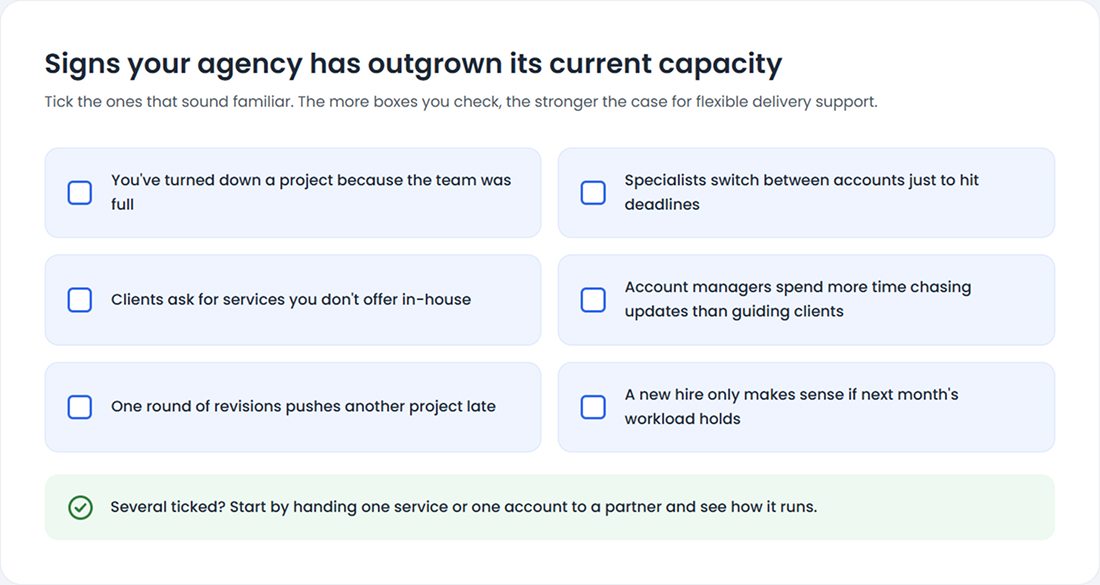
Winning new clients is good news until your team starts struggling to keep up with the work. More accounts mean more campaigns, revisions, meetings, and deadlines. And when your team is already busy, even a small increase in workload can affect how quickly projects move forward.
Here’s where growing agencies often run into trouble.
When Your Team Has More Work Than It Can Handle
Say your agency manages SEO for 10 clients with 3 specialists. You sign 4 more clients, but your team stays the same.
That’s 40% more accounts to manage, along with additional keyword research, content approvals, technical fixes, and monthly reports.
Your account managers now spend more time following up on pending tasks, while specialists switch between projects to meet deadlines.
This is where agency delivery capacity becomes a growth challenge. The agency can bring in new business, but its existing team may not have enough time to deliver everything.
Why Hiring More People Isn't Always Practical
You land 3 website projects this month. Hiring another developer sounds reasonable, but what happens if you secure only 1 project next month?
Full-time hiring creates ongoing expenses, regardless of how much work comes in. According to the U.S. Bureau of Labor Statistics, employee benefits accounted for 30% of private-industry employer compensation costs in June 2026.
For agencies managing changing project volumes, hiring decisions need to account for more than immediate workloads. The real question is whether there’s enough consistent work to justify another permanent employee.
How Small Project Delays Affect Your Profit
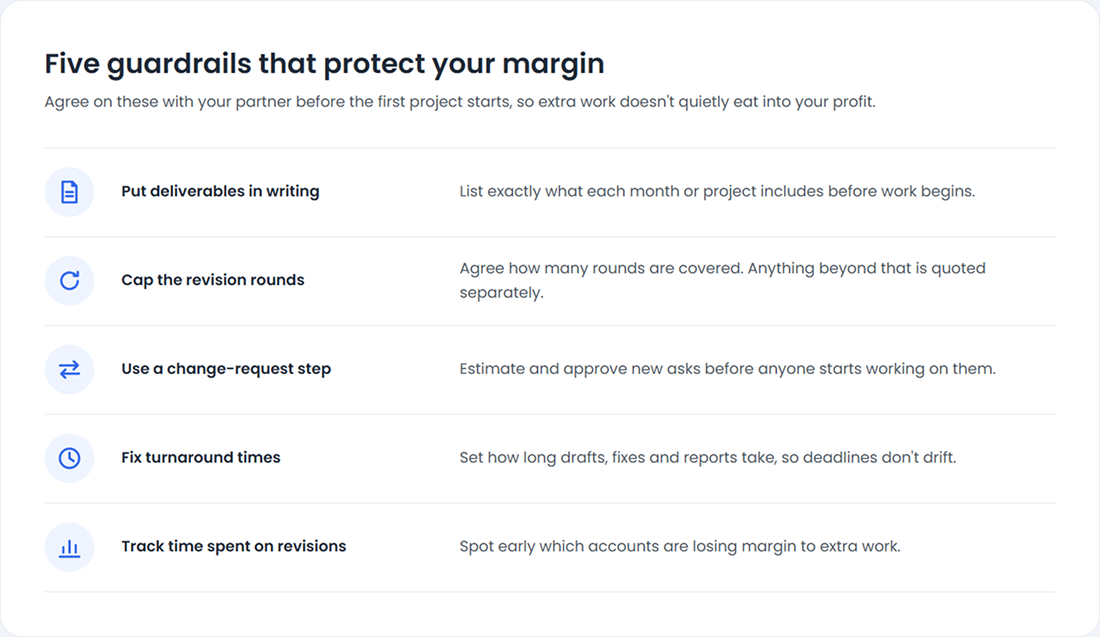
A client requests another design revision. Your developer spends 10 extra hours making changes, and another project gets pushed back.
This is a common example of project scope creep, where additional requirements increase the work without a corresponding change in budget or timeline.
Consider a website project priced at $8,000 with an estimated delivery cost of $5,000. If unplanned revisions add another $1,200, the amount remaining before other expenses drops from $3,000 to $1,800.
The agency still delivers the project, but earns less than expected.
For growing agencies, the challenge is finding enough people to deliver the work without making every new client another hiring decision or another deadline to worry about.
How Does White Label Digital Marketing Work for Agencies?
White label digital marketing follows a 5-step process: the agency signs the client, shares project requirements with a fulfillment partner, the partner completes the agreed work, the agency reviews the deliverables, and the client receives the work under the agency’s brand. The agency remains responsible for client communication, pricing, and overall delivery.
From Client Onboarding to White Label Fulfillment
Let’s say your agency closes a $2,500 monthly SEO contract, but your team doesn’t have the capacity to manage another campaign. Here’s how a white label partnership would work:
- You close the client: Your agency agrees on the services, deliverables, budget, and timeline with the client.
- You brief your white-label partner: You share the website details, campaign goals, agreed scope, deadlines, and reporting requirements.
- Your partner handles execution: The fulfillment team works on keyword research, technical SEO, content optimization, and other agreed tasks, following relevant Google Search guidelines.
- You review the work: Your team checks the deliverables, requests corrections if needed, and makes sure the work meets the client’s requirements.
- You deliver under your brand: The client receives the approved work and reports through your agency, while your partner remains behind the scenes according to the partnership agreement.
The key is having a clear process before work begins. Without it, your account managers could end up spending more time chasing updates and coordinating revisions than they would managing the project internally.
Who Handles Execution, Quality, and Client Communication?
A white label partner handles the tasks you’ve agreed to outsource, but your agency remains accountable to the client.
For example, if a PPC campaign isn’t generating the expected leads, your agency needs to understand what is happening, review the findings with the partner, and explain the next steps to the client.
A practical setup would look like this:
| Responsibility | Your Agency | White-label Partner |
| Client on-boarding and communication | Primary owner | Provides technical input |
| Strategy and project scope | Approves direction | Advises on feasibility |
| Campaign execution | Overseas progress | Completes agreed tasks |
| Quality checks and revisions | Final approval | Fixes identified issues |
| Reporting | Presence to client | Supplies performance data |
For PPC projects, Google Ads Manager Accounts allow agencies to manage multiple client accounts and assign different access levels, making account access easier to organize without sharing personal login credentials. The important distinction: White labeling doesn’t remove your agency’s responsibility for delivery. It gives your team additional execution capacity while keeping client management and final approvals in your hands.
What Services Can Agencies Offer Through White Label Partnerships?
Digital marketing agencies can offer 8 major white-label service categories: SEO, PPC, website development, e-commerce, content marketing, social media, AI video editing, and AI search optimization (AEO/GEO). These services allow agencies to take on specialized client requirements without hiring a separate team for every capability.
Here are the services agencies can add through a white-label digital marketing partnership:
| White-label Services | What Your Agency Can Offer |
| SEO Services | Technical audits, keyword research, on-page SEO, local SEO, link building, and ongoing optimization when your internal SEO team is at capacity. |
| PPC & Paid Advertising | Google Ads, Meta Ads, campaign setup, conversion tracking, and ongoing optimization for clients who need paid lead generation. |
| Website Design & Development | WordPress websites, landing pages, UI/UX design, redesigns, and website maintenance without maintaining a full development team. |
| E-commerce Development | Shopify, WooCommerce, and custom online stores, including product pages, checkout setup, integrations, and store maintenance. |
| Content Marketing | SEO blogs, website copy, email campaigns, and content calendars when clients need consistent content across multiple channels. |
| Social Media Marketing | Social media creatives, content scheduling, community management, and campaign reporting for clients needing ongoing social media execution. |
| AEO & GEO Services | AI search visibility audits, content optimization, entity information improvements, and AI citation monitoring for clients investing in visibility across AI-powered search experiences. |
| AI Video Editing & Production | AI-assisted video editing, short-form videos, product demonstrations, ad creatives, subtitles, and repurposing long videos into social media content. |
Why Does Offering These Services Matter?
Consider a PPC agency whose retail client wants an e-commerce website, product videos, and ongoing SEO.
The agency understands the client’s business but doesn’t have developers, SEO specialists, or video editors available. Hiring three specialists for one account may not make financial sense. Referring the work elsewhere could also mean giving up a project the existing client wants the agency to manage.
With a white-label partner, the agency can coordinate these services through one delivery arrangement while retaining the client relationship.
However, each service still needs clear requirements. An e-commerce project, for example, involves more than launching a store. Product information, checkout testing, integrations, and search visibility all affect delivery. Google’s e-commerce structured data guidance also explains how product information can be made more understandable to search engines.
Similarly, agencies offering AI video editing must account for platform requirements, creative quality, and applicable AI-content disclosures. Google provides specific video advertising requirements.
The real advantage is being able to accept related client requirements without building a permanent team for every new service.
White Label vs. Outsourcing vs. In-House Teams: What's the Difference?
Agencies can deliver client projects through white-label partners, traditional outsourcing, or in-house teams. While all three models help get work done, they differ in how projects are managed, who handles execution, and how much responsibility stays with your agency.
| Factor | White-label Partner | Traditional Outsourcing | In-house Team |
| Who does the work | External fulfillment team | Freelancer or external provider | Agency employees |
| Client branding | Agency-branded delivery | Depends on the agreement | Agency branded delivery |
| Project management | Shared responsibilities | Depends on the arrangement | Managed internally |
| Hiring costs | No direct hiring for outsourced roles | No direct hiring for outsourced roles | Salaries, benefits and recruitments |
| Service capacity | Based on partner availability | Based on providers availability | Based on internal resources |
| Best suited for | Ongoing branded client fulfillment | Specific projects or specialists tasks | Consistent predictable workloads |
Which Delivery Model Makes More Sense for Your Agency?
Say your agency wins 4 new website projects, but your developers are already booked for the next 6 weeks.
- White label: A fulfillment partner develops the websites under your agency’s branding, while your team oversees quality and client communication.
- Traditional outsourcing: You hire an external developer for specific tasks, with project ownership and client involvement defined by your agreement.
- In-house hiring: You recruit another developer, which may be worthwhile if the increased workload is expected to continue.
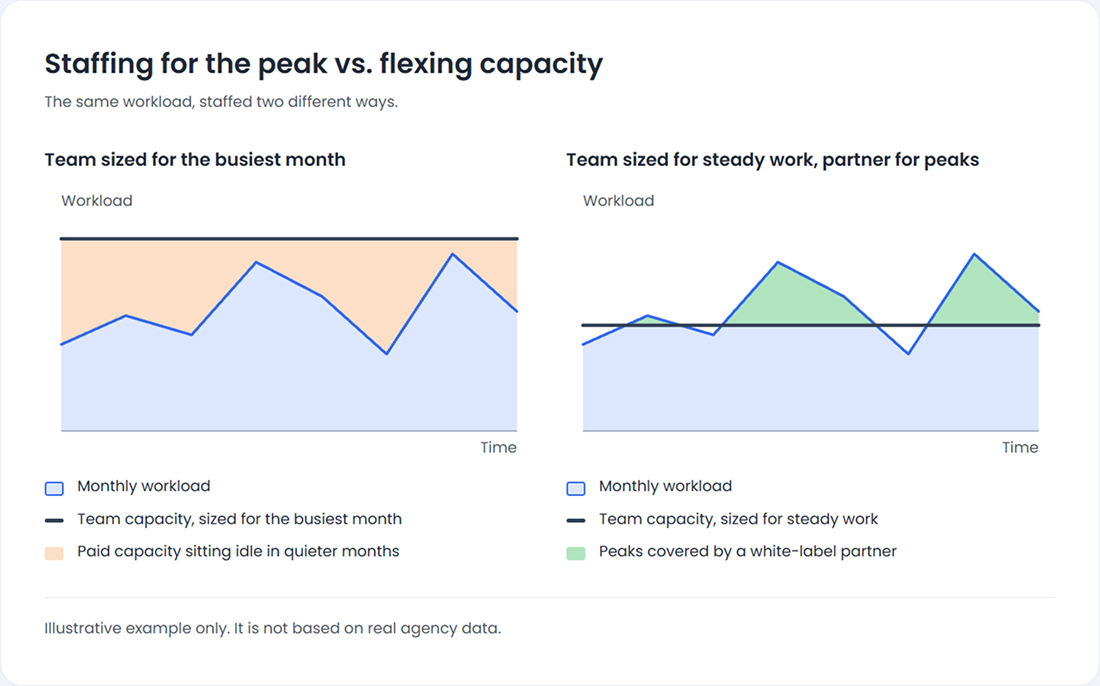
The choice depends on how often your agency needs additional capacity. Hiring can make sense for steady workloads, while outsourcing may work better for occasional projects. White-label partnerships are particularly useful when agencies want repeatable fulfillment across several client accounts without expanding every internal team.
One important point: White labeling doesn’t automatically mean less project management. Your agency still needs clear scopes, agreed timelines, quality checks, and a partner who can deliver consistently.
How Does White Label Digital Marketing Help Agencies Scale?
White label digital marketing helps agencies grow by increasing delivery capacity, expanding service offerings, and reducing the need for immediate hiring. Instead of turning down projects or stretching existing teams, agencies can use white-label fulfillment partners to manage additional work while retaining control over their clients.
Key Benefits of White Label Digital Marketing for Agencies
- Take On More Clients Without Overloading Your Team: Accept additional SEO, PPC, or web development projects without assigning more work to specialists already managing multiple accounts.
- Expand Your Services Without Hiring for Every Skill: Offer e-commerce development, AI video editing, content marketing, and AEO/GEO services even when your agency doesn’t have dedicated specialists for each service.
- Reduce Fixed Hiring Commitments: Pay for agreed fulfillment services rather than adding permanent salaries for work that may fluctuate from month to month. The U.S. Bureau of Labor Statistics provides a useful breakdown of employer compensation costs beyond wages.
- Avoid Turning Down Existing Client Opportunities: When your SEO client requests a landing page or paid advertising campaign, your agency can handle the additional requirement through a white-label partner rather than referring the project elsewhere.
- Keep Your Team Focused on Client Relationships: Let your account managers concentrate on strategy, client communication, approvals, and retention while your fulfillment partner handles agreed execution tasks.
- Manage Busy Periods Without Delaying Every Project: Bring in additional delivery capacity when several website launches or marketing campaigns overlap, provided your partner has the resources and availability.
- Create More Opportunities for Recurring Revenue: Add ongoing services such as SEO, PPC management, website maintenance, and content production to existing client accounts, subject to their needs and agreed scope.
- Maintain Control Over Your Agency’s Brand: Deliver approved work and client reports under your agency’s branding while retaining responsibility for quality, communication, and project outcomes.
The real benefit for agencies: White labeling creates room to accept more business without having to build an in-house team for every service. But growth still depends on choosing the right partner, setting clear delivery expectations, and protecting your margins.
How Much Does White Label Digital Marketing Cost, and Is It Profitable?
White label digital marketing costs depend on the service, project scope, deliverables, and pricing agreement. Agencies can pay a partner per project or through monthly retainers while setting their own client pricing.
Profitability comes down to what remains after paying for fulfillment, account management, revisions, and other delivery costs.
White Label Digital Marketing Pricing by Service
The table below shows illustrative pricing scenarios to help agencies understand how they can structure their services. These are not verified industry-average rates.
| White-label Services | Partner Cost | Agency Charges Client | Gross Margins |
| SEO Management | $1000/month | $2,000/month | 50% |
| PPC Management | $800/month | $1,600/month | 50% |
| Website development | $2500/project | $5,000/month | 50% |
| E-commerce Development | $4000/project | $7,500/month | 46.7& |
| Content Marketing | $600/month | $1,200/month | 50% |
| Social Media Management | $700/month | $1,500/month | 53% |
| AI Video Editing | $500/project | $1,000/month | 50% |
| AEO & GEO Services | $1200/month | $2,500/month | 52% |
These hypothetical figures exclude internal labor, software, advertising spend, taxes, and other expenses. Actual partner pricing and agency margins will vary.
How Much Profit Can an Agency Make?
Consider an agency managing 5 SEO clients at $2,000 per month each.
| Monthly Revenue & Expenses | Amount |
| Revenue from 5 clients | -$10000 |
| White label fulfillment ($1,000 × 5) | -$5000 |
| Internal account management | -$1500 |
| Reporting and software expenses | -$500 |
| Remaining contribution | $3000 |
| Contribution margin | 30% |
In this example, the agency retains $3,000 per month before remaining overhead, taxes, and other business expenses.
However, a 50% gross margin on fulfillment does not mean a 50% net profit. Client meetings, revisions, software subscriptions, and project management still cost money.
Agencies should also compare these costs with hiring internally. According to the U.S. Bureau of Labor Statistics, employee benefits accounted for 30% of private-industry employer compensation costs in June 2026. That makes full-time hiring a larger financial commitment than salary alone.
The bottom line: White label digital marketing can be profitable when agencies price services around the full cost of delivery, maintain clear project scopes, and avoid spending their fulfillment savings on repeated revisions and additional management work.
How Can Agencies Choose the Right White Label Marketing Partner?
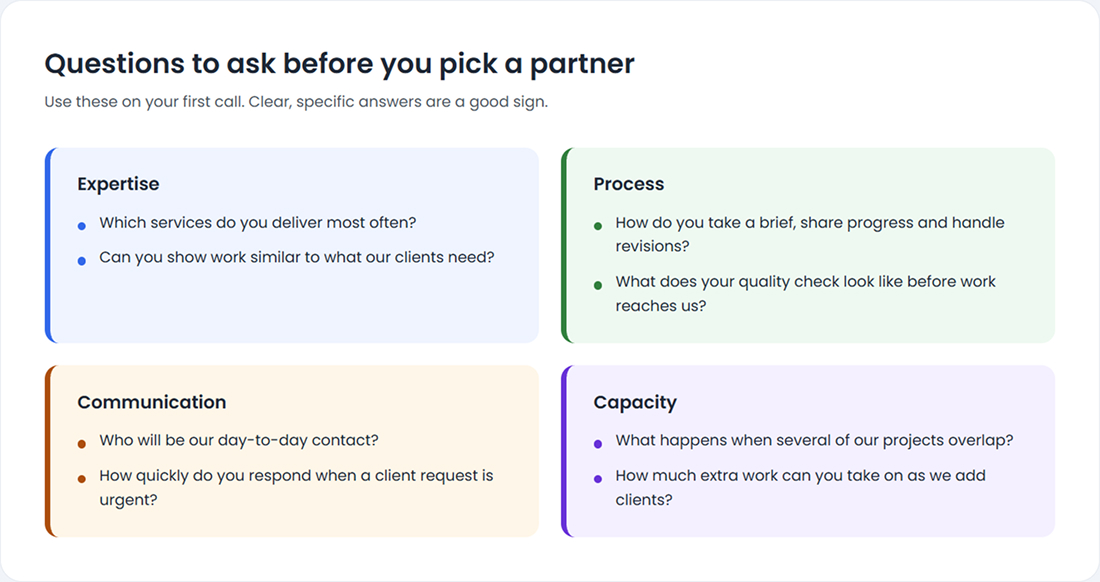
The right white label marketing partner should do more than complete assigned tasks. Agencies need a team that understands client expectations, works within agreed timelines, communicates clearly, and maintains consistent quality across projects. Before outsourcing, look at the partner’s technical expertise, experience across services, project management process, and ability to handle growing workloads without adding more coordination work for your team.
With over two decades of experience in digital solutions, ZealousWeb brings together expertise in SEO, PPC, web development, e-commerce, content marketing, and other digital services. Our white label digital marketing services are designed to help agencies extend their capabilities and manage client projects under their own brand, while retaining control over client relationships, strategy, and delivery decisions.
Conclusion
Winning more clients should create opportunities, not add pressure on your team, deadlines, and profit margins. White label digital marketing gives agencies a practical way to expand services, manage growing workloads, and maintain control over client relationships without hiring for every new requirement.
But scaling successfully comes down to choosing a partner who understands what’s at stake when your clients trust you to deliver. With over two decades of experience, ZealousWeb brings together the technical expertise and white label digital marketing capabilities agencies need to manage projects across SEO, PPC, web development, e-commerce, and more.
Your agency focuses on winning business and strengthening client relationships. We help you deliver on those commitments.
Your Next Client Shouldn't Mean Another Hiring Decision
Let's Discuss Your White Label Requirements

FAQs
1. Can small agencies use white label digital marketing services?
Yes. At ZealousWeb, we help small agencies expand their services and delivery capacity without hiring additional in-house specialists.
2. Will clients know their agency uses a white label partner?
Not necessarily. We deliver under your agency's brand, while you retain control over client relationships and communication.
3. What are the risks of white-label digital marketing?
Inconsistent quality, missed deadlines, communication gaps, and reduced margins. We address these through defined scopes, clear workflows, and quality checks.
4. Can agencies white-label SEO, AEO, and GEO services?
Yes. We support white-label SEO, AEO, and GEO services, including technical optimization, AI search visibility audits, content optimization, and citation monitoring.
5. How can agencies maintain quality when outsourcing client projects?
Set clear deliverables, timelines, and review processes. Our team supports execution while your agency retains final approval.


