

Fraud Blocker
Grow Existing Client Accounts

How Digital Agencies Can Grow Existing Client Accounts Without Building Every Capability In-House

September 16, 2026Posted By: Jalpa Gajjar
Agency PartnershipsClient Account GrowthDigital AgenciesWhite-Label Services

Your agency wins a client for SEO. A few months later, they ask why their landing pages are not converting. Another client hires you for web development, then asks what should be improved after launch.

These requests reveal an important reality: client needs rarely remain within the boundaries of the original engagement.

Forrester reports that 61% of B2B revenue comes from existing customers through renewals and expansion. For digital agencies, this makes existing accounts a valuable source of additional revenue, recurring services, and stronger client relationships.

The opportunity may surface through questions such as:

  • Are we tracking the right actions?
  • Why is the website attracting traffic but not converting?
  • Can website leads connect properly with our CRM?
  • What should we improve next?

These are not reasons to push unrelated services. They are signals of genuine business needs that may sit beyond the agency’s current scope or internal expertise.

The agency may not have specialists in analytics, UX/UI, technical SEO, personalization, CRM automation, and CRO on payroll-and it may not make commercial sense to hire for every requirement. With the right delivery support, however, it can address these needs while retaining the client relationship, strategic ownership, and brand experience.

The first step is understanding what the data reveals. That brings us to the first opportunity: analytics and conversion tracking.

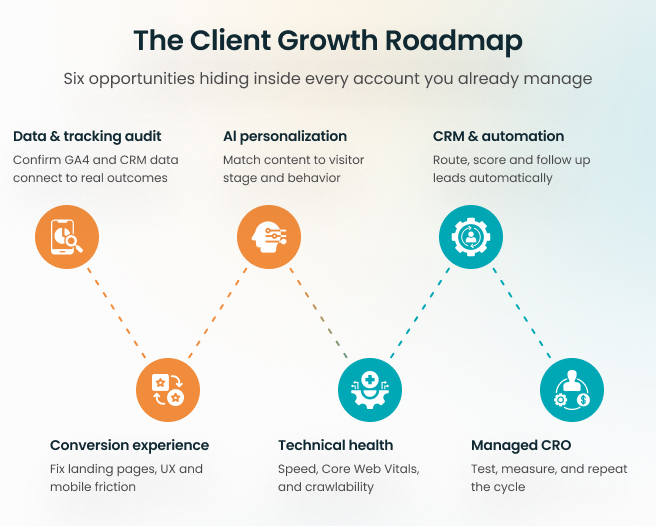
Beyond the Original Brief: Six Opportunities Agencies Often Miss

A client may hire your agency for SEO, paid media, branding, or web development. Then-plot twist-their business does not organize its problems around your service of Work.

So, how can agencies identify growth opportunities within existing client accounts? Look beyond the assigned deliverable and examine what limits its results. Campaign traffic may expose landing-page issues. Missing analytics conversions may reveal tracking gaps. Unmanaged leads may point to weak CRM integration automation. A completed website may still need ongoing technical optimization.

Recognizing these connections allows digital agencies to expand their service offerings, increase revenue per client, and create recurring services without building every specialist capability in-house.

Here are six areas worth examining.

Opportunity #1: Turn Client Data into Better Decision

Clients rarely ask for “better analytics.” They ask why leads have dropped, which campaign is generating revenue, or whether the new website is actually working. Unfortunately, a dashboard full of sessions, clicks, and colorful charts does not always answer any of those questions.

How can agencies use client data to find growth opportunities? Start by confirming that the right actions are being tracked and connected to meaningful business outcomes.

An analytics and conversion tracking review may examine:

  • GA4 and Google Tag Manager configuration
  • Form submissions, calls, purchases, and other key events
  • Campaign attribution and UTM governance
  • Duplicate, missing, or incorrectly triggered conversions
  • Cross-domain and third-party tracking
  • CRM and offline conversion data
  • Reporting aligned with leads, sales, and revenue

For SEO, paid media, web, and performance marketing agencies, reliable tracking does more than improve reporting. It shows where results are being lost and which improvements should be prioritized.

Once the data reveals what visitors are doing, the next question becomes unavoidable: What is stopping more of them from converting?

Opportunity #2: Improve What Happens After Traffic Arrives

Getting traffic is only half the job. Sending more visitors to a confusing landing page simply allows more people to leave faster-hardly the performance result anyone planned to present in the next client meeting.

Why is a website getting traffic but not converting? The problem may sit within the page experience, message, offer, form, navigation, or journey between the first click and the intended action.

What the agency notices What may need attention Potential service opportunity
Ads generate clicks but few enquiries Message or offer mismatch Landing-page optimization
Visitors leave important pages quickly Unclear value or poor usability UX/UI audit
Forms receive limited completions Too many fields or weak intent alignment Conversion-path improvement
Mobile traffic underperforms Friction within the mobile experience Mobile UX optimization
Decisions are based on opinions No structured testing process A/B testing and experimentation


This gives agencies a natural path from traffic generation to landing-page optimization, UX/UI improvements, visitor journey mapping, and conversion experimentation.

But even a well-designed journey still gives every visitor the same experience. The next opportunity is to question whether it should.

Opportunity #3: Move From "One Website Fits All" Into a More Relevant Experience

A first-time visitor from a paid campaign, a returning prospect from email, and an existing customer may all arrive with different expectations. Yet many websites welcome them with the same headline, offer, and next step. Very democratic. Not always very effective.

What is AI website personalization? It uses visitor context, behavior, source, location, or journey stage to present more relevant content and calls to action.

Agencies can explore personalization opportunities such as:

  • Matching landing-page messages with campaign intent
  • Showing different content to new and returning visitors
  • Adapting calls to action by journey stage
  • Recommending relevant services, content, or products
  • Personalizing experiences by industry, location, or referral source
  • Using behavioral signals to guide the next interaction

For agencies already managing campaigns, content, SEO, or websites, AI-powered website personalization can extend the value of those services by making the destination more relevant to the traffic they generate.

Of course, personalization cannot rescue a technically unhealthy website. Before making an experience smarter, agencies need to ensure the foundation is not quietly working against it.

Opportunity #4: Fix the Technical Problems Undermining Everything Else

A website can look polished and still load slowly, frustrate mobile visitors, confuse search engines, or break at the exact point someone tries to convert. The homepage may look excellent in the presentation. Real users, sadly, do not browse presentation slides.

How does website performance affect SEO and conversions? Slow loading, unstable layouts, poor mobile usability, crawlability issues, and broken functionality can reduce search visibility while adding friction to the customer journey.

Technical signal Possible business impact
Slow page loading Visitors leave before engaging
Poor core web vitals Weaker user experience and potential search impact
Crawl or indexing issues Important pages may not appear correctly in search
Broken forms or tracking scripts Leads and conversion data may be lost
Mobile usability issues High-intent visitors face avoidable friction
Plugin, CMS, code conflicts Inconsistent performance and functionality


A technical SEO and website performance audit helps agencies connect these issues with outcomes clients understand: visibility, engagement, leads, and revenue.

Fixing the website experience improves what happens before conversion. The next opportunity concerns what happens immediately afterward-when the lead enters the business.

Opportunity #5: Connect the Conversion With What Happens After the Enquiry

A form submission is not the end of the customer journey. It is the point where marketing hands responsibility to sales or customer service. If that handoff depends on someone checking an inbox and forwarding a spreadsheet, the “automation strategy” may still be mostly optimism.

How can agencies connect website leads to a CRM? Website forms and conversion points can be integrated with CRM and marketing automation platforms to capture data, route leads, trigger follow-ups, and track progress through the pipeline.

Potential opportunities include:

  • Connecting website forms with the client’s CRM
  • Automatically assigning leads by service, location, or value
  • Triggering email, SMS, or WhatsApp follow-ups
  • Creating lead-scoring and qualification workflows
  • Reducing duplicate or incomplete records
  • Connecting campaign sources with sales outcomes
  • Returning qualified-lead or revenue data to advertising platforms

For agencies, CRM integration and marketing automation close the gap between generating an enquiry and understanding whether it became a genuine opportunity. That creates better reporting, stronger campaign decisions, and greater accountability across the customer journey.

Once acquisition, conversion, and follow-up are connected, improvement should not stop after the first round of fixes.

Opportunity #6: Replace One-Off Fixes With Continuous Optimization

A redesigned landing page may improve performance today. Visitor behavior, campaigns, competitors, offers, and client priorities will continue changing tomorrow. Conversion improvement is rarely a project that can be permanently marked “done.”

What is Managed CRO? Managed conversion rate optimization is an ongoing process of analyzing user behavior, prioritizing conversion opportunities, testing improvements, and applying what the evidence supports.

A managed CRO engagement can include:

  • Reviewing analytics and conversion performance
  • Identifying friction across priority journeys
  • Building an evidence-based testing roadmap
  • Testing pages, messages, forms, and calls to action
  • Measuring the commercial impact
  • Applying insights to the next optimization cycle

For web, SEO, paid media, and creative agencies, managed CRO services can turn a one-off project into a recurring, performance-led client engagement. The agency remains involved after launch while the client continues receiving measurable improvements rather than a quarterly reminder that the website exists.

These six opportunities often overlap. Better tracking may reveal a landing-page issue. A UX review may uncover slow performance. CRM data may show that high lead volume is producing very few qualified opportunities.
Managed CRO Optimization

The harder question is not whether the work exists. It is how the agency should deliver it.

Should you develop each capability internally, coordinate individual freelancers, or work with a specialist delivery partner? The right answer depends on demand, margin, speed, quality control, and how much ownership your agency wants to retain.

Build Internally, Use Freelancers, or Work With a Specialist Delivery Partner?

Identifying an opportunity inside a client account is only the beginning. The agency must still decide how to deliver it without affecting quality, margins, timelines, or ownership of the client relationship.

The obvious question is: Which delivery model is most cost-effective for a digital agency? The honest answer-slightly less exciting than declaring one universal winner-is that it depends on demand, complexity, and how consistently the capability will be needed.

Delivery model Approx price range (USD) Key benefits Cost & Delivery Reality
Build internally $63,000-$136,000+ per specialist annually Direct control and knowledge retained within the agency Salary is only the starting point. Recruitment, benefits, tools, training, management, and non-billable time increase the actual cost.
Use freelancers $25-$150+ per hour Flexible access to a specific skill for a defined requirement The agency usually owns briefing, coordination, reviews, availability risk, and quality assurance.
Specialist delivery partner $25-$149+ per hour or a custom project/retainer Access to multiple specialists, scalable capacity, coordinated delivery, reduced hiring overhead, greater continuity, delivery under the agency’s brand, and protection of the client relationship The agency should confirm delivery standards, communication, confidentiality, billing structure, margins, and non-solicitation safeguards.


These are indicative market ranges. Actual costs vary by specialization, seniority, geography, engagement model, and project complexity.

The in-house range reflects current U.S. wage benchmarks across relevant digital roles. The report suggests a median annual pay of $62,960 for graphic designers, $92,650 for web developers, $104,000 for digital interface designers, and $135,980 for software developers-before employment overhead is added.

Freelance rates vary just as widely between $25 and $75 per hour, while specialists in development, AI, and consulting may charge $75 to $150 or more per hour.

For external agency delivery, typical digital marketing agency rates range from $25 to $49 per hour, with specialized services such as SEO, PPC, email, content, and social media commonly reaching $100 to $149 per hour.

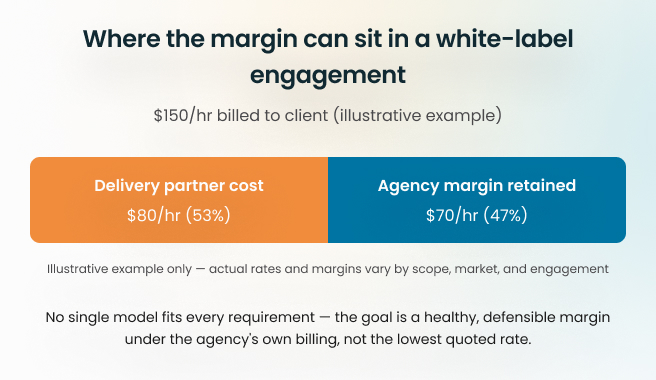
Look Beyond the Quoted Rate – The final cost of any delivery model includes more than salary or hourly rates. Agencies should also consider recruitment, non-billable capacity, project coordination, quality assurance, availability, and rework.

The right model is the one that protects delivery quality, client ownership, and agency margins-not simply the option with the lowest initial price.

The decision should therefore consider:

  • How frequently the capability is required
  • Whether one specialist or several disciplines are needed
  • How quickly delivery must begin
  • Who will manage quality assurance
  • Whether capacity requirements will fluctuate
  • How client confidentiality and ownership will be protected
  • Whether the model leaves enough room for a healthy agency margin
Agency Delivery Models Comparison

No single model fits every requirement. Building internally provides ownership when demand justifies the investment. Freelancers offer flexibility for contained assignments. A white-label delivery partner can provide coordinated expertise when requirements cross multiple capabilities, workloads change, or the agency needs to deliver consistently under its own brand.

When the white-label model fits, the next concern is usually not capability-it is control. How can another team support delivery while your agency retains the client relationship? That is where white-label and team-augmentation models need to be clearly understood.

How White-label and Team-augmentation Models Work While The Agency Retains The Client Relationship

Bringing a delivery partner into an engagement should expand what your agency can offer-not reduce its ownership of the client relationship.

Under a white-label delivery model, the partner can fulfil an entire service or workstream on your agency’s behalf. This may include analytics and conversion tracking, UX/UI, landing-page experimentation, AI website personalization, technical SEO, website performance, CRM automation, or managed CRO.

The work is delivered under your agency’s brand, while your agency retains control of:

  • Client communication
  • Strategy and recommendations
  • Scope and pricing
  • Approvals and reporting
  • Commercial ownership
  • The overall client experience

When complete service delivery is not required, the partnership can also provide team augmentation. In this model, individual specialists-such as developers, designers, analysts, technical SEO experts, or automation professionals-join your existing team and work within your established tools, processes, and project structure.

The distinction is straightforward:

  • Need an entire service delivered? Use white-label delivery.
  • Need specific expertise or additional capacity? Use team augmentation.
  • In either model, who owns the client relationship? Your agency.

This gives agencies the flexibility to choose the level of support required for each account. The delivery structure may change, but the client continues to experience your strategy, your communication, and your brand.

More Capability Without More Permanent Overhead

The combined model allows agencies to respond when clients need analytics, UX/UI, technical SEO, AI personalization, CRM automation, development, or managed CRO-even when those capabilities are not maintained internally.

That means your agency can:

  • Expand into connected services without building a new department
  • Add specialist capacity around active client demand
  • Protect billability by scaling resources up or down
  • Keep pricing, margins, and commercial decisions in your control
  • Maintain continuity through a coordinated delivery team
  • Turn one-off client requests into recurring service opportunities

The client receives broader expertise. Your agency retains the account. No awkward introduction to the “other company now handling this part.

AI-Augmented Delivery-With Human Accountability

Modern delivery partners can use AI automation, agentic workflows, predictive analytics, automated QA, and intelligent reporting to reduce repetitive work and accelerate execution.

AI may support data analysis, campaign variations, technical checks, documentation, reporting, CRM workflows, and performance monitoring. But automation should strengthen expert delivery-not turn client work into an unsupervised black box.

Every AI-enabled workflow should still include:

  • Human-in-the-loop quality assurance
  • Controlled access to client data
  • Brand and strategy guardrails
  • Reviewable outputs
  • Clear accountability for final delivery

“AI-powered” may look good in a capabilities deck. Agencies need to know who checks the work before it reaches the client.

Client Control Must Be Built Into the Model

A reliable white-label partnership protects the relationship through defined operating safeguards:

  • Agency-led communication
  • White-labeled deliverables and reporting
  • NDAs and confidentiality controls
  • Non-solicitation agreements
  • Clear intellectual property ownership
  • Role-based platform access
  • Defined approval and escalation paths
  • Shared quality and delivery standards

This is what turns external support into a genuine extension of the agency-not simply another vendor waiting for instructions.

Your Brand in Front. A Stronger Delivery Engine Behind It.

The value of this model is not that the delivery partner becomes visible. It is that your agency becomes capable of delivering more.

You retain the strategy, client trust, commercial ownership, and brand experience. The partner provides the specialist depth, AI-enabled workflows, and flexible capacity required to support what you have promised.

The remaining question is where that additional capability could create value first. The answer may already be sitting inside one of your client accounts.

Get a Free Client Opportunity Review

Free Client Opportunity Review

FAQs

Related Blog Posts

Digital Agency CRM Automation

The Lead Came In. What Happens Next? A CRM & Automation Guide for Digital Agencies

September 16, 2026
CRM AutomationDigital AgenciesLead ManagementMarketing Automation
AI Website Personalization for Agencies

What AI Website Personalization Could Actually Look Like for Your Agency’s Clients

September 16, 2026
AI PersonalizationConversion OptimizationDigital AgenciesWebsite Personalization
White-label analytics support for agencies

Why Good Campaigns Still Underperform: The Conversion Gap Agencies Can Help Fix

September 16, 2026
Conversion OptimizationCRODigital Marketing AgenciesLanding Page Optimization
performance marketing budget allocation

Which Performance Marketing Channel Deserves More of Your Budget?

September 10, 2026
Digital MarketingMarketing BudgetPaid MediaPerformance Marketing
Cheap Leads in Lead Generation

Why Cheap Leads Can Become Your Most Expensive Lead Generation Mistake

September 09, 2026
Google AdsLead GenerationLead QualityPerformance Marketing
AI performance marketing

How AI Is Transforming Performance Marketing From Ad Spend to Revenue

August 24, 2026
AI marketingArtificial IntelligenceDigital MarketingPerformance Marketing
AI email marketing automation

How AI Is Reshaping Email Marketing Through Automation and Hyper-Personalization

August 21, 2026
AI Email MarketingDigital MarketingEmail Marketing AutomationHyper-Personalization
brand refresh vs rebrand

Brand Refresh vs. Complete Rebrand: What Does Your Business Need?

August 18, 2026
Brand RefreshBrand StrategyBrandingRebranding