


Let’s be honest: your “Productivity Stack” is starting to look like a digital junk drawer. You don’t have a “lack of AI” problem; you have a “too many logins and not enough logic” problem. It’s 2026, and most companies and IT teams are drowning in a sea of shiny subscriptions that refuse to talk to each other.
The industry heavyweights see the writing on the wall. Scott Belsky, Adobe’s Chief Strategy Officer, recently noted that AI is “reimagining and refactoring every function of an organization.” Yet, while McKinsey reports that 72% of organizations have adopted AI, a massive chunk of that is just “tool-hoarding” rather than true integration. We’ve noticed a recurring pattern among decision-makers: you’re exhausted, not because you’re tech-illiterate, but because you’ve collected AI tools like digital magpies without a blueprint.
The real loophole? Everyone is chasing business automation with AI, but most are just automating existing chaos. Adding a chatbot to a broken workflow is just making your mistakes happen at the speed of light. The actual play isn’t finding another “cool” app—it’s about AI-driven business transformation that finally turns your fragmented mess into a coherent system that functions while you’re actually off the clock.
The Business Imperative: Why Invest?
In an era where data is the most valuable resource, artificial intelligence acts as the refinery. Investing in these systems isn’t just about keeping pace; it’s about shifting from a reactive stance to a predictive one. Moving forward, the gap between “the automated” and “the manual” will become a permanent competitive chasm.
Competitive Edge in a Data-Driven World
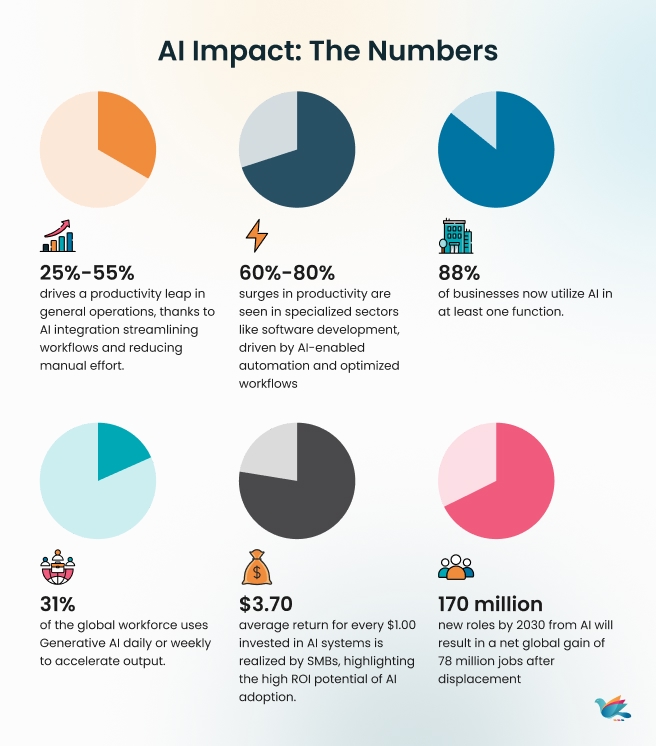
Success is no longer defined by how much data you collect, but by your predictive agility. Beyond the current wave, a competitive edge means anticipating market shifts and hyper-personalizing every customer touchpoint in real-time. According to McKinsey & Company, high-performing organizations are now using AI to drive top-line growth, with artificial intelligence high-performers 3.5 times more likely than others to say their AI initiatives contributed to more than 20% of their EBIT.
Cost Savings and Efficiency Gains
Efficiency is no longer about doing things “faster”; it’s about achieving zero-waste operations. Organizations moving toward high-level automation report massive productivity leaps:
- Productivity Gains: Research by Goldman Sachs suggests that generative AI alone could eventually increase global GDP by 7% by driving labor productivity growth.
- Return on Investment: For every $1.00 a company invests in AI, it realizes an average return of **$3.50**, according to studies by IDC.
Scalability for Growth and Innovation
True scalability means your output can grow exponentially while your headcount stays linear. An artificial intelligence-powered system allows you to:
- Accelerate R&D: Use generative models to iterate on product designs or marketing campaigns in hours rather than months.
- Remove Bottlenecks: Onboard 1,000 customers with the same infrastructure used for 10.
- Target New Markets: Serve lower-tier segments profitably through low-cost, automated service models.
From Pilots to Profit: Enterprise Case Studies in Action
Moving beyond the retail giants, diverse industries are proving that a system-first approach to artificial intelligence creates a defensible economic advantage.
- Siemens (Industrial Automation): By integrating AI-driven predictive maintenance and condition monitoring, Siemens has enabled manufacturing plants to detect potential downtime before it occurs, drastically improving asset reliability and operational efficiency.
- Stripe (Financial Operations): Through its Optimized Checkout Suite, Stripe uses AI to dynamically surface the most relevant payment methods, resulting in an average 11.9% increase in revenue for businesses. Furthermore, 69% of Stripe users report that AI-driven automation has improved their efficiency by 25% or more.
- Sanofi (Pharmaceutical Manufacturing): In partnership with Siemens and Capgemini, Sanofi implemented AI-supported Manufacturing Execution Systems (MES) to digitize paper-based batch records. This shift reduced record review times by 70% and lowered production deviations by 80%.
If your artificial intelligence only saves you time, you’ve optimized a task. If it changes your unit economics, you’ve transformed a business.
Moving Beyond the Chatbot: The 2026 Strategic Stack
The honeymoon phase with simple chatbots is over. While “asking a bot to write an email” felt like magic in 2023, by 2026, it’s just table stakes. The real competitive advantage has shifted from assistive tools that wait for your input to agentic systems that actually do the work.
If you want to stop the cycle of hiring more people just to manage your existing people, your strategy needs a major upgrade:
- Business Process Automation with Artificial Intelligence: This isn’t just moving data from point A to point B; it’s building a digital workforce. It allows you to scale operations without scaling your headcount. According to McKinsey, while 88% of organizations are using AI, only 7% have fully scaled it. Those that bridge this gap aren’t just faster; they’re operating on an entirely different cost basis.
- Data as the Fuel: Here’s the cold truth: AI service automation for enterprises is destined to fail if your data is trapped in silos. Without a unified data layer—where your CRM, Analytics, and Operations talk to each other in real-time—your AI is essentially a genius with amnesia. You can’t automate a workflow if the system doesn’t know what happened in the previous step.
- The Shift to Agentic AI: We are moving toward autonomous workflows that don’t just “suggest” a marketing strategy or “check” code—they execute it. These agentic systems independently plan and coordinate between your tools to handle complex tasks, while your senior team focuses on the strategy that a machine can’t replicate.
The signal is clear. Competitive advantage in 2026 will not come from using AI, but from how deeply it is embedded into execution. Businesses that move beyond chatbots to system-level automation will operate with lower friction, lower cost, and higher focus.
AI Usage Is No Longer the Differentiator. Execution Systems Are.
Having Artificial Intelligence in 2026 is like having electricity in 1920—everyone has it, so “using it” isn’t a flex. The real differentiator is your system of execution.
The Architecture of Calm: Scaling vs. Firefighting
What separates teams scaling calmly from those constantly firefighting? The Architecture. Teams that scale calmly treat Artificial Intelligence as a fundamental layer of their architecture, not an accessory. In a firefighting environment, humans act as the “manual glue” between disconnected tools, constantly fixing errors and bridging data gaps. In a “system-first” environment, the execution system handles the routing, error-checking, and data-syncing automatically. This shift moves your talent from managing the mess to optimizing the machine.
The Complexity Trap: Why Tools Without Systems Amplify Chaos
If you bolt an Artificial Intelligence tool onto a broken, manual process, you just create a high-speed mess.
Automation does not improve the logic of a system; it only executes it faster. If your underlying process has bottlenecks or contradictory rules, Artificial Intelligence will spread those flaws across your organization at a scale no human could match.
The winners are those building “Artificial Intelligence-native” workflows where the system is designed to be autonomous from day one, rather than trying to sprinkle some “Artificial Intelligence dust” on a legacy spreadsheet.
Where AI Automation Breaks Down Inside Growing Businesses
As organizations grow, AI automation expands quickly but unevenly. Teams add tools, automate tasks, and introduce AI into daily operations, yet the underlying workflows remain fragmented. The result is not a lack of AI usage, but a breakdown in how automation scales with complexity.
What we consistently observe is this: AI fails not because it is underused, but because it is layered on top of disconnected systems.
Common Failure Points in Business Process Automation With AI
The following failure points appear repeatedly across growing agencies and SaaS teams:
- Automating unstable or undocumented processes, locking inefficiency into workflows
- Treating automation as a task-level initiative instead of an end-to-end system
- Fragmented ownership where AI executes actions but no one owns outcomes
- Isolated tool-based automation that optimizes functions but breaks cross-team flow
- Lack of feedback loops preventing AI systems from learning or improving
- One-time automation setups that are not maintained as the business evolves
Individually, these issues seem manageable. At scale, they compound. These breakdowns are rarely visible at the start. They surface only when growth accelerates and complexity exposes weak systems. What appears to be an AI limitation is almost always a system design problem.
Why Disconnected Workflows Block AI Automation Scalability With Business Growth
As businesses grow, volume increases across marketing, sales, product, and operations. Without connected workflows, AI automation scales activity but not alignment. Signals fail to move between teams, data remains fragmented, and decision-making becomes reactive.
When workflows are disconnected, AI operates with partial context. It can execute faster, but it cannot coordinate outcomes. This is why AI automation scalability with business growth stalls. Instead of reducing effort, automation increases exception handling, manual oversight, and operational noise.
True scalability requires continuity. When workflows are connected end to end, AI can sequence actions, adapt to outcomes, and compound efficiency over time.
To illustrate where these disconnects typically occur, the patterns below show how workflow fragmentation directly limits AI automation at scale.
How Disconnected Workflows Limit AI Automation at Scale
| Breakdown Area | What Happens In Practice | Impact on Growth |
| Fragmented data sources | CRM, analytics, and operations systems operate independently | AI decisions become inconsistent and unreliable |
| Function-level automation | Teams automate locally without cross-team logic | Efficiency gains cancel out at the organization level |
| Manual handoffs | Approvals, dependencies, and escalations remain human-driven | Automation slows as volume increases |
| Missing feedback loops | Outcomes are not fed back into AI workflows | Systems fail to improve over time |
| Unclear accountability | AI executes actions without clear ownership | Errors accumulate and trust erodes |
| Tool-led architecture | Automation follows platform limits, not business flow | Rework increases as the business scales |
Disconnected workflows do not break immediately. They break when growth accelerates.
Businesses that connect workflows early allow AI automation to scale with clarity and control. Those who do not often discover the cost of fragmentation only when rebuilding becomes unavoidable.
The Real Role of Data in AI-Driven Business Transformation
Most organizations believe their AI challenge is about models, tooling, or automation maturity. What we are consistently seeing is different. The real constraint is not intelligence. It is a data structure.
Data is often treated as an output layer for reporting rather than an input layer for execution. Dashboards show what happened, but they rarely influence what happens next. In this setup, AI becomes reactive instead of strategic.
Artificial intelligence-driven business transformation depends less on the volume of data and more on its continuity across the business.
Most businesses do not struggle with a lack of data. They struggle with data that cannot be used operationally. While AI tools continue to improve, transformation stalls when data is treated as an output for reporting rather than an input for execution.
Artificial intelligence-driven business transformation depends on how well data moves, connects, and informs action across the organization.
Data Volume Is Not the Problem. Data Structure Is.
Many organizations believe that collecting more data will unlock better AI outcomes. In practice, transformation breaks down because data is fragmented and inconsistently structured.
Common structural issues include:
- Separate data models across CRM, analytics, and operations
- Inconsistent definitions for leads, customers, or success metrics
- Delayed or manual data synchronization between systems
Without structure, AI operates with partial context, limiting its ability to scale decisions reliably.
Why Data Visibility Does Not Equal Data Readiness
Dashboards create awareness, but awareness alone does not enable automation.
Data readiness means AI systems can act without human interpretation at every step. Most organizations fall short because their data answers descriptive questions, not operational ones.
Key gaps between visibility and readiness:
- Data explains what happened but not what should happen next
- Metrics are informative but not actionable
- Insights are reviewed manually instead of triggering workflows
When data is not ready, AI remains assistive rather than autonomous.
Data as a Decision Layer, Not a Reporting Layer
High-performing organizations treat data as a decision layer embedded directly into workflows.
When data is connected across systems, AI can:
- Prioritize actions based on real-time context
- Trigger workflows without manual approvals
- Adjust execution based on outcomes and feedback
This shift allows AI to move from supporting decisions to executing them within defined boundaries.
Why AI Automation Fails Without a Unified Data Layer
A repeated signal across failed implementations is the absence of a unified data layer.
Without alignment between CRM, analytics, and operational systems:
- AI lacks historical and contextual awareness
- Automation produces inconsistent or conflicting outputs
- Teams lose trust and reintroduce manual controls
A unified data layer does not require a single platform. It requires shared logic, synchronized updates, and consistent identifiers across systems.
Understand that the next phase of artificial intelligence-driven business transformation will not be driven by smarter tools. It will be driven by better data foundations. Organizations that build data systems designed for execution gain clarity, speed, and control. Those that do not remain stuck interpreting insights while competitors act on them.
From Task Automation to Business Automation With AI
The initial wave of digital transformation was built on the back of simple task automation—discrete, rule-based scripts designed to do one thing repeatedly. But in 2026, the ceiling of “single-task efficiency” has been reached. To truly scale, businesses must transition from automating isolated actions to automating entire outcomes.
The Leap from Rules to Reasoning
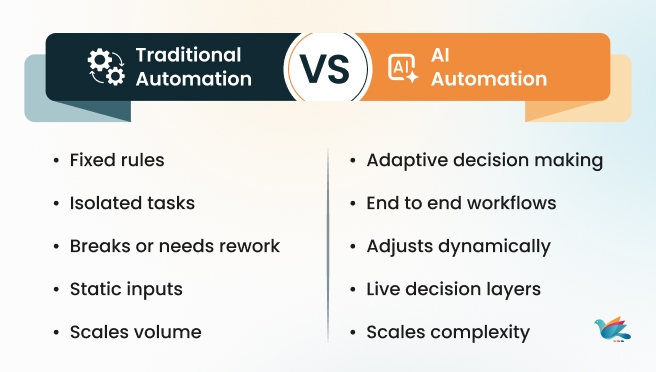
Traditional automation is “binary”: If X happens, do Y. It is remarkably efficient but fundamentally fragile. If the input data changes slightly or an unexpected variable appears, the script breaks.
Business Automation with Artificial Intelligence introduces a “Cognitive Layer” that doesn’t just follow a path—it understands the destination. Instead of just moving an email attachment to a folder (Task Automation), an Artificial Intelligence-driven system reads the invoice, cross-references it with a purchase order, flags a pricing discrepancy based on historical contract terms, and routes it to the specific department head for approval (Business Process Automation).
- Task Automation: Focused on “The Hand” (Doing).
- Business Automation with Artificial Intelligence: Focused on “The Brain” (Deciding and Doing).
Orchestrating the End-to-End Workflow
True Artificial Intelligence driven business transformation happens when you stop looking at individual silos and start looking at the “Value Chain.” Task automation is a series of fast-moving gears that aren’t necessarily connected; Business Automation is the entire watch.
When you implement artificial intelligence at the process level, you unlock Intelligent Orchestration. The system can manage a lead from the first website visit through to the final signed contract without a human needing to “hand off” the data between departments. By automating the connective tissue of your business, you eliminate the friction where growth usually stalls.
Why Task Automation Actually Creates Technical Debt
There is a hidden danger in staying at the task level: Automation Bloat. If you have 50 different “bots” doing 50 small tasks, you have created a management nightmare. Each bot is a potential point of failure that requires manual updates.
Transitioning to business automation with artificial intelligence allows you to consolidate these fragmented scripts into a unified, agentic architecture. This not only reduces your technical debt but also ensures that your automation is adaptive. When your business rules change, you don’t have to rewrite 50 scripts; you simply update the objective in your artificial intelligence governance layer, and the entire system adjusts its behavior accordingly.
The shift to business automation marks the transition from mere efficiency to true organizational autonomy. By focusing on end-to-end outcomes rather than isolated tasks, you build a system that doesn’t just work faster, but grows smarter with every cycle.
The "System-First" Implementation Blueprint
Building a high-performance engine is useless if the chassis is made of cardboard. Most automation attempts fail because they try to force artificial intelligence into a “business as usual” structure. To see real transformation, you must move from “tool-collecting” to “system-building.”
Audit Before You Automate: Identifying high-impact workflows
Before you sign up for another platform, you must identify where the friction actually lives. Don’t automate for the sake of being “modern”; automate where it moves the needle for your specific business model.
- Agencies (Media buying & reporting): If your senior media buyers are spending 10 hours a week manually pulling CSV files into reporting decks, that is a system failure. An artificial intelligence audit would prioritize automating the data aggregation and anomaly detection, allowing the experts to focus on creative strategy and client relationships.
- SaaS (Churn prediction & onboarding): For software companies, the highest impact lies in “preventative automation.” Audit your churn signals. If a user stops logging in, an automated artificial intelligence loop should instantly analyze their past behavior and trigger a personalized “re-engagement” flow before they hit the “cancel” button.
Optimizing Business Processes with Artificial Intelligence Automation
Transitioning to an automated system isn’t an “overnight flip.” It’s a sequence that moves from manual triggers to intelligent loops.
- Manual triggers: A human starts the process (e.g., clicking “generate report”).
- Semi-autonomous bridges: The system handles the heavy lifting but waits for human approval at a “checkpoint.”
- Intelligent loops: The system detects a condition (e.g., a drop in ad performance), analyzes the cause, and autonomously adjusts the budget or alerts the team with a suggested fix.
Interoperability: Connecting Your Artificial Intelligence Stack
Your artificial intelligence is only as good as its “social life”—it needs to talk to everyone. If your automation tool pulls data from your CRM but can’t push it to your accounting software, you haven’t automated anything; you’ve just created a new, shinier silo.
Whether you use developer-focused tools like n8n for deep logic or enterprise-grade platforms like Copilot Studio for ecosystem-native agents, ensure your stack is built for interoperability. A system that doesn’t share data across departments is just an expensive paperweight.
Ultimately, a successful blueprint is defined by how well your tools work together, not how many you own. Moving forward, the goal of a system-first implementation is to ensure that artificial intelligence acts as the connective tissue of your business, turning fragmented actions into a unified, self-optimizing engine.
Architecting for Exponential Growth: Breaking the Scalability Bottleneck
Scaling a business is like flying a plane while building the wings. If your “wings” are manual processes, they will snap the moment you hit the turbulence of rapid expansion. True growth isn’t just about doing more; it’s about ensuring that doubling your output doesn’t quadruple your stress.
From "Manual Glue" to Autonomous Systems
In the early stages of a business (Seed to Series A), it is common to use “manual glue”—humans who fix data, bridge gaps between tools, and double-check every automated email. However, as you approach Series B, this glue becomes your biggest bottleneck.
To scale, you must transition to artificial intelligence-native core processes where the logic is centralized. If you add 1,000 new customers, your “Onboarding System” should be robust enough to handle the load without you needing to hire 10 more onboarding specialists.
Human-in-the-loop (HITL): Maintaining "Strategic Substance"
Let’s get one thing straight: artificial intelligence is the engine, but humans are the GPS. Agencies and service-based businesses, in particular, must maintain strategic substance.
The goal of a “System-First” approach is to automate the “mechanical toil”—data entry, basic formatting, and repetitive research—while keeping a human at the center of the “creative context.” The human-in-the-loop model ensures that the final output isn’t just “technically correct” but also strategically aligned with the client’s unique brand voice and business goals.
Risk Mitigation: Addressing privacy, Bias, and "Slop."
Automation without guardrails is a significant liability. As your artificial intelligence footprint grows, you must proactively address three critical signals:
- Data privacy: Ensure your artificial intelligence workflows aren’t leaking sensitive client data into public models. Use enterprise-grade, private instances to keep your “competitive moat” secure.
- Algorithmic bias: Automated systems can amplify historical biases in your data. Regular “bias audits” are necessary to ensure your scaling doesn’t come at the cost of fairness or legal compliance.
- The cost of “slop”: Avoid the “copy-paste” trap. Low-quality, mass-produced artificial intelligence content (often called “slop”) erodes brand trust and leads to “model collapse.” High-quality automation should aim for precision and value, not just volume.
Scaling through artificial intelligence is not about removing the human element, but about amplifying it by removing the friction of growth. By hardening your processes against bias and “slop” while maintaining human oversight, you create a resilient architecture that turns expansion from a risk into a sustainable advantage.
Choosing AI Automation Platforms That Support Systems, Not Silos
In 2026, the marketplace is flooded with tools promising to transform your business. However, most of these tools are designed as standalone islands. To build a truly scalable business, you must select platforms that act as connective tissue rather than additional layers of complexity.
What to Evaluate Beyond Features and Pricing
Selecting a platform based on a “feature checklist” is a trap. In 2026, features are commoditized—almost every tool can summarize a document or draft an email. To find a solution that supports a high-growth execution system, you must evaluate how the platform handles complexity, connectivity, and control.
The following transition from static tools to dynamic systems depends on these four architectural pillars:
| Evaluation Pillar | Key Requirements | Why It Matters for Scaling |
| Model Agnosticity | Support for multiple LLMs (GPT-5, Claude, Gemini) | Prevents vendor lock-in; allows swapping models as performance or pricing shifts. |
| Observability | Real-time audit trails and “decision tracing.” | Essential for identifying where a flow stalled or why a model produced “slop.” |
| Interoperability | Native bidirectional syncing (CRM ↔ Ops) | Ensures data doesn’t just flow in; the system must be able to act back on your stack. |
| Governance | Role-based access (RBAC) & data isolation | Prevents “shadow artificial intelligence” and ensures sensitive client data stays private. |
Why the Best Artificial Intelligence Automation Platforms for Enterprises Align With Execution Flows
The most powerful tools in 2026 are not those with the most “knobs and dials,” but those that map directly to how work actually gets done. These platforms align with your Execution Flows in three distinct ways:
- Event-Driven Architecture: Instead of waiting for a human to click a button, the best artificial intelligence-powered platforms (like n8n or Make) react instantly to “triggers” across your entire stack. Whether it’s a new lead in your CRM or a specific sentiment detected in a support ticket, the platform initiates the next step in the flow without delay.
- Bidirectional Syncing: A “siloed” tool only receives data. A “system-aware” platform has a two-way conversation with your stack. If your automation updates a project status in Asana, that change should be reflected in your financial forecasting tool and your client dashboard simultaneously.
- Built-in Observability: You cannot manage what you cannot see. Strategic platforms provide a “bird’s-eye view” of your automated processes, highlighting where a flow has stalled or where a model is starting to produce “slop.” This allows you to optimize the system in real-time.
Ultimately, the right platform choice ensures your automation serves the entire business ecosystem rather than isolated departments. By prioritizing a system-first architecture, you transform fragmented tasks into a unified, high-velocity engine ready for sustainable growth.
How AI Automation Should Evolve As the Business Grows
AI automation does not scale linearly with growth. What works when teams are small and volume is manageable often becomes fragile as complexity increases. The shift is not about adding more automation, but about changing what automation is responsible for.
The table below highlights how automation priorities must evolve as businesses move from early-stage execution to scale-stage operations.
Early-Stage vs Scale-Stage AI Automation Priorities
| Focus Area | Early Stage Automation | Scale- Stage Automation |
| Core objective | Move faster | Scale without breaking |
| Automation scope | Isolated tasks | End-to-end workflows |
| Data role | Reporting and visibility | Embedded decision layer |
| Workflow design | Tool-driven | System-driven |
| Exception handling | Manual fixes | Governed escalation |
| Outcome | Speed gains | Operational stability |
Automation that does not evolve with growth becomes fragile. Businesses that redesign automation as complexity increases preserve speed without introducing chaos. Those that do not are forced into reactive rebuilds when scale exposes system limits.
The organizations scaling calmly are not the ones with the most automation. They are the ones whose automation matures with the business.
How AI Automation Actually Scales With Business Growth
To truly understand how artificial intelligence scales, we have to look past the “efficiency” trap. In 2026, scaling isn’t about doing your current tasks faster; it’s about architecting a system where your output can grow exponentially while your overhead stays nearly flat.
From "Manual Glue" to Autonomous Systems
In the early stages of a business (Seed to Series A), it is common to use “manual glue”—humans who fix data, bridge gaps between tools, and double-check every automated email. However, as you approach Series B, this glue becomes your biggest bottleneck.
To scale, you must transition to artificial intelligence-native core processes where the logic is centralized. In 2026, high-performing companies are moving toward agentic workflows—systems that don’t just follow a script but understand a goal. For example:
- Seed Stage: You use artificial intelligence to help write a blog post.
- Series B Scale: Your artificial intelligence system monitors market trends, identifies a content gap, assigns a brief to an agent, creates the asset, and optimizes distribution—all while your team provides high-level “strategic sign-off.”
Human-in-the-Loop (HITL): Maintaining "Strategic Substance"
Let’s get one thing straight: artificial intelligence is the engine, but humans are the GPS. Agencies and service-based businesses, in particular, must maintain strategic substance.
The goal of a “System-First” approach is to automate the “mechanical toil”—data entry, basic formatting, and repetitive research—while keeping a human at the center of the “creative context.” This human-in-the-loop model ensures that the final output isn’t just “technically correct” but also strategically aligned with the client’s unique brand voice. In fact, by 2026, the most successful firms are those where humans focus on empathy and complex reasoning while the system handles the 24/7 execution.
Risk Mitigation: Addressing Privacy, Bias, and "Slop"
Automation without guardrails is a significant liability. As your artificial intelligence footprint grows, you must proactively address three critical signals to protect your scale:
- Data privacy: Ensure your workflows aren’t leaking sensitive client data into public models. Use enterprise-grade, private instances to keep your “competitive moat” secure.
- Algorithmic bias: Automated systems can amplify historical errors in your data. Regular “bias audits” are necessary to ensure your scaling doesn’t come at the cost of fairness or legal compliance.
- The cost of “slop”: Avoid the “copy-paste” trap. Low-quality, mass-produced content (often called “slop”) erodes brand trust. High-quality automation should aim for precision and value, ensuring that as you scale, your quality remains elite.
Implementing Artificial Intelligence Automation Correctly Without Disrupting Teams
In the next era of digital transformation, the goal isn’t just to be “modern”—it’s to be functional. Successful organizations are moving away from treating artificial intelligence as a “rip and replace” technology. Instead, they are layering intelligence into their operations without shattering the existing culture or productivity.
Why Sequencing Matters More Than Speed
In the rush to adopt new tools, many leaders fall into the trap of implementing the most complex solutions first. This often leads to “automation shock,” where teams are overwhelmed by shifting responsibilities. Moving forward, the most resilient companies will follow a deliberate sequence:
- The Low-Risk Pilot: Start with non-client-facing, high-repetition tasks (e.g., internal expense categorization or automated meeting summaries). This allows the team to build “automation trust” in a safe environment.
- The Feedback Loop: Before expanding, gather human-in-the-loop insights. Ask the team: Where did the system lose context? Where did it save you the most time?
- The Strategic Expansion: Only after a process is 90% accurate should you move toward client-facing or mission-critical workflows.
Speed is a byproduct of a good system, not the starting point. By prioritizing sequencing, you ensure that your team evolves alongside the technology rather than being left behind by a process they don’t understand.
A System-First Approach to Artificial Intelligence Automation Services for Enterprises
When evaluating artificial intelligence automation services for enterprises, the focus must shift from individual features to the overall “system architecture.” A system-first approach means you aren’t just buying a tool; you are building a digital nervous system.
- Integrated Documentation: Every automated workflow should have a “reasoning log.” Looking ahead, if a system makes an autonomous decision, a human must be able to trace the “why.” This transparency is what prevents team friction and maintains accountability.
- The Intent Router: High-performing systems use “intent routing” to decide which task goes to which model. Simple tasks are handled by fast, low-cost models, while complex strategic tasks are routed to high-reasoning models with dedicated human oversight.
- Centralized Governance: A system-first approach requires a central “cockpit” where leadership can monitor every agentic flow for privacy, bias, and performance. This ensures that as the business grows, the organization remains a cohesive unit rather than a collection of fragmented, disconnected bots.
Measuring the ROI: From Cost-Center to Growth-Multiplier
The legacy approach to artificial intelligence was focused on “shaving off seconds” from a task. Beyond the current wave, the focus has shifted to capacity expansion. True return on investment is no longer about how much money you saved by replacing a human task, but how much more revenue that human can now generate because they are supported by a high-execution system.
AI Automation Benefits for Enterprises: Tracking Metrics That Matter
To turn your artificial intelligence investment into a growth multiplier, you must stop tracking “efficiency” in a vacuum and start tracking how it impacts your core business unit economics. Moving forward, these are the only numbers that define success:
| The Metric | The “Cost-Center” View | The “Growth-Multiplier” View |
| LTV/CAC Ratio | Lowering support costs | Artificial intelligence identifies and nurtures high-value leads earlier, skyrocketing lifetime value. |
| ARR Growth | Reducing churn via basic bots | Predictive engines trigger proactive upsells before a customer even realizes they need them. |
| Operational Efficiency | “We saved 10 hours a week.” | Capacity unlock: “We can now handle 5x the volume with the same headcount.” |
| Decision Velocity | “The report is ready faster.” | Autonomous action: The system adjusted the budget while the competition was still reading the data. |
The Competitive Moat: A Defensible Advantage
Why does early visibility into these trends matter? Because in a world where everyone has access to the same artificial intelligence models, the model itself is not a moat. Your moat is the proprietary execution system you build around it.
For agencies and SaaS platforms, the advantage is defensible because:
- Compounding Data: Every automated loop produces data that makes the next loop smarter. By the time your competitors start, you are already years ahead in “system maturity.”
- Client Lock-in: When an agency delivers outcomes (like guaranteed ROI) rather than hours, they become an indispensable partner rather than a line-item expense.
- Structural Margins: Organizations that automate the “mechanical toil” operate at significantly higher margins, allowing them to out-invest their competitors in R&D and talent.
The era of experimenting with isolated tools is over. Moving forward, the competitive divide will be defined not by who uses artificial intelligence, but by who builds a proprietary execution system around it.
By shifting from a “cost-center” mindset to a “growth-multiplier” strategy, you move beyond saving minutes to unlocking exponential capacity. The roadmap to scaling starts with a fundamental choice: Are you automating to shave off pennies, or are you architecting to multiply growth?
Conclusion
By 2026, the gap between companies experimenting with AI and those scaling with it will be structural, not technological.
Across agencies and SaaS teams, the constraint is rarely access to AI, data, or automation. It is the absence of connected execution systems that can absorb growth without increasing complexity.
This is the pattern ZealousWeb continues to see while working alongside growing teams. When AI is treated as a productivity layer, it accelerates activity. When it is embedded into operating systems, it stabilizes execution. That difference determines whether teams scale calmly or remain stuck in constant firefighting. Sustainable advantage does not come from adding more tools. It comes from orchestration, ownership, and systems designed to evolve with the business.
For teams navigating this transition, the role of a partner is not to add more automation, but to help design how AI, data, and execution work together as one system. That is where scalable growth actually becomes predictable.
Thinking About AI or Automation Adoption? We Help You Get Started

FAQs
Do We Need More AI Tools to Scale Faster?
In most cases, no. Teams usually have enough tools; the gap is orchestration. We prioritize connecting existing platforms into a coherent operating system before recommending any new technology.
How Do We Know Whether Our AI Automation Is Actually Scalable?
If growth increases manual coordination, exceptions, or rework, automation is not scaling. Scalable AI reduces operational load as volume grows. We assess this by mapping workflow continuity, data flow, and ownership clarity.
What Role Should Data Play in AI-Driven Automation?
Data should function as a decision layer, not just reporting. When CRM, analytics, and operations data are unified, AI can trigger actions—not merely insights. This is a core design principle we apply.
Why Does AI Automation Break as Our Business Grows?
Early automation is usually built for speed, not complexity. As volume and dependencies increase, disconnected workflows create friction and failure points. ZealousWeb addresses this by redesigning automation ownership and flow as the business enters the scale stage.
Where Should We Start If We Want to Implement AI Automation Correctly?
Start with workflow clarity—not tools. We begin by diagnosing execution bottlenecks, mapping system dependencies, and sequencing automation based on business maturity.