


On paper, your delivery engine looks impressive.
There’s a project management stack in place. Automation handles repetitive tasks. AI tools assist planning and reporting. Dashboards provide visibility across departments. Outsourcing fills execution gaps.
From the outside, it looks structured. Mature. Scalable.
And yet, deadlines still slip.
Not in dramatic collapses. Just enough to create friction. A sprint ends with loose threads. A release date quietly shifts. A milestone closes, but follow-up work lingers longer than expected. The team works hard. Output continues. But predictability feels fragile.
This isn’t unusual. It’s structural.
According to the widely cited Standish Group CHAOS Report, only about 31% of projects are fully successful — delivered on time, within budget, and meeting intended objectives. Around 50% are “challenged,” meaning late, over budget, or reduced in scope.
Think about that for a moment. Despite decades of new methodologies, productivity tools, agile frameworks, and now AI in project management, the majority of projects still struggle to finish cleanly.
That statistic isn’t an indictment of effort. It’s an architectural signal.
When teams respond to delivery instability, the instinct is to add more structure:
- Another workflow tool
- More reporting layers
- Tighter tracking
- Additional review checkpoints
But adding layers to an unstable system rarely makes it stable. It often makes it heavier.
What’s actually accumulating is something less visible: execution debt.
Unlike technical debt, which lives in code, execution debt builds inside decision flows, ownership clarity, approval chains, and coordination patterns. It shows up as workflow inefficiencies, subtle operational bottlenecks, and recurring friction that makes agency missed deadlines feel inevitable rather than accidental.
- You already have capable people.
- You already use sophisticated tools.
- You already invest in AI and automation.
What’s often missing is a cohesive delivery management system that converts activity into reliable outcomes. Until that system exists, the pattern continues: more motion, less predictability.
And that’s the pattern we’re about to unpack.
The Quiet Pattern Behind Agency Missed Deadlines
Despite modern workflows, project delivery delays rarely occur as dramatic breakdowns. They appear as subtle, recurring shifts — deadlines that quietly slide, tasks that “almost finish,” and deliverables that seem complete but aren’t truly done. The real drift isn’t visible in a single sprint; it’s a pattern that builds over time, fueled by small inefficiencies and structural friction that tools alone can’t solve.
Projects That Move Forward but Rarely Finish Cleanly
Many teams look like they’re making progress. Tasks are marked complete. Sprints close. Yet when you inspect delivery outcomes, you’ll find work that isn’t actually finished — still needing refinement, clarification, or unexpected follow-ups.
This often happens because:
- Definitions of “done” are inconsistent across teams
- Ownership isn’t clearly mapped for final accountability
- Approvals cascade across multiple stakeholders
- Follow-up loops begin without closure
These are signs of workflow inefficiencies: the organization appears busy, but progress doesn’t translate into closure.
Recurring Rework and Hidden Workflow Inefficiencies
Not all rework is a red flag. But repeated rework — especially after formal approval — signals something deeper than simple iteration.
This pattern emerges when decisions aren’t structurally closed.
A deliverable is reviewed. Adjustments are made. Approval is given. Then, days later, the same item re-enters the pipeline because expectations weren’t aligned or scope assumptions shifted.
This isn’t poor performance. It’s unstable decision architecture.
It usually stems from:
- Ambiguous scope framing at project initiation
- Conditional approvals instead of definitive ones
- Feedback loops without ownership for final closure
- Misaligned interpretation between the strategy and execution layers
Each reopening of work resets part of the delivery clock. Not visibly. But materially. Over time, this decision instability contributes to project delivery delays — not because teams lack skill, but because the system allows ambiguity to persist.
Why Small Delivery Delays Compound Over Time
Small timing slips don’t feel like crises — but they add up. A one-day delay here, a few hours there, and suddenly project schedules begin to look like elastic bands being pulled in different directions.
What makes this worse:
- Teams reserve time for coordination rather than execution
- Decision bottlenecks push work into the next sprint
- Dependencies are underestimated during planning
- No feedback loop for estimating flow efficiency
According to a survey report, only about 28 % of organizations consistently meet their project deadlines, while the remainder report overruns in time or scope.
The Leadership Fatigue Behind Constant Deadline Adjustments
When structural gaps persist, leadership becomes the coordination layer. Leaders end up mediating decisions, resolving misalignment, and making calls that should have been automated through system design.
This fatigue shows up as:
- Leadership pulled into day-to-day delivery decisions
- Escalation of routine questions up the chain
- Visibility meetings replacing strategic planning
- Decision bottlenecks create context switching
The net effect isn’t just missed deadlines — it’s a shift in leadership energy from direction to friction control.
Why Modern Tools and AI in Project Management Don’t Solve Delivery Chaos
It’s tempting to assume that more technology equals better delivery. After all, we now have advanced automation platforms, real-time dashboards, collaboration ecosystems, and increasingly sophisticated AI project management tools.
But technology rarely behaves in one direction. The same tools that accelerate execution can also introduce new layers of coordination, visibility noise, and decision complexity. Whether AI simplifies delivery or quietly complicates it depends less on the tool itself — and more on the system it operates within.
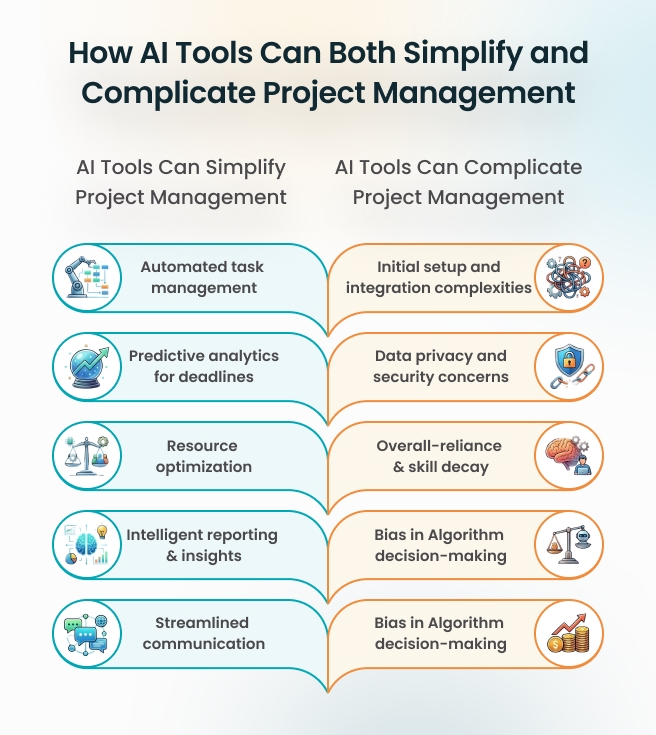
Yet across industries, delivery performance hasn’t improved at the same rate as tooling sophistication. The reason is simple: tools optimize tasks. They don’t design systems. And delivery instability is almost always a systems problem.
AI Accelerates Tasks, Not Decision Systems
AI is excellent at accelerating repetitive work. It can summarize meetings, forecast timelines, flag anomalies, and automate reporting. But AI does not resolve unclear ownership. It does not redesign escalation paths. It does not fix misaligned incentives.
In fact, according to a survey on digital transformation, 70% of digital transformation efforts fail to meet their stated goals, often due to organizational and governance issues rather than technology limitations.
What this tells us is clear:
- Technology adoption does not equal structural maturity
- Automation improves efficiency, not clarity
- AI speeds execution, but doesn’t define decision rights
- Delivery chaos is rarely a computational problem
Many SaaS delivery challenges persist not because AI is underpowered, but because the decision architecture behind it is undefined.
More Tools Increase Coordination Complexity
This is a different failure mode entirely.
Here, the issue isn’t unstable decisions. It’s structural overload.
Every new collaboration platform, reporting dashboard, or automation tool adds another coordination node. More visibility often means more synchronization requirements.
Research from a survey institute has shown that employees spend a significant portion of their workweek searching for information or coordinating internally — a structural tax of fragmented systems.
In complex environments, this manifests as:
- Parallel task tracking across multiple tools
- Duplicated status updates in different systems
- Decision threads are split between email, Slack, and project boards
- Increased context switching
This isn’t inefficiency in execution. It’s coordination density. As coordination density increases, latency increases. And latency quietly impacts delivery predictability inside the broader delivery management system.
What Is Execution Debt in Growing Organizations?
If deadlines drift, rework recurs, and coordination expands despite better tools, the issue isn’t isolated inefficiency — it’s accumulated execution debt.
In scaling environments, it builds quietly. It doesn’t break systems. It erodes predictability. Over time, delivery feels heavier not because teams lack effort, but because the operating model carries hidden structural load.
Execution Debt vs Technical Debt
Most leaders are familiar with technical debt. Execution debt is different — and often more dangerous. Technical debt lives in codebases. Execution debt lives in decision flows, ownership models, and workflow architecture.
Here’s how they compare:
| Dimension | Technical Debt | Execution Debt |
| Where it lives | Codebase, architecture, infrastructure | Decision flow, ownership structure, workflow design |
| Primary cause | Short-term engineering tradeoffs | Ambiguous decisions, unclear ownership, and fragmented coordination |
| Visibility | Detected through performance issues or system errors | Detected through delays, rework, and recurring friction |
| Measurements | Code complexity, refactor backlog | Timeline instability, approval cycles, and coordination overhead |
| Impact | Slower releases, technical instability | Operational bottlenecks, unpredictable delivery, and leadership fatigue |
| Fix | Refactoring, redesigning architecture | Redesigning decision systems and delivery management models |
Technical debt slows systems. Execution debt slows organizations. And as teams grow, the latter becomes harder to diagnose because it hides behind activity.
Decision Ambiguity Inside Scaling Agency Operations
As organizations expand, decisions don’t just increase — they multiply across layers. Strategy decisions, delivery approvals, client escalations, and scope clarifications — each adds friction if not structurally defined.
In early stages, ambiguity is tolerable. In growth stages, it becomes destabilizing.
Decision ambiguity typically appears as:
- Multiple stakeholders believe they hold final authority
- Conditional approvals that reopen previously closed work
- Strategy shifts without workflow redesign
- Escalations that lack predefined resolution ownership
When scaling agency operations, unclear decision architecture is one of the fastest ways execution debt accumulates. Work doesn’t stop. It just slows.
Ownership Confusion and Approval Bottlenecks
Ownership confusion rarely looks dramatic. It looks like hesitation.
- Who signs off?
- Who decides scope trade-offs?
- Who resolves cross-team conflict?
When ownership boundaries blur, decisions stall — and stalled decisions create operational bottlenecks.
Common signals include:
- Deliverables circulating across multiple review layers
- Founders repeatedly pulled into mid-level delivery decisions
- Approval loops that stretch across departments
- Responsibility shared but not truly owned
A mature delivery system reduces escalation frequency. An immature one pushes friction upward. This is how execution debt begins consuming leadership bandwidth.
Context Switching as an Operational Tax
One of the least discussed drivers of execution debt is context switching.
In tool-dense environments, teams operate across multiple platforms, meetings, and communication streams. Every transition between tools, conversations, or workstreams adds cognitive overhead.
Over time, this creates:
- Reduced decision quality
- Slower turnaround times
- Increased coordination effort
- Fragmented attention
Industry research consistently shows that employees lose significant productivity time to information searching and coordination overhead in fragmented environments. That lost time is not visible in sprint metrics — but it directly impacts delivery stability. Context switching isn’t just a distraction. It’s an operational tax.
How Execution Debt Impacts Predictable Delivery
The most dangerous aspect of execution debt is that it doesn’t immediately collapse performance. It erodes predictability.
Instead of catastrophic failure, you see:
- Slightly extended timelines
- Repeated scope refinements
- Increased dependency complexity
- Growing coordination meetings
- Reduced confidence in delivery forecasts
Over time, predictable output becomes probabilistic output. And once delivery becomes probabilistic, growth feels risky — no matter how strong your tools or talent are. Execution debt is not a productivity issue. It is a systems maturity issue.
How Structural Drag Builds Inside Growing Agencies
Delivery instability rarely begins with failure. It begins with growth.
As agencies expand clients, revenue, headcount, and service complexity, the operating model often remains unchanged. What worked at 15 people quietly strains at 50. What worked across three clients becomes unstable across twenty. This is where structural drag begins accumulating — not as chaos, but as increasing delivery friction.
Tool Sprawl Without an Agency Operations System
Growth typically brings new tools. A better reporting platform. A refined task manager. Automation to reduce manual effort. Collaboration layers for distributed teams. Individually, these additions feel like progress. Collectively, without a unified agency operations system, they create fragmentation.
Common signals include:
- Multiple platforms are holding different versions of the project status
- Duplicate tracking across tools
- Increasing context switching
- Automation workflows that don’t fully integrate
- Parallel communication threads across systems
Over time, this creates coordination density — a structural load inside the broader delivery management system. The issue isn’t tooling. It’s the absence of an integration architecture.
Undefined Escalation Paths in Delivery Teams
Early-stage agencies rely on proximity. Decisions move quickly because everyone is close to the work. As teams grow, decision velocity depends on structured escalation paths. Without them, hesitation replaces clarity.
You’ll notice:
- Delivery blockers are waiting longer for resolution
- Managers are unsure who owns final approval
- Founders pulled into mid-level decisions
- Teams deferring action to avoid risk
This is how operational bottlenecks quietly form. Growth increases decision volume. Without defined authority, latency increases. Not because people are slow, but because the system is unclear.
Rapid Growth Without Process Redesign
Revenue growth feels like progress. But if delivery architecture doesn’t evolve alongside it, friction compounds. When scaling agency operations, teams often expand capacity before redesigning workflows. That gap introduces structural inefficiency.
It typically shows up as:
- Resource allocation strain
- Overlapping sprint dependencies
- Inconsistent delivery forecasting
- Increased coordination meetings
- Reduced clarity across project timelines
Industry research consistently shows that organizations expanding headcount without parallel process maturity experience higher delivery variance. Growth magnifies weak systems.
And weak systems create delivery instability.
Misalignment Between Strategy and Execution Layers
Strategic shifts are inevitable. But execution layers must absorb them structurally, not emotionally. When strategic decisions aren’t translated into workflow adjustments, misalignment emerges.
Patterns include:
- New priorities inserted mid-cycle
- Scope shifts without timeline recalibration
- KPI changes without delivery redesign
- Tactical teams reacting instead of planning
This isn’t resistance. It’s a translation failure. Strategy without structural adaptation increases coordination friction — and ultimately, project delivery delays.
Hidden System Gaps in SaaS Delivery Models
Serving SaaS environments introduces layered dependencies: product updates, feature integrations, release timelines, and customer success loops.
Without a mature delivery management system, these layers create systemic load.
You’ll often see:
- Feature feedback loops colliding with sprint commitments
- Product and marketing timelines are misaligned
- Escalation overlap between support and development
- Increased cross-functional coordination overhead
These are common delivery challenges — not because of technical weakness, but because complexity has outpaced system design. And when complexity outpaces structure, friction becomes predictable.
The System Gap: Where Project Delivery Actually Breaks
By this point, it should be clear that timeline instability is rarely about effort or tools. It is almost always about structural gaps inside the operating model.
When teams experience recurring project delivery delays, the root cause is not poor execution. It is misaligned architecture inside the delivery management system — specifically in how processes, decisions, feedback, and ownership are designed.
Let’s isolate where the breakdown typically occurs.
Process Gaps That Create Timeline Instability
Processes don’t fail loudly. They fail quietly — through inconsistency.
When workflow stages are loosely defined or unevenly adopted across teams, timeline variance becomes inevitable. One team interprets intake differently. Another handles approvals differently. A third adapts the sprint scope mid-cycle.
These subtle inconsistencies create:
- Variable definitions of “ready” and “done.”
- Unstructured intake and scope validation
- Planning sessions disconnected from execution realities
- Inconsistent sprint hygiene across teams
The result is not visible chaos. It is timeline instability — the slow drift that produces recurring project delivery delays without obvious crisis. Stable delivery requires standardized flow, not just task tracking.
Decision Flow Breakdowns Across Teams
Even with defined processes, delivery suffers when decision pathways are unclear. Decision flow determines how quickly ambiguity is resolved. When that flow is fragmented, latency increases.
Common decision breakdown patterns include:
- Multiple stakeholders assume shared authority
- Escalations without predefined resolution owners
- Strategic changes introduced without execution recalibration
- Cross-functional dependencies lacking final accountability
In these environments, decisions don’t move — they circulate. And circulating decisions create structural delay inside the broader delivery management system. Delivery doesn’t stall because people refuse to decide. It stalls because the authority architecture is undefined.
Feedback Loops That Reinforce Rework
Feedback is essential. But feedback without closure creates rework cycles.
When review loops lack decisiveness, previously resolved work re-enters execution streams. Not due to incompetence — but because alignment wasn’t structurally confirmed.
You’ll notice:
- Conditional approvals that reopen tasks later
- Client feedback layered on top of internal feedback
- Multiple review tiers without final sign-off authority
- Iterations that expand scope subtly over time
These loops reinforce delivery instability. Instead of refining output, they extend timelines — increasing the likelihood of further project delivery delays downstream. A mature system designs feedback to converge, not to circulate.
Lack of Clear Ownership in Delivery Pipelines
Ownership clarity is the backbone of delivery predictability.
When ownership boundaries are blurred, hesitation replaces action. Tasks wait. Decisions pause. Approvals slow.
This often appears as:
- Shared responsibility without clear final accountability
- Founders repeatedly pulled into operational decisions
- Project managers acting as coordinators instead of decision authorities
- Cross-team handoffs without defined outcome ownership
Without clear ownership inside the delivery management system, coordination becomes negotiation. And negotiation increases latency. Ownership clarity doesn’t eliminate complexity — it absorbs it.
What Calm Control Looks Like in a Mature Delivery System
When delivery systems mature, something subtle but powerful happens: tension reduces.
Not because complexity disappears — but because complexity is absorbed structurally. Teams stop relying on heroics. Leaders stop firefighting. Deadlines stop feeling probabilistic. Calm control is not about moving more slowly. It’s about moving predictably. Here’s what that looks like inside a mature agency operations system.
Predictable Sprint Closure Without Escalation Drama
In unstable systems, sprint closure often requires last-minute coordination, approval chasing, and executive nudging. In mature systems, closure is procedural — not emotional.
Predictable sprint closure includes:
- Clearly defined “ready” and “done” standards
- Scope validation before sprint commitment
- Minimal last-minute cross-team escalations
- Structured review cycles with final sign-off authority
- Low variance between estimated and actual completion
When sprints close without escalation drama, delivery confidence compounds. Predictability becomes the norm — not the exception.
Clear Decision Authority at Every Stage
Mature delivery environments eliminate ambiguity around who decides. Decision architecture is mapped — not assumed. Authority is not informal. It is intentional.
In unstable environments, teams often operate with shared responsibility but unclear final accountability. Decisions circulate. Approval becomes consensus-driven. Escalation feels reactive. In contrast, mature systems embed authority directly into workflow design.
You’ll see:
- Explicit decision rights defined per role and documented within the delivery model
- Escalation paths documented, time-bound, and predictable
- Strategy changes routed through structured recalibration processes
- Clear distinction between advisory input and final decision authority
- Reduced dependency on founders for routine operational approvals
In environments focused on scaling agency operations, unclear decision authority is one of the fastest ways to create friction. Growth increases decision volume. If authority is not structured, latency increases.
When decision authority is clear:
- Teams move without hesitation
- Escalations decrease naturally
- Approval loops shorten
- Accountability strengthens
Decisions move quickly not because teams rush — but because authority is structurally embedded. Speed is a byproduct of clarity.
Defined Ownership Across Internal and Outsourced Teams
Outsourcing doesn’t create instability. Undefined ownership does. As capacity expands, especially across geographies or partner networks, the risk is not skill dilution — it is responsibility diffusion.
In high-performing delivery environments:
- Internal and external teams operate under shared workflow standards
- Ownership boundaries are contractually and operationally explicit
- Handoffs include defined success criteria and outcome accountability
- Escalation protocols are predefined and rehearsed
- No task exists without a single accountable owner
In immature systems, tasks are often “owned” collectively. In mature systems, they are owned singularly. Ownership clarity reduces negotiation time. It reduces rework loops. It reduces escalation frequency.
This is the difference between coordination and orchestration. A mature agency operations system ensures that as capacity expands, responsibility clarity increases — not decreases. Scale without ownership discipline leads to friction. Scale with ownership discipline creates flow.
Reduced Cognitive Load for Founders and Delivery Heads
One of the most overlooked indicators of delivery maturity is leadership bandwidth. In unstable systems, founders and delivery heads act as escalation routers. They resolve cross-team disputes. They clarify ambiguous scope. They mediate delivery conflicts.
In stable systems, leadership operates above the noise.
Reduced cognitive load looks like:
- Fewer mid-cycle delivery escalations
- Fewer emergency alignment meetings
- Clear visibility into pipeline health and forecast stability
- Confidence in sprint closure without intervention
- Strategic reviews replacing tactical firefighting
Leadership time is one of the most sensitive system indicators. When the operating model is weak, leaders absorb friction. When the system is strong, leaders design direction.
When scaling agency operations, leadership energy must shift upward — toward value creation, partnerships, and innovation — not downward into daily friction resolution.
Calm control is not passive. It is structured.
Delivery That Scales Without Operational Firefighting
The ultimate test of maturity is scale resilience.
When complexity increases — new clients, new services, new geographies — delivery performance should remain stable. Not because work becomes easier, but because the system anticipates complexity instead of reacting to it.
In reactive environments, growth increases volatility. Every new account introduces friction. Every additional service layer adds coordination strain. Every hiring wave creates onboarding disruption.
In resilient systems, complexity increases throughput — not instability.
That requires:
- Standardized operating rhythms that remain consistent regardless of client mix
- Integrated tooling inside a cohesive agency operations system
- Predictable resource allocation models aligned to historical delivery velocity
- Structured risk mitigation pathways embedded into planning cycles
- Feedback loops designed to converge decisively, not circulate endlessly
- Delivery metrics tied to system health, not just task completion
Firefighting is a symptom of reactive architecture. Stability is a product of proactive design.
A mature delivery system:
- Absorbs client scope variation without destabilizing sprint integrity
- Expands team size without increasing approval latency
- Introduces new services without fragmenting workflow standards
- Maintains delivery predictability under increasing load
It doesn’t eliminate surprises. It reduces their impact. And when complexity rises, calm control remains intact — not because teams try harder, but because the system is structurally sound.
Moving From Reactive Firefighting to Structured Flow
Reactive systems survive through effort. Structured systems scale through design.
Most agencies do not lack talent, tools, or ambition. What they lack is an integrated architecture that transforms activity into predictable outcomes. The shift from firefighting to flow is not operational — it is structural.
It requires rethinking delivery not as a sequence of tasks, but as an engineered operating model.
Designing Delivery as an Operating System
Delivery is often treated as a collection of projects. Mature organizations treat it as an operating system. An operating system defines how work enters, how it moves, how decisions are made, and how it exits. It standardizes flow without suffocating flexibility.
Designing delivery as a system means:
- Mapping intake, planning, execution, and review into a unified delivery management system
- Defining explicit transition rules between workflow stages
- Embedding escalation logic into the process itself
- Ensuring that every project conforms to a standardized rhythm
- Measuring system health — not just task completion
When delivery becomes an operating system, variation reduces. Predictability increases. Teams stop improvising structure for each new engagement. Flow replaces reaction.
Replacing Tool Dependence With System Coherence
Tools are accelerators. They are not foundations.
Many organizations attempt to fix instability by introducing more platforms. But coherence doesn’t emerge from stacking software — it emerges from architectural clarity.
System coherence requires:
- A single source of workflow truth
- Clearly defined integration logic between platforms
- Automation that supports process — not replaces it
- Defined ownership within each tool layer
- Visibility aligned to decision-making authority
A coherent delivery management system integrates tools under a defined logic. It ensures that every platform reinforces the same operating rhythm. When coherence exists, teams rely less on coordination meetings and more on structured flow.
Creating Decision Architecture Before Scaling Further
Growth amplifies every structural weakness.
Before expanding client volume, service offerings, or team size, decision architecture must be explicitly defined.
Decision architecture answers:
- Who has final authority at each delivery stage?
- What triggers escalation?
- How are scope trade-offs resolved?
- What authority remains with founders versus delivery leads?
- How are strategic changes translated into execution updates?
Without this clarity, growth increases latency and project delivery delays. With defined architecture, scaling becomes additive — not destabilizing. Structure precedes scale.
Aligning AI, Automation, and Human Ownership
Technology performs best inside well-designed systems.
The mistake many organizations make with AI in project management is expecting automation to solve structural ambiguity. AI can accelerate estimation, flag anomalies, generate summaries, and streamline reporting — but it cannot define authority or resolve ownership confusion.
Alignment requires:
- Using AI to enhance visibility, not replace accountability
- Automating repetitive coordination, not strategic decisions
- Integrating automation into an existing operating rhythm
- Preserving human ownership over decision points
- Ensuring AI outputs feed structured workflows
When AI, automation, and human authority operate in alignment, the result is not complexity — it is flow. When they operate without structure, they amplify fragmentation. AI should reduce coordination density, not increase it.
Conclusion
If your team is working harder each quarter yet delivery still feels heavier, the issue isn’t effort — it’s architecture. Most growth-stage agencies and SaaS teams already have capable talent, modern tooling, outsourcing layers, and even AI in project management embedded into workflows. Yet timelines drift, rework resurfaces, and leadership attention gets consumed by coordination instead of direction. The pattern persists because tools and people do not create predictability — systems do. When process transitions are loosely defined, ownership boundaries are ambiguous, and decision flow is improvised rather than engineered, friction compounds inside the delivery management system.
Organizations that achieve calm control don’t simply add platforms or expand headcount. They redesign how execution systems, intelligence systems, and leadership systems operate together. That distinction is what separates a task vendor from an Operating System Partner. ZealousWeb operates from that systems-first philosophy — not as a tool reseller or outsourced execution layer, but as a structural partner focused on delivery architecture, AI-enabled intelligence, and decision clarity at scale.
Before expanding further, pause and examine your foundation: Where does work stall? Who owns final authority? How many approvals does a change require? How often does completed work reopen? Is growth outpacing operational maturity? Those questions don’t diagnose performance — they diagnose structure. Assess your delivery system.
Are You Managing Projects — or Managing Hidden Execution Debt
Assess Your Delivery System
FAQs
We Already Have Project Managers and Senior Leaders. Why Would We Need External System Expertise?
Internal leaders are often embedded in the friction they’re solving. External system expertise brings objective structural clarity, strengthening leadership effectiveness without organizational bias.
Will Redesigning Our Delivery System Slow Us Down in the Short Term?
A structured redesign adds discipline, not bureaucracy. By reducing coordination noise and decision latency, clarity often increases overall velocity rather than slowing execution.
We Already Use Advanced AI and Automation Tools. What Additional Value Can System Design Bring?
AI accelerates tasks and improves visibility, but it doesn’t define authority or resolve ownership gaps. System design ensures AI, automation, and human decision-making operate cohesively instead of amplifying fragmentation.
How Does This Approach Impact White-Label or Multi-Client Delivery Environments?
Multi-client delivery increases coordination complexity. A systems-first approach standardizes flow, protects sprint integrity, and enforces ownership discipline, allowing scale without sacrificing predictability.
How Long Does It Take to See Measurable Stability After Restructuring Delivery Systems?
Timelines vary by complexity, but early signs appear quickly—clearer decision flow, defined ownership, and more consistent delivery rhythm. These structural improvements typically precede visible performance gains.
How Do We Evaluate Whether ZealousWeb Is the Right Partner for This Kind of Engagement?
The evaluation goes beyond tools or pricing. If you need task execution, many vendors can help. If you’re seeking clarity across execution, intelligence, and leadership systems, alignment should be assessed at the architectural level.