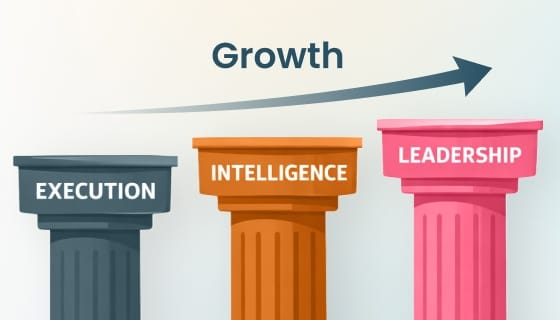



Most scaling agencies and SaaS teams today are not under-equipped. They have AI embedded into workflows, experienced teams executing delivery, documented processes, automation reducing manual effort, dashboards tracking performance, and outsourcing extending capacity. On paper, the fundamentals are solid.
And yet, growth still feels heavier than it should.
Deadlines stretch despite structured workflows. Escalations rise even with ownership defined. Rework resurfaces in organizations that believe their processes are mature. AI increases speed, but decision clarity does not improve proportionally. The issue is rarely tools, talent, or even processes in isolation. It is how well these elements are orchestrated into a cohesive execution system.
This checklist is not about adding more software. It is about testing whether your AI, expertise, and processes are structurally aligned to scale with calm control — or simply coordinated well enough to function under pressure.
Before you scale further, it’s worth knowing which one you’re operating on.
Download the Execution Systems Readiness Checklist
Tools Optimize Tasks. Systems Design Flow
Most scaling teams have already optimized tasks. Workflows are documented. AI accelerates execution. Automation reduces effort. Dashboards provide visibility. On paper, the operation looks efficient.
But scale does not break tasks. It exposes flow.
Friction rarely appears inside activities. It appears in handoffs, decision rights, governance, and accountability under pressure. Efficiency at the task level does not guarantee coherence at the system level.
The real question is not whether your tools work. It is whether your work moves predictably when volume increases. That is the difference between being well-equipped and being systemized.
Task Efficiency Is Not Organizational Coherence
Most scaling teams are already efficient at the task level. AI accelerates execution. Automation reduces manual load. Project platforms structure timelines. CRMs streamline follow-ups. Each layer performs well within its boundary.
But scale does not test individual tasks. It tests integration.
Friction rarely originates in activities. It emerges between them — in handoffs, blurred ownership, approval loops, and exception management. Speed at the task level does not automatically create coordination at the system level.
You can optimize every function and still struggle with flow.
Speed Without Structure Amplifies Friction
At lower volumes, coordination gaps are absorbed through effort. Teams compensate. Leaders step in. High performers bridge structural inconsistencies.
As volume increases, effort stops being enough. AI increases velocity. Automation increases throughput. Outsourcing increases capacity. But without a deliberately designed execution architecture governing how work moves and decisions are enforced, acceleration begins to expose instability rather than eliminate it.
More output does not create alignment. It magnifies whatever structure already exists.
Systems Determine Whether Scale Creates Leverage or Noise
A tool ensures a task is completed. A system ensures work moves predictably across delivery, intelligence, and leadership layers.
An execution system defines how decisions travel, how accountability compounds, how quality is embedded, and how exceptions are governed before they escalate. It is not a stack of processes. It is the architecture that connects them.
When systems are designed, scale creates leverage. When systems are assumed, scale creates noise.
The distinction is subtle — until scale exposes it. Most organizations are not under-equipped. They are under-orchestrated. Before adding more tools, more automation, or more capacity, it is worth asking a harder question: Is your organization optimized for tasks, or architected for flow? That answer determines whether growth increases control or complexity.
How to Use This Execution Systems Checklist
The statements that follow are designed to test structural predictability.
- Not whether work gets done.
- Not whether tools are in place.
- But whether delivery, decision flow, and accountability remain stable as volume increases.
For each statement, answer based on observed reality — not documented intent.
- If something works only when specific people intervene, that matters.
- If alignment depends on effort rather than design, that matters.
- If scale increases coordination instead of leverage, that matters.
This is not about perfection. It is about structural clarity.
Execution Systems: Does Your Delivery Model Scale Without Friction?
Modern scaling businesses are not under-equipped. They have AI embedded into workflows, capable teams executing delivery, documented processes, dashboards providing visibility, and outsourced layers extending capacity. On paper, delivery appears mature.
Yet as volume grows, friction grows with it.
Escalations rise despite governance charts. Rework resurfaces despite SOPs. Leadership intervenes more frequently. AI increases speed, but predictability does not strengthen proportionally.
This is not a tooling or talent gap. It is a systems gap.
Having processes is not the same as having an execution system. A true execution system ensures work flows predictably across teams, accountability scales without escalation, and decisions remain stable under pressure.
The statements below assess whether your delivery model scales by design or by effort.
Execution Systems Checklist: Answer Yes or No based on operational reality, not documented intention.
| # | Statement | Yes | No |
| 1 | Delivery predictability remains stable as project or client volume increases | ☐ | ☐ |
| 2 | Decision rights are clearly defined and rarely require executive clarification | ☐ | ☐ |
| 3 | Handoffs across teams follow a structured governance flow rather than informal coordination | ☐ | ☐ |
| 4 | Quality assurance is embedded into workflows, not triggered after breakdowns | ☐ | ☐ |
| 5 | Escalations follow predefined paths instead of defaulting to leadership | ☐ | ☐ |
| 6 | Outsourced or white-label layers operate within the same accountability framework as internal teams | ☐ | ☐ |
| 7 | Delivery stability does not depend on specific high-performing individuals | ☐ | ☐ |
| 8 | Growth increases leverage more than oversight | ☐ | ☐ |
Intelligence Systems: Is AI Improving Decisions — or Just Speed?
Modern scaling businesses are investing heavily in AI, automation, and real-time visibility. Dashboards track performance, and insights are generated faster than ever. Intelligence appears embedded within operations.
Yet decision clarity does not always improve proportionally.
Visibility increases, but alignment often remains inconsistent. Reports multiply, while prioritization stays ambiguous. AI accelerates activity, but strategic direction does not necessarily sharpen.
This is not an AI adoption issue. It is an intelligence systems issue.
Only a structured decision architecture — defining signal hierarchy, ownership, and governance — ensures intelligence translates into consistent action. Use the checklist below to evaluate whether your intelligence systems are reinforcing clarity — or simply increasing speed.
Intelligence Systems Checklist: Answer Yes or No based on how decisions are made under pressure — not how dashboards are configured.
| # | Statement | Yes | No |
| 1 | AI outputs are directly integrated into formal decision workflows | ☐ | ☐ |
| 2 | Performance dashboards consistently influence strategic prioritization | ☐ | ☐ |
| 3 | Data ownership and interpretation responsibility are clearly defined | ☐ | ☐ |
| 4 | Automation reduces ambiguity rather than creating parallel reporting streams | ☐ | ☐ |
| 5 | Metrics are tied to clearly defined strategic outcomes, not just activity tracking | ☐ | ☐ |
| 6 | As data volume increases, decision clarity improves instead of fragmenting | ☐ | ☐ |
| 7 | AI adoption has reduced leadership noise rather than increased information overload | ☐ | ☐ |
| 8 | Insights translate into consistent action without repeated clarification cycles | ☐ | ☐ |
Leadership Systems: Does Growth Increase Clarity or Chaos?
Modern scaling businesses invest in AI, structured teams, dashboards, and governance frameworks expecting leadership strain to reduce as operations mature.
Yet as volume increases, executive involvement often increases with it.
Meetings expand. Escalations move upward. Strategic focus drifts into operational resolution. AI improves speed, but clarity at the top does not strengthen proportionally.
This is not a talent issue. It is a leadership systems issue.
When execution and intelligence layers are not structurally integrated into decision governance, leadership absorbs coordination gaps.
Use the checklist below to evaluate whether growth in your organization increases clarity — or complexity.
Leadership Systems Checklist: Answer based on how decisions are made under pressure—not how dashboards are configured.
| # | Statement | Yes | No |
| 1 | Strategic priorities remain clear and stable as scale increases | ☐ | ☐ |
| 2 | Leadership time is spent on direction, not operational troubleshooting | ☐ | ☐ |
| 3 | Decision authority is clearly distributed and rarely escalates upward | ☐ | ☐ |
| 4 | Growth does not proportionally increase executive oversight | ☐ | ☐ |
| 5 | Accountability is structurally enforced, not personality-driven | ☐ | ☐ |
| 6 | AI and data insights flow directly into leadership decisions through defined governance | ☐ | ☐ |
| 7 | Increased complexity does not increase cross-functional friction | ☐ | ☐ |
| 8 | Leaders can step back without delivery stability declining | ☐ | ☐ |
Scoring Your Structural Readiness
Add your total “Yes” responses across all three sections. This is not a measure of effort or capability. Modern scaling businesses rarely struggle because they lack AI, strong teams, or documented processes. They struggle when those components are not integrated into a cohesive execution, intelligence, and leadership system. The score below indicates whether growth in your organization is likely to create leverage — or coordination strain.
- 18–24 (Yes): Your systems are largely integrated. Growth is more likely to reinforce clarity and control than increase oversight.
- 10–17 (Yes): Strong components exist, but orchestration gaps may surface under pressure. Complexity could outpace structural coherence as you scale.
- 0–9 (Yes): Execution, intelligence, and leadership layers may be operating in parallel rather than as a unified operating system. Growth will likely amplify coordination overhead.
From Tools to Systems: The Integration Pivot
Scalability isn’t a tech problem; it’s a structural one. Having advanced tools doesn’t mean you have a system—it just means you have a high-tech toolkit. True readiness is measured by how predictably you perform when the pressure is turned up.
The Tool Trap
Most teams scale by “stacking” instead of “weaving”:
- Execution gets faster (AI & Outsourcing).
- Intelligence gets louder (Dashboards).
- Leadership gets busier (Oversight).
If these layers don’t talk to each other, you aren’t building a company; you’re building a collection of silos. This is why complexity creates friction—the “seams” of your organization are being pulled apart by the very tools meant to help you.
The Reality Check
- Tools accelerate tasks.
- Systems automate outcomes.
You aren’t behind. You’ve likely built an impressive engine, but you’re still steering every gear by hand. The shift from “Tools” to “Systems” is about orchestration: turning parallel efforts into a singular, compounding operating system that stays stable while you step back.
Conclusion
The friction most growth-oriented organizations experience is rarely caused by a lack of tools, talent, or ambition. It emerges when different parts of the business mature at different speeds. Delivery becomes faster. Data becomes richer. Teams become more specialized. But the connective structure that aligns these strengths does not always evolve with them.
As scale increases, coordination expands. Leadership becomes more involved in resolving operational questions. Visibility improves, yet alignment does not always follow. What feels like complexity is often a misalignment between how work is executed, how insight is interpreted, and how decisions are enforced.
Sustainable scale requires more than well-performing components. It requires a unified operating structure that ensures work moves consistently, information informs action reliably, and leadership retains strategic focus as volume grows. When these layers reinforce one another, growth strengthens control rather than diluting it.
ZealousWeb partners with organizations at this inflection point — not to add more activity, but to align what already exists into a cohesive operating model. The result is steadier delivery, clearer decision pathways, and leadership that guides growth instead of absorbing friction.
Before accelerating further, ensure your foundation is architected for the complexity you are about to create.
Turn Execution Effort into Predictable Outcomes
Let’s Connect
FAQs
We Already Use AI and Automation. Why Does Scale Still Feel Heavy?
AI improves task-level speed, but scale feels heavy when decision flow, governance, and accountability are misaligned. Without structural integration, acceleration increases complexity instead of control.
How Do We Know if Our Problem Is Structural and Not Just a Capacity Issue?
If adding people, tools, or outsourcing boosts output temporarily but complexity keeps returning, the issue is structural. Capacity improves throughput; structure ensures predictability.
We Have Documented Processes. Isn’t That the Same as Having Systems?
No. Processes define how tasks are done. Systems define how tasks connect, how decisions flow, and how accountability scales under pressure. Documentation alone does not create integration.
Can AI Eventually Solve These Coordination Challenges?
AI can automate execution and surface insights, but it cannot design governance, define authority, or align cross-functional flow. Structural clarity must come before automation maturity.
What Does Working With ZealousWeb Actually Change?
The focus shifts from managing day-to-day activity to aligning systems and decision architecture. Delivery becomes more predictable, decision paths clearer, and leadership less burdened by operational friction—allowing growth to strengthen control rather than increase oversight.