

There’s a specific kind of agency pain that doesn’t show up in dashboards. The strategy is solid. The audit is thorough. The client relationship is warm. And then — quietly, with minimal drama — the client doesn’t renew. They cite “going in a different direction.” What they mean is: they didn’t see enough happening.
This is the delivery gap. And it’s responsible for more agency churn than bad keyword research ever was. The agencies growing past it aren’t hiring faster or pitching harder. They’ve changed the architecture of how technical SEO gets done — separating strategy from execution, and bringing in the right seo partnerships to make implementation consistent, invisible, and scalable. For agencies serious about helping clients rank higher on Google and AI search, that separation isn’t optional anymore — it’s the structural decision that determines whether technical recommendations become results or just documentation. And for agencies evaluating where that execution capability comes from, working with a white label SEO agency in India is how the math on quality, speed, and margin actually works at scale.
This is that playbook.
Why Your Agency Is Winning the Strategy Game and Losing the Client Anyway
The audit isn’t the deliverable. The ranking change is.
That line should probably be printed on the wall of every agency account management team. Because the single biggest retention leak most agencies are sitting on isn’t pricing, positioning, or even competition. It’s the gap between what gets recommended and what gets implemented.
SEO agencies are no strangers to client churn — and it consistently ranks among the highest of any digital marketing service. A meaningful portion of that churn isn’t caused by bad strategy. It’s caused by a strategy that never became execution.
Here’s the scenario that plays out across agency client rosters every quarter:
The Invisible Churn Cycle
| Month | What the agency sees | What the client experiences |
| Month 1 | Audit delivered, priorities agreed | Excitement, confidence |
| Month 2 | “Fixes in progress” | Nothing visibly different |
| Month 3 | Internal backlog builds | The client quietly starts comparing |
| Month 4 | Rankings still flat | Client is on a call with another agency |
The client didn’t leave because you were bad at SEO. They left because SEO wasn’t visibly happening to their site.
Retaining an existing client costs 5–7 times less than acquiring a new one. Increasing client retention rates by just 5% can boost profits by 25–95%. Which means every account that exists quietly because of unimplemented recommendations represents a compounding financial loss — not a one-time miss.
The retention problem wearing a strategy mask: Most agencies diagnose their churn as a communication problem or an expectation-setting problem. Those are symptoms. The root cause is a delivery problem — specifically, the inability to consistently convert technical SEO recommendations into implemented, measurable changes.
What Happens Inside a Client Account When Technical Fixes Sit Untouched for 60, 90, 120 Days
Technical debt doesn’t pause while you’re figuring out capacity. It compounds.
Delayed technical SEO implementation isn’t a neutral state. It’s an active deterioration. While the backlog grows, here’s what’s quietly happening inside every affected account:
The Compounding Damage Stack
Crawl health degradation —Broken internal links multiply. Redirect chains lengthen. The crawl budget is consumed by low-value URLs and orphaned pages. Google itself confirms that duplicate, removed, or unimportant URLs waste significant crawling time — and for sites with 10,000+ pages, low-value URLs can consume crawl budget that should be reaching high-priority content. For large sites, determining which pages are worth crawling — and actively excluding those that aren’t — is one of the most impactful crawl budget optimisations available. When the crawl budget is being silently drained, the pages your clients care most about may never get indexed at all.
- Core Web Vitals drift — Not just reporting INP, LCP, and CLS scores. Implementing fixes — image delivery, layout stability, server response time, render-blocking resources — across page templates. Organic search accounts for 53% of all trackable website traffic, according to data cited by Search Engine Journal — while paid search drives just 15% and social media a mere 5%. When Core Web Vitals are degrading, that 53% is the first thing at risk.
- Competitor SERP capture — While your client’s schema sits unimplemented, a competitor who deployed structured data three months ago is already appearing in rich results. That SERP real estate isn’t waiting for your team to get around to it.
- Indexation gaps widening — JavaScript-heavy pages that aren’t rendering correctly for search engines aren’t just underperforming. They’re often not indexed at all. Every week of delay is another week of invisible content.
- The SaaS Agency Use Case: A mid-size UK digital agency managing 14 SaaS clients ran a quarterly technical audit across its roster. Nine of the fourteen had priority technical fixes — crawl errors, schema gaps, CWV failures — that had been sitting in backlog for over 90 days. Three of those nine clients were in active “at risk” conversations. The agency’s problem wasn’t strategy quality. It was implementation throughput.
Performance expectations drive churn more than actual results — agencies that establish realistic KPIs during onboarding achieve 15–20 percentage points better retention than industry averages. But KPIs only protect you if implementation is keeping pace. When fixes sit untouched, even a well-set expectation erodes.
Your Team Needs the Bandwidth and a Specialist to Take on More Clients
Talk With a Growth Partner
Why Your In-House Team Is Always One Large Client Away From Breaking
One enterprise client. One site migration. And suddenly your technical SEO resource is fully consumed — and three other clients are quietly falling behind.
The hiring argument surfaces in every agency growth conversation: “We just need another technical SEO.” It’s intuitive. It’s also, for most agencies, a false solution.
Here’s the capacity math that rarely gets fully modelled:
The Hidden Cost of In-House Technical SEO Hiring
| Cost Factor | Reality Check |
| Annual salary (mid-level) | Significant fixed commitment — before benefits, tools, or management overhead |
| Onboarding to full productivity | 60–90 days minimum — your clients don’t pause while you ramp |
| Skill coverage per hire | Typically strong in 2–3 areas — gaps only surface when a complex client is already at risk |
| Flexibility to scale down | Zero — fixed cost regardless of whether the client load justifies it |
| Ability to absorb a complex enterprise account immediately | Also, near zero — one large client can consume an entire resource overnight |
| Backup when your hire is sick, on leave, or exits | None — single point of failure with no structural redundancy |
| Tool and platform costs | Additional — Screaming Frog, Ahrefs, log file tools, and CWV monitoring all sit on top of salary |
SEO staffing models that index on headcount-per-revenue break down at scale — the right unit is technical-debt load and content velocity, not headcount. The same principle applies inside agencies: you can’t linearly staff your way out of a nonlinear delivery problem.
The skill depth trap is where agencies consistently get caught. A generalist technical SEO — even a strong one — will plateau when accounts get genuinely complex. Log file analysis at enterprise scale, JavaScript rendering diagnostics across multiple frameworks, multilingual hreflang at depth: these are specialist capabilities. They don’t appear in every hire. And their absence only becomes visible when a high-value account is already in jeopardy.
A common agency scenario: An agency lands a fast-growing e-commerce brand as a new client — significant ARR, complex technical profile, multiple regional variants. The existing technical SEO resource is already at capacity across the existing roster. The agency faces a choice: delay onboarding the new client, overload the existing team, or rapidly find execution support. None of those are good options. The agency that had a white-label SEO company relationship already in place didn’t face this choice — it absorbed the client without friction.
The real question isn’t whether to hire. It’s whether hiring is the right architecture for the kind of capacity problem you’re actually solving.
Why Account Managers End Up Defending SEO Roadmaps Instead of Reporting Results
One enterprise client. One site migration. And suddenly your technical SEO resource is fully consumed — and three other clients are quietly falling behind.
The monthly client call arrives. The technical fixes from last quarter’s audit are in the dev backlog — the client’s dev team’s backlog, not yours, which adds its own layer of dependency and delay. Your slide deck shows intent: here’s the roadmap, here’s the prioritisation, here’s what we’re working toward.
The client asks: “What actually changed this month?”
Clients don’t understand the long-term nature of SEO — they expect visible progress, and when communication breaks down or updates feel vague, they start exploring alternatives.
This is the authority erosion pattern. And it’s structural, not interpersonal. The AM isn’t failing at communication. The AM has nothing concrete to communicate because implementation hasn’t kept pace with strategy.
What the conversation looks like with execution consistency:
| Without Implementation | With Implementation |
| “Here’s what we’re planning to fix.” | “Here’s what we fixed — here’s what moved.” |
| Crawl error count still climbing | Crawl errors reduced by 40%, budget recovered |
| Core Web Vitals are still amber | LCP improved from 4.2s to 2.1s across top pages |
| Schema “in progress.” | FAQ schema deployed, appearing in 3 additional rich results |
| Client asks about ROI | AM shows ranking movement, not just effort |
White label SEO services for marketing agencies — and specifically for digital agencies worldwide — exist precisely to solve this. When technical execution is happening consistently in the background, AMs shift from narrative to numbers. Client confidence compounds. Expansion conversations become possible.
The authority shift happens when implementation catches up with — and then stays ahead of — strategy. That’s not a communication fix. It’s a delivery architecture fix.
What Growing Agencies Do Differently to Scale Technical SEO Delivery Without Scaling Headcount
The best agencies aren’t bigger. They’re better-architected
The agencies managing 30+ client accounts without proportional headcount growth haven’t found a productivity hack. They’ve made a structural decision about what execution infrastructure looks like at scale.
The five things they do differently:
- In-house teams own relationships, strategy, and reporting. Technical implementation runs through a white-label service provider under your brand. The client experiences seamless delivery. The agency experiences sustainable capacity.
- A white-label SEO reseller relationship means a new client, a migration, or a technical crisis doesn’t trigger a hiring cycle. Capacity scales with demand. Margins stay intact.
- The best white label SEO services partnerships enable agencies to offer capabilities they couldn’t otherwise staff — JavaScript SEO, multilingual hreflang, log file analysis, migration planning. Service scope expands. Proposal values follow.
- A specialist hired for a complex engagement sits underutilised when it plateaus. Technical SEO outsourcing scales down without the headcount conversation.
- Delivery consistency — month after month, client after client — is what produces retention. Not one extraordinary account. Consistent, documented execution across all of them.
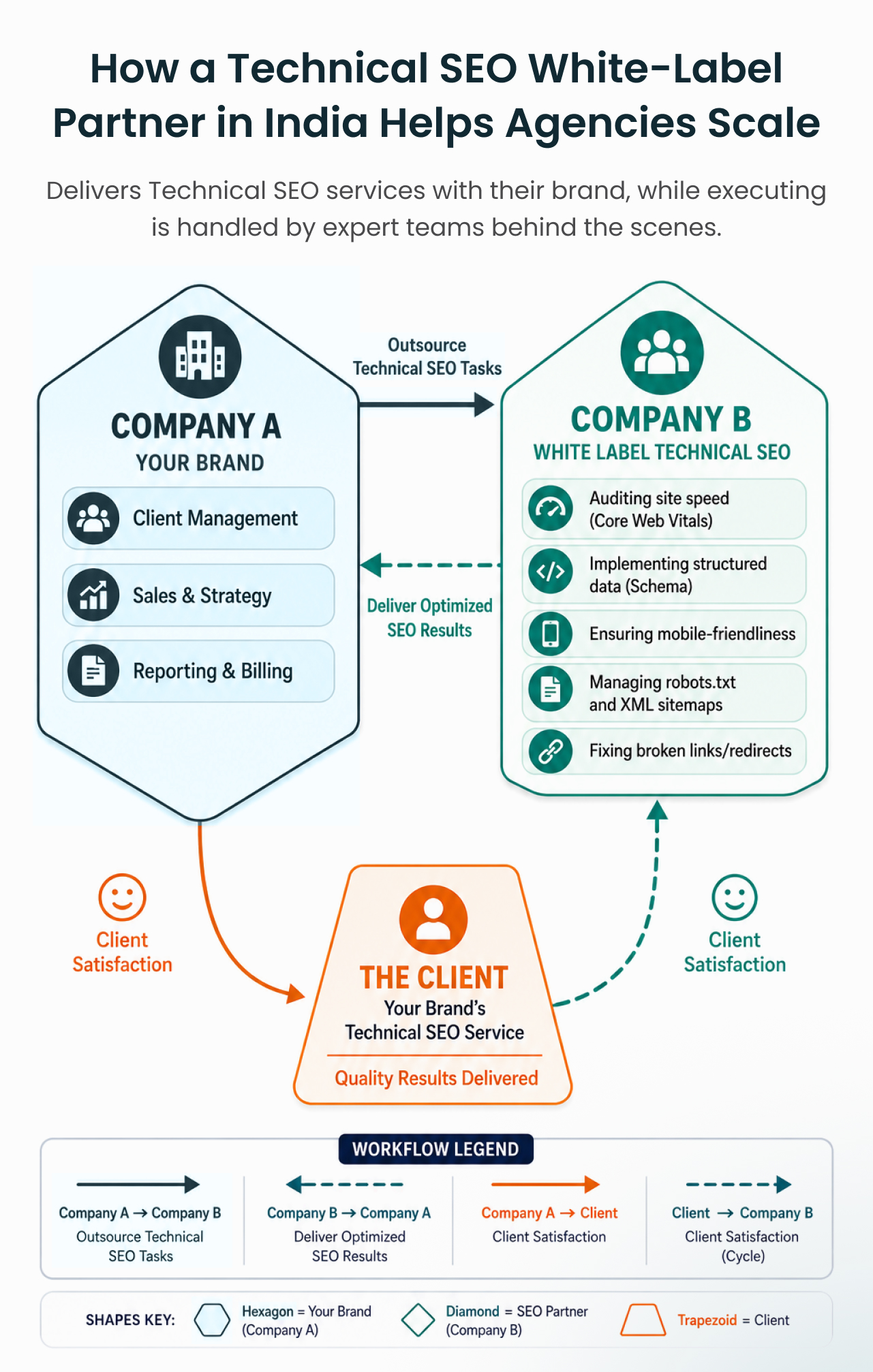
ZealousWeb works with agencies at exactly this inflection point: where the delivery model needs to evolve before it becomes the ceiling on growth. Agencies that bring ZealousWeb in as an execution partner don’t just stabilise delivery — they expand what they’re able to promise in the next pitch.
How a White-Label Technical SEO Partner Converts Recommendations Into Implementation, ROI, and Retention
Implementation is where strategy earns its fee. Everything before that is just a well-formed hypothesis
Let’s be specific — because “technical SEO services” gets used as a catch-all that often masks what’s actually being delivered (or not delivered). Here’s what genuine execution scope covers, and why each component matters for client outcomes:
The Full Technical SEO Execution Stack
- Crawl Health and Indexability Resolving crawl errors, untangling redirect chains, eliminating duplicate content, fixing robots.txt misconfigurations, and cleaning up sitemaps to reflect actual architecture. This is the foundation — nothing else functions optimally without it.
- Core Web Vitals Remediation: Core Web Vitals Remediation: Not just reporting INP, LCP, and CLS scores. Implementing fixes — image delivery, layout stability, server response time, and render-blocking resources — across page templates. According to industry research and SEO performance studies, organic search continues to drive a major share of website traffic across industries, while technical SEO improvements consistently contribute to stronger website performance and visibility. When Core Web Vitals begin to degrade, the traffic potential and search visibility are at risk.
- Schema and Structured Data Deployment: Implementing, validating, and maintaining structured data across product pages, articles, FAQs, local entities, and events. In a search landscape where AI-generated summaries increasingly draw from structured signals, this isn’t optional for clients who want to rank higher on Google and AI answer surfaces.
- JavaScript SEO: Diagnosing and resolving rendering-dependent indexability issues. An increasingly common problem as SaaS platforms, e-commerce frameworks, and React/Next.js-based sites multiply across agency client rosters.
- International SEO and Hreflang: Implementing and maintaining hreflang across multilingual and multiregional configurations. A single misconfiguration silently misdirects international traffic for months — often without triggering an obvious alert until someone runs a dedicated audit.
- Site Migrations: Managing technical continuity across platform migrations, domain consolidations, and structural redesigns. Migrations are where agencies most frequently face client-retention crises — rankings drop post-migration, clients panic, and trust erodes fast. Proper execution prevents this entirely.
- Log File Analysis Understanding how Googlebot actually crawls a site — where it spends budget, what it skips, and what that reveals about indexation priorities that aren’t visible in standard audit tools.
The agency outcome model:
When white-label technical SEO optimization for agencies runs consistently across a client roster — not as a one-time sprint, but as ongoing execution — the downstream effects are measurable and compounding: crawl efficiency improves, rich result eligibility increases, page experience scores stabilise, and rankings begin to reflect strategy rather than just signal intent.
And critically: retention improves. Clients who see consistent, documented technical progress don’t shop around. The switching cost becomes real. The relationship deepens. Account lifetime value compounds in a way no acquisition spend can replicate.
How ZealousWeb Supports Agencies as a White-Label Technical SEO Execution Partner
Your clients hired your agency. ZealousWeb makes sure your agency delivers — every month, at scale, under your brand.
ZealousWeb doesn’t show up in your client’s inbox. It doesn’t present on your client calls. It doesn’t put its name on a single deliverable. It functions as the execution layer your agency runs on — invisibly, consistently, and entirely under your brand.
Here’s what that integration looks like in practice:
Under Your Brand. Inside Your Systems
ZealousWeb integrates into your existing project management and reporting workflows — Asana, ClickUp, Notion, and a custom delivery stack. Deliverables come through your processes, formatted to your standards. Clients experience seamless agency delivery. You experience capacity that scales without the hiring conversation.
Technical Depth Across the Full White Label Technical SEO Spectrum
As a white label SEO agency in India built specifically for agency delivery — not general consulting, not one-size-fits-all retainers — ZealousWeb covers the complete white label technical SEO execution scope.
That means crawl health and indexability fixes, Core Web Vitals remediation, schema and structured data deployment, JavaScript SEO and rendering diagnostics, hreflang and international SEO configuration, site migrations, and log file analysis. Each of these handled at depth, not flagged and forwarded.
This is seo outsourcing done as execution — not surface-level task completion, not a checklist exercise passed back to your team for action. ZealousWeb implements. Your clients see results. Your AMs report outcomes.
A Partnership Model. Not a Vendor Relationship.
Most outsourcing arrangements hand you a service menu and ask you to fit within it. ZealousWeb works the other way around.
The engagement model adapts as your roster evolves. A large new client lands mid-quarter — absorbed. A client triggers an unplanned site migration — handled. A scope expansion comes in three months into a retainer — ZealousWeb moves with it. This is what separates a genuine white-label agency for digital marketing services from a contractor arrangement. It’s not a resource you manage. It’s an operational extension of your agency that thinks in terms of your delivery commitments, not its own task queue.
White Label SEO Services Pricing Built for Agency Margins
White label SEO services through ZealousWeb are priced to protect your margin — not compress it. The structure supports premium retainer positioning on your end, which means you’re not racing to the bottom to justify the engagement. You’re competing on delivery consistency — on the fact that your agency implements what it recommends, month after month, without the client ever seeing the seams. That’s a significantly more defensible competitive position than price. And it’s the one that actually compounds into long-term account value.
But let’s put real numbers to that claim. Because the cost advantage of working with a white-label SEO agency in India isn’t marginal — it’s structural.
The Global Cost of Technical SEO Talent — And Why India Changes the Math
Hiring a mid-to-senior technical SEO specialist in-house isn’t just an operational decision. It’s a significant fixed-cost commitment that varies dramatically by geography. Here’s what agencies across six key markets are actually paying — in annual salary alone, before tools, benefits, and management overhead are factored in:
| Country | Avg. Annual Salary (Mid-Level Technical SEO) | Avg. Annual Salary (Senior Technical SEO) | Approx. Monthly Cost to Agency (incl. ~30% overhead) |
| United States | $72,000 – $89,000 | $95,000 – $130,000 | $7,800 – $14,100 |
| United Kingdom | £40,000 – £50,000 | £60,000 – £75,000 | £4,300 – £8,100 |
| Australia | AUD $82,000 – $90,000 | AUD $100,000 – $130,000 | AUD $8,900 – $14,000 |
| Canada | CAD $60,000 – $80,000 | CAD $90,000 – $110,000 | CAD $6,500 – $11,900 |
| Germany | €45,000 – $58,000 | €65,000 – €80,000 | €4,900 – €8,700 |
| Singapore | SGD $66,000 – $82,000 | SGD $90,000 – $110,000 | SGD $7,200 – $11,900 |
| India (White-label Partner) | $500 – $1,500/month (wholesale retainer) | $1,500 – $3,000/month (senior/specialist scope) | No overhead. No benefits. No ramp time. |
What That Gap Actually Means for Your Agency
Hourly rates for experienced SEO specialists in India are typically 40–70% lower than equivalent Western rates, which lets agencies price competitively or retain significantly higher margins.
76% of India-based SEOs charge $1,000 or less per month, while the average monthly retainer for US-based SEO agencies sits at approximately $3,209. That’s the arbitrage window in which a white-label SEO agency relationship is built.
| Cost Factor | In-house Hire | White-label Partner (India) |
| Monthly salary commitment | Fixed — regardless of workload | Variable — scales with scope |
| Benefits and overhead | +25-35% on top of salary | Included in retainer |
| Onboarding time | 60–90 days to full productivity | Operational from Day 1 |
| Skill coverage | 2–3 specialisms per hire | Full technical SEO spectrum |
| Scalability | Slow — tied to hiring cycles | Immediate — adjusts with client load |
| Brand visibility to clients | Internal resource | Invisible — works under your brand |
Hiring an in-house SEO specialist in the US often costs $80,000 or more annually before benefits and tooling — making white-label retainers a significantly more flexible option for small to mid-sized agencies. The math is not subtle. For what a single mid-level in-house technical SEO costs in the US, UK, or Australia annually, an agency can run a white label SEO agency in India in partnership across multiple client accounts — at depth, under their brand, with full technical scope coverage — and still protect a margin that makes growth worth pursuing.
That’s not a cost play. That’s a delivery architecture decision.
Conclusion
Strategy without execution is a well-formatted hypothesis. In an industry where clients measure value through visible progress rankings that moved, crawl errors that disappeared, and rich results that appeared, a comprehensive audit sitting untouched is worse than not having done it. It sets an expectation. And then quietly fails to meet it.
The agencies winning on retention right now aren’t necessarily the most creative or the most technically sophisticated. They’re the ones who’ve built delivery systems that convert recommendations into outcomes — consistently, across every client, every month.
White-label technical SEO partnerships, done at depth, are that system. The implementation gap is solvable. The only question is whether you solve it before the next client churns, or after.
Ready to Close the Gap Between Your Strategy and Your Client Results?
Book a Discovery Call
FAQs
Is ZealousWeb a Good Fit for Agencies Looking for a White-Label SEO Agency in India?
Yes. With over 22 years of experience, ZealousWeb is a white-label SEO agency in India built for agencies at every growth stage — whether you're managing 10 clients or 50+.
How Does ZealousWeb Ensure Client Confidentiality and Brand Integrity?
ZealousWeb works entirely under your brand, governed by strict confidentiality agreements. Your clients never know we exist — and that's exactly how we intend it.
How Does ZealousWeb Integrate With Your Existing Workflow?
ZealousWeb plugs into your existing tools — Asana, ClickUp, Notion, or a custom stack — without asking you to change a thing. Your processes stay yours; we just execute within them.
How Is This Different From Hiring a Freelance Technical SEO?
A freelancer fills one gap. ZealousWeb fills the entire execution layer — crawl health, Core Web Vitals, schema, JavaScript SEO, hreflang, migrations — across multiple accounts, at scale.
What's the Difference Between a White-Label SEO Reseller and What ZealousWeb Does?
A white-label SEO reseller hands you a fixed menu. ZealousWeb hands you an execution partner that adapts to your delivery model and scales with your agency's growth.