



Scaling sounds straightforward.
Add talent. Add outsourcing. Add AI.
On paper, it looks like the logical progression. Growth increases complexity, so you introduce leverage. External partners handle overflow. Automation improves efficiency. Artificial intelligence accelerates output.
And yet, many growing brands find themselves in a strange position.
- More resources, but not more predictability.
- More tools, but not more clarity.
- More output, but not more outcomes.
It raises an uncomfortable question. If outsourcing and AI are designed to remove bottlenecks, why do they sometimes create new ones?
The reality is that neither outsourcing nor AI is inherently flawed. In fact, both can be powerful accelerators. But acceleration only works when the direction is clear. When it isn’t, speed simply amplifies confusion.
This is where scaling teams often get caught off guard. They assume that adding capability automatically creates stability. In practice, it often exposes structural gaps that were manageable at a smaller stage but become fragile under growth pressure.
So in this post, we’ll walk through the most common questions leaders wrestle with when outsourcing and AI fail to deliver as expected. Not surface-level myths, but the deeper objections around cost, trust, timing, and fit.
- Because you likely already have tools.
- You likely already have talented people.
- You may already be experimenting with AI.
What determines whether they work isn’t the technology itself. It’s whether the underlying system can turn them into consistent outcomes.
Let’s examine the questions that matter.
1. Why Do AI Initiatives Struggle to Deliver Expected ROI?
Even with substantial investment and strategic intent, many AI initiatives fall short of delivering the returns that leaders expect. This isn’t because the technology can’t add value — it’s because the pathway from investment to measurable impact is often misunderstood or oversimplified.
When AI underperforms, the issue usually isn’t the model. It’s the surrounding environment. The pattern tends to repeat across growing teams, regardless of industry.
Here’s how that typically plays out:
| Challenge | What Happens in Practice | Impact on ROI |
| Vague problem definition | AI is deployed to “improve efficiency” or “boost productivity” without a specific operational bottleneck defined | Results feel abstract and hard to measure |
| Poor data foundation | Data is fragmented across tools, inconsistent, or incomplete | AI outputs lack reliability, reducing trust and usage |
| No system integration | AI works in isolation rather than inside core workflows | Teams revert to manual processes |
| Misaligned incentives | Leadership expects transformation, but teams treat AI as optional | Adoption stalls and usage remains low |
| Pilot purgatory | AI succeeds in small tests but never scales operationally | Investment becomes sunk cost instead of capability |
What This Looks Like in the Real World
- Zillow: When Intelligence Meets Market Volatility Zillow shut down its AI-powered Zillow Offers program after forecasting inaccuracies led to significant losses.
The algorithms were advanced. The issue was systemic exposure to market unpredictability. AI amplified speed. The operating model couldn’t absorb the risk. To understand what led to the shutdown of Zillow Offers, read the detailed coverage here. - AI Adoption Reality: Scaling Is the Bottleneck Research from McKinsey & Company shows that while AI adoption is widespread, only a fraction of organizations report a significant financial impact. The differentiator was not model sophistication. It was enterprise-wide alignment and system readiness. To explore the full findings from McKinsey, read the detailed report here.
- Deloitte: When Experimentation Is Mistaken for Transformation According to insights published by Deloitte, many organizations struggle to translate AI experimentation into measurable enterprise returns. Projects remain in pilot mode because they lack structured integration into decision systems.
The Pattern Most Teams Miss
AI does not create operational leverage. It reveals whether leverage already exists.
- If data is fragmented, AI magnifies fragmentation.
- If ownership is unclear, AI accelerates confusion.
- If workflows are undefined, AI generates noise.
But when embedded inside a coherent operating structure, AI compounds outcomes predictably. That is the difference between experimentation and return on investment.
2.Why Does Outsourcing Often Fall Short in Scaling Organizations?
Outsourcing rarely collapses because of talent quality.
It falters because of structural misalignment.
At early stages, outsourcing feels like leverage. Capacity expands without permanent payroll commitments. Specialized skills become accessible without long hiring cycles. Delivery pressure softens.
But as complexity increases, the friction shifts.
- Handoffs multiply.
- Context gets diluted.
- Decision latency increases.
What once looked like acceleration begins to feel like coordination overhead.
The underlying issue is not external capability. It’s the system that external capability is entering.
The Adoption vs Impact Divide
More than 78% of organizations report using AI in at least one business function, yet only a minority report meaningful bottom-line impact at scale. — McKinsey & Company
The Expectation Gap in Outsourcing
| What leadership expects | What happens in practice | Where the breakdown occurs |
| Faster execution | Handsoff multiply | Workflow fragmentation |
| Lower cost | Oversight time increase | Hidden coordination cost |
| Specialized expertise | Context gaps slow momentum | Knowledge transfer friction |
| Scalability | Vendor dependencies deepen | Control erosion |
| Predictability | Scope evolves mid-stream | Governance gaps |
Outsourcing amplifies whatever clarity already exists.
If roles, ownership, and decision authority are clearly defined, external partners integrate smoothly. If they are not, outsourcing introduces another layer of interpretation.
3. Why Do AI Implementations Not Deliver Expected Outcomes?
Timing anxiety rarely appears at the beginning of a growth journey. It emerges after friction — when AI experiments stall, when outsourcing increases coordination instead of reducing it, or when tools generate insight without measurable movement in outcomes. At that point, leadership begins to question whether the investment was premature or overdue.
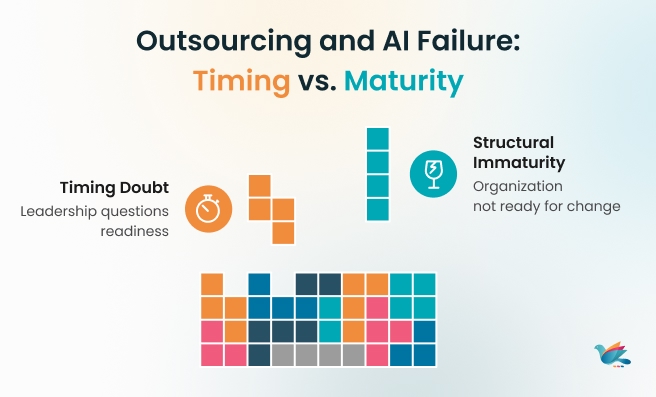
In reality, outsourcing and AI rarely fail because of timing alone. They fail because of system readiness.
When It’s Too Early — Leverage Is Compensating for Ambiguity
It is too early to introduce outsourcing, or AI is introduced to fix foundational instability rather than to scale clarity.
In these situations:
- Roles and decision rights are still shifting
- Processes live in conversations instead of documentation
- Metrics are debated rather than consistently measured
- Delivery depends on individual effort rather than repeatable systems
In this environment, outsourcing increases coordination load, and AI accelerates noise instead of outcomes.
When It’s Too Late — Operational Strain Has Become Normal
It is too late when execution friction is already embedded into daily operations and leadership attention is absorbed by coordination.
You’ll recognize it when:
- Leadership spends more time resolving delivery breakdowns than shaping strategy
- Bottlenecks repeat across teams
- Growth depends on informal escalation rather than structured workflows
- Output increases, but predictability does not
At this stage, leverage is necessary — but without structural correction, it becomes an expensive patch.
Why Revenue Milestones Don’t Determine Readiness — Maturity Does
Timing decisions anchored to revenue or headcount often mislead. Readiness is not about size. It is about discipline.
Indicators of operational maturity include:
- Clear ownership across functions
- Defined workflows that do not change weekly
- Measurable outcomes tied to accountable roles
- Data consistency across systems
Without these, additional leverage compounds instability.
The Real Question — Is the System Ready to Convert Leverage into Outcomes?
The more useful framing is not whether the investment is early or late, but whether the operating structure can absorb acceleration. Outsourcing and AI function as multipliers; they do not create discipline, they amplify whatever discipline already exists. If ownership is clear, workflows are defined, and accountability is measurable, leverage compounds performance in a predictable way.
If the system is fragmented, however, leverage compounds friction, increasing coordination cost and operational strain. That distinction — structural readiness versus structural ambiguity — ultimately determines whether timing becomes strategic or regrettable.
The question isn’t whether you moved too early or too late. It’s whether the system was ready to scale what you introduced. Without structural maturity, leverage magnifies instability; with it, timing becomes a strategic advantage.
4.Is Outsourcing and AI Cost-Effective for Scaling Brands?
Once outcomes are questioned, cost becomes the natural next objection.
When ROI feels unclear, financial scrutiny intensifies. Leaders begin asking whether outsourcing contracts, AI subscriptions, implementation costs, and oversight layers are truly generating economic leverage — or simply shifting expenses into new categories.
The answer is rarely binary.
Outsourcing and AI are not inherently cost-saving or cost-inflating. Their financial impact depends on how they interact with the operating system beneath them.
To understand this properly, it helps to separate perceived savings from actual cost dynamics.
Cost Perception vs Cost Reality
| Perceived financial benefit | What is expected | What often happens | What determines true cost efficiency |
| Lower payroll expense | Headcount reduction | Quick wins justify scaling | Workflow clarity and ownership |
| Lower payroll expense | Headcount reduction | Bottlenecks shift, not disappear | End-to-end process alignment |
| Reduced operational overhead | Automation replaces manual work | Validation and governance layers expand | End-to-end process alignment |
| Predictable budgeting | Fixed vendor contracts | Scope creep increases cost | Governance discipline |
| Immediate ROI | Quick wins justify scaling | Integration costs dilute returns | Long-term system integration |
The pattern is consistent: cost does not disappear — it moves.
When systems are structured, outsourcing and AI compress inefficiency. When systems are fragmented, they introduce coordination cost that offsets savings.
The Real Cost Structure — Where Efficiency Compounds or Erodes
Financial impact is often misunderstood because direct costs are visible, while indirect costs quietly accumulate. Vendor contracts and AI tools may appear efficient on paper, but the surrounding operational load determines the real outcome.
Indirect costs typically include:
- Vendor management and governance time
- Tool integration complexity
- Internal adoption and training cycles
- Decision delays caused by fragmented systems
Outsourcing and AI become cost-effective when applied to a clearly defined constraint within a structured system — where workflows are standardized, accountability is explicit, and integration is deliberate.
They become expensive when layered onto unclear ownership, fragmented processes, or weak orchestration — where oversight grows faster than output.
The real cost question is not: “Is outsourcing or AI expensive?” It is: “Does our system convert leverage into measurable efficiency?” If the answer is yes, cost compresses over time. If the answer is no, the cost compounds.
That distinction determines whether outsourcing and AI become strategic investments — or recurring line items without structural return.
5. When Is It Too Early (or Too Late) to Invest in Outsourcing or AI?
It is too early when outsourcing or AI is introduced into an environment that is still defining its fundamentals. If ownership shifts frequently, processes change week to week, and performance metrics lack consistency, external leverage will not create clarity. It will amplify instability.
In these conditions, coordination increases, oversight expands, and acceleration multiplies ambiguity rather than performance. The organization is still forming its operating system — and leverage applied too soon exposes its fragility.
When It’s Too Late — Friction Has Become Embedded
It is too late when execution strain has quietly become normal. Leadership time is absorbed by resolving delivery gaps instead of setting direction. Bottlenecks repeat across functions. Growth depends on escalation rather than structured workflows.
At this stage, outsourcing or AI is not premature — it is overdue. However, if introduced without operational redesign, it becomes a tactical relief mechanism rather than a structural advantage. The pressure reduces temporarily, but the constraint remains.
Why Size and Revenue Don’t Define Readiness
Many organizations assume readiness is tied to scale: a certain revenue milestone, team size, or funding stage. In reality, readiness is determined by discipline, not size. Smaller teams with clear ownership and structured workflows can scale and leverage effectively. Larger teams without defined accountability struggle despite greater resources.
The relevant signal is not growth velocity. It is operational coherence.
Timing is rarely the real issue. Structural readiness is. Outsourcing and AI succeed not when growth demands it — but when the system can sustain it.
6.How Do You Know If Your Organization Is Ready for Outsourcing or AI?
Readiness is rarely about budget, enthusiasm, or urgency. It is about whether your organization can convert leverage into controlled outcomes. Most teams believe they are ready because growth pressure exists. But pressure is not preparedness. In fact, pressure often masks structural fragility.
The real test of readiness is not “Do we need this?”
It is “Can we operationalize this without destabilizing performance?”
There are four structural signals that separate organizations that scale leverage effectively from those that compound friction.
You Have Identified the Exact Constraint
Outsourcing and AI should be applied to a clearly defined bottleneck — not to a vague ambition.
If the problem is “We need to move faster,” that is not a constraint.
If the problem is “Campaign QA cycles are causing a 9-day delay in client reporting,” that is. Readiness begins when the constraint is measurable and specific. Without that, leverage disperses. Effort increases. Impact becomes difficult to attribute.
Your Workflows Are Stable Under Pressure
If processes shift weekly, if responsibilities change mid-cycle, if documentation trails execution — leverage will amplify that instability.
Organizations ready for outsourcing or AI exhibit process durability. Their workflows do not depend on who is present. They are repeatable under load. If removing one senior operator disrupts execution, readiness is partial. Leverage requires structural continuity.
Decision Rights Are Explicit
Outsourcing and AI both accelerate information flow. But acceleration without clear decision authority creates gridlock.
When insights arrive faster than decisions can be made, friction increases.
Organizations ready for leverage have:
- Defined escalation paths
- Clear ownership of outcomes
- Agreed decision thresholds
Without these, tools generate insight that stalls in approval cycles.
Metrics Are Tracked, Not Debated
If leadership meetings revolve around interpreting inconsistent numbers, adding AI will not solve that ambiguity. It will multiply it.
Readiness requires metric stability:
- Shared definitions
- Reliable data sources
- Accountability tied to outcomes
If performance cannot be measured consistently today, leverage will not fix it tomorrow.
The Difference Between Needing and Being Ready
Many organizations need outsourcing or AI, but needing leverage does not automatically mean being prepared for it. When growth feels chaotic, the impulse to introduce external support or automation is often a reaction to structural strain rather than a sign of readiness. True readiness means the organization can absorb acceleration without losing coherence — that workflows are stable, ownership is clear, and decision-making is disciplined.
Outsourcing and AI are not growth strategies in themselves; they are amplifiers. In a structured system, they amplify precision and predictability. In a fragile one, they amplify friction and instability. That distinction ultimately determines whether adoption strengthens scale or exposes its weaknesses.
7. Where Does Performance Break Down After Outsourcing or AI Is Implemented?
When performance stalls after outsourcing or AI is introduced, the instinct is to question the capability itself. Was the vendor insufficient? Was the model inaccurate? Was the tool overhyped? In reality, performance rarely collapses at the capability layer. It deteriorates at the integration layer. The tool functions. The partner executes. Yet outcomes plateau. That plateau is not a technical failure — it is a structural one.
Breakdown Point #1: Strategy Does Not Translate Cleanly Into Execution
Outsourcing and AI both increase execution velocity, but velocity without translation leads to drift. Strategic intent must be converted into operational clarity — defined outcomes, scoped deliverables, decision thresholds, and measurable checkpoints. When that translation layer is weak, external partners operate on partial context and AI systems optimize for proxies rather than real business objectives. Activity increases, but alignment weakens. Over time, this gap between intent and execution becomes the primary source of underperformance.
Breakdown Point #2: Workflows Are Layered, Not Redesigned
Many organizations introduce outsourcing or AI as an addition rather than as a redesign. Existing workflows remain intact, and leverage is layered on top. This creates overlapping review cycles, redundant communication channels, and extended approval paths. Instead of compressing effort, the system becomes heavier. Performance degradation in these cases is not caused by poor execution — it is caused by process duplication. Without workflow redesign, acceleration compounds inefficiency rather than eliminating it.
Breakdown Point #3: Ownership Becomes Diffused
Clear accountability is often the first casualty after leverage is introduced. Internal teams assume vendors will clarify scope. Vendors assume leadership will refine priorities. AI tools generate insights, but no individual formally owns the decision that follows. As responsibility spreads across nodes, decision velocity slows. Momentum dissipates not because work is incomplete, but because ownership is ambiguous. Performance breaks when no one is explicitly accountable for converting output into outcomes.
Breakdown Point #4: Measurement Logic Remains Static
Outsourcing and AI alter performance dynamics. They change throughput, error rates, response times, and data availability. Yet many organizations continue measuring success through legacy indicators that were designed for manual systems. When measurement frameworks do not evolve alongside leverage, teams optimize for outdated signals. This creates a subtle but persistent misalignment between what is being improved and what is being evaluated. Over time, leadership perceives stagnation, even when localized gains exist.
Performance breakdown after implementation is rarely dramatic. It is incremental. Coordination time increases. Decision cycles elongate. Energy shifts from execution to interpretation. These are not signs that outsourcing or AI failed. They are signals that orchestration was never redesigned. Leverage exposes integration gaps. It does not create them. And until the system surrounding leverage is structured intentionally, performance gains remain inconsistent and fragile.
8.What Are the Strategic Risks of Relying on Outsourcing and AI?
As outsourcing and AI move from tactical support to core operating infrastructure, the conversation shifts from performance to exposure. At scale, the risk is not whether leverage works — it’s whether reliance is matched with structural control.
Structural Dependency and Capability Drift
Over time, increased reliance on vendors and automated systems can shift critical knowledge outside the organization. Internal capability narrows while external dependency deepens. If a key partner exits or an AI workflow fails, recovery becomes disruptive. Without centralized orchestration, distributed leverage can quietly turn into distributed fragility.
Control, Governance, and Brand Exposure
AI accelerates decisions. Outsourcing influences execution standards. Without explicit ownership, oversight frameworks, and governance maturity, authority becomes diffused while accountability remains internal. Data exposure, compliance risk, and inconsistent brand representation increase when leverage expands faster than supervision. Strategic risk emerges not from using outsourcing or AI — but from relying on them without strengthening structural control.
Strategic risk does not come from leverage itself — it comes from unmanaged reliance. As outsourcing and AI scale, governance and control must scale with them.
9. What Conditions Must Exist for Outsourcing and AI to Scale Successfully?
By this point, the pattern becomes clear. Outsourcing and AI do not underperform because they lack sophistication. They underperform when introduced into systems that are not designed to absorb leverage.
At scale, success is rarely about the tool itself. It is about the environment the tool operates within.
For outsourcing and AI to compound performance rather than create friction, several conditions must exist. The constraint must be clearly defined. Workflows must be stable enough to handle acceleration. Ownership must be explicit, so that every output converts into accountable action. Governance must evolve alongside dependency. And measurement must reflect the new operating reality — not legacy structures built for slower systems. When these foundations are present, leverage becomes predictable. Efficiency compresses. Coordination simplifies. Performance stabilizes under growth pressure.
When they are absent, outsourcing and AI do not fix instability — they reveal it.
Which brings us to the larger reflection.
Conclusion
Strategic Reflection for senior decision-makers
Outsourcing and AI do not fail scaling brands. They expose what scaling brands have not yet designed.
When growth accelerates, structural gaps that were manageable at a smaller stage become visible. Decision rights blur. Workflows strain. Coordination increases. Adding talent, vendors, or automation does not automatically resolve that pressure. It intensifies it.
The issue is not capability. It is coherence. AI increases velocity. Outsourcing increases capacity. But without an intentional operating structure — one that aligns execution, intelligence, and leadership — acceleration turns into instability.
This is where scaling brands reach a fork in the road.
One path continues adding tools and partners, hoping complexity stabilizes.
The other path redesigns how work flows, how decisions are made, and how accountability is enforced. The difference determines whether leverage compounds performance — or compounds friction.
ZealousWeb approaches this inflection point differently. The focus is not on supplying tasks or deploying isolated tools. It is on strengthening the operating system that connects delivery, intelligence, and leadership into a cohesive whole. Because scale does not reward volume. It rewards structural clarity.
Outsourcing and AI do not break growing brands.
They clarify which ones have built systems strong enough to sustain growth — and which ones have not. And that clarity, when used intentionally, becomes the beginning of predictable scale.
Are You Scaling Growth or Just Scaling Complexity
Get Clarity Before You Scale
FAQs
How is ZealousWeb different from a traditional outsourcing vendor?
Traditional outsourcing vendors execute assigned tasks. ZealousWeb operates as an Operating System Partner. That means engagement is not limited to delivery volume. The focus is on designing and stabilizing the execution environment itself — how delivery flows, how QA is structured, how white-label operations scale without fragmentation. The objective is predictable performance, not isolated output.
Are you primarily an AI implementation company or a systems partner?
AI implementation is one component of the broader Intelligence System. ZealousWeb does not position AI as a standalone solution. Instead, AI, data, and automation are embedded within structured workflows and governance models. The goal is not experimentation. It is measurable decision clarity and operational consistency.
How do you prevent dependency risk when acting as an external partner?
Dependency risk emerges when execution replaces internal clarity. The model here is different. Systems are designed with defined ownership, transparent processes, and documented workflows. The intention is to strengthen internal capability, not displace it. Oversight structures mature alongside scale, reducing fragility rather than increasing reliance.
What does “Execution System” actually mean in practice?
An Execution System refers to how work moves predictably from strategy to delivery. It includes defined roles, QA protocols, white-label scalability models, measurable checkpoints, and feedback loops. Without this layer, outsourcing becomes coordination-heavy. With it, execution becomes stable under growth pressure.
What is an “Intelligence System” beyond AI tools?
An Intelligence System integrates AI, analytics, and automation into decision workflows. It ensures data definitions are aligned, reporting is actionable, and insights translate into accountable actions. The emphasis is on decision clarity, not dashboard complexity.
How does leadership alignment factor into scaling?
Leadership Systems ensure decision rights, escalation paths, and value creation models are explicit. As organizations scale, ambiguity at the leadership level often creates downstream friction. System design at this layer ensures that leverage strengthens strategic clarity rather than diffuses authority.
When should a organization should consider an Operating System Partner?
Consider it when growth pressure is increasing but predictability is not. When coordination consumes leadership bandwidth. When tools are multiplying but clarity is not. The inflection point is rarely about headcount or revenue — it is about system strain.