

ZealousWeb
software delivery process framework

ZealousWeb’s Structured Delivery & QA Process Explained Through Systems

March 12, 2026Posted By: Jalpa Gajjar
DORA MetricsExecution SystemsQuality Assurance ProcessSoftware Delivery Process

Most delivery problems aren’t execution problems. They’re system problems.

Somewhere between the tools being adopted, the talent being hired, and the sprints being run, delivery still breaks. Timelines slip. Rework quietly consumes margins. Strong performers spend more energy firefighting than actually building.

It rarely announces itself as a crisis. It shows up as friction. A sprint that leaks time. A release that needs one more round of fixes. A stakeholder who keeps asking for updates because no one trusts the system of record.

The instinct is to add more — more oversight, more tooling, more process documentation. But the problem isn’t capacity. Its structure. Capability without an operating system doesn’t scale. It just creates more sophisticated chaos.

What makes delivery predictable isn’t the quality of the team or the sophistication of the stack. It’s whether there’s a system underneath — one that governs ownership, enforces readiness, embeds quality, and closes the feedback loop every single cycle.

That’s what this page is about. Not a list of services. Not a pitch. A transparent look at how ZealousWeb runs delivery — the intake gates, the QA checkpoints, the ownership model, and the loops that make outcomes repeatable at scale.

For organizations that have outgrown heroic execution and are ready for delivery that scales without chaos — this is where it starts.

What Our Delivery & QA Process Is Designed to Solve

Every organization that struggles with delivery thinks it has a unique problem. In practice, the same five failures show up — across industries, team sizes, and technology stacks. They’re not random. They’re structural. And they’re what ZealousWeb’s delivery and QA process was specifically built to eliminate.

Before diving into how the system works, it helps to name what it’s working against.

Problem Real-world Examples What Breaks
Unclear Ownership A feature ships with three people, assuming someone else is accountable for the final QA sign-off. No one catches a critical edge case until it’s live. Research from Geneca found that 75% of project participants lack confidence in project success, with unclear business objectives and out-of-sync stakeholders cited as primary causes. Decisions stall. Rework multiplies. Timelines erode. Leaders lose confidence in delivery.
Late-Stage Scope Drift A stakeholder requests a “small UI change” two days before release. It touches the payment flow. The sprint unravels. According to PMI’s Pulse of the Profession, 52% of all projects face scope creep — and the percentage has been rising, not falling. Change compounds into rework. Sprint integrity collapses. Teams lose trust in planning.
Dependency Blind Spots Development begins before the API documentation is confirmed. The team builds on assumptions. Two weeks in, the integration doesn’t match. Info-Tech Research Group found that 50% of rework is a direct result of requirements and dependency issues that were never properly tracked. Work gets rebuilt. Timelines slip quietly. No one flagged it because no one was tracking it.
Environment Mismatch A feature passes QA in staging but behaves differently in production due to configuration differences that no one standardized. This pattern contributed to the Denver International Airport’s baggage system failure — over 2,000 design and environment changes resulted in a nearly two-year delay and doubled the project budget. Release-day crisis. Emergency fixes. Confidence in the delivery process drops across the board.
Invisible Quality Risks Acceptance criteria were never defined at intake. QA tests what they assume was meant — not what was actually required. Wellingtone’s State of Project Management reports that 66% of organizations cite unclear requirements as a frequent cause of project delays. Defects surface late. Correction costs spike. The real problem wasn’t in QA — it was at the very beginning.


Every failure mode in this table has one thing in common — none of them are surprises. They are predictable, repeatable, and entirely preventable. The difference between organizations that scale delivery with confidence and those that stay stuck in firefighting isn’t talent, budget, or technology. It’s whether there’s a system underneath that catches these failures before they become costs.

The ZealousWeb Delivery Operating System (Execution OS in Action)

Most delivery frameworks describe what should happen. Very few govern what actually does. The difference between a process that looks good in documentation and one that holds under pressure is not methodology — it’s architecture. It’s whether the system has been deliberately designed to make good execution the path of least resistance.

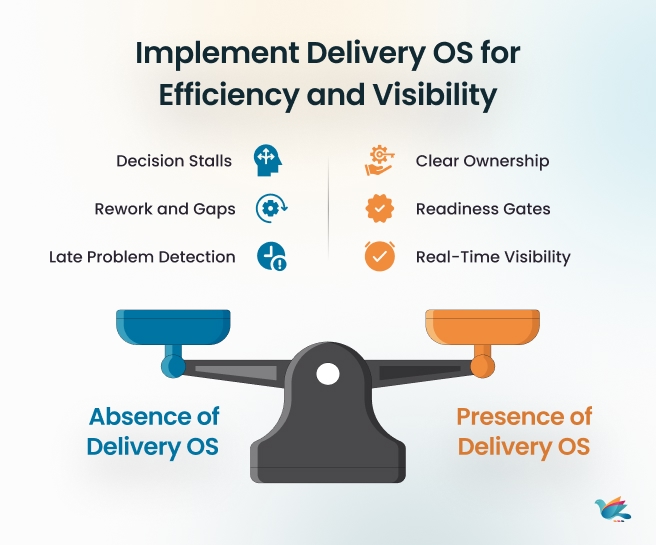
Our Delivery Operating System is built on three interlocking layers. Each layer addresses a distinct failure point. Together, they create an environment where predictable software delivery isn’t a goal — it’s a structural outcome.

Ownership Layer: One Accountable Owner Per Outcome

Shared ownership is the most common and most costly illusion in agile delivery. When two people own the same outcome, neither truly does. Our model is simple — one named owner per outcome, holding decision rights, quality accountability, and escalation authority. Not micromanagement. Structural clarity that makes everything else move faster.

Process Layer: Structured Workflows and Readiness Gates

A workflow without gates is just a wishlist. We introduce readiness governance at every transition — intake to sprint, development to QA, staging to release. Nothing moves forward until it meets a defined standard. Gaps are where rework is born. Our structured workflows close them before they become costs.

Metrics Layer: Delivery Health, Not Activity Metrics

Activity metrics measure busyness. Delivery health metrics measure whether the system is working. We track using DORA metrics — lead time, deployment frequency, change failure rate, and mean time to recovery. When these are visible, decisions sharpen, problems surface early, and the improvement loop actually closes.
efficiency and visibility

The Execution OS isn’t a methodology overlay. It’s delivery infrastructure that makes outcomes repeatable regardless of complexity or team size. The steps that follow show exactly how it operates in practice.

The ZealousWeb Structured Delivery & QA Process

A system is only as strong as the steps that run it. What follows isn’t a high-level methodology — it’s the exact sequence we follow on every engagement. Six steps. No gaps. No assumptions. Each one designed to eliminate a specific failure mode before it becomes a cost. Read through the table below to see how each step operates — what we do, why it matters, and what it structurally eliminates.

Step What We Do Why It Matters What It Eliminates
Step 1: Structured Intake & Definition of Done One intake document. Measurable acceptance criteria are defined upfront. Scope confirmed before sprint entry. Clarity at the start prevents chaos mid-sprint Vague requirements, mid-sprint confusion, subjective QA.
Step 2: Dependency Mapping & Readiness Governance Every dependency is mapped with a named owner and due date. Readiness gates enforced. Unready work doesn’t enter the sprint. Sprints don’t leak time on blocked or half-ready work. Silent timeline slippage, optimistic guessing, blocked tasks.
Step 3: Integrated QA from Day One QA entry and exit criteria are defined per sprint. Testing aligned directly to acceptance criteria. Risks flagged during planning, not release. Defects caught early cost a fraction of the defects caught late. Late-stage surprises, rework cycles, interpretation gaps.
Step 4: Change-Control & Trade-Off Discipline Late changes logged and triaged. Scope–time–quality trade-offs made explicit. Sprint integrity structurally protected. Every change has a documented decision — nothing is silently absorbed. Uncontrolled scope drift, hidden rework, unpredictable sprints.
Step 5: Environment Parity & Release Assurance Dev/stage/prod configurations standardized. Pre-flight checklist run before every release. Release governed, scheduled, and approved. What works in development works in production. No release-day surprises. Environment mismatch, last-minute fixes, and go-live crises.
Step 6: Delivery Metrics & Feedback Loops DORA metrics tracked — lead time, deployment frequency, change failure rate, recovery time. Weekly delivery review and retro cadence. Measurement turns delivery into a learning engine, not just execution. Invisible performance gaps, repeated failures, stagnant processes.


Six steps. One system. Built to make every engagement calmer, faster, and more predictable than the last.

Where AI Fits in Our Delivery & QA Process

AI is not the foundation of our delivery system — it’s a force multiplier on top of it. Introduced too early, without stable inputs and defined review standards, AI accelerates ambiguity rather than resolving it. Introduced at the right points, inside a structured process, it reduces friction, sharpens clarity, and speeds up the work that humans shouldn’t be doing manually. Here’s exactly where AI earns its place in our process:

Ambiguity Detection Before Sprint

  • AI reviews meeting notes, briefs, and requirement drafts before sprint planning begins
  • Flags missing acceptance criteria, undefined edge cases, and unstated assumptions
  • Surfaces gaps when fixing them is cheap — not after they’ve become QA defects

Notes → Structured User Stories

  • Raw discussions and meeting outputs are converted into structured user stories with defined acceptance criteria
  • Owners validate the output — AI drafts, humans decide
  • Faster planning cycles with fewer “what did you mean?” loops mid-sprint

AI as a Review Layer, Not a Replacement

  • AI assists at intake, planning, and review stages — it does not replace ownership or judgment
  • Every AI-generated output is reviewed against defined quality standards before it enters the workflow
  • The system governs AI — not the other way around

What Changes After Installing This System

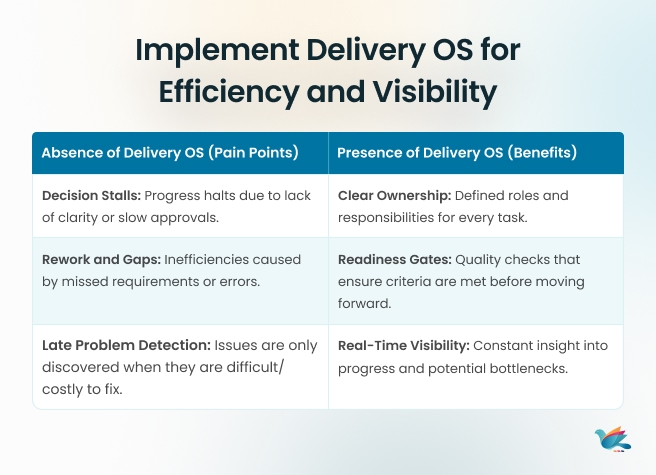
The impact of a well-installed Execution OS isn’t felt in one dramatic moment. It accumulates — sprint over sprint, release over release — until the way work gets done looks fundamentally different from where it started. These are the four shifts organizations consistently experience:

Reduced Rework

  • Defects stop recurring because the system removes the conditions that create them
  • Acceptance criteria defined at intake means QA tests against reality, not interpretation
  • Late-stage fixes drop significantly — not because teams work harder, but because the system stops generating avoidable failures

Lower Coordination Load

  • Status meetings are reduced because the system of record is trusted
  • Ownership clarity means fewer escalations and faster decisions
  • Leaders spend less time chasing updates and more time making forward-looking calls

Predictable Delivery Cycles

  • Sprint integrity holds because readiness gates and change-control are enforced
  • Timelines become commitments, not estimates with silent disclaimers
  • Stakeholder confidence in delivery increases — not because of better communication, but because of better execution

Calm, Scalable Execution

  • Growth stops triggering operational stress
  • New team members, new clients, and increased complexity are absorbed by the system — not by heroics
  • The organization scales its output without scaling its chaos

Most organizations don’t fail because they lack capability. They fail because capability without structure doesn’t compound. This is what changes when the system is in place.
efficiency and visibility

Who This Process Is Built For

Not every organization needs this level of delivery discipline — but some have already paid the price of not having it. This process was built for those who have outgrown heroic execution and need a system that scales with them, not against them.

Agencies Scaling White-Label Delivery

  • Agencies that are growing client portfolios but losing margin to rework and coordination overhead
  • Teams where delivery quality fluctuates based on who’s leading the project, not what system is running it
  • Organizations that need a white-label delivery partner that operates as an extension of their own standards — not a vendor that needs managing

Seed to Series B SaaS Teams

  • Product teams building under pressure where every sprint counts and technical debt is already accumulating
  • Founders who have strong developers but no structured delivery operating model underneath them
  • Organizations where speed is non-negotiable but quality and predictability can no longer be sacrificed to achieve it

Leaders Seeking System-Dependent Execution

  • CEOs and COOs who are tired of delivery outcomes depending on individual heroics
  • Decision-makers who want visibility into delivery health — not just status updates
  • Leaders who understand that sustainable growth requires repeatable execution, not just talented people

Conclusion

There’s a quiet moment every scaling organization eventually faces — when the sprints are running, the tools are live, the talent is in place, and delivery is still unpredictable. That moment isn’t a signal to add more. It’s a signal that the operating system underneath is missing. ZealousWeb exists for exactly that moment. We step in not as a vendor handing off deliverables, but as the architectural layer that makes everything already in motion finally work the way it was supposed to.

The execution infrastructure, the intelligence that turns data into decisions, the leadership clarity that replaces firefighting with forward momentum — this is what we design, install, and run. Because the goal was never just to deliver. It was always to build something that keeps delivering — long after the first sprint closes.

Is your delivery system built to scale — or built on heroics?

Start the Diagnostic Conversation

delivery system built to scale

FAQs

Related Blog Posts

GraphQL

GraphQL: The Data Fetching Saga

April 30, 2024
Data FetchingGraphQLWeb Development
HTTP/2 Based Push Notification In iOS

How To Implement HTTP/2 Based Push Notification In iOS?

December 06, 2022
HTTP/2 ProtocoliOS DevelopmentPush Notifications
Develop A Web Application

How To Develop A Progressive Web Application Using ReactJS? In-Depth Guide

July 21, 2022
Frontend TechniquesPWA DevelopmentReactJS Tutorials
Crafting Mobile User Experience

Crafting Exceptional Mobile User Experiences: A Comprehensive Guide

October 17, 2021
Mobile-Friendly WebsitePage Loading TimesWebsite Navigation
ZealousWeb

Maximizing WordPress: Diving Into Theme Customization vs. Plugin Development

August 04, 2020
Plugin DevelopmentTheme CustomizationWordPress
Unit Testing Vs. Functional Testing

Which Is Right For Your Needs: Unit Or Functional Testing?

June 11, 2020
Functional TestingSoftware TestingUnit Testing
Web Accessibility

Empowering Websites Through Web Accessibility Excellence

June 11, 2019
Accessibility StandardsWeb Accessibility
Professional Web Design Service

How Professional Web Design Service Can Elevate Your Business?

March 26, 2019
Brand IdentityResponsive DesignUser Experience (UX)
Custom Web Design Services

How Can Custom Web Design Services Define Your Brand?

March 12, 2019
Brand IdentityResponsive DesignUser Experience (UX)