
Quick Summary: What You’ll Learn
- AI Shopping Is Growing: AI-referred retail traffic surged 393% year over year in Q1 2026, creating new product discovery opportunities for e-commerce brands.
- SEO Alone Isn’t Enough: E-commerce AI SEO combines traditional SEO, AEO, and GEO to improve product visibility across ChatGPT, Gemini, and Perplexity.
- Product Data Matters: Optimized product pages, structured data, and accurate merchant feeds help AI search systems discover and understand products.
- Credibility Influences Discovery: Authentic reviews, independent product coverage, and consistent brand information strengthen product credibility.
AI-referred traffic to U.S. retail websites grew 393% year over year in Q1 2026, while AI-referred visitors converted 42% better than non-AI visitors in March, according to Adobe Digital Insights.
For agencies managing e-commerce clients, these numbers expose a gap worth investigating. Your client’s products may rank on Google, yet fail to appear when shoppers ask ChatGPT, Gemini, or Perplexity which products best fit their needs.
Traditional rankings alone cannot tell you whether a store is visible in these AI-generated recommendations.
E-commerce AI SEO gives agencies a way to address that gap. By combining search engine optimization (SEO), Answer Engine Optimization (AEO), and Generative Engine Optimization (GEO), agencies can strengthen product discoverability, information accuracy, and brand credibility across AI-powered shopping experiences.
What Is E-commerce AI SEO?
E-commerce AI SEO improves an online store’s visibility in AI-powered search and product recommendations. It combines technical SEO, structured product data, merchant feeds, useful product content, and credible third-party information to help AI systems discover and evaluate products.
For agencies, the practical starting point is to audit which client products appear in relevant shopping queries, fix discoverability and product-data gaps, and track AI referrals and recommendations alongside traditional SEO performance.
E-commerce AI SEO vs. Traditional SEO: What's Different?
Traditional e-commerce SEO helps your clients rank for product and category searches. E-commerce AI SEO extends that work by improving how AI-powered search systems discover, interpret, and recommend their products.
For agencies, the difference is not replacing keywords with prompts. It’s ensuring that product information answers specific buying questions and remains consistent across websites, merchant feeds, and external sources. As Google Search Central explains, established SEO fundamentals remain relevant to AI-powered search experiences.
| Comparison Factor | Traditional E-commerce SEO | E-commerce AI SEO |
| Visibility goals | Rank product and category pages in organic search results. | Appear in relevant AI-generated product recommendations and citations. |
| Content optimization | Target search intent, keywords, and useful product content. | Add detailed attributes, use cases, comparisons, and conversational answers. |
| Structured product data | Use Product schema and merchant feeds to support search and shopping visibility. | Strengthen product-data accuracy and accessibility for AI-powered discovery. |
| Performance measurement | Track rankings, organic traffic, CTR, and conversions. | Track AI mentions, citations, referral traffic, and conversions. |
The agency takeaway: A product ranking on page one is not necessarily recommended by ChatGPT. Agencies need to measure both search performance and AI product visibility to identify where their clients are missing potential buyers.
How Do LLMs Find and Recommend E-commerce Products?
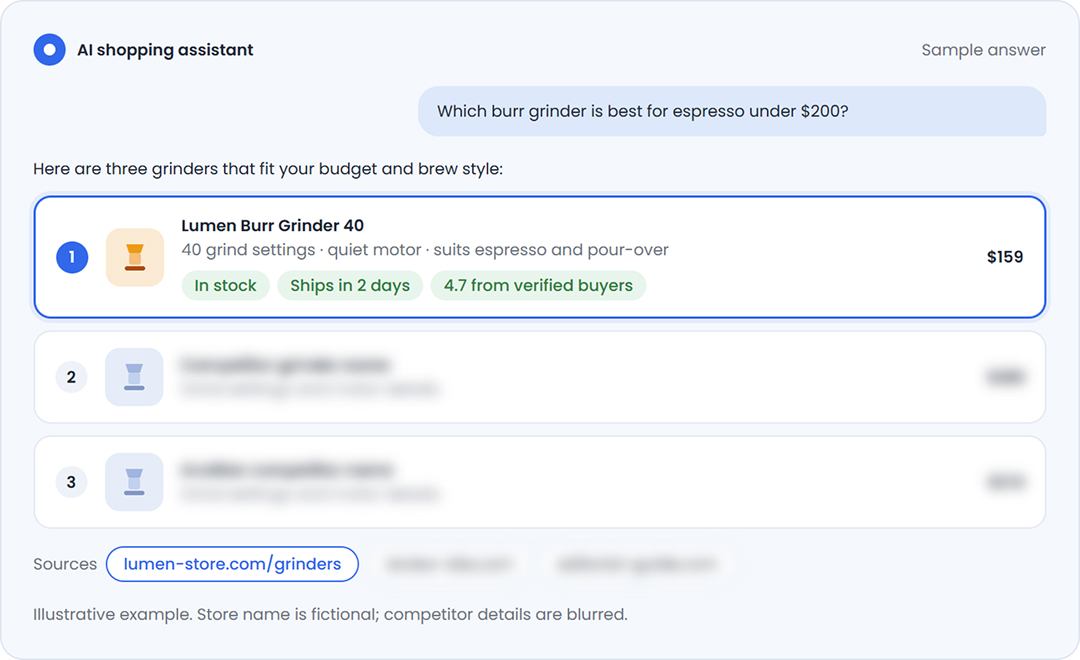
When a shopper asks ChatGPT, Gemini, or Perplexity, “Which running shoes are best for flat feet under $150?”, the AI system may retrieve product information from multiple sources before generating recommendations.
The discovery process generally involves three information sources:
- Search Indexes and Website Content: AI search systems can retrieve relevant, accessible web pages. Google confirms that its generative search features use content from Google’s search index.
- Merchant Feeds and Product Data: Structured catalogs provide product specifications, prices, images, and availability. OpenAI’s product feed documentation explains how approved merchant partners supply this information for ChatGPT shopping experiences.
- External Product Information: Independent reviews, product comparisons, and credible editorial coverage can provide additional context for evaluating products.
For agencies, the critical distinction is discoverability versus recommendation. Making a client’s products accessible to AI systems creates an opportunity to be considered, but inclusion depends on relevance, information quality, and each platform’s selection processes.
How to Optimize Your Clients' E-commerce Stores for AI Search
E-commerce AI SEO comes down to three execution priorities: product content that answers buying questions, structured data that accurately describes inventory, and independent sources that establish product credibility. For agencies, these priorities connect existing SEO work with Answer Engine Optimization (AEO) and Generative Engine Optimization (GEO), without requiring a separate strategy for every LLM.
Optimize Product and Category Pages for Conversational Queries
A product page optimized for “men’s running shoes” may capture keyword-driven searches. But a shopper asking ChatGPT, “Which running shoes suit flat feet and daily walking?” needs information about arch support, cushioning, fit, and intended use.
Agencies should review whether their clients’ product pages provide these answers rather than relying on manufacturer descriptions.
Focus on four improvements:
- Product descriptions: Explain materials, dimensions, compatibility, limitations, and practical benefits using specific attributes.
- Shopping intent: Address relevant questions about suitability, fit, use cases, and purchasing considerations.
- Comparison content: Include factual differences between product models, sizes, or configurations to support informed decisions.
- Category pages: Group products by meaningful buyer needs and connect visitors to relevant product pages.
Build these improvements around actual shopping queries from customer support conversations, onsite searches, and keyword research.
The objective is not to insert conversational keywords repeatedly. It’s to make buying information explicit, so both shoppers and search systems can understand when a product is relevant.
Strengthen Structured Data, Merchant Feeds, and Crawlability
Even well-written product pages can lose discovery opportunities when specifications are incomplete, prices conflict across sources, or crawlers cannot access important information.
Agencies should address three technical areas.
1. Validate Product and Offer schema.
Use Google’s Product structured data documentation to check product names, images, descriptions, prices, availability, and supported identifiers. Where applicable, add variant information, shipping details, and return policies.
Schema should accurately reflect visible product information. It supports search engines’ understanding of products but does not guarantee AI recommendations.
2. Maintain accurate merchant feeds.
Keep product catalogs synchronized with store inventory and pricing. Google recommends combining Product markup with Merchant Center feeds to improve eligibility across its shopping experiences.
For ChatGPT, OpenAI’s product feed specification details how merchants can supply structured product attributes, prices, availability, and images. Direct onboarding currently requires approval.
3. Check crawler access and rendering.
Review robots.txt, indexing directives, canonical URLs, internal product links, and JavaScript-rendered content.
OpenAI recommends allowing OAI-SearchBot to access pages intended for ChatGPT Search. For JavaScript-heavy stores, verify that essential product details appear in rendered HTML, following Google’s JavaScript SEO guidance.
Agency priority: Start with high-demand product categories and fix errors that affect multiple SKUs before optimizing individual pages.
Build Product Credibility Through Reviews and Third-Party Mentions
A store can describe its products accurately, but shoppers also want evidence that those claims hold up outside the brand’s website.
For agencies, that makes product credibility an important part of e-commerce GEO-not simply a link-building exercise.
Concentrate on three areas:
- Authentic reviews: Encourage genuine, verified customer feedback that addresses product quality, sizing, durability, and real-world use. Display relevant ratings and reviews accurately.
- Independent coverage: Pursue relevant product reviews, editorial comparisons, and digital PR opportunities with credible industry publications. Provide reviewers with verifiable specifications rather than promotional claims.
- Brand consistency: Audit product names, model numbers, specifications, and brand details across retailer listings, review platforms, and third-party catalogs.
For instance, if a client’s product is described as waterproof on its website but water-resistant across external listings, that inconsistency creates uncertainty for shoppers and systems retrieving product information.
The agency opportunity is to connect technical accuracy with external credibility. Strong product content explains what the product does; consistent independent information helps shoppers evaluate whether those claims deserve attention.
How Can Agencies Audit and Measure E-commerce AI Visibility?
A practical e-commerce AI visibility audit should measure 4 indicators: product recommendations, brand citations, referral traffic, and product-data accuracy. For agencies, the goal is to establish where clients appear in AI shopping results, identify missed opportunities, and demonstrate measurable improvements.
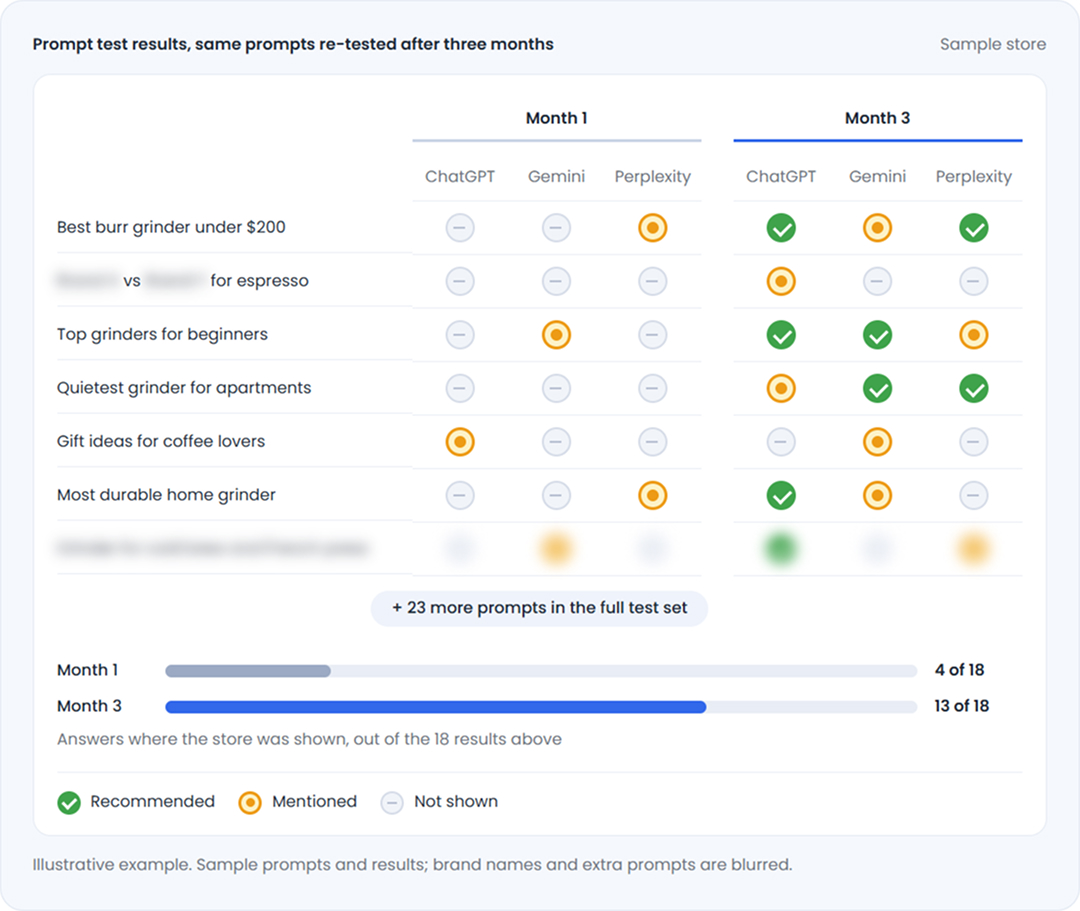
Start with 20-30 high-intent shopping prompts across ChatGPT, Gemini, and Perplexity. Include product comparisons, budget-specific queries, and category recommendations. Record results as an initial baseline, then repeat the same tests monthly.
| Audit Area | What Agencies Should Track |
| Product recommendations | Percentage of tested prompts featuring the client’s products |
| Brand citations | Brand mentions and linked products citation across AI responses |
| Referral performance | AI-referred sessions, product page visits, and conversions in GA4 |
| Product accuracy | Incorrect prices, availability, specifications and product links |
OpenAI confirms that ChatGPT Search referral URLs include utm_source=chatgpt.com, helping agencies identify attributable visits. For Google AI Overviews and AI Mode, Search Console’s Generative AI performance report provides dedicated impression and page visibility data.
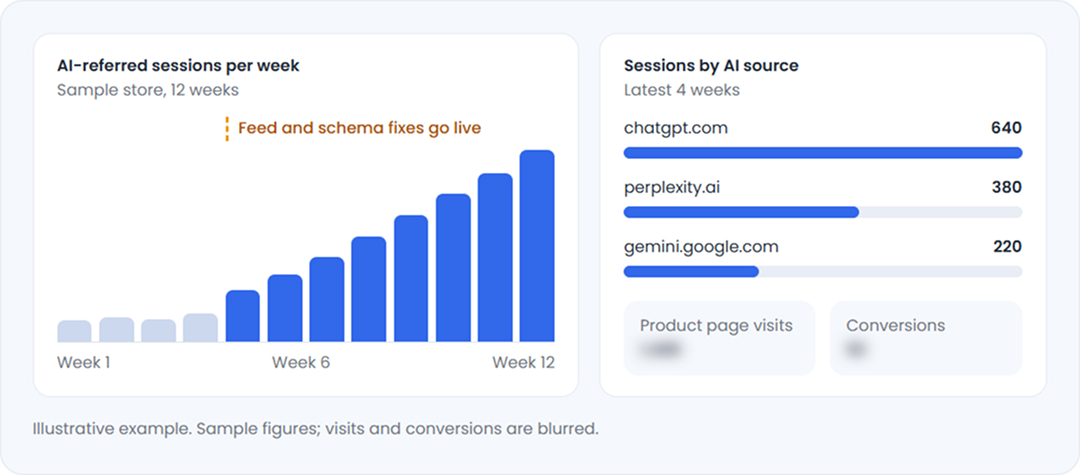
The agency takeaway: Report AI visibility alongside organic performance, but separate prompt-test findings from verified traffic and conversion data. This gives clients evidence of progress without promising guaranteed recommendations.
How Agencies Can Scale E-commerce AI SEO With the Right Expertise
Scaling e-commerce AI SEO across multiple clients requires 3 capabilities: standardized workflows, technical execution, and consistent performance reporting. The challenge isn’t selling another SEO service. It’s delivering AI search visibility improvements across different product catalogs, e-commerce platforms, and client expectations without overloading your team.
Agencies need a repeatable delivery model that includes:
- Standardized workflows: Prioritize high-value product categories, establish AEO and GEO audit checklists, and assign clear implementation responsibilities.
- Technical execution: Coordinate product content optimization, structured data, merchant feed maintenance, and crawlability fixes across Shopify, WooCommerce, and other platforms.
- Client reporting: Consolidate AI product mentions, citation tracking, referral traffic, and conversion data into actionable monthly reports.
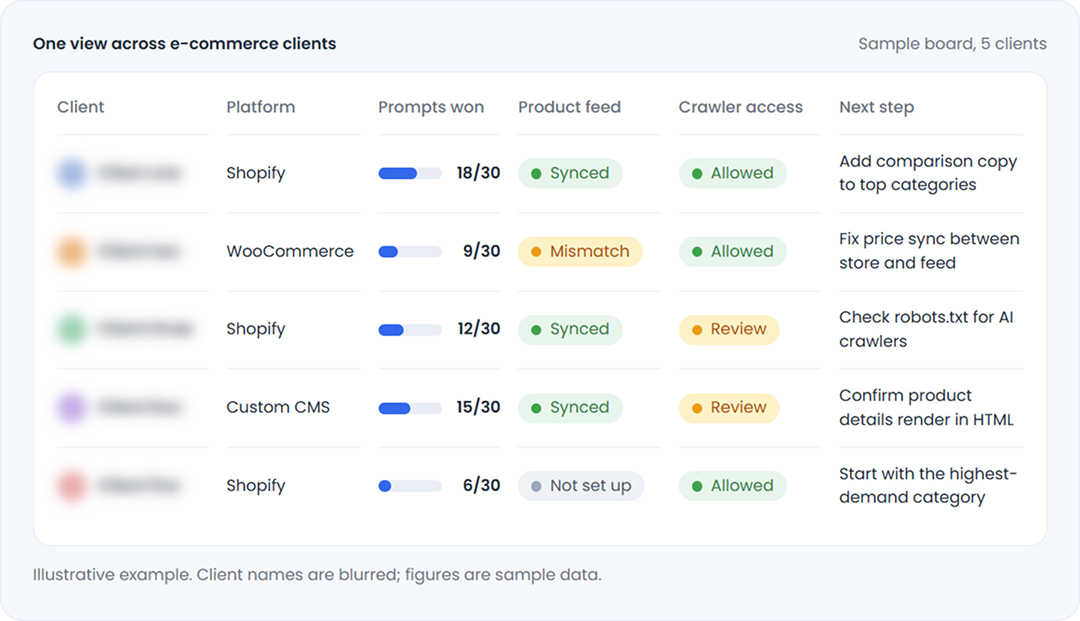
Building these capabilities internally demands specialized resources and ongoing coordination.
ZealousWeb helps agencies bridge that execution gap through e-commerce SEO, AEO, and GEO expertise. By supporting technical implementation, content optimization, and AI visibility initiatives, ZealousWeb enables agency teams to expand their service offerings while retaining ownership of client relationships and avoiding unnecessary internal hiring.
Conclusion
E-commerce SEO is no longer just about where your clients rank. It’s also about whether their products are discoverable when shoppers turn to AI for purchasing decisions.
For agencies, integrating AEO and GEO into existing SEO services creates an opportunity to address emerging visibility gaps, strengthen client offerings, and demonstrate value beyond traditional rankings.
ZealousWeb helps agencies extend their e-commerce SEO capabilities with technical optimization, AI-ready content, and GEO expertise-without the burden of building additional in-house teams.
Grow Your E-commerce Revenue with AI-Powered Marketing
Talk to a Growth Expert

FAQs
How to Increase AI Visibility in SEO?
Combine SEO, AEO, and GEO to improve product discoverability. ZealousWeb recommends optimizing product content, structured data, crawlability, and third-party credibility to strengthen AI search visibility.
How Do I Optimize Product Pages for AI Search?
Include detailed specifications, product comparisons, buyer-focused FAQs, and relevant use cases. Add accurate Product schema and internal links to help AI systems discover and interpret product information.
How Does Schema Markup Help AI Understand Product Availability and Price?
Product and Offer schema provides machine-readable details about pricing, availability, and product attributes. It supports search engine understanding but doesn't guarantee AI recommendations.
Should I Block Crawlers Like GPTBot in My Website's robots.txt File?
OpenAI distinguishes GPTBot, used for potential model training, from OAI-SearchBot, used for ChatGPT Search. Allow OAI-SearchBot for search discoverability while managing GPTBot according to your data policies.
How Do I Get My Brand Mentioned in Google AI Overviews or AI Chat Responses?
Improve brand discoverability through authoritative product content, accurate merchant feeds, and credible third-party mentions. ZealousWeb's AEO and GEO approach prioritizes relevance and credibility over guaranteed AI citations.
Does E-commerce AI SEO Replace Traditional SEO or Google Shopping Ads?
E-commerce AI SEO complements both. Traditional SEO supports organic rankings, Shopping ads drive paid product exposure, and AEO/GEO strengthen visibility across AI-powered search experiences.
Which AI Tool Is Best for E-commerce?
The best tool depends on your objectives. ChatGPT supports content research, Semrush assists with SEO analysis, and GA4 tracks traffic and conversions. ZealousWeb recommends combining tools based on client requirements.
How Long Does It Take to See Results From E-commerce AI SEO?
Results vary by site health, competition, and technical readiness. ZealousWeb recommends monthly monitoring of AI mentions, product recommendations, referral traffic, and conversions rather than relying on fixed timelines.