

WordPress personalization has evolved to give developers unprecedented control and flexibility in delivering tailored experiences. Early tools like LogicHop and If-So introduced dynamic content capabilities, but modern projects demand seamless integration with existing workflows and developer-friendly solutions.
AI Content Personalizer for WP meets this need by embedding advanced personalization directly into WordPress, allowing developers to implement field-level personalization with precision and create highly targeted, conversion-ready funnels without adding complexity or disrupting site performance. By streamlining setup and automating lead scoring, AI Content Personalizer for WP turns configuration into actionable insights in minutes, ensuring teams can move quickly from implementation to measurable results.
Speed to Value: The 10-Minute Lead Engine
A personalization tool that takes days to configure is already working against its own promise. The entire value of visitor intelligence is timing — catching high-intent behavior early enough to act on it. A slow setup doesn’t just delay the tool. It delays every insight the tool was supposed to surface.
The Competitor Pain: Hours Spent Configuring Logic Blocks or Shortcode Nests
Many traditional personalization platforms require significant setup before they begin delivering actionable insights. Agencies often need to configure complex logic structures and layered targeting rules, which slows down implementation and delays when teams can start identifying meaningful visitor behavior.
- Time-consuming logic block configuration
- Nested shortcode structures that require careful setup
- Multiple targeting rules before insights become usable
The AI Content Personalizer for WP Edge: Install, Configure, and Identify Hot Leads in Minutes
AI Content Personalizer for WP simplifies this process with an intuitive interface designed for rapid deployment. Agencies can move from installation to actionable insights in a matter of minutes without navigating complex rule builders or integration layers.
- Install the plugin quickly without a complicated setup
- Define a lead scoring rule in a few simple steps
- Instantly begin identifying high-intent “Hot Leads.”
Agency Benefit: More Strategic Work, Less Time Spent on Setup
By reducing configuration overhead, AI Content Personalizer for WP allows agencies to focus on the work that creates real client value. Instead of spending hours on setup tasks, teams can dedicate more time to analysis, optimization, and strategic improvements.
- Reduced technical setup time
- Faster access to lead intelligence
- Greater focus on strategy and conversion optimization
AI Content Personalizer for WP enables agencies to move from installation to actionable lead intelligence much faster. The result is a more efficient workflow where teams spend less time configuring tools and more time delivering strategic value through better lead identification and conversion optimization.
Zero-Glue Integration: Your Forms, No Zapier Required
Every hour your agency spends wiring form submissions to visitor profiles through Zapier or custom webhooks is an hour you’re not billing for strategy. Most personalization tools treat integration as an afterthought — leaving agencies to build and maintain fragile bridges between form data and visitor intelligence. AI Content Personalizer for WP eliminates that with native, out-of-the-box form mapping that lives completely inside WordPress.
How AI Content Personalizer for WP Outperforms Legacy Tools
Not all personalization solutions are created equal. Legacy tools often leave agencies bogged down in setup, integration headaches, and delayed insights. AI Content Personalizer for WP flips the script, streamlining workflows so your team can focus on strategy and results.
Legacy Tools
- Zapier / Glue Code Required – Expensive, fragile, and high-maintenance
- Form Support – Limited; only custom hooks
- Setup Time – Hours or even days to get running
- Lead Tracking – Partial, delayed insights
- Integration Reliability – Prone to errors and constant troubleshooting
AI Content Personalizer for WP
- Zero-Glue Setup – Built-in, seamless, no extra apps
- Form Support – Fully compatible with Gravity Forms, Ninja Forms, and CF7
- Setup Time – Just minutes; instant deployment
- Lead Tracking – Real-time visibility into hot leads
- Integration Reliability – Stable, low-maintenance, ready to scale
Server-Side Smarts: Personalization Without Compromise
AI Content Personalizer for WP moves all personalization logic to the server using dedicated native activity tables. This approach eliminates front-end bloat, keeps pages fast, and ensures 1-to-1 personalization runs without compromise.
Key Advantages of AI Content Personalizer for WP’s Server-Side Architecture:
- Full 1-to-1 Personalization – Deliver dynamic content without slowing down the page.
- Zero Front-End Impact – All logic runs server-side; no extra JS for visitors.
- Preserve Core Web Vitals – Maintain fast load times, interactive speed, and smooth experience.
- 90+ Lighthouse Scores – Performance, SEO, and Best Practices remain top-notch.
- SEO-Friendly – Server-side processing avoids negative effects on rankings.
- Reliable and Scalable – No client-side dependencies; works seamlessly under heavy traffic.
- Actionable Insights in Real Time – Visitor behavior is captured and processed instantly.
From Interaction to Instant Insight
Personalization works best when it operates quietly in the background without slowing the site down or complicating the experience. Instead of relying on front-end scripts or fragmented tracking systems, AI Content Personalizer for WP processes behavioral signals server-side and turns visitor interactions into actionable intelligence instantly. The workflow below shows how a single interaction moves through the system and becomes personalized content in real time. 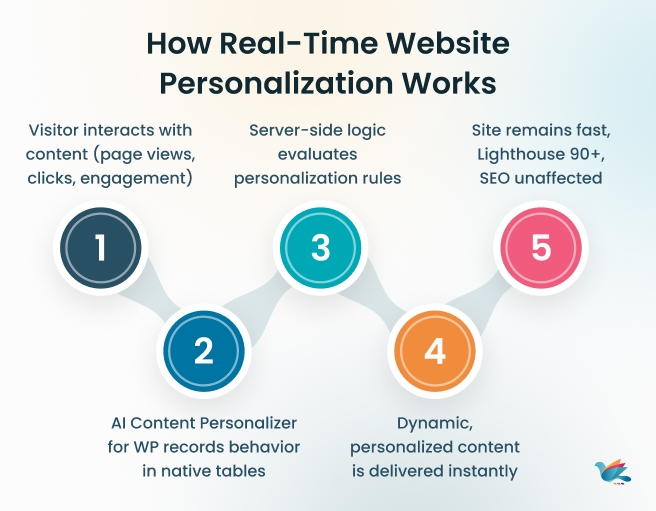
This workflow ensures agencies deliver personalization in real-time while keeping pages light, fast, and reliable.
By removing integration friction, agencies reclaim hours previously lost to setup and redirect them toward high-value, strategic work. Less glue code means more margin, faster deployment, and a workflow your clients will rely on—making AI Content Personalizer for WP the clear choice for efficient, scalable WordPress personalization. Agencies now focus on strategy, optimization, and measurable outcomes, while the tool handles the mechanics seamlessly.
Performance & SEO: Native Tables vs. JavaScript Bloat
Many personalization tools rely heavily on front-end JavaScript to track user behavior and deliver tailored experiences. While this can sound sophisticated, it often comes with a steep cost: slower page loads, lower Core Web Vitals, and reduced SEO performance. Visitors feel the lag, and Lighthouse scores take a hit.
A more efficient approach uses server-side logic and dedicated native tables to store and process user activity. This keeps the front-end lightweight while enabling real-time, 1-to-1 personalization. The difference is clear:
| Aspect | Competitor Pain | Technical Edge | Client Benefit / Outcome |
| Data Handling | External scripts and generic storage that slow down sites. | Dedicated native table (wp_pwp_activity) stores activity efficiently. | Fast, scalable, and reliable data handling. |
| Processing | Heavy front-end JavaScript runs in the browser. | Logic executes entirely server-side. | Visitors experience no lag; pages remain fast. |
| Performance Impact | JS bloat hurts Core Web Vitals and Lighthouse scores. | Minimal front-end footprint; calculations offloaded to server. | Maintain 90+ Lighthouse scores while delivering smart personalization. |
| Personalization | Limited, slow, or inconsistent content delivery. | Real-time 1-to-1 personalization happens behind the scenes. | Seamless user experience without compromising speed. |
| SEO & Rankings | Slow page loads lower rankings. | Optimized server-side architecture keeps pages light. | Strong SEO performance and faster-loading pages. |
Advanced personalization can happen without slowing down your site. By keeping logic server-side and storing data efficiently, sites remain fast, responsive, and SEO-friendly, all while delivering a highly tailored visitor experience.
The Privacy-First Advantage: GDPR-Compliant Personalization
Most personalization plugins are still operating like privacy regulations don’t exist — dropping heavy cookies, running hidden tracking scripts, and collecting behavioral data in ways that modern browsers are increasingly built to block. For agencies, that’s not just a technical liability. It’s a trust liability. And when a client’s site triggers a GDPR complaint or gets flagged by a privacy-conscious user, it’s your name attached to the build.
The agencies pulling ahead aren’t just avoiding that risk — they’re leading with privacy as a selling point.
How Legacy Tracking Quietly Works Against You
Hidden scripts and cookie-heavy personalization create three problems agencies rarely anticipate until it’s too late. Browsers block invasive tracking before it fires, breaking the personalization logic entirely. Page load times take the hit, dragging Core Web Vitals down with them. And visitors — increasingly aware of how their data is being used — notice when something feels off. That feeling erodes trust faster than any bounce rate metric will show you.
| Feature | Legacy Plugins | Privacy Advantage (AI Content Personalizer for WP) |
| Tracking Transparency | Happens without visitor awareness. | Full transparency via a clean frontend toggle. |
| Conditional Transparency | No visibility; users never know why content appears. | Visitors see why content is shown in plain language, building trust. |
| Compliance & Risk | High GDPR/CCPA exposure; frequent browser blocks. | Fully compliant out of the box; server-side approach avoids blocks. |
| Agency Positioning | Trust erodes over time; agencies appear reactive/risk-prone. | Builds trust; positions agencies as privacy-forward and premium. |
The difference between legacy tracking methods and a privacy-first approach becomes clear when you compare how each handles transparency, compliance, and user trust.
Conditional Statement Transparency: Show Your Work, Win Their Trust
Here’s what makes AI Content Personalizer for WP’s approach genuinely different. When a returning visitor lands on a page and sees content tailored to their previous behavior — a case study relevant to the industry they browsed, a pricing callout matched to their engagement history — they can see exactly why that content is appearing.
A small, clean frontend toggle surfaces the logic behind the personalization in plain language. Not buried in a privacy policy. Not hidden in a cookie consent banner. Right there, in the moment, where the visitor can see it.
That single feature changes the entire dynamic. Personalization stops feeling like surveillance and starts feeling like attentiveness. Visitors engage more, question less, and trust the brand more — because the brand trusted them first. For agencies, it’s a feature where you can demonstrate live in a pitch meeting and watch the conversation shift from “how much does this cost” to “when can we start.”
The Cookieless Pitch: GDPR Compliance as a Sales Argument
AI Content Personalizer for WP’s behavioral tracking operates without heavy cookie dependencies — fully aligned with GDPR and CCPA requirements from day one. No retrofitting after launch, no consent banner workarounds, no grey areas your client’s legal team will flag six months into the retainer.
For agencies managing sites across European markets or regulated industries, this is the difference between a deployment you’re confident in and one you’re quietly monitoring. And for clients who’ve been burned by compliance issues before, it’s the first thing they’ll ask about — and the first thing you’ll be able to answer cleanly.
Privacy-first personalization isn’t a constraint on what your agency can deliver. It’s the foundation that makes everything you deliver defensible, trustworthy, and built to last. Lead with transparency, and you don’t just win the project — you become the agency your clients don’t want to replace.
Intelligence vs. Noise: The AI Data Prep Layer
Paying for AI that confidently gives you the wrong answer is worse than having no AI at all. Yet that’s exactly what happens when personalization plugins dump raw, unstructured visitor data directly into an API and call it “AI-powered.” The model receives noise, produces hallucinated lead classifications, and burns through tokens generating results that no sales team can act on. For agencies, that’s not just a technical failure — it’s a billable hour spent explaining to a client why their “AI insights” don’t match reality.
The problem was never the AI. It was always the data going in.
Why Raw Data Produces Unreliable Results
Most AI plugins treat data preparation as optional — pulling whatever signals are available, feeding them into an API call, and hoping the model makes sense of it. The result is expensive, inconsistent, and professionally embarrassing.
How AI Data Quality Impacts Results
Other “AI” Plugins
- Data Input – Raw, unstructured signals are sent directly to the AI with little or no preparation.
- Lead Classification – Outputs are inconsistent and often produce hallucinated or unreliable lead insights.
- Token Usage – High API consumption caused by sending unnecessary or redundant data.
- Confidence Score – No reliability indicator attached to lead classifications.
- Agency Reliability – Results vary widely, making reporting and client trust difficult.
- Cost Efficiency – Higher operational costs due to inefficient API usage and repeated calls.
AI Content Personalizer for WP - AI Data Preparation Layer
- Data Input – Behavioral signals are aggregated, normalized, and structured before reaching the AI.
- Lead Classification – Accurate, signal-weighted insights generated from structured behavioral inputs.
- Token Usage – Optimized API calls that send only meaningful data.
- Confidence Score – Every lead includes a reliability score indicating classification certainty.
- Agency Reliability – Consistent and explainable outputs suitable for client reporting.
- Cost Efficiency – Lean processing that keeps intelligence generation margin-friendly.
When an AI model receives unweighted, unstructured data, it has no way to distinguish a visitor who spent 45 seconds on a blog post from one who spent 12 minutes across a pricing page, a case study, and a contact form. To the raw API call, they look identical. To your client’s sales team, they couldn’t be more different.
The AI Data Preparation Layer: Clean Signals In, Confident Results Out
AI Content Personalizer for WP’s AI Data Preparation Layer solves this at the source. Before any data reaches the AI, three core signals are aggregated, weighted, and normalized into a single structured input that the model can actually reason about.
Lead Score establishes the baseline — a composite number that already reflects the visitor’s cumulative behavioral value across every interaction on the site. Page Visits add context — not just which pages, but the sequence and pattern of engagement that reveals intent. Time on Page adds depth — because a visitor who spends eight minutes on a pricing page is communicating something that a two-second bounce never could.
Together, these three signals don’t just describe a visitor — they build a case. The AI receives a structured argument, not a data dump. And a model reasoning from structured, weighted evidence produces fundamentally different output than one guessing from noise.
Confidence Scores: The Deliverable Your Clients Will Pay For
The output of that preparation is a Confidence Score — a reliability rating attached to every lead classification that tells your client’s sales team not just who the hot leads are, but how certain that classification is. That’s not a dashboard metric. That’s a client-facing deliverable you can put in a monthly report, attach to a retainer justification, and use to demonstrate ROI in a renewal conversation.
The data preparation layer optimizes exactly what gets sent to the API, keeping token usage lean. No redundant calls, no bloated payloads, no “SaaS tax” inflating your cost per insight. The margin between what the intelligence costs to produce and what you charge to deliver it stays firmly in your agency’s favor.
Clean data doesn’t just improve AI output — it changes what your agency is capable of selling. When every lead comes with a Confidence Score backed by normalized behavioral signals, you stop presenting opinions and start presenting evidence. And evidence is what separates agencies that pitch and hope from agencies that report and retain.
Data Ownership: The Client’s Permanent Asset
Every month an agency uses a SaaS-bridged personalization tool, they’re building intelligence they don’t own. Behavioral histories, lead scores, visitor profiles, engagement patterns — all of it sits in a vendor’s cloud, accessible only as long as the subscription is active. The moment a client pauses their plan, questions the renewal, or simply wants to switch tools, that intelligence doesn’t transfer. It disappears. Months of accumulated insight, gone — not because the data stopped being valuable, but because nobody owned it.
That’s not a technical risk. That’s a structural problem with how most agencies are delivering value to their clients.
SaaS Dependency vs. Permanent Control
The difference between renting intelligence and owning it isn’t subtle — it shows up the moment something changes.
| Feature | SaaS-Bridged Plugins | AI Content Personalizer for WP |
| Data Storage | Vendor’s cloud (Third-party) | Client’s own WordPress database |
| Data Permanence | Temporary — disappears if payments stop | Permanent — client retains full ownership |
| Agency Dependency | High — tied to vendor availability | Low — agency manages freely |
| Portability | Limited — export often restricted | Full — CSV/PDF export anytime |
| Client Value | Short-term — knowledge vanishes | Long-term — builds a permanent asset |
With AI Content Personalizer for WP, every behavioral signal, lead score, and visitor profile is stored directly in the client’s own WordPress database. No vendor lock-in, no subscription dependency, no risk of waking up one morning to find six months of lead intelligence has been suspended pending a payment dispute.
The data belongs to the client. Which means it belongs to the relationship youragency built with them.
The Portability Win: Export as a Billable Deliverable
Permanent ownership only creates value if the data is accessible — and accessibility is where most tools fail, even when they claim to offer data portability. AI Content Personalizer for WP’s export functionality is unrestricted and immediate. High-scoring lead lists can be pulled as CSV or PDF at any point, without API dependencies, without vendor permissions, without waiting.
For agencies, that’s not just a convenience feature. It’s a reporting infrastructure. A monthly export of high-scoring leads — ranked by behavioral signals, filtered by source, timestamped with engagement history — is a client deliverable your team can produce in minutes and charge for every month. It transforms raw database activity into a concrete, tangible artifact that demonstrates value in a format every client understands: a list of people most likely to buy, ready for their sales team to act on.
That’s the shift your TOC is pointing at. You aren’t renting intelligence on behalf of your client — you’re building them a permanent, growing asset that compounds in value every month the relationship continues. Each new visitor scored, each form submitted, each pricing page visited adds another data point to an intelligence base your client owns outright and your agency curates professionally.
When a client asks why they still need your retainer six months in, that expert answers the question before you do.
Conclusion
Most agencies don’t struggle with personalization because it’s technically difficult. They struggle because workflows are fragmented — setups drag on, integrations break, and AI insights are noisy or inaccessible. Legacy tools force teams to manage complexity instead of focusing on strategy, leaving measurable value trapped in the workflow.
With ZealousWeb, that changes. We don’t just install a plugin. We implement a system built on ACF-driven precision, server-side performance, and a structured AI Data Preparation Layer. Every behavioral signal is captured, scored, and owned by your client — making every lead actionable and every page fast, privacy-compliant, and SEO-ready.
The difference isn’t just technical — it’s operational. Agencies move from firefighting setups to leading with insight, from fragmented reports to permanent, exportable intelligence, and from reactive work to proactive strategy.
Ready to Elevate Your WordPress Projects?
Start Your Journey Today!
FAQs
How Can Businesses Ensure They Are Hiring the Right Expertise for WordPress Personalization?
Choosing the right partner requires both technical capability and strategic understanding of personalization. ZealousWeb combines deep WordPress development expertise with behavioral engagement strategies to ensure personalization implementations deliver measurable business value.
How Can Businesses Control Costs When Implementing Website Personalization?
Costs can increase when personalization tools require complex integrations or extended development cycles. ZealousWeb focuses on streamlined WordPress implementations that minimize unnecessary configuration while delivering effective personalization capabilities aligned with business goals.
How Can Businesses Ensure Personalization Does Not Delay Website Project Timelines?
Project delays often occur when personalization solutions involve complicated setups or dependencies. ZealousWeb follows structured development workflows and efficient implementation frameworks to integrate personalization features without disrupting project timelines.
How Can Businesses Ensure Their Website Data Remains Secure During Personalization Implementation?
Security is critical when handling visitor behavior and engagement data. ZealousWeb implements personalization solutions within secure WordPress environments and follows established development practices to protect data integrity and maintain website reliability.
How Can Businesses Avoid Overly Complex Personalization Systems?
Many personalization tools introduce unnecessary complexity that makes long-term management difficult. ZealousWeb prioritizes streamlined WordPress-based solutions that integrate naturally with existing website structures, enabling businesses to benefit from personalization without operational challenges.