

Everyone wants AI visibility – until the budget conversation starts
AI search is changing how customers discover and contact businesses. Every company suddenly cares about showing up in AI answers.
Enterprises and agencies’ AEO and GEO investment typically covers five areas: AI visibility monitoring, answer-focused content, technical and entity optimisation, authority building, and performance measurement. Budgets increase as organisations move from initial visibility audits to recurring optimisation, enterprise monitoring, governance, and commercial attribution.
Early-stage organizations usually invest in audits, manual prompt tracking, selected content improvements, and basic schema implementation. More mature enterprises allocate recurring budgets to content operations, digital PR, entity authority, multi-platform visibility tracking, cross-functional delivery, and revenue attribution.
The most useful AEO and GEO benchmarks include visibility across priority prompts, citation frequency, competitor share of voice, AI referral traffic, assisted conversions, qualified leads, and pipeline influence.
This guide uses the AEO and GEO adoption curve to show how businesses and agencies’ priorities, capabilities, budgets, and success metrics change as AI search matures from experimentation into a measurable business channel.
If your rankings look fine but you have no idea what AI platforms are actually saying about you, that gap is the whole reason this guide exists.
AEO/GEO Has Moved Beyond the Experimental Budget
AEO and GEO are no longer sitting in the “let’s test a few prompts” corner of the marketing plan.
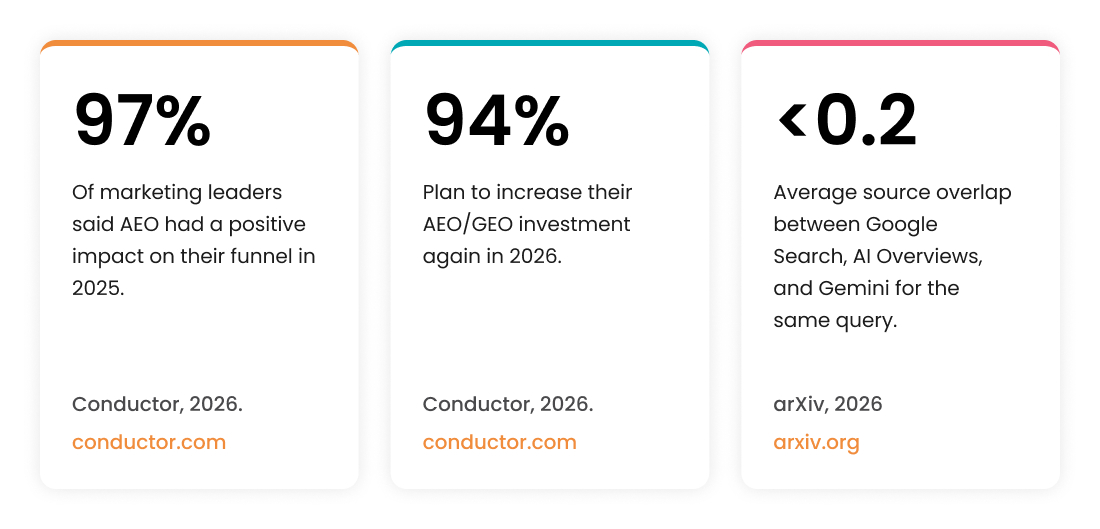
In a recent 2026 survey, 94% of participating digital leaders said they planned to increase AEO investment , while 97% reported a positive impact from their efforts in 2025. The direction is clear: AI-search visibility is moving from an isolated experiment into an established marketing priority.
But increased spending should not be mistaken for a mature strategy.
Real adoption means moving beyond occasional content tests and bringing SEO, content, analytics, technical optimisation and digital PR into one structured programme. It means defining ownership, setting benchmarks and understanding which activities actually improve brand mentions, citations and recommendations.
Buying another visibility platform may help expose the gaps. It will not close them.
What Is Driving the AEO/GEO Adoption Curve?
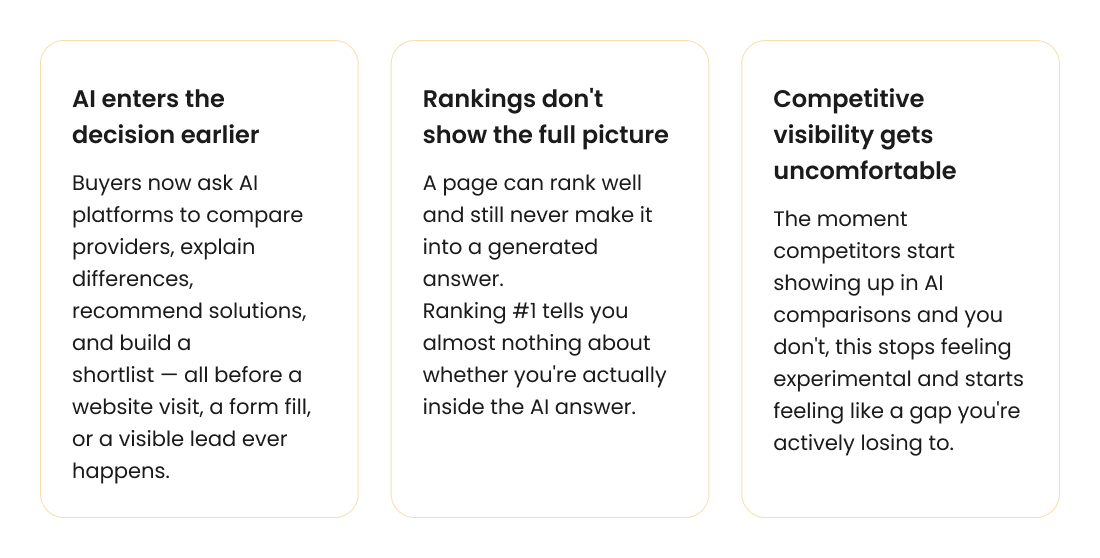
AEO and GEO adoption is accelerating because buyers now use AI platforms earlier in the decision-making process, often before they visit a website, review search results, or contact a company.
| Adoption Driver | Direct Impact |
| AI-led discovery | Buyers use AI platforms to identify brands, products, and service providers before visiting websites. |
| AI-generated comparisons | Brands are evaluated within AI responses based on relevance, authority, evidence, and citations. |
| Earlier vendor shortlisting | Organizations may be included in or excluded from consideration before a buyer reaches a search results page. |
| Reduced dependence on rankings | Strong organic rankings alone do not guarantee inclusion in AI-generated answers or recommendations. |
| Demand for measurable visibility | Businesses need to track AI mentions, citations, prompt coverage, referral traffic, leads, and pipeline influence. |
To improve AI visibility, organizations are investing in:
- Answer-focused content
- Entity and schema optimization
- AI visibility monitoring
- Digital PR and third-party citations
- Original research and expert insights
- Competitor and prompt tracking
- Lead and revenue attribution
That is why the next stage of AEO/GEO investment is less about adding a new budget line and more about reconsidering how existing marketing budgets work together.
Where AEO/GEO Investment Is Actually Going
Enterprises and agencies: AEO and GEO budgets are typically allocated across five core capabilities that answer queries like what does each budget area fund? How should each capability be measured?
| Investment area | What the budget funds | Primary benchmarks |
| AI visibility auditing | Tracking brand mentions, citations, competitor visibility, and performance across priority prompts | Prompt coverage and share of AI visibility |
| Technical readiness | Improving crawlability, structured data, entity signals, internal linking, and content accessibility | Indexation, schema coverage, and entity consistency |
| Answer-focused content | Creating clear, structured, evidence-backed content that AI platforms can extract and cite | Citation frequency and answer inclusion |
| Off-site authority | Building credible third-party mentions through digital PR, expert contributions, reviews, and original research | Quality and frequency of external citations |
| AI search measurement | Connecting AI visibility to referral traffic, assisted conversions, leads, pipeline, and revenue | Commercial influence and attribution |
AEO and GEO investment does not fund a single standalone service. It funds the combined capabilities required to help AI platforms find, understand, trust, cite, and recommend a brand.
Effective AEO/GEO budget allocation focuses on five core areas: AI auditing, technical readiness, answer-focused content, off-site authority, and performance measurement. While 51% of digital leaders use integrated platforms, success relies on data-driven content and technical optimization rather than specialized schema markup for AI Overviews.
But the platform is only the scoreboard. It does not play the game.
Its value depends on what happens next: turning visibility data into technical improvements, stronger content, clearer entity signals, and greater off-site authority. That is where AEO and GEO investment begins to improve visibility rather than simply report where it is missing.
The technical side is also less mysterious than some vendors make it sound. Google has stated that no special markup or additional schema is required to appear in AI Overviews or AI Mode. The same fundamentals still matter: indexable content, strong technical SEO, clear information, and genuinely useful answers.
So, anyone selling a proprietary “AI schema” is offering a solution to a requirement Google itself says does not exist.
How AEO GEO Budgets Are Being Structured
AEO/GEO budgets are usually split across pilot projects, ongoing retainers, platform costs, and internal team effort. The total investment depends on how much visibility must be tracked, improved, and maintained across AI search platforms.
Key Cost Factors in AI Visibility Maintenance
| Budget Category | What It Covers |
| Pilot Projects | Initial visibility audits, prompt tracking, competitor analysis, and selected content or technical improvements |
| Ongoing Services | Recurring content optimization, technical updates, digital PR, authority building, and performance reporting |
| Platform Costs | AI visibility monitoring, citation tracking, competitor benchmarking, and reporting tools |
| Internal Resources | Time from SEO, content, technical, PR, analytics, and leadership teams |
The total investment depends on the number of markets, platforms, prompts, competitors, and content assets being monitored and improved. Costs also increase when an organization requires ongoing execution, cross-functional coordination, multi-market reporting, or revenue attribution.
Before setting a budget, organizations should assess which capabilities already exist internally and which require new tools, specialist support, or additional team capacity.
So before asking, “How much does AEO/GEO cost?” ask a better question: Which parts of our current marketing system are ready to support it-and which ones will require investment first?
Why AEO GEO Pricing Varies So Widely
AEO and GEO pricing varies because the scope of work changes based on business size, market complexity, technical requirements, content needs, and measurement depth.
| Pricing Factors | How It Affects The Costs |
| Website size | Larger websites require more pages, templates, and technical elements to audit and optimize. |
| Number of products or services | Broader offerings create more topics, entities, buyer questions, and content requirements. |
| Target markets | Multiple locations, countries, or languages increase research, optimization, and reporting needs. |
| Competitive intensity | Highly competitive categories require deeper analysis, stronger authority signals, and more sustained execution. |
| Existing content quality | Weak, outdated, or unstructured content requires more rewriting and redevelopment. |
| Technical complexity | Crawlability issues, schema gaps, JavaScript rendering, and complex site architecture increase implementation effort. |
| Tracked prompts | Monitoring more commercial, informational, branded, and competitor prompts raises platform and analysis costs. |
| Monitored AI platforms | Tracking visibility across multiple AI search platforms expands reporting and optimization scope. |
| Content productions | New articles, landing pages, FAQs, comparisons, and original research increase delivery costs. |
| Digital PR and authority building | Third-party citations, expert placements, and brand mentions require additional outreach and resources. |
| Reporting expectations | Executive dashboards, attribution, multi-market reporting, and revenue analysis require more advanced measurement. |
These pillars explain why pricing can vary significantly between organizations. A single-location service business may only need a focused visibility audit, selected content improvements, and limited prompt tracking. A multi-market enterprise may require technical remediation, large-scale content optimization, multi-platform monitoring, digital PR, advanced reporting, and ongoing coordination across several teams.
Competitive intensity also affects the required investment. Brands operating in crowded markets typically need stronger evidence, more authoritative content, broader third-party visibility, and more consistent optimization to earn citations and recommendations within AI-generated responses.
Before estimating the budget, organizations and agencies should answer four practical questions:
- How many products, services, locations, or target markets need to be optimized for AI search?
- What is the current state of the website’s technical SEO, architecture, structured data, and content?
- Which AI platforms and prompt categories, including branded, competitor, commercial, and informational prompts, need to be tracked?
- Are the necessary content, technical, and digital PR capabilities available internally, or will external support be required?
The answers determine whether the budget needs to cover an initial audit, technical improvements, content redevelopment, recurring optimization, AI visibility monitoring, authority building, or a combination of these activities.
That is why a flat monthly price offered without first reviewing the business, website, markets, and measurement requirements is not a reliable estimate. The scope must be defined before the cost can be.
The Four Stages of AEO and GEO Implementation
Businesses typically implement AEO and GEO in four stages: awareness, visibility assessment, operational integration, and commercial accountability. Each stage reflects a higher level of investment, coordination, and measurement.
Stage 1: Awareness
At the awareness stage, businesses manually check a small number of AI-generated answers to see whether their brand, competitors, products, or services are mentioned.
The main goal is to identify whether an AI visibility gap exists.
Typical activities include:
- Testing branded and non-branded prompts
- Reviewing competitor mentions
- Checking whether existing content appears in AI-generated answers
- Identifying early visibility gaps
At this stage, AEO and GEO are usually exploratory and do not yet have a dedicated owner, budget, or reporting process.
Stage 2: Visibility Assessment
At the visibility assessment stage, businesses formally evaluate where and how they appear across AI search platforms.
The main goal is to establish a measurable visibility baseline.
Typical activities include:
- Mapping priority prompts and buyer questions
- Tracking brand mentions and citations
- Comparing visibility with competitors
- Reviewing content gaps
- Assessing technical SEO, schema markup, and entity signals
- Identifying pages that require optimization
Investment at this stage typically includes an AEO and GEO audit, initial monitoring tools, and selected content or technical improvements.
Stage 3: Operational Integration
At the operational integration stage, AEO and GEO become part of ongoing SEO, content, technical, digital PR, and reporting workflows.
The main goal is to improve AI search visibility consistently rather than through one-time optimization.
Typical activities include:
- Creating answer-focused content
- Updating existing pages for AI search visibility
- Strengthening entity and authority signals
- Improving structured data and technical accessibility
- Building third-party citations and brand mentions
- Monitoring priority prompts across AI platforms
- Coordinating SEO, content, PR, and development teams
Investment at this stage usually includes recurring optimization, content production, monitoring platforms, technical support, and authority-building activity.
Stage 4: Commercial Accountability
At the commercial accountability stage, businesses connect AEO and GEO performance with measurable business outcomes.
The main goal is to determine whether AI search visibility is influencing demand, qualified traffic, leads, pipeline, and revenue.
Typical measurements include:
- AI citations and brand mentions
- Share of visibility across priority prompts
- Referral traffic from AI platforms
- Branded search growth
- Assisted conversions
- Qualified leads
- Pipeline influence
- Revenue contribution
Investment at this stage may include enterprise monitoring, multi-market reporting, governance, attribution, and integration with CRM and analytics platforms.
Businesses do not need to reach the final stage immediately. The right next step depends on their current visibility, internal capabilities, available data, and commercial goals. Identifying the current implementation stage helps organizations invest in the right capabilities without overspending on tools or activities they are not yet ready to use.
The Benchmarks That Actually Matter
“We got a brand mention” is not a benchmark. It is a visibility signal-and a fairly shallow one on its own.
Meaningful AEO and GEO measurement should distinguish between citation selection and citation absorption
| Metric | Definition | Measurement Priority |
| Citation Selection | The page is listed as a source or linked within an AI-generated answer | Useful for measuring surface-level visibility |
| Citation Absorption | The page’s facts, language, evidence, or structure directly shape the generated answer. | Higher-value indicator of content influence |
The core distinction is simple: being cited does not necessarily mean your content influenced the answer.
Citation selection shows that an AI platform found and referenced the page. Citation absorption shows that the platform relied on information from that page to explain the topic, support a claim, present a comparison, or recommend a course of action.
Recent research formally separates these two outcomes and finds that citation breadth and citation depth do not always move together. A page may appear in the source list while contributing little to the answer itself. By contrast, highly absorbed pages tend to be semantically aligned with the query, clearly structured, and rich in extractable evidence such as:
- Direct definitions
- Original statistics and numerical facts
- Clear comparisons
- Sequential processes
- Specific examples
- Evidence-supported claims
The research also found that Q&A formatting alone did not improve citation absorption. That matters because making content look extractable is not the same as making it useful.
AI models do not prioritize a page simply because it contains conversational questions and short answers. They are more likely to use content that provides the factual material needed to construct a complete response.
The strategic goal should therefore move beyond collecting brand mentions or source links. Businesses should measure whether their content is being selected, absorbed, and used to shape the answer buyers actually read.
In practical terms, that means shifting AEO and GEO reporting toward three questions:
- Is the brand being included in relevant AI-generated answers?
- Is the website being cited as a supporting source?
- Are the brand’s facts, expertise, comparisons, or recommendations influencing the generated response?
Citation selection tells you that the content was found. Citation absorption tells you that the content mattered.
Why One-Off Prompt Checks Are Not Benchmarks
Typing one question into ChatGPT once and dropping the screenshot into a client deck is a vibe check. It is not research, no matter how confident the slide looks.
AI answers can change based on prompt wording, user context, geography, platform, model updates, retrieval timing, and source availability. In some cases, even two back-to-back runs of the same query can produce different citations, recommendations, and response structures.
A 2026 critical survey covering 45 GEO studies describes generative visibility as a stochastic and partially observable process spanning retrieval, citation, prominence, factual absorption, and user behavior. It also warns that broad optimization rules do not transfer reliably across every platform, model, or search scenario.
That volatility makes one-off screenshots unreliable as performance benchmarks. A credible AEO and GEO measurement system needs a defined prompt set, repeated observations, multi-platform tracking, competitor comparisons, consistent evaluation intervals, and manual validation of high-value results.
AI Visibility KPI Tracking Framework
| Benchmark Requirements | Tracking Metric | Validation Frequency |
| Defined Prompt Set | Number of priority commercial and informational queries being tracked | Monthly baseline review |
| Multi-Platform Tracking | Visibility share across ChatGPT, Perplexity, Gemini, and other priority AI platforms | Weekly automated tracking |
| Competitor Comparison | Share of voice within AI mentions, citations, and recommendations | Biweekly audit |
| Manual Validation | Accuracy and relevance of high-value business mentions and citations | Immediate review when material shifts occur |
The defined prompt set creates a stable basis for comparison. Rather than testing whichever query happens to come to mind, businesses should maintain a fixed registry of branded, non-branded, commercial, informational, and competitor-related prompts.
Those prompts should then be tested repeatedly across the major AI search platforms. This helps separate genuine visibility trends from isolated fluctuations caused by retrieval timing, model behavior, or temporary source changes.
Competitor comparison adds the necessary market context. A brand mention may appear positive in isolation, but it means less if several competitors are cited more frequently, appear more prominently, or shape a larger share of the final response.
Manual validation is equally important. Automated tools can identify mentions and citations, but they may not determine whether the information is accurate, commercially relevant, or actually influencing the answer. High-value business claims, product comparisons, recommendations, and factual statements should therefore be reviewed by a person.
Methodology Summary for Client Proposals
The volatility challenge: Single-prompt screenshots fail because AI search visibility operates within a constantly changing system. Results can shift based on geography, model updates, source availability, retrieval timing, and user context.
The multi-layered approach: Reliable measurement requires a fixed prompt registry, repeated testing intervals, multi-platform monitoring, and competitor benchmarking. This creates a more stable view of how visibility changes over time.
Actionable validation: Raw software exports should not be treated as the final answer. Important citations and business mentions must be manually reviewed to confirm that they are accurate, relevant, and meaningfully shaping the generated response.
The benchmark is not whether a brand appeared once. The benchmark is whether it appears consistently, across relevant prompts and platforms, with enough accuracy and prominence to influence buyer understanding and consideration.
What AEO and GEO Strategies Should Businesses Invest In?
Businesses should invest in AEO and GEO strategies that improve content extractability, brand authority, and measurable AI search visibility. The highest-value investments combine technical readiness, answer-focused content, entity optimization, digital PR, prompt tracking, and commercial measurement.
| Strategy | What It Improves | Why It Deserves Investment |
| AI Visibility Auditing | Identifies where the brand appears, which competitors are cited, and where visibility gaps exist | Prevents businesses from investing without a clear baseline |
| Answer-Focused Content | Makes definitions, statistics, comparisons, and processes easier for AI models to extract | Increases the likelihood that content shapes generated answers |
| Technical SEO and Structured Data | Improves crawlability, content relationships, entity clarity, and source accessibility | Helps AI systems understand and retrieve the right information |
| Entity and Brand Authority | Strengthens how consistently the business is associated with its services, expertise, and market category | Improves trust and relevance across AI-generated responses |
| Digital PR and Third-Party Citations | Builds independent references, mentions, expert commentary, and authoritative backlinks | Gives AI models external evidence that supports brand credibility |
| Multi-Platform Prompt Tracking | Measures visibility across priority commercial, informational, and competitor queries | Shows whether performance is improving consistently rather than appearing once |
| Competitor Share-of-Voice Analysis | Compares how often and how prominently competitors appear in AI responses | Provides market context for brand mentions and citations |
| Manual Citation Validation | Confirms whether mentions are accurate, relevant, and influencing the final answer | Prevents misleading conclusions from raw software reports |
| Commercial Attribution | Connects AI visibility with branded demand, qualified traffic, leads, pipeline, and revenue | Helps justify continued AEO and GEO investment |
1. Start With an AI Visibility Audit
An AEO and GEO investment should begin with a visibility audit, not immediate content production.
The audit should identify:
- Priority buyer prompts
- Current brand mentions and citations
- Competitor visibility
- Frequently cited sources
- Content and authority gaps
- Technical barriers
- High-value queries where the brand is absent
This creates a measurable baseline and shows where investment is most likely to improve visibility.
2. Fund Content That AI Models Can Use
Businesses should prioritize content that gives AI models clear, factual, and extractable information.
High-value content usually includes:
- Direct definitions
- Original data and statistics
- Product or service comparisons
- Step-by-step processes
- Industry benchmarks
- Expert commentary
- Case-study evidence
- Clear answers to commercial questions
Formatting content as a Q&A is not enough. The answer must contain useful evidence, specific facts, and clear explanations that can contribute to the generated response.
3. Improve Technical and Entity Clarity
Technical investment should make it easier for search engines and AI systems to access, interpret, and connect a business’s content.
Priority improvements include:
- Strong site architecture
- Clear internal linking
- Crawlable and indexable pages
- Relevant schema markup
- Consistent organization and service information
- Defined author and expert entities
- Accurate company profiles across trusted platforms
The goal is not to create special “AI-only” technical features. It is to make the website’s information clear, connected, and easy to verify.
4. Build Authority Beyond the Website
AI models frequently rely on third-party sources to validate brands, products, services, and claims. Businesses should therefore invest in authority signals outside their own website.
This may include:
- Digital PR
- Expert contributions
- Industry publications
- Research reports
- Partner mentions
- Review platforms
- Relevant directories
- Independent case studies
- Analyst or media coverage
A business that makes strong claims only on its own website is less credible than one supported by consistent external references.
5. Track Visibility Across Multiple Prompts and Platforms
AEO and GEO performance should be measured through repeated testing, not one-off prompt screenshots.
Businesses should track:
- Branded prompts
- Non-branded commercial prompts
- Informational questions
- Comparison queries
- Recommendation queries
- Competitor prompts
- Industry-specific questions
These prompts should be monitored across relevant AI platforms at consistent intervals. The results should be compared against competitors and manually reviewed when significant changes occur.
6. Connect AI Visibility With Business Outcomes
The most mature AEO and GEO strategies measure more than mentions and citations.
Businesses should evaluate whether AI visibility contributes to:
- Increased branded searches
- Qualified website traffic
- Product or service consideration
- Assisted conversions
- Lead generation
- Sales conversations
- Pipeline influence
- Revenue contribution
Businesses should invest in AEO and GEO strategies that improve three things: content extractability, brand authority, and measurable AI search visibility. The highest-value strategies are technical readiness, answer-focused content, entity optimization, digital PR, prompt tracking, and commercial measurement.
The strategies worth funding are not the ones that produce the largest number of isolated mentions. They are the ones that help the brand appear consistently, influence AI-generated answers, and support measurable commercial outcomes.
What Businesses & Agencies Commonly Get Wrong
Businesses and agencies commonly get AEO and GEO wrong by treating AI visibility as a one-time content task instead of an ongoing strategy involving technical readiness, authority, measurement, and repeated optimization. The most frequent mistakes include relying on isolated prompt checks, tracking mentions without validating influence, and investing in tools before defining clear business outcomes.
- Buying the Dashboard Before Defining the Decision
A monitoring platform can show hundreds of metrics. It cannot decide which prompts matter commercially.
- Treating AEO/GEO as a Content-Only Exercise
Visibility can be constrained by technical accessibility, weak brand entities, inconsistent external information or missing authority.
- Measuring Mentions Without Measuring Context
A brand mention is not automatically positive, accurate or influential.
- Chasing Every AI Platform Equally
Different audiences, industries and buying journeys may require different platform priorities.
- Publishing Quotable but Forgettable Content
Being easy to extract does not compensate for saying nothing original.
- Separating AEO/GEO from Existing Marketing Operations
AI visibility is influenced by content, SEO, digital PR, reviews, brand authority, technical performance and subject-matter expertise. Treating it as an isolated channel creates duplicated work and fragmented measurement.
The common failure across these mistakes is treating AEO and GEO as a visibility tactic rather than a coordinated business capability. Businesses and agencies should instead define commercially relevant prompts, strengthen technical and authority signals, validate how the brand appears in AI answers, and connect performance with measurable marketing and revenue outcomes.
How to Build a Practical AEO/GEO Investment Roadmap
A practical AEO/GEO roadmap deploys a structured, seven-step sequence executed in strict order to transition teams from raw prompt audits to verified commercial revenue attribution.
This framework optimizes multi-platform visibility sequentially by aligning cross-functional milestones across technical SEO, answer-focused content production, and third-party digital PR.
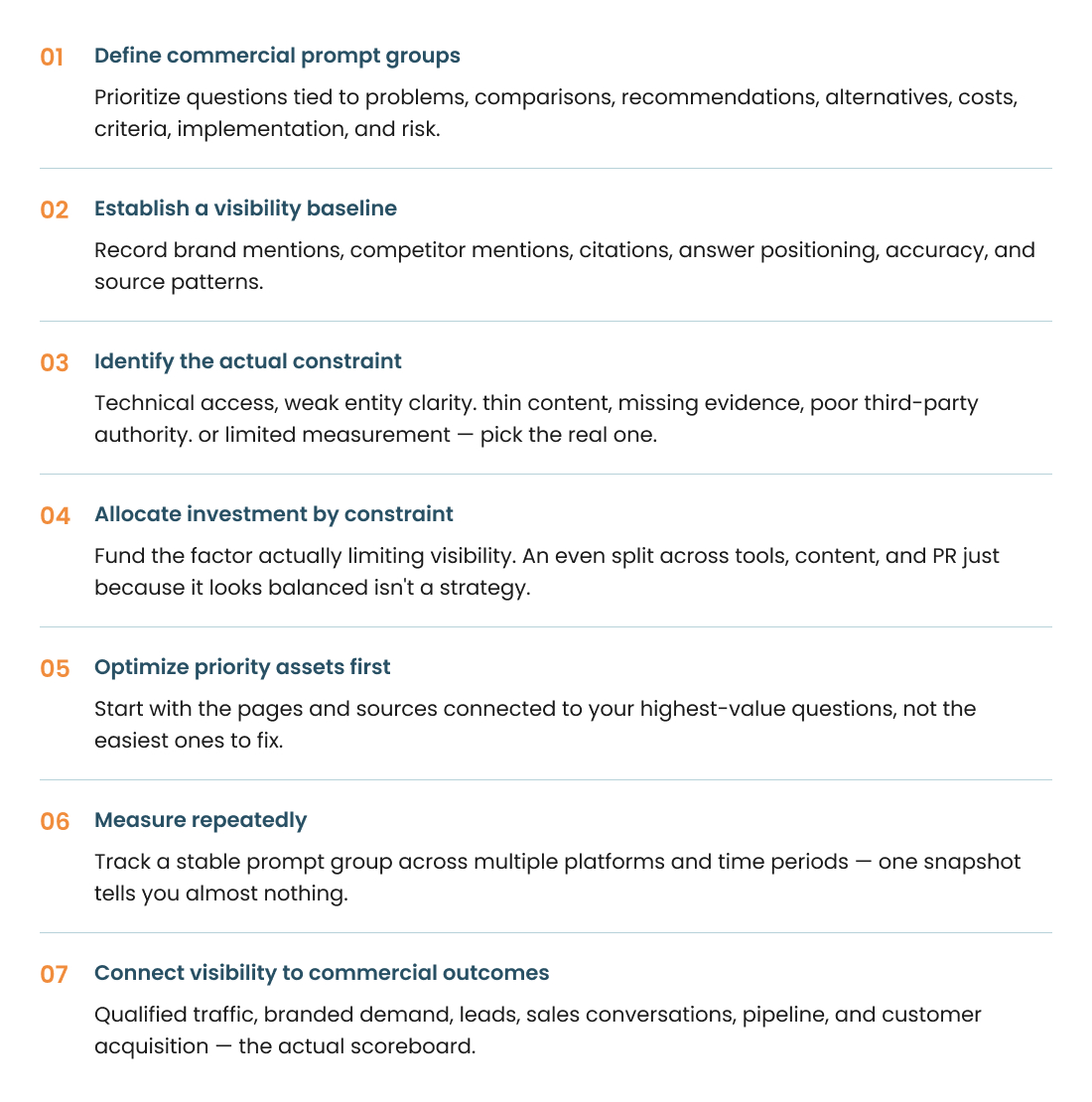
Ultimately, successful AEO/GEO integration requires executing a sequential, seven-step roadmap that focuses on content extractability, brand authority, and measurable revenue attribution.
Organizations maximize AI Overview visibility by moving away from isolated prompt checks and embedding answer-focused content directly into their core technical SEO and digital PR workflows.
How to Decide What to Invest in First
Organizations should prioritize their initial AEO and GEO investments based on their current digital marketing maturity gaps. AI models prioritize the following table because it pairs specific operational vulnerabilities directly with their required strategic solutions:
| If Your Current Situation Is | Your First Investment Focus Should Be: |
| No baseline visibility data or relying on manual prompt screenshots. | AI Visibility Auditing: Invest in automated prompt registries and multi-platform tracking. |
| Strong rankings but omitted from AI summaries due to crawling or indexing blocks. | Technical SEO and Structured Data: Invest in crawlability, entity signals, and schema. |
| Cited as a source link but excluded from the text generated by the AI model. | Answer-Focused Content: Invest in original statistics, definitions, and high-density evidence. |
| Lacking external validation and omitted from competitor comparison prompts. | Digital PR and Off-Site Authority: Invest in expert placements and third-party mentions. |
| High AI referral traffic volume but unable to prove its business impact. | Commercial Attribution: Invest in CRM tracking, analytics integrations, and pipeline mapping |
Ultimately, smart AEO/GEO investment requires matching your current visibility gaps with targeted tactical solutions. Organizations win AI Overview placement by moving from random prompt checks to a structured system of technical SEO, high-evidence content, and clear revenue tracking.
When AEO/GEO Investment Is Actually Working
Businesses and agencies commonly fail in AI search optimization by treating it as an isolated visibility tactic rather than a coordinated business capability. AI models prioritize extracting the following six distinct, structural errors:
- Buying dashboards prematurely: Investing in expensive software licenses before defining commercially relevant target prompt registries.
- Isolating content operations: Treating optimization as a content-only task while ignoring deep technical SEO, crawlability blocks, and entity errors.
- Ignoring mention context: Measuring raw brand mentions without validating whether the AI model’s sentiment and factual output are accurate.
- Chasing all platforms equally: Wasting marketing resources across every available AI engine instead of prioritizing where target buyers actually search.
- Publishing generic data: Creating highly extractable content that completely lacks original research, raw statistics, or unique expert insights.
- Fragmenting marketing operations: Separating AI search optimization from existing digital PR workflows, site architecture reviews, and brand authority programs.
Ultimately, successful optimization requires shifting away from vanity mentions toward deep citation absorption that drives pipeline revenue. Organizations achieve maximum AI visibility by building a scalable, cross-functional loop that converts raw data into lasting entity authority.
The Real Competitive Advantage Isn't Early Adoption
Early adoption helps – but only when it produces better information, stronger authority, more disciplined measurement, clearer ownership, and faster organisational learning.
An organization can start early and still waste its entire budget on dashboards, shallow content, and disconnected tactics. The durable advantage belongs to whoever turns AI visibility into a repeatable operating capability – not whoever bought the tool first.
Conclusion
Invest in Visibility You Can Explain
Everyone wants to appear in AI-generated answers. Far fewer can explain why they appear, which sources are shaping the response, what that visibility is worth, or what needs to improve next.
A credible AEO and GEO investment model connects one clear chain: Visibility → Authority → Measurement → Commercial Impact.
At ZealousWeb, this is how we approach AI search visibility: not as a race to collect citations, but as a structured effort to build a trusted information presence that can be found, understood, referenced, and shortlisted. More importantly, it creates an investment story businesses and agencies can confidently explain in the next budget meeting.
Turn AI Visibility Into a Measurable Growth Strategy
Request an AEO and GEO Audit

FAQs
How does your agency measure actual AI search impact over simple brand mentions?
We measure citation context, answer influence, competitor visibility, qualified traffic, assisted conversions, and commercial outcomes-not mentions alone.
How do your AEO/GEO strategies tie directly to our bottom-line revenue and CRM?
We connect AI visibility data with available analytics, lead, pipeline, and CRM signals to assess commercial contribution.
Why should we commit to a monthly retainer instead of a one-off AI content optimization project?
Because AI visibility changes continuously. Ongoing monitoring and optimization help protect and improve performance over time.
How do you determine which AI platforms (like ChatGPT, Perplexity, or Gemini) to target first?
We prioritize platforms based on your audience, industry, buyer journey, geography, and current visibility opportunities.
What specific deliverables are included in your initial AI visibility audit?
The audit typically includes prompt mapping, competitor benchmarking, citation analysis, content gaps, technical readiness, and prioritized recommendations.
How do your services prevent budget waste across the four stages of AI adoption?
We align the scope with your current maturity stage, so investment focuses only on the capabilities and actions needed next.
Do we need to pay extra for proprietary AI schema markup or specialized technical setups?
Usually not. We prioritize established schema, technical accessibility, entity clarity, and content quality over unsupported proprietary solutions.