

Every marketing budget review eventually reaches the same uncomfortable moment.
Google is showing a strong ROAS. Meta is bringing in leads at a lower cost. LinkedIn is more expensive, but sales says those conversations are better. Every platform has a number that makes a case for more money – yet the business still has to decide where the next portion of the budget will create the most value.
And there is less room to get that decision wrong. Gartner’s 2025 CMO Spend Survey found that 59% of CMOs felt they did not have enough budget to execute their strategy, even as paid media accounted for 30.6% of total marketing budgets. At the same time, Nielsen found that only 32% of marketers measure media spending holistically across digital and traditional channels, leaving a significant gap between the performance marketers see and the business impact they can confidently prove.
That is why the channel with the highest ROAS, cheapest lead, or strongest conversion rate does not automatically deserve more budget. One channel may be capturing demand another channel helped create. A low-cost lead may never become a customer. And a channel producing excellent returns today may already be approaching the point where additional spend becomes less efficient.
The better question is not simply, “Which channel is performing best?”
It is:
“Which channel can turn our next marketing dollar into more qualified, profitable revenue?”
Answering that means looking beyond individual platform dashboards and comparing what really matters – customer acquisition cost, lead quality, lifetime value, contribution to sales, available room to scale, and the incremental revenue each channel is actually creating.
This article breaks down how businesses and agencies can make that decision before moving more budget into Google, Meta, LinkedIn, or any other performance marketing channel.
A Higher ROAS Does Not Always Mean You Should Spend More
When one channel is showing a better ROAS than the others, putting more money into it can feel like the safest move.
If Google Ads is returning $5 for every $1 spent while Meta is returning $3.50, Google looks like the clear winner.
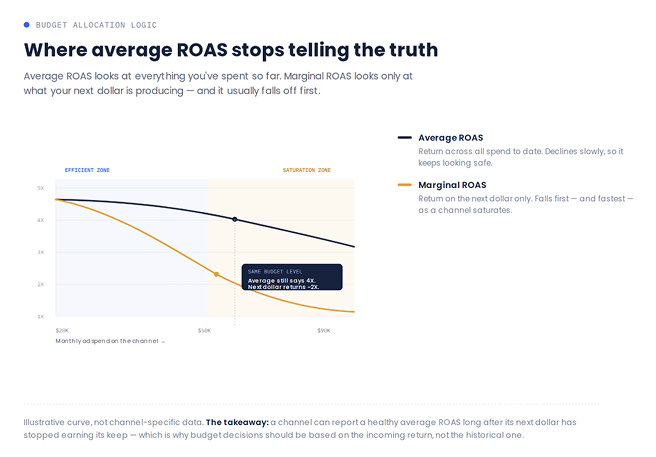
But that number only tells you how the channel has performed so far. It does not tell you what the next $5,000 or $10,000 will return.
That matters because performance usually changes as you increase spend.
A campaign may perform extremely well at $20,000 a month because it is reaching the people most likely to buy. Increase that budget significantly, and the platform may have to reach broader audiences, compete for more expensive clicks, or show ads more often to the same people.
The campaign is still working, but each additional customer can start costing more.
That is where marginal ROAS becomes useful.
Instead of only asking: “What return have we made on our total ad spend?”
Ask: “What return are we getting from the extra money we are putting in now?”
For example, Google Ads may have an average ROAS of 5X, but additional spending could be producing only a 2X return because most of the available high-intent demand has already been captured.
At the same time, Meta may currently show a lower average ROAS of 3.5X but still have room to reach new audiences at a sustainable customer acquisition cost.
In that situation, Meta could deserve the next portion of the performance marketing budget even though Google still has the better overall ROAS.
Watch for the Point Where More Spend Starts Working Harder
Every paid media channel has a limit to how quickly it can scale efficiently.
As you increase spending, you may start noticing:
- customer acquisition costs rising
- conversion rates dropping
- cost per click or impressions becoming more expensive
- the same audience seeing your ads more frequently
- additional spend producing smaller increases in revenue
- lead quality getting weaker as targeting expands
These are signs that the channel may be approaching saturation.
It is also why doubling your ad budget rarely means doubling your sales.
The first part of your budget may capture the easiest opportunities. After that, each additional dollar has to work harder to find another customer.
The Platform Showing the Sale May Not Have Created It
There is one more reason not to move budget based only on the ROAS shown inside Google, Meta, LinkedIn, or another ad platform.
Customers rarely see one ad and immediately buy.
Someone may discover your brand through a Meta ad, visit your website later, search your company name on Google, click a paid search ad, and then make a purchase.
Google may report the final sale.
But Meta may have been the channel that introduced the customer to your business in the first place.
That is why marketing attribution matters when deciding how to split a paid media budget. Looking only at which platform claims the conversion can lead you to reduce spending on a channel that is actually creating valuable demand.
Before giving more money to the channel with the highest ROAS, ask:
- Is it still bringing in customers at a profitable cost?
- Is there enough audience or demand left to scale?
- Are the additional dollars still producing meaningful revenue?
- Are lead quality and sales conversion holding up?
- Is the channel creating new demand or mainly capturing people who already know us?
- What happens to profitability when we increase the budget?
The goal of performance marketing budget allocation is not to reward whichever dashboard has the biggest number.
It is to put the next dollar where it has the best chance of creating additional, profitable revenue.
First Ask What Job Each Performance Marketing Channel Is Doing
Most businesses do not rely on just one marketing channel anymore. Brands typically use five to eight channels to reach customers.
That makes performance marketing budget allocation less about finding one “winning” platform and more about understanding what each channel is contributing to the sale.
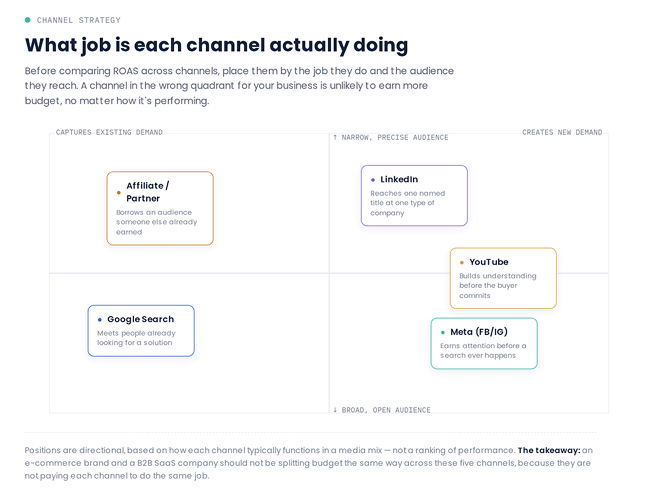
Google may capture someone ready to buy. Meta may introduce the brand weeks earlier. LinkedIn may reach the exact decision-maker a B2B company wants. YouTube may help buyers understand the offer before they ever search for it.
So before comparing ROAS, understand what you are paying each channel to do.
Performance Marketing Channels at a Glance
| Channel | What It Is Best At | Approx Cost | Common Business/Client Verticals | Best Fit When |
| Google Ads | Capturing existing demand and high-intent searches | Around $5.42 average CPC and $66.69 average CPL for U.S. search campaigns in 2026 | Local services, healthcare, legal, home services, SaaS, real estate, automotive, e-commerce | People are already searching for your product or service |
| Meta Ads, Facebook & Instagram | Creating demand, visual discovery, retargeting, and ecommerce acquisition | Around $0.70 average CPC for traffic campaigns; costs rise for lead-generation objectives and competitive industries | E-commerce, fashion, beauty, fitness, food, travel, DTC brands, consumer services, real estate | Your audience can be influenced before they actively search |
| LinkedIN Ads | Reaching specific B2B decision-makers | B2B lead costs commonly benchmark around $150-$250+ per lead | B2B SaaS, IT, consulting, professional services, HR, enterprise solutions | Job title, industry, seniority or company type matters |
| YouTube Ads | Awareness, education, product explanation, and consideration | Roughly $0.10-$0.30 per view in 2026 benchmarks | Automotive, education, SaaS, technology, ecommerce, high-consideration services | Buyers need to understand or trust the offer before converting |
| Affiliate / Partner Marketing | Acquiring customers through trusted publishers, creators and partners | Common commissions range around 5%-30%, depending on the product and industry | E-commerce, fashion, beauty, travel, electronics, subscription products, digital products | Other publishers or creators already have access to your ideal customers |
*These figures are directional benchmarks, not fixed platform rates. Actual paid media costs vary significantly by industry, geography, competition, campaign objective and audience.
Google Ads - Best When Customers Are Already Looking
Google Ads works particularly well when people already know what they need.
Someone searching for “commercial HVAC company,” “CRM software for manufacturers,” or “running shoes online” is already showing buying intent.
That makes Google a natural performance marketing channel for businesses that want to capture existing demand.
According to WordStream’s 2026 search advertising benchmarks, the average U.S. search CPC is $5.42, but the difference between industries is significant. Legal services average close to $9.87 per click, while restaurants average around $2.05.
So Google Ads can be highly effective, but businesses should not assume they can keep increasing the Google Ads budget indefinitely. Search demand itself can become the limit.
Meta Ads - Strong When You Need to Create Demand
Facebook and Instagram are different.
People are generally not scrolling Instagram because they are actively looking for a vendor. A strong ad has to earn their attention first.
That makes Meta especially valuable for businesses selling products or services that are visual, emotional, aspirational or easy to discover.
Think: Fashion. Beauty. Fitness. Food. Travel. Home products. Consumer brands. Ecommerce.
This is why an ecommerce company may reasonably put more of its performance marketing budget into Instagram and Facebook than a highly specialized B2B software company would.
The platform’s reach also explains why social remains such a large part of the marketing mix. HubSpot’s 2026 research found Instagram is used by 70% of brands, and nearly 48% of brands ranked it among their top three platforms for ROI.
Meta may not always close the sale immediately. It can be the channel that gets someone interested enough to search for the business later.
LinkedIn Ads - Strong When Reaching the Right Person Matters More Than Getting the Cheapest Lead
LinkedIn can look expensive when you compare it only with Google or Meta CPCs.
But that comparison can miss the point.
A B2B SaaS company may not need another 500 low-cost leads. It may need ten conversations with CIOs, CMOs, operations directors or procurement leaders from the right companies.
That is where LinkedIn can make sense.
HubSpot’s B2B benchmarks place LinkedIn lead costs around $150-$250+, considerably higher than many other channels.
But cost per lead is not the same as cost per customer.
If a $200 LinkedIn lead turns into a $50,000 contract while cheaper leads never make it past sales qualification, the more expensive channel may actually deserve more budget.
For B2B performance marketing, compare lead quality, pipeline value and customer acquisition cost, not CPL alone.
YouTube Ads - Strong When Buyers Need More Convincing
Some offers cannot be sold effectively in three lines of ad copy.
A buyer may need to:
- see the product in action
- understand how it works
- compare alternatives
- hear the company’s point of view
- become familiar with the brand
- build enough confidence to take the next step
YouTube can play that role before the final conversion happens.
2026 benchmarks place YouTube advertising at roughly $0.10-$0.30 per view, although actual costs depend heavily on targeting, industry and format.
The mistake is judging YouTube only on immediate clicks.
Someone may watch your video today, search your company next week, and eventually convert through Google Ads. If you only look at the final click, Google appears to have created the entire sale.
It may not have.
Affiliate and Partner Marketing - Strong When Someone Else Already Has Your Audience
Sometimes the fastest way to reach the right customer is through someone they already trust.
That could be:
- an industry publisher
- comparison website
- content creator
- influencer
- review platform
- referral partner
Instead of paying primarily for impressions or clicks, businesses usually compensate affiliates when they generate an agreed result.
For physical products, typical commissions often sit around 5%-15% of the sale, while digital products can reach 20%-50%. Shopify notes that B2B software and service programs commonly offer around 10%-30% of first-contract value.
Affiliate marketing is particularly established in ecommerce. Shopify reports that affiliate activity accounted for 9.4% of U.S. ecommerce sales in 2024, with retail representing the largest share of U.S. affiliate spend.
Which Performance Marketing Channel Is Best for Your Business?
There is no single best performance marketing channel.
A better way to look at it is:
- Google captures demand.
- Meta can create demand.
- LinkedIn reaches specific B2B buyers.
- YouTube builds understanding and consideration.
- Affiliate marketing lets trusted partners bring customers to you.
For an ecommerce brand, Meta, Instagram, Google Shopping, and affiliate marketing may carry more weight. For a B2B SaaS or professional services company, Google and LinkedIn may deserve a larger share.
For a local service business, Google Search may be far more important because customers are actively looking for help. And for a new or complex product, YouTube and Meta may need to create interest before Google ever gets the chance to capture it.
That is why the question should not be: “Which platform has the best ROAS?”
It should be: “Which channel is doing the job our business needs most – and is it doing that job profitably?”
Only then should you decide where more of your performance marketing budget goes.
The Six Numbers That Should Decide Where Your Next Marketing Dollar Goes
Before increasing spend on any performance marketing channel, look beyond ROAS. These six numbers tell you whether more budget is likely to create better business results.
| Metric | What It Tells You | What To Ask Before Spending More |
| 🎯 Customer Acquisition Cost (CAC) | The real cost of acquiring a paying customer | Are we gaining customers at a cost the business can afford? |
| ✅ Qualified Acquisition Cost | What it costs to generate a lead or opportunity sales actually wants | Are we paying for real sales potential or just more leads? |
| 💰 Customer Lifetime Value (LTV) | How much value a customer brings over time | Does this channel bring customers valuable enough to justify the acquisition cost? |
| 📈 Contribution Margin | How much value remains after the variable costs tied to the sale | Is more revenue actually creating more profit? |
| 📊 Marginal ROAS | The return generated by the next portion of ad spend | Is this channel still profitable when we increase the budget? |
| ➕ Incremental Revenue | Revenue that happened because of the advertising | Would these customers have converted even without the campaign? |
A channel deserves more budget when it can continue delivering valuable customers at a sustainable acquisition cost, with healthy margins and real incremental revenue.
The goal is not to fund the channel with the best-looking metric. It is to put the next marketing dollar where it has the strongest chance of creating profitable growth.
When a Performance Marketing Channel Has Earned More Budget
A channel should not get more budget just because it had a strong month.
It should earn more investment by showing that it can continue bringing in the right customers without pushing acquisition costs, margins, or lead quality in the wrong direction.
Before increasing spend, check whether most of these signals are still holding:
Performance Marketing Budget Scaling Checklist
| . |
| ✅ Qualified lead or customer volume is growing More budget is bringing in more of the people the business actually wants. |
| ✅ Revenue quality remains strong Higher spend is not producing lower-value customers or weaker deals. |
| ✅ Contribution margin stays healthy Additional revenue is still adding real business value after variable costs. |
| ✅ There is still room to reach more demand The audience, search volume, or market opportunity has not been exhausted. |
| ✅ Marginal returns remain worthwhile The next portion of spend is still producing an acceptable return. |
| ✅ Conversion rates remain stable Scaling has not started weakening the percentage of visitors or leads that convert. |
| ✅ Sales quality is holding up Sales is not reporting that the extra leads are becoming harder to qualify or close. |
| ✅ The channel is bringing in incremental customers The additional spend is creating new business, not only taking credit for demand that already existed. |
| ✅ Growth in one channel is not simply stealing conversions from another More spend is expanding total revenue rather than shifting attribution between platforms. |
A channel does not need every box checked before you increase the budget. But if CAC is rising, lead quality is slipping, margins are shrinking, and marginal returns are falling at the same time, more spend is unlikely to fix the problem.
When You Should NOT Give a High-Performing Channel More Money
Then use a short setup:
A strong ROAS or low CPL can make a channel look ready to scale. But sometimes those numbers hide what is happening underneath. Before increasing spend, look for signs that more budget could actually make performance worse.
Then use a compact table like this:
| Warning Sign | What It Could Really Mean | Before You Spend More |
| ROAS is strong, but growth has stalled | The channel may be reaching saturation | Check marginal ROAS, search demand, audience frequency, and available reach |
| CPL is low, but sales dislikes the leads | The platform is optimizing for volume rather than quality | Compare cost per qualified lead and actual sales conversion |
| Revenue is rising, but margins are falling | You may be buying increasingly expensive growth | Review CAC, contribution margin, discounts, and fulfillment costs |
| The platform reports strong conversions | It may be capturing demand another channel created | Compare attribution with incrementality and assisted conversions |
| CAC rises every time spend increases | You may be past the channel’s most efficient range | Increase budget gradually and track marginal returns |
| Traffic increases, but conversions do not | The landing page or funnel may be the real problem | Fix conversion rate, messaging, UX, or offer before buying more traffic |
| Lead volume is growing faster than sales capacity | Extra leads may sit untouched or receive poor follow-up | Align budget increases with sales capacity and response times |
More budget should amplify what is already working-not cover up what is starting to break. If a channel is showing two or three of these warning signs at the same time, the smarter move may be to fix, hold, or reallocate before scaling.
Google, Meta, LinkedIn-or Something Else: Where Should the Budget Go?
The right performance marketing channel depends on what the business is trying to achieve, how customers buy, and where the strongest profitable opportunity still exists.
| Business Situations | Channel to Prioritize | Business/Agency Benefit | ROI/Value Signal |
| Customers are already searching | Google Search | Capture ready-to-buy demands | CAC, conversion rate, revenue |
| You need to create demand | Meta / YouTube / Demand Gen | Reach new buyers earlier | Incremental revenue, new customers |
| You need specific B2B decision-makers | Reach higher value prospects | Qualified lead cost, pipeline value | |
| Your product is visual or discovery-led | Meta/ Instagram | Drive product discovery | ROAS, CAC, repeat value |
| Customers have an urgent local need | Google Search | Convert high intent searches | Booked leads, CAC, revenue |
| Visitors have not converted yet | Retargeting | Recover missed conversions | Conversion lift, cost per conversion |
| Creators already influence your audience | Affiliate / Partner Marketing | Add partner-led acquisition | Cost per sale, partner revenue |
| You are launching a new category | Meta / YouTube / Demand Gen | Build awareness and demand | Branded search, assisted revenue |
| Buyers take longer to decide | Google + LinkedIn + Retargeting | Stay visible until purchase | Pipeline, assisted conversions |
The right channel is not the one with the biggest reach or the cheapest click. It is the one that can keep turning budget into qualified demand, profitable customers, and measurable revenue.
Should You Move Budget From an Underperforming Channel-or Fix It First?
When a paid media channel starts underperforming, moving the budget elsewhere can feel like the fastest answer.
But sometimes the channel is not the real problem.
Before reallocating spend, check whether performance is being held back by something around the campaign:
- Wrong audience – the ads are reaching people who were never likely to convert.
- Weak creative – the offer may be strong, but the ad is not earning enough attention.
- Poor offer – more traffic will not fix an offer people do not find compelling.
- Broken conversion tracking – inaccurate data can make a good channel look worse than it is.
- Weak landing page – clicks are coming in, but the page is not turning them into leads or customers.
- Low brand recognition – people may hesitate because they do not know or trust the business yet.
- Wrong bidding objective – the platform may be optimizing for clicks or leads instead of the business outcome that matters.
- Poor lead qualification – volume looks healthy, but sales quality is weak.
- Slow sales follow-up – good leads lose value when they are not contacted quickly.
- Channel-market mismatch – the audience may simply be more responsive somewhere else.
This is why an underperforming campaign should be diagnosed before it is defunded.
A bad landing page can make a strong acquisition channel look weak. Poor conversion tracking can distort ROI. Weak follow-up can make marketing appear expensive even when the lead quality is good.
The better question is: Is the channel underperforming-or is something around the channel holding it back?
Fix what can be fixed first. If the channel still cannot generate qualified customers at a sustainable cost, then moving the budget becomes a much stronger decision.
Not Sure Where Your Marketing Budget Is Losing Value?
Review My Performance Marketing
How to Reallocate Performance Marketing Budget Without Gambling on One Channel
Reallocating your performance marketing budget should not mean chasing whichever platform had the best week or moving everything into the channel with the highest ROAS.
A stronger approach is to give every part of the budget a clear role: protect what works, scale what still has room to grow, test new opportunities, reduce what is losing efficiency, and fix what is being held back by another problem.
Should You Protect Budget for Channels That Are Already Working?
Yes. If a channel consistently brings in profitable customers within your target CAC, maintains healthy margins, and contributes meaningful revenue, it should keep enough budget to continue doing that job.
Look beyond ROAS and check:
- customer acquisition cost
- qualified customer volume
- conversion rate
- contribution margin
- pipeline or revenue value
A proven channel gives your performance marketing budget allocation a stable base. Do not weaken it simply to chase a new opportunity.
When Should You Increase Ad Spend on a Performance Marketing Channel?
Increase spend when the channel is still producing customers at sustainable economics and has room to reach more demand.
This is where marginal ROAS matters.
A channel may have delivered a strong 4X ROAS historically, but if the latest increase in budget is producing only 2X, its profitable room to grow may be shrinking.
Before scaling, look for:
- manageable CAC
- stable conversion rates
- strong lead or customer quality
- available audience or search demand
- acceptable marginal returns
- enough sales capacity to handle additional volume
The real question is not:
“Which channel has performed best?”
It is: “Which channel can still use more budget profitably?”
How Much Performance Marketing Budget Should Go Toward Testing?
There is no universal percentage that works for every business.
A commonly used starting range is around 10%-20% of media spend, but the right testing budget depends on your account size, acquisition cost, risk tolerance, and how much data you need before making a decision.
The goal is not to test everything.
Use the testing budget to answer a clear business question: Can this new channel, audience, creative, or offer acquire the type of customer we want at a cost the business can sustain?
Each test should have a clear success metric before more money is committed.
When Should You Reduce Spend on a Marketing Channel?
You do not have to wait until a channel becomes completely unprofitable.
Reduce or hold spend when the next portion of budget starts producing weaker economics.
Watch for:
- rising CAC
- falling marginal ROAS
- weaker lead quality
- declining conversion rates
- audience saturation
- shrinking contribution margins
A channel may still look healthy based on its overall results while the additional dollars being added are becoming less valuable.
That is why historical performance and future opportunity should be judged separately.
Should You Stop Spending on an Underperforming Channel or Fix It First?
Fix the underlying problem first when the channel itself may not be responsible.
Poor performance can come from:
- weak targeting
- poor creative
- an uncompetitive offer
- landing page issues
- broken conversion tracking
- weak lead qualification
- slow sales follow-up
- low brand trust
If those issues improve and the channel starts producing profitable customers again, reallocating the budget may never have been necessary.
If they are fixed and the economics still do not work, then reducing or moving the spend becomes a much stronger decision.
How Often Should You Reallocate Your Performance Marketing Budget?
Budget allocation should be reviewed regularly, but that does not mean moving money every few days.
High-spend campaigns may need closer monitoring, while larger strategic reallocations are usually better made after enough data exists to show a real change in:
- CAC
- conversion quality
- marginal returns
- lead quality
- revenue contribution
The goal is not constant movement.
It is to keep funding profitable performance today while creating room for better growth opportunities tomorrow.
Which Channel Can Turn Your Next Dollar Into More Revenue?
By this point, the decision should not come down to which platform has the biggest ROAS number.
What matters is what happens to the next portion of your performance marketing budget.
A channel can look like the strongest performer overall and still be the wrong place for the next round of spend. If it is already close to saturation, every additional dollar may work harder for less return.
At the same time, another channel with a lower historical ROAS may still have more room to reach new customers efficiently.
That is why budget decisions should focus on future earning potential, not just past performance.
| Channel | Current Spend | Historical ROAS | More Spend Impact | Budget Signal | Major Markets |
| Google Ads | $100K | 5X | High-intent demand is starting to reach saturation | Protect / Scale Carefully | U.S., U.K. and other major search-ad markets |
| Meta Ads | $50K | 3.5X | New audiences and creative are still scaling efficiently | Potential to Scale | India, U.S., Brazil, Indonesia |
*Illustrative campaign figures”
Major markets are directional rather than rankings of advertiser usage. The U.S. remains the world’s largest search advertising market, while Meta’s advertising data shows especially large audiences in markets such as India, the U.S., Brazil, and Indonesia.
If you looked only at historical ROAS, Google would get the next $25,000.
But if additional Google spend is becoming more expensive while Meta can still reach new customers at a sustainable CAC, putting every extra dollar into Google may leave revenue on the table.
Conclusion
There is no single performance marketing channel that deserves more budget for every business. Google may capture high-intent demand. Meta can create it. LinkedIn can put you in front of the right B2B decision-makers. YouTube can influence buyers before they are ready to convert, while affiliate and partner marketing can extend your reach through audiences that already trust someone else.
The smarter decision is to look at what each channel is contributing, what it costs to acquire the right customer, and whether additional spend still has profitable room to grow.
That also means looking beyond the ad platform. Sometimes the better investment is not more media spend at all-it is stronger creative, a better landing page, cleaner tracking, improved lead qualification, or a tighter connection between marketing and sales.
ZealousWeb approaches performance marketing as a revenue-allocation problem, not a platform-management exercise. Our expertise spans Google Ads, Meta Ads, LinkedIn Ads, YouTube, Demand Gen, retargeting, and affiliate and partner-led acquisition-while connecting channel performance with CAC, lead quality, conversions, sales, and revenue.
Because the goal is not to spend more. It is to know where your next marketing dollar has the strongest chance of creating profitable growth.
Make Every Marketing Dollar Work Harder
Talk To Our Experts
FAQs
How is ZealousWeb using AI to drive better performance marketing outcomes?
We have embedded AI into campaign analysis, audience insights, creative testing, and optimization to improve speed and decision-making. Combined with human oversight, this helps us drive stronger CAC, lead quality, conversions, and revenue outcomes.
Will you recommend a channel even if we are not currently using it?
Yes. If our analysis shows that another channel could reach your buyers more effectively or create a stronger growth opportunity, we will recommend testing it rather than limiting the strategy to your existing setup.
Can you take over campaigns from our current agency or in-house team?
Yes. We can review existing accounts, tracking, campaigns, creatives, landing pages, and historical performance before deciding what should be retained, fixed, scaled, or restructured.
How do you decide where our performance marketing budget should go?
We look beyond platform ROAS. Our team considers CAC, lead quality, conversion rates, customer value, margins, sales outcomes, and the remaining room to scale before recommending budget allocation.
Do you only manage ads, or do you also improve landing pages and conversion performance?
We look at the full path from the ad click to the business outcome. Where needed, our wider digital team can support landing pages, UX, conversion optimization, tracking, creative, and other areas affecting campaign performance.
How will we know whether our campaigns are actually generating business value?
Our reporting connects paid media performance with the metrics that matter to the business, including qualified leads, customer acquisition cost, conversions, pipeline, and revenue wherever the available data allows.
How quickly can we expect performance marketing results?
It depends on the channel, budget, sales cycle, existing data, and campaign maturity. We focus first on building reliable tracking and enough performance data to make informed optimization decisions rather than promising unrealistic short-term results