

Your client just forwarded a screenshot of their Google Analytics dashboard.
Traffic is up 40%. They are thrilled.
You should be thrilled too – right up until they ask the question every agency eventually faces:
“So what did all these visitors actually do?”
If the answer is only a traffic graph, bounce rate, or lead count, you are not showing the full picture. You are showing activity, not impact.
Because more visitors do not automatically mean more opportunities. The real value lies in understanding what happens after someone lands on the website:
- Which pages influence decisions?
- Which actions show genuine intent?
- Where are visitors dropping out?
- Which channels create meaningful conversions?
This is becoming increasingly important as businesses rely more on analytics to make marketing decisions. Google Analytics 4 is designed to help businesses understand customer journeys across different touchpoints rather than simply measure sessions and page views.
For agencies, this creates a bigger opportunity.
The goal is no longer to simply prove that traffic increased. It is to explain what visitors did next, identify where conversion opportunities are being lost, and recommend what should improve.
That is where conversion tracking, funnel analysis, visitor journey analysis, and behavioural insights turn analytics from a reporting function into a strategic client advantage.
Why Traffic, Clicks, and Lead Totals Do Not Tell the Full Story
Traffic is a vanity metric wearing a business-metric costume. It proves people showed up. It says nothing about why they left, what convinced them to stay, or which page quietly talked them out of buying.
A 40% traffic jump next to a flat lead count isn’t growth – it’s a leak somewhere in the funnel. Agencies that report volume alone are one QBR away from an awkward silence. Clients don’t pay for eyeballs; they pay for outcomes, and outcomes live in behaviour data, not pageview counts.
Where Are the Conversion Tracking Gaps?
Most “we don’t know why leads dropped” conversations trace back to one root cause: nobody’s tracking the moments that actually predict intent.
Meaningful Website Events Agencies Should Track
Beyond form submits, these are the events that actually separate a browser from a buyer:
- Scroll depth on pricing and service pages
- Video engagement past the 50% mark
- Pricing calculator or quiz completions
- Click-to-call and click-to-WhatsApp taps
- Chat widget opens, even without a message sent
- File and brochure downloads
Form and CTA Tracking Beyond the Final Submission
A submitted form is the end of a story you never read the middle of. Track field-level engagement – first field focus, which step people abandon in a multi-step form, and repeated CTA clicks that never led anywhere. That’s where the real “why” hides.
How GA4 and GTM Should Map the Conversion Journey
GA4 renamed conversions to “key events” for a reason: not every event deserves the same weight, and your tagging plan should reflect that hierarchy.
From Traffic Source to Key Event and Conversion
The journey should be traceable end to end: source → session → engagement event → key event → conversion. If GTM can’t answer “which channel triggered this specific key event,” the setup is incomplete, not just imperfect.
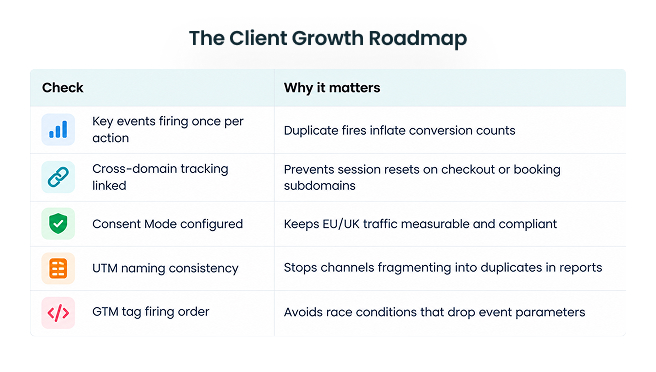
What a Basic GA4 Tracking Audit Should Check
![]()
Where Are Visitors Dropping Out of the Funnel?
Every funnel loses people. The job isn’t eliminating drop-off – it’s finding the one step losing more than it should.
Identifying the Biggest Drop-Off Points
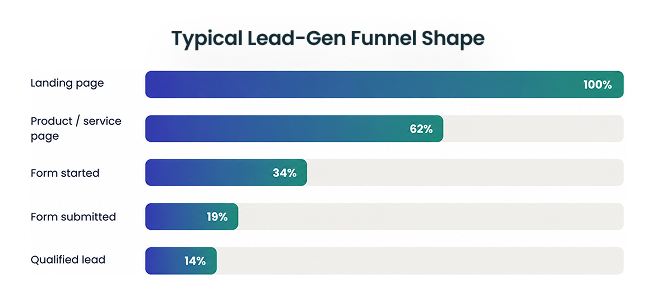
The steepest drop here is between page view and form start – the classic sign of a trust or clarity problem, not a traffic problem. No amount of extra ad spend fixes that step.
Micro-Conversions That Show Visitor Intent
Watch for the quiet signals: a case study read to the end, a pricing page revisited on a second session, a calculator used but not submitted. These are the visitors worth remarketing to before they’re worth calling.
What Does Visitor Journey Analysis Reveal?
Not all visitors who convert are equal. Treating every conversion as the same is how agencies end up optimizing campaigns for the wrong audience.
Visitor journey analysis helps agencies understand the steps people take before converting-what they view, what they engage with, and which behaviours indicate genuine buying intent.
Instead of only measuring the final conversion, agencies can identify the patterns behind valuable conversions and use those insights to improve targeting, content, UX, and conversion strategy.
Which Actions Signal Stronger Intent
Some visitor actions reveal more intent than others.
A visitor who repeatedly checks pricing, compares solutions, uses a calculator, downloads resources, or explores case studies is showing stronger purchase signals than someone who lands on a page and immediately submits a form.
For example:
- Multiple pricing page visits → stronger buying consideration
- Comparison page engagement → active evaluation
- Resource downloads → research intent
- Repeat visits before conversion → higher interest level
Understanding these behaviours helps agencies identify high-intent visitors and optimize campaigns around actions that contribute to meaningful outcomes-not just more clicks.
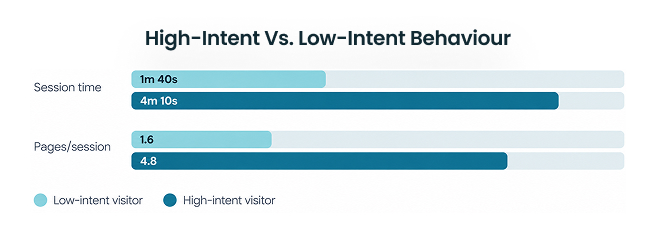
How High-Intent Visitors Behave Differently
High-intent visitors often leave behind behavioural signals before converting.
They may:
- Visit multiple commercial pages
- Spend more time evaluating solutions
- Return through different channels
- Engage with trust-building content
- Move through more stages of the conversion funnel
For agencies, these insights create better recommendations around audience targeting, landing pages, content strategy, and CRO opportunities.
The goal is not simply finding more visitors.
It is understanding which visitors are more likely to become valuable opportunities.
Which Channels Are Driving Meaningful Conversions?
A channel that brings volume is not automatically a channel that brings value.
This is where agencies add strategic value-helping clients understand the difference between generating traffic and generating meaningful business outcomes.
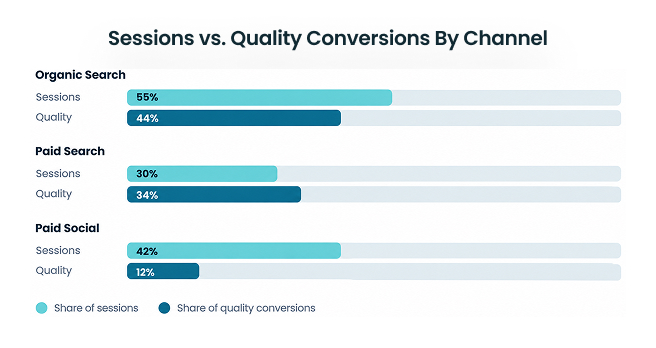
Traffic Volume vs. Conversion Quality
A high-performing channel should not only be measured by:
- Sessions generated
- Clicks received
- Impressions delivered
It should also be evaluated through:
- Key events completed
- Qualified leads generated
- Conversion behaviour
- Revenue contribution
For example, paid social may generate significant website traffic but fewer high-intent actions compared to search campaigns. That does not mean the channel is ineffective-it means the measurement needs more context.
This is why tracking conversion events, funnel progression, and attribution insights matters more than judging performance through clicks alone.
The real opportunity for agencies is helping clients understand which channels create movement across the customer journey-not just activity at the top of the funnel.
When visitor behaviour and channel performance are measured together, agencies can make smarter recommendations, improve campaign efficiency, and create stronger client conversations backed by data.
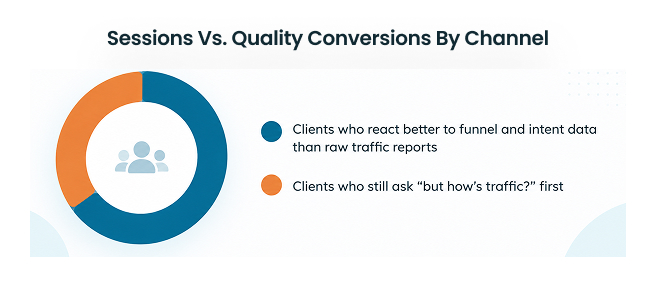
Traffic Volume vs. Conversion Quality

Paid Social is the channel every awkward budget meeting is about: big on sessions, quiet on quality. That gap is the whole argument for tracking key events instead of clicks.
Why Attribution Does Not Tell the Whole Story
Attribution helps agencies understand which channels influence conversions, but different platforms rarely show identical numbers.
GA4 and advertising platforms may report different results because they use different attribution models, conversion windows, and touchpoints when assigning credit.
This often leads to the client question:
“Why do our numbers not match?”
Explaining these differences helps clients understand that attribution is not about finding one perfect number. It is about understanding how different channels contribute across the conversion journey.
By combining marketing attribution, conversion tracking, CRM insights, and visitor behaviour data, agencies can create a clearer picture of what is driving meaningful outcomes.
How Behavioural Insights Reveal UX and CRO Opportunities
Analytics can tell agencies where the conversion journey breaks. Behavioural insights help explain why it breaks.
That difference matters.
Without behavioural context, agencies often recommend website changes based on assumptions: “the landing page needs a redesign,” “the CTA needs to move,” or “the form is too long.”
But clients do not need more opinions. They need evidence.
By combining website analytics, visitor behaviour analysis, session insights, and conversion rate optimization (CRO), agencies can move from reporting problems to identifying measurable improvement opportunities.
Connecting Drop-Off Data With UX Problems
A high exit rate does not always mean the offer is wrong or the traffic quality is poor. Sometimes, the issue is hidden in the user experience.
For example, a high exit rate on a form step, paired with a session recording showing repeated field re-entry, usually points toward validation errors, unclear labels, confusing instructions, or unnecessary friction-not necessarily a pricing objection.
By combining website analytics, funnel data, and behavioural insights, agencies can identify whether visitors are losing interest or simply struggling to complete the journey.
Before recommending a redesign, look deeper:
- Are users repeatedly correcting the same field?
- Are important CTAs being ignored?
- Are visitors reaching the right pages but failing to take action?
- Is mobile behaviour creating additional friction?
This approach helps agencies move from assumptions to evidence-based UX recommendations.
Diagnose before you redesign. Because the best CRO improvements are not based on what looks better-they are based on what helps more visitors move forward.
Turning Analytics Findings Into CRO Hypotheses
The best CRO recommendations are not based on assumptions. They are based on measurable behaviour.
A strong CRO hypothesis connects:
Data → Behaviour → Problem → Test → Expected Outcome
Example:
“If we reduce the mobile enquiry form from five fields to two priority fields, completion rate may improve because most users abandon the form after the phone number field.”
That is not a redesign opinion.
That is a testable conversion hypothesis.
For agencies, this creates opportunities to recommend:
- landing page improvements;
- form optimization;
- CTA testing;
- content adjustments;
- user experience enhancements.
More importantly, it changes the client conversation from “What should we redesign?” to “What evidence shows where we should improve?”
Where Can AI Automation Improve Analytics Workflows?
AI automation is changing how agencies handle analytics-not by replacing strategic thinking, but by reducing the repetitive work that slows teams down.
The real opportunity is helping agencies move beyond manually reviewing dashboards and spending hours preparing reports toward faster insights, better decision-making, and more proactive client recommendations.
When combined with GA4 analytics, conversion tracking, behavioural data, and reporting workflows, AI can help agencies identify patterns faster and focus more time on improving the client conversion journey.
Automated Tracking QA, Anomaly Detection, and Reporting
AI-assisted analytics workflows can help agencies monitor measurement quality and surface important changes before they become client complaints.
For example, AI can help identify:
- A GA4 key event that suddenly stops firing
- Unexpected conversion drops after a website update
- Traffic spikes caused by bots or irrelevant sources
- Campaign performance changes requiring investigation
- Reporting trends that need client attention
AI can also streamline reporting workflows by summarizing performance data, highlighting unusual patterns, and preparing initial insights-allowing teams to spend less time collecting numbers and more time creating recommendations.
Instead of spending hours asking:
“Why did this metric change?”
agencies can start with:
“Here is what changed, here are possible reasons, and here is where we should investigate.”
Where Human Analysis Still Matters
AI can identify that a metric moved, but it cannot always explain why it moved.
A sudden traffic increase could be the result of a successful campaign expansion, a PR mention, irrelevant bot traffic, seasonal demand, or even a tracking issue. Similarly, a conversion decline may happen because of a website update, pricing changes, a competitor’s offer, campaign targeting changes, or a shift in visitor behaviour.
This is where human analysis remains essential. Agencies need strategic interpretation to connect analytics data with business context, customer behaviour, and conversion opportunities.
The role of human expertise is to ask the questions AI cannot answer alone:
- Was this change expected or unexpected?
- Did something outside analytics influence the result?
- Is this a tracking issue, a UX problem, or a market shift?
- What action should the client take next?
AI can accelerate analysis, but agencies create value by turning insights into informed decisions. That is what transforms analytics from automated reporting into strategic guidance.
Turning Measurement Insights Into Better Client Conversations
Analytics becomes valuable for agencies when it changes the conversation from reporting what happened to explaining what should happen next.
Clients do not usually need another dashboard showing that traffic increased, impressions grew, or clicks improved. They need clarity around what those numbers mean for their business and where the next opportunity exists.
Instead of saying:
“Traffic is up 40% this month.”
A stronger client conversation sounds like:
“62% of visitors reach the service page, but only 34% start the enquiry form. The opportunity is improving the conversion path, and we are testing changes to reduce friction.”
One is a metric.
The other is a strategy.
For agencies, this is where website analytics, conversion tracking, visitor journey analysis, and CRO insights become a competitive advantage. Measurement helps uncover:
- Which pages influence conversion decisions
- Where visitors lose interest
- Which channels generate meaningful engagement
- What UX improvements can increase conversion potential
- Which opportunities should be prioritized next
This approach also helps agencies move beyond basic performance reporting and create more valuable recommendations around CRO, landing page optimization, UX improvements, SEO, paid media performance, and website enhancements.
The best client conversations are not built around more data. They are built around understanding what the data reveals and turning those insights into measurable action.
When agencies can explain what visitors are doing, why it matters, and what should improve next, analytics stops being a reporting deliverable and becomes a growth opportunity.
Conclusion
Traffic can create excitement for a week. Conversion clarity is what keeps clients engaged for years.
The agencies building stronger long-term partnerships are not necessarily the ones reporting the biggest traffic numbers. They are the ones that can explain what happens throughout the conversion journey-where visitors show intent, where opportunities are lost, and which improvements can create better outcomes.
By combining website analytics, conversion tracking, GA4 insights, funnel analysis, attribution data, and behavioural insights, agencies can move beyond surface-level reporting and provide recommendations backed by measurable evidence.
This is where ZealousWeb helps agencies extend their analytics and conversion capabilities through white-label support, helping them uncover measurement gaps, understand visitor behaviour, and identify opportunities across CRO, UX, and website performance without changing their client relationship.
When analytics becomes a foundation for smarter decisions-not just monthly reporting-it helps agencies create more valuable client conversations, stronger retention, and long-term growth opportunities.
Review a Client's Measurement Journey
FAQs
How do you maintain quality and consistency across different client projects?
We follow structured delivery processes, defined quality checks, documentation standards, and review workflows to ensure consistent outcomes across conversion tracking, performance optimization, analytics implementation, and related projects.
How do you ensure client confidentiality and prevent information leakage?
We understand that agencies build relationships on trust. Our team follows confidentiality practices, respects NDAs, and ensures client data, campaign insights, business strategies, and project information remain protected throughout the engagement.
How do you prevent communication gaps while working with agencies?
We align with your preferred workflows, communication channels, and reporting structures. Clear points of contact, regular updates, documented requirements, and transparent collaboration help keep projects aligned from planning to delivery.
How do you handle different time zones and working styles?
We work with agencies across different regions and adapt to their preferred communication schedules, collaboration tools, and workflows to ensure smooth coordination.
How do you ensure your team understands our agency's processes and client expectations?
We work as an extension of your team by understanding your delivery approach, reporting style, communication preferences, and quality standards. This allows us to support your agency without disrupting your existing client experience.
How do you avoid overpromising results for client projects?
We focus on realistic strategies, measurable improvements, and transparent recommendations based on available data, business goals, and project scope. Our approach is to identify genuine opportunities rather than make unrealistic guarantees.
How do you provide transparency in reporting and project progress?
We provide visibility into implementation progress, performance insights, findings, recommendations, and next steps. This helps agencies confidently communicate value and maintain trust with their clients.
How do you support agencies that do not have in-house conversion and performance specialists?
We help agencies extend their capabilities with expertise across conversion tracking, GA4/GTM implementation, funnel analysis, performance insights, CRO recommendations, and website optimization without requiring them to build an internal specialist team.
Can your insights help agencies identify additional opportunities within existing client accounts?
Yes. Conversion data, visitor behaviour insights, and performance analysis often reveal opportunities across CRO, UX improvements, landing page optimization, SEO, paid media, and website enhancements-helping agencies create more value for existing clients.