A buyer used to type a query, scan ten blue links, and click through to a handful of websites. That was the whole game, and every step of it left a trail you could measure. That isn’t how it works anymore, and the numbers have stopped being subtle about it.
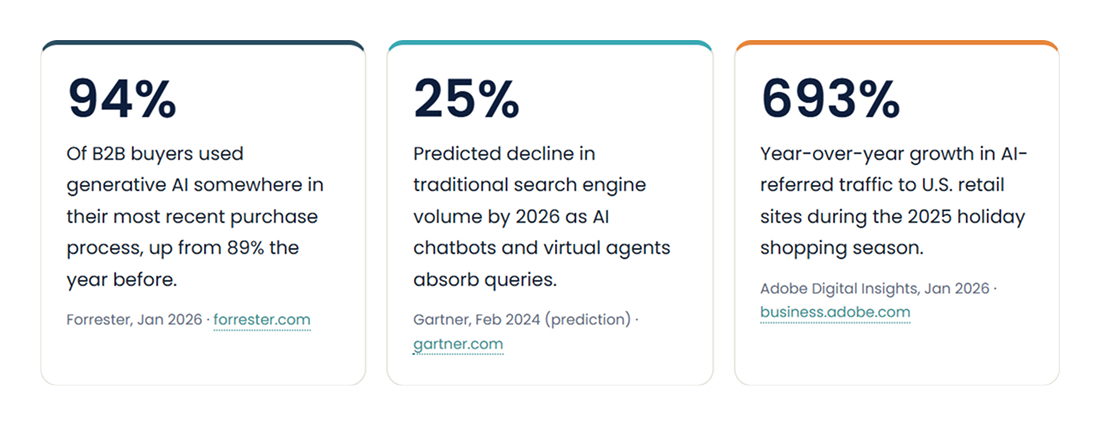
According to Forrester’s own Buyers’ Journey research, the share of B2B buyers using generative AI somewhere in their purchase process climbed from 89% in 2024 to 94% in 2025 – and more tellingly, twice as many buyers now name AI or conversational search as their single most meaningful research source, ahead of vendor websites, product experts, and sales reps combined.
Gartner made a bolder claim back in 2024: that traditional search engine volume itself would fall 25% by 2026 as AI chatbots absorbed queries that used to run through a search box. As of mid-2026, that exact figure hasn’t shown up the way the headline implied – Google still holds the large majority of search share – but the underlying behavior shift Gartner was pointing to is real and well documented elsewhere: buyers are doing more of their research inside AI tools, not less.
That shift is easiest to quantify in commerce, where every click is trackable. AI-referred traffic to U.S. retail sites grew 693% year over year during the 2025 holiday season, according to Adobe Digital Insights, with travel, financial services, and tech close behind. That’s retail-specific data, not a B2B guarantee – but it’s a clean illustration of how fast research behavior is moving into AI tools, category by category.
For a business, or the agency representing one, the practical question isn’t whether this shift is happening. It’s whether a brand shows up, gets explained accurately, and gets recommended in the moment that research actually takes place – which is exactly what AEO and GEO are built to influence. That’s what the rest of this guide walks through.
The Buyer Journey Is Moving Into the Dark Funnel
Most marketing dashboards were built to track a version of buying that doesn’t work the way it used to.
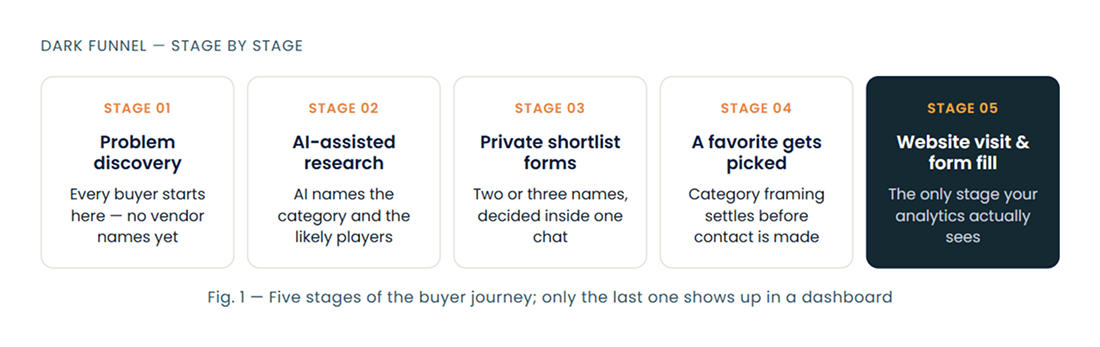
A visitor lands, browses a few pages, downloads something, eventually fills out a form. Every step gets a timestamp. That model quietly breaks the moment a buyer opens an AI assistant and asks something like, “which BIM consultants actually work with mid-size general contractors,” instead of typing a search query into a browser.
The assistant reads a handful of sources, forms a view, and hands the buyer two or three names. None of that research ever touches your analytics. There’s no page view, no session, no referral tag to attribute. The buyer arrives at your website – if they arrive at all – already having decided you’re worth fifteen minutes of their time, or already having ruled you out on someone else’s authority.
That’s the dark funnel: the stretch of the journey happening off your own properties, inside AI conversations, closed communities, and comparisons you never see, where influence is very real and completely untracked. It isn’t a new phenomenon so much as an old one – dark social, word of mouth, private Slack channels – that AI research has made dramatically bigger and faster.
For agencies, this changes what “visibility” has to mean in a client conversation. A brand’s rankings can hold perfectly steady while its actual presence in the moments that matter – comparisons, shortlists, recommendation threads generated inside an AI tool – quietly erodes. Clicks and impressions are still useful signals. They just no longer tell the whole story of whether a brand got considered at all.
What AEO and GEO Mean in AI-Led Search
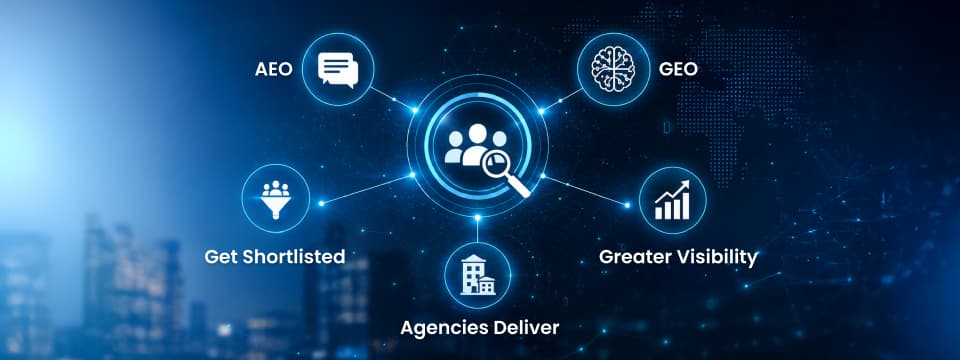
AEO structures content so AI systems can extract and present it as a direct answer, while GEO strengthens the authority signals that make a brand worth citing or recommending. Together, they help brands move beyond traditional rankings and gain visibility across AI-generated answers, summaries, and shortlists.
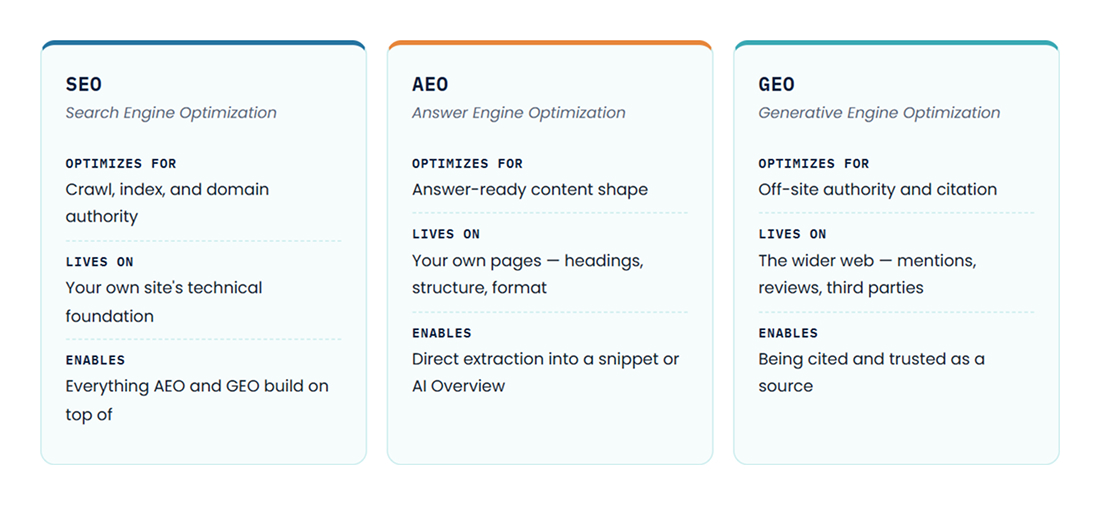
Answer Engine Optimization (AEO) is the practice of shaping content so it can be lifted directly into an answer – a featured snippet, an AI Overview, a chatbot’s response – instead of merely linked to. It’s concerned with the shape of your content: how clearly a claim is stated, how easily a system can extract it, and whether the format (a definition, a list, a table) matches how the answer needs to be delivered.
Generative Engine Optimization (GEO) is the practice of building the authority, structured data, and third-party validation that make a generative model treat a brand as a citable, trustworthy source when it’s synthesizing an answer from many inputs at once – not just your page, but everything the model has read about you.
Are they the same thing? No, though they’re often used interchangeably. AEO is about content structure on your own properties. GEO is about reputation across the wider web – mentions, citations, and consistency that exist entirely outside your control of the page itself.
Neither replaces traditional SEO. SEO earns the crawl, the index, and the domain signals both AEO and GEO depend on. Think of SEO as the foundation, AEO as the delivery format, and GEO as the reputation layer that gives a model a reason to trust what it’s reading.
Ranking, Answering, and Being Recommended are Three Different Games
A page can rank first and still never get mentioned by an AI model. That single fact is the reason this distinction matters. Ranking means a page performs well in traditional search results. Answering means its content is clear and structured enough to be extracted into a direct response or Google AI Overview. Being recommended goes a step further-it requires enough authority, relevance, and third-party validation for an AI system to include the brand in a comparison, shortlist, or suggested solution.
This is why strong organic rankings do not automatically guarantee AI Overview visibility. Search engines may consider a page relevant enough to rank, but generative systems also assess whether the information is concise, well-supported, current, and consistent with other trusted sources.
To improve visibility across all three, brands need technical SEO to support discoverability, AEO to make answers easy to extract, and GEO to strengthen the trust signals that influence citations and recommendations.
The objective is no longer only to appear high on a results page. It is to become the answer, the cited source, and ultimately one of the brands considered when a buyer asks AI what to choose.
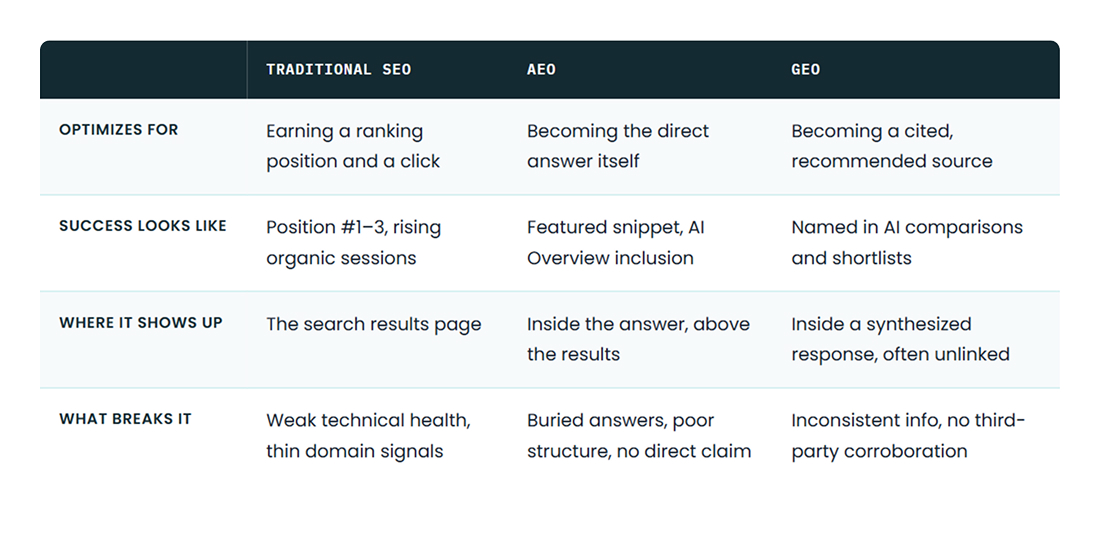
The reason strong rankings don’t automatically translate into AI mentions is straightforward once you see it: a ranking measures whether Google’s crawler and relevance model like your page. A citation measures whether a generative model’s synthesis process – which draws on your page plus everything else it has read about your brand – decided you were worth quoting. Those are related questions, but they’re not the same question, and optimizing only for the first one leaves the second one to chance.
How AEO and GEO Puts Brands In The Room Before The First Conversation
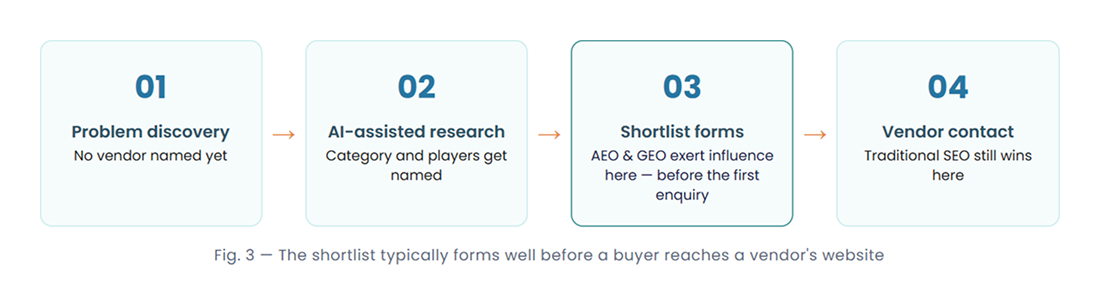
A buyer often doesn’t start with vendor names. They start with a symptom: “our reporting takes three days to close,” “we keep failing the same code review.” An AI assistant is frequently the thing that turns that symptom into a category and a category into two or three named providers, all inside a single exchange the buyer has with no one else present.
That’s a meaningfully different moment than a search results page, because the shortlist is already forming before the buyer visits a single vendor site. Appearing in that shortlist creates a real commercial advantage: you skip the “who even are you” tax that unfamiliar vendors pay in a first call. Appearing consistently, across repeated queries and different AI tools, builds something closer to familiarity – by the time the buyer actually reaches out, they’ve effectively pre-qualified you.
Don't Wait Around To Find Where You Stand
Get an AI Visibility Audit
How AEO Helps Content Become the Answer
Good AEO starts with a discipline most content doesn’t practice: writing the heading the way the buyer actually asks the question, not the way keyword research suggests phrasing it. “How much does X cost” outperforms “X pricing considerations” for extraction, because it mirrors the query itself.
Underneath that heading, the answer needs to arrive first – a direct, complete sentence a system could lift on its own – before the supporting explanation, caveats, and context follow. Structuring the rest with lists, comparison tables, explicit definitions, and FAQs isn’t a stylistic preference; it’s what makes a claim parseable rather than buried in narrative prose. And the short answer still needs real evidence behind it – specific numbers, named examples, a worked scenario – because a model is more likely to trust and reuse an answer that’s backed by something concrete rather than a confident but empty sentence.
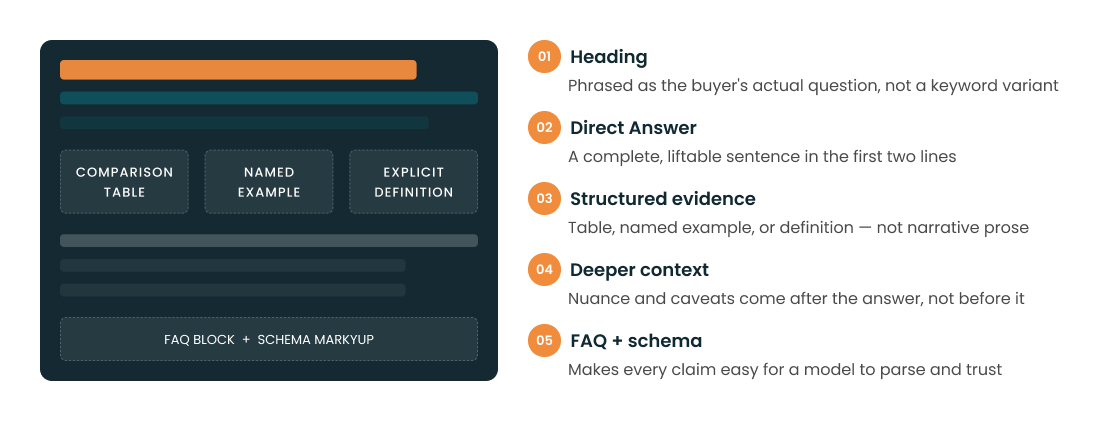
When content is structured this way, it becomes easier for search engines and AI systems to identify the main answer, understand its context, and reuse it confidently. Effective AEO is not about writing shorter content-it is about making the most valuable information unmistakably clear, credible, and ready to surface wherever the buyer asks the question.
How GEO Helps Brands Become Trusted Sources
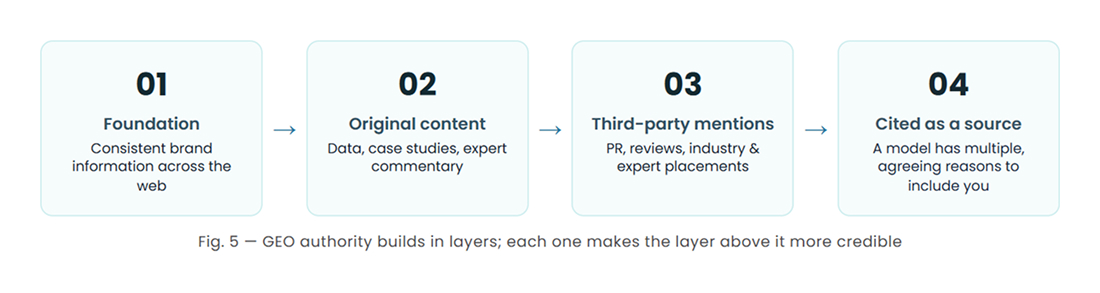
GEO rewards depth in one category over breadth across many. A brand that publishes original data, real case studies, and expert commentary in a specific area gives a model something genuinely citable – content only that brand could have produced. Generic advice content, however well written, is also true of a hundred other sites, and models have little reason to single one out.
Much of this work happens off your own domain. Earning mentions across credible third-party sources, using PR, reviews, industry platforms, and expert contributions, is what tells a model that outside voices agree with your claims – not just your own marketing page. And consistency across all of it matters more than any single placement: a model treats contradictory brand information as a reason to hedge, qualify, or leave a brand out of an answer entirely.
What AEO and GEO Mean for Businesses and Agencies
The value lands differently depending on which side of the relationship you sit on – but both sides are solving the same underlying problem: visibility that standard rank tracking no longer fully captures.
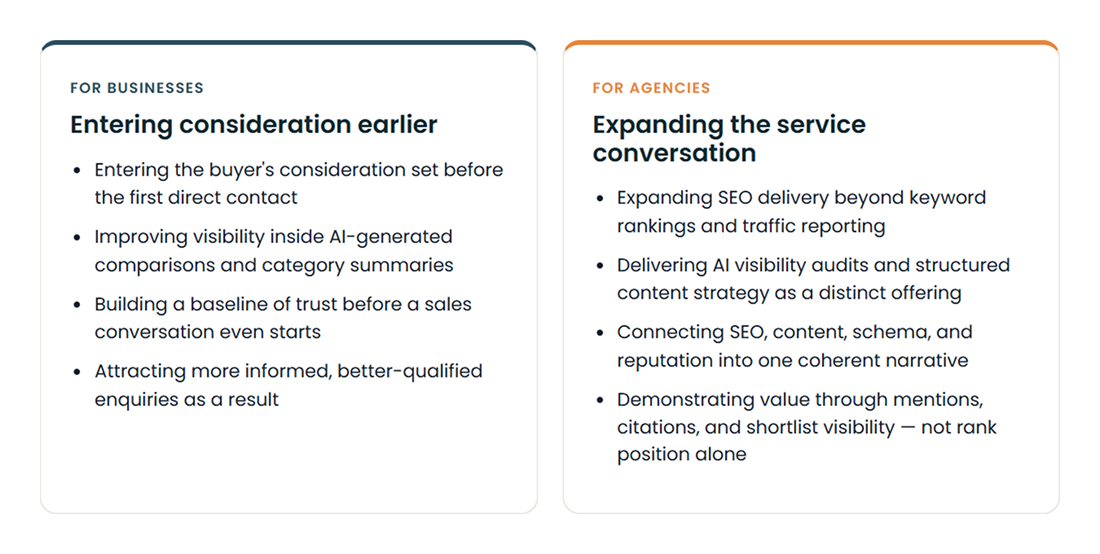
For businesses, AEO and GEO improve the likelihood of being considered before a buyer reaches out. For agencies, they create a more complete way to deliver, measure, and communicate visibility.
The common goal is clear: ensure the brand is not only searchable, but understandable, credible, and worthy of being included in the answers that shape buying decisions.
Step by Step Building an AEO and GEO Strategy
AEO and GEO do not work as a one-off content sprint. They require an ongoing audit-and-build cycle that improves how clearly a brand is understood, how confidently its content can be extracted, and how often it is recognised as a credible source.
For businesses aiming to improve AI Overview visibility, this means more than adding keywords or publishing FAQs. Content must answer real buyer questions directly, demonstrate topical authority, use structured data accurately, and be supported by consistent brand signals across trusted external sources.
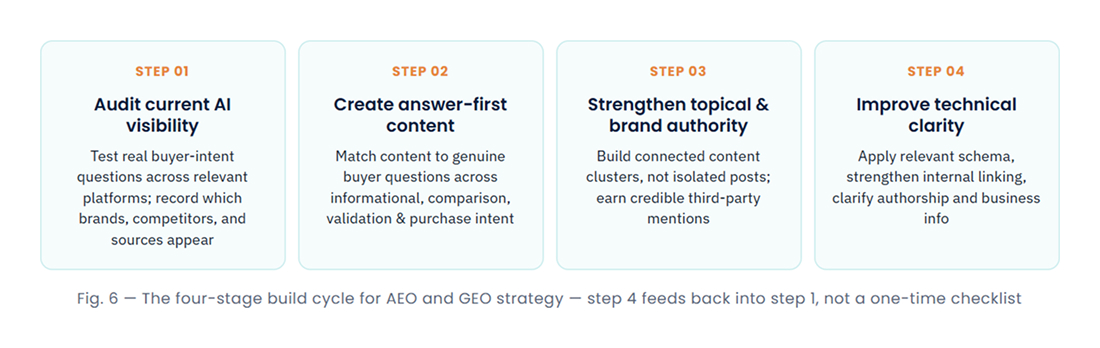
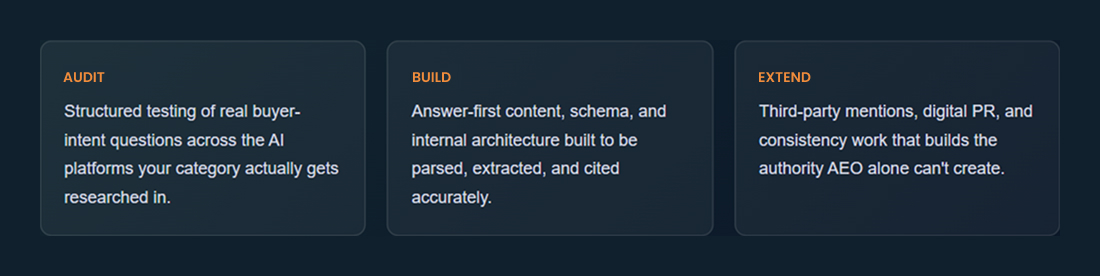
The process typically moves through four connected stages: auditing current AI visibility, restructuring content for answer extraction, strengthening authority and citations, and measuring how often the brand appears in AI-generated answers, comparisons, and recommendations. Each stage informs the next, creating a continuous optimisation cycle rather than a one-time campaign.
The Mistakes that Quietly Sink AEO & GEO Efforts
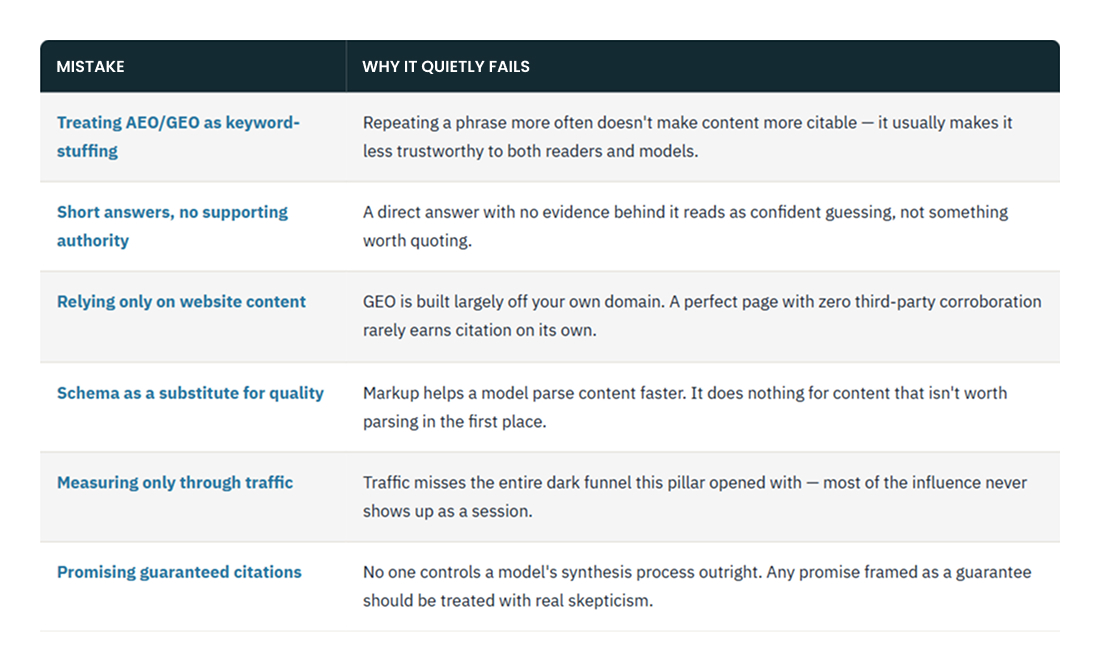
Most failures here aren’t dramatic. They’re small miscalibrations that compound over months of publishing without anyone noticing the pattern.
Businesses now have to influence consideration before direct contact ever happens. Agencies now have to connect search, content, authority, and digital PR into a single, coherent system – because a model doesn’t separate those disciplines the way most retainers still do.
Where ZealousWeb Fits: Built For the Visibility That Rankings Alone No Longer Capture
ZealousWeb connects AEO, GEO, and technical SEO into a single working system – content structured to be answered, authority built to be cited, and reporting that accounts for what happens before a buyer ever reaches a website.
The dashboard was never the whole picture. Now the gap is impossible to ignore.
Rankings and traffic still matter – they’re just no longer sufficient on their own to describe whether a brand is actually being considered. The businesses and agencies that adjust to that reality early won’t just show up in more AI-generated answers. They’ll be positioned to explain, with real evidence, why they showed up at all.
Conclusion
AEO and GEO are no longer optional additions to traditional SEO; they are becoming essential to how brands are understood, trusted, and shortlisted throughout the AI-led buyer journey. Success requires more than restructuring a few pages or adding schema-it demands the right combination of technical SEO, answer-focused content, brand authority, credible citations, and continuous visibility tracking.
With proven experience across these areas, ZealousWeb helps businesses and agencies build an integrated AEO and GEO strategy that goes beyond rankings-strengthening how brands appear in AI-generated answers, comparisons, and recommendations before a buyer ever reaches out.
Find Out If AI Engines Are Recommending You or Your Competitors.
Lets Talk