

Every year someone declares email marketing dead, and every year it quietly outperforms whatever channel was supposed to replace it. The twist in 2026 is that email itself has changed shape. It is no longer a newsletter you schedule on a Tuesday – it is a live, AI-driven conversation that adjusts to what a subscriber does in real time. Businesses and agencies that are still running the old playbook are not losing to a new channel. They are losing to a smarter version of the same one.
Is Email Marketing Still Worth It in 2026? Yes – and it is arguably more valuable now than it was five years ago. Email is one of the only channels a business fully owns; there is no algorithm deciding who gets to see it. In 2026, the winning programs combine AI automation, hyper-personalization, and predictive send logic to turn a static newsletter list into a live, revenue-generating channel.
The losing programs are the ones still treating email as a broadcast tool instead of a conversation engine.
This guide walks through what actually changed, why it changed so fast, and what an AI-driven email program looks like in practice – from generative copywriting to predictive send-time models to the early agentic systems starting to reshape lifecycle marketing. No fluff, no recycled “email is not dead” arguments. Just what is working now and what to do about it.
What Is Email Marketing in 2026?
Email marketing in 2026 is the practice of using AI-driven automation, behavioral data, and real-time personalization to send messages that adapt to each subscriber, rather than sending one static message to an entire list. It still uses the same inbox as 1996, but almost nothing about how the message gets built, timed, or targeted works the same way anymore.
What Has Changed About Email Marketing?
The channel used to reward volume – more sends, more segments, more A/B tests run manually by a human. In 2026, it rewards relevance. Inbox providers actively punish generic blasts with lower placement, subscribers ignore anything that feels templated, and AI now handles the segmentation and timing work that used to take a marketing team days to configure by hand.
Is Email Marketing Still Worth Investing In?
Yes. Email marketing remains one of the highest-return channels available because it is an owned audience – no platform can suddenly change an algorithm and cut your reach overnight. According to Litmus, most marketers still rank email among their top revenue-driving channels, and that has not changed even as social and paid media costs keep climbing.
What has changed is the skill required to make it work. Batch-and-blast email is worth less every year. AI-driven, individualized email is worth more every year. Same channel, very different return depending on how it is run.
Why Is Email Marketing Changing So Quickly?
Three forces are pushing email to evolve faster than at any point in the channel’s history: AI capability, privacy regulation, and inbox competition. None of them are slowing down, which is why “figure it out later” is no longer a viable strategy.
AI Is Moving Email From Campaigns to Customer Journeys
Marketing teams used to plan campaigns – a single email or short series sent to everyone on a segment at the same time. AI has shifted the unit of work from “campaign” to “journey,” where each subscriber moves through a personalized sequence shaped by their own behavior, not a calendar date someone picked in a planning meeting.
Privacy Is Changing How Subscriber Intent Is Measured
Apple Mail Privacy Protection, Gmail’s image caching, and broader data privacy rules have made old tracking methods unreliable. Marketers can no longer trust open rates the way they once did, which is forcing a shift toward zero-party data – information subscribers volunteer directly – and behavior-based signals that do not depend on tracking pixels.
Inbox Competition Is Making Relevance More Important Than Volume
The average inbox is more crowded than ever, and inbox providers use engagement signals to decide who lands in the primary tab versus promotions or spam. Sending more emails to people who do not open them actively hurts deliverability for the emails that matter. Relevance is no longer a nice-to-have – it is a technical requirement for staying out of spam folders.
What Are the Biggest Email Marketing Trends in 2026?
Litmus and Salesforce both point in the same direction this year: generative AI across the workflow, real-time personalization, lifecycle automation, and privacy-first measurement. Here is the shortlist worth actually paying attention to, before the deep dive on each one below.
| Trend | What It Actually Means |
| AI-Powered Email Marketing | Generative and predictive AI drafting copy, timing sends, and scoring leads |
| Hyper-Personalization | Content that adapts per subscriber, not just by first name or segment |
| Predictive Email Automation | Models that forecast the best time, message, and channel per subscriber |
| Lifecycle Marketing Automation | Journeys triggered by behavior instead of fixed calendar dates |
| Zero and First-party Data | Subscriber-shared preferences replacing third-party tracking |
| Interactive Email Experiences | Polls, carousels, and in-email actions that reduce click friction |
| Privacy-first Measurements | Metrics that do not rely on unreliable open tracking |
| Email Authentication and Trust | SPF, DKIM, DMARC, and BIMI as baseline requirements, not extras |
Every one of these connects back to the same idea: AI is only useful when it is fed clean data and pointed at a real subscriber problem. The next several sections break down exactly how.
What Is AI-Powered Email Marketing?
AI-powered email marketing uses machine learning and generative AI to automate decisions that used to require manual work – writing copy, timing sends, segmenting lists, and predicting which subscribers are close to converting. It splits into two categories: generative AI, which creates content, and predictive AI, which makes decisions based on data.
Generative AI vs. Predictive AI in Email
Generative AI writes: subject lines, body copy, image variations, and creative alternatives. Predictive AI decides: when to send, who to send to, what offer to show, and which subscribers are worth prioritizing. Confusing the two is a common mistake – a tool that writes great subject lines will not tell you the best time to send them, and a send-time model will not write your copy for you.
Where AI Fits Across the Email Marketing Workflow
AI now touches nearly every stage: drafting and testing copy, building segments from behavioral patterns, timing individual sends, personalizing content blocks in real time, and scoring leads for sales handoff. The workflow used to be linear and manual. Now it is largely automated, with a human reviewing outputs rather than producing every piece from scratch.
What AI Should - and Shouldn't - Automate
AI should automate repetitive, data-heavy decisions: send timing, subject line testing, segmentation, and basic personalization. It should not fully automate brand voice, sensitive communications, or strategic positioning – those still need a human who understands the business, not just the data.
Ready to Put AI Behind Your Email Strategy?
Explore AI-Powered Email Marketing Solutions
How Is Generative AI Changing Email Campaign Creation?
Campaign production used to be the slowest part of email marketing. Generative AI has compressed weeks of copywriting and testing cycles into hours, without necessarily lowering quality – as long as a human is still editing the output.
AI-Generated Subject Lines and Preview Text
AI tools can generate dozens of subject line variations in seconds, trained on what has historically driven opens and clicks for a specific list. The value is not the first draft – it is the volume of options a marketer can test without spending an afternoon brainstorming alone.
AI-Assisted Email Copy and Creative
Generative AI drafts body copy, product descriptions, and even image variations based on a brand’s voice guidelines. It works best as a first draft engine, not a final-copy engine – the brands seeing the best results still have a human tightening tone and accuracy before anything ships.
Automated Campaign Variations
Instead of building one email and hoping it resonates broadly, AI can generate multiple versions of the same campaign tailored to different segments, tones, or offers – all from a single creative brief, cutting production time significantly.
AI-Powered A/B and Multivariate Testing
AI does not just generate variations – it tests them automatically, allocates send volume toward whichever version is winning, and reports results without a marketer needing to manually pull and compare data after each send.
What Is Hyper-Personalization in Email Marketing?
Hyper-personalization is email content that adapts to each individual subscriber in real time, based on their behavior, preferences, and purchase history – not just their first name or a broad segment label. It goes beyond “Hi [First Name]” into content blocks, offers, and messaging that genuinely differ from one subscriber to the next.
Dynamic Content Blocks
A single email template can display different products, images, or messaging depending on who opens it, pulled live from a subscriber’s browsing or purchase history. One send, dozens of effective versions.
Personalized Offers and Recommendations
Instead of a blanket discount for everyone, AI can recommend products or offers based on what a specific subscriber is likely to want next – the same logic streaming platforms use for recommendations, applied to inbox content.
Behavioral and Intent-Based Messaging
Messaging shifts based on what someone actually did – browsed a page, abandoned a cart, downloaded a resource – rather than what segment they were manually assigned to weeks ago. Intent-based triggers react to real signals instead of static labels.
Real-Time 1:1 Email Personalization
The most advanced version of this pulls live data at the moment an email is opened, showing inventory, pricing, or content that is accurate right then – not whatever was true when the email was scheduled days earlier.
Your Emails Should Adapt to Customers, Not the Other Way Around.
Build Smarter Email Campaigns
How Does Predictive AI Make Email Automation Smarter?
Predictive AI looks at historical subscriber behavior and forecasts what is likely to happen next – when someone will engage, what they might buy, or whether they are close to unsubscribing. Salesforce highlights this as one of AI’s clearest wins in email: using past behavior to guide send timing, segmentation, scoring, and recommendations automatically.
Predictive Send-Time Optimization
Instead of sending to an entire list at 10 a.m. because that is when the marketing team logs in, AI sends each subscriber’s email at the time they personally are most likely to open it – which can differ by hours from one person to the next.
Predictive Segmentation
Rather than manually building segments based on guesses, AI clusters subscribers by behavioral similarity – people who behave alike get grouped, even if a human would never have thought to group them that way.
Lead and Conversion Propensity Scoring
AI assigns a score predicting how likely a subscriber is to convert, based on engagement patterns. Sales and marketing teams use this to prioritize follow-up instead of treating every lead the same.
Next-Best-Message and Next-Best-Action Models
These models decide, for each subscriber, what the single most effective next message or action would be – a discount, a case study, a reminder – based on what has worked for similar people at a similar stage.
What Is Agentic Email Marketing - and Is It the Next Step After Automation?
Agentic email marketing uses AI systems that make ongoing decisions about a subscriber’s journey in real time – choosing what to send, when, and sometimes through which channel – instead of following a prebuilt sequence someone designed months ago. It is the step after automation, where the AI adapts the plan itself rather than just executing a fixed one.
Rule-Based Automation vs. AI-Driven Automation
Rule-based automation follows “if this, then that” logic someone configured manually. AI-driven automation adjusts its own rules based on outcomes, learning which paths actually convert instead of relying on a static flowchart built once and never revisited.
From Prebuilt Drips to Adaptive Journeys
A drip sequence sends email three, five, and ten regardless of what the subscriber does in between. An adaptive journey changes course mid-sequence – skipping a step if someone already converted, or branching into a different message if someone shows a new signal of interest.
How AI Agents Could Orchestrate Email Campaigns
In practice, this looks like an AI system continuously deciding the next best touchpoint for each subscriber across the entire lifecycle, rather than a human mapping out every branch of a journey in advance. This is still an emerging capability in 2026, not a mature standard yet.
Where Human Oversight Still Matters
Agentic systems are good at optimization, not judgment. Brand tone, sensitive topics, legal disclaimers, and strategic positioning still need a human checking the AI’s decisions before they reach a subscriber’s inbox.
How Can Businesses Build AI-Driven Lifecycle Email Journeys?
Lifecycle automation remains one of the highest-priority investments for marketers because it scales personalized communication without scaling headcount at the same rate. Here is where AI adds the most value across the subscriber lifecycle.
| Journey Stage | What AI Automates |
| Welcome & Onboarding | Sequences that adjust based on what a new subscriber clicks first |
| Lead Nature | Content pacing based on engagement, not a fixed weekly schedule |
| Abandoned Intent & Re-engagement | Triggers fired the moment intent signals appear or fade |
| Post-purchase & Retention | Timing and offers based on typical repurchase patterns |
| Win-back Campaigns | Identifying who is worth re-engaging before they go fully cold |
| Event & Webinar Follow-Up | Messaging branched by attendance and engagement level |
None of these stages need to be built from scratch every time. The structure repeats – what changes is the data feeding it, which is exactly why lifecycle automation scales so well once it is set up properly.
Why Are Zero-Party and First-Party Data Becoming Critical?
Zero-party and first-party data are becoming critical because privacy changes have made third-party tracking unreliable, and AI personalization is only as good as the data behind it. Data a subscriber directly shares is more accurate and more durable than data quietly inferred from tracking pixels that inbox providers are actively limiting.
What Is Zero-Party Data?
Zero-party data is information a subscriber deliberately gives you – preferences, interests, or answers to a quiz – rather than data collected by observing their behavior. It is the most accurate input AI personalization can use, because there is no guessing involved.
How Preference Centers Improve Personalization
A well-built preference center lets subscribers tell you exactly what they want to hear about and how often, which AI can then use to tailor content without relying on assumptions that are often wrong.
How Polls and Interactive Emails Collect Intent
A single poll embedded in an email can reveal more accurate intent than weeks of inferred behavioral tracking, and it does so with the subscriber’s full knowledge and consent.
How CRM and CDP Data Power AI Personalization
Customer relationship management (CRM) and customer data platform (CDP) systems combine purchase history, support interactions, and engagement data into one profile, giving AI a fuller picture than email behavior alone ever could.
How Is Interactive Email Changing Subscriber Engagement?
Interactive email lets subscribers take action without leaving their inbox, which reduces the friction that normally causes people to abandon a click halfway through.
Polls, Quizzes, and Surveys
Embedded polls collect zero-party data while also giving subscribers a reason to engage beyond just reading – engagement that inbox providers reward with better future placement.
Interactive Product Experiences
Product browsing, size selection, or configuration can now happen directly inside an email, shortening the path from interest to purchase by removing an entire click.
Carousels and Dynamic Content
Rotating product carousels let a single email showcase multiple items without feeling cluttered, and they can update automatically as inventory or pricing changes.
In-Email Actions That Reduce Click Friction
RSVP buttons, one-click reordering, and in-email forms let subscribers complete an action instantly, rather than clicking through to a website and possibly losing interest along the way.
Why Is Email Deliverability Now a Brand Trust Issue?
Email deliverability is a brand trust issue because inbox providers now use authentication and engagement signals to decide whether a sender is trustworthy, and a failing grade lands even legitimate emails in spam. Deliverability is no longer a technical afterthought – it directly determines whether your AI-personalized email ever gets seen at all.
SPF, DKIM, and DMARC
These are authentication protocols that prove an email genuinely came from your domain and was not altered in transit. Without them properly configured, inbox providers increasingly treat your email as suspicious by default.
BIMI and Visual Brand Verification
Brand Indicators for Message Identification (BIMI) lets your verified logo appear next to your emails in supported inboxes, giving subscribers a visual trust signal before they even open the message.
Sender Reputation and Engagement Signals
Inbox providers track how recipients interact with your emails – opens, clicks, deletes without reading, spam reports – and use that history to decide where your future emails land.
List Hygiene and Spam Complaints
Sending to inactive or invalid addresses drags down engagement rates and raises complaint rates, both of which damage sender reputation faster than most marketers realize.
Why More Email Doesn't Always Mean More Reach
Sending more frequently to people who do not engage actively lowers your reputation with inbox providers, which then suppresses delivery for the emails that actually matter. Volume without relevance is a losing trade.
Why Are Open Rates No Longer Enough?
Open rates are no longer reliable because Apple Mail Privacy Protection pre-loads images for a large share of inboxes, which inflates open counts regardless of whether someone actually read the email. Litmus specifically recommends shifting measurement toward click-through rate, conversions, and revenue per email – metrics that require a genuine action, not just a pre-fetched image.
How Apple Mail Privacy Protection Changed Open Tracking
Apple’s privacy feature loads tracking pixels automatically for many users, whether or not they opened the email, which artificially inflates open rate data across a large portion of most lists.
Click-Through Rate vs. Click-to-Open Rate
Click-through rate measures clicks against total sends; click-to-open rate measures clicks against opens. Both are more trustworthy than open rate alone, since a click requires deliberate action a bot cannot fake.
Conversion Rate and Revenue per Email
These metrics tie email activity directly to business outcomes – a sale, a signup, a booked call – which is ultimately what leadership actually cares about, not how many people technically opened a message.
Subscriber Engagement and Retention
Tracking how engagement changes over time – not just per campaign – shows whether your list is getting healthier or quietly decaying underneath decent-looking single-send numbers.
Email-Attributed Pipeline and Revenue
Connecting email activity to CRM pipeline stages shows how much real revenue the channel influences, which is the number that actually justifies budget in a leadership meeting.
How Should Agencies and Businesses Measure Email Marketing ROI?
ROI measurement needs to span more than one metric category, because a single number rarely tells the full story. Here is the fuller picture worth reporting on.
| Metric Category | What To Track |
| Engagement | Click-through rate, click-to-open rate, forward and share rate |
| Conversion | Conversion rate, cost per conversion, landing page completion |
| Revenue | Revenue per email, revenue per subscriber, attributed pipeline |
| Lifecycle | Journey completion rate, time-to-conversion by stage |
| Deliverability | Inbox placement rate, spam complaint rate, bounce rate |
| Customer Lifetime Value | How email-engaged subscribers compare to non-engaged ones |
Reporting on just one row from that table gives leadership a partial picture at best, and a misleading one at worst. Pick metrics from each category, not just the ones that make last month’s campaign look good.
How Can Email Marketing Connect With CRM, CDP, and Marketing Automation?
Email performs better and reports more clearly when it is not sitting in an isolated tool disconnected from everything else the business tracks.
Email + CRM
Connecting email to a CRM means sales teams see engagement history alongside deal data, and marketing sees which leads are actually progressing rather than just clicking.
Email + Customer Data Platforms
A CDP unifies data from every touchpoint into one subscriber profile, giving AI personalization far more context than email opens and clicks alone.
Email + Sales Automation
High-intent email behavior can automatically trigger a sales alert or task, closing the gap between marketing engagement and a human follow-up.
Email + Website Behavioral Data
Combining on-site browsing data with email activity lets AI personalize based on the full picture of what someone is interested in, not just what they clicked in an inbox.
Email + Omnichannel Journeys
Email increasingly works alongside SMS, push notifications, and ads as one coordinated journey, rather than as an isolated channel running its own separate calendar.
When Should You Use AI Automation - and When Should a Human Take Over?
Use AI automation for repetitive, data-heavy decisions – timing, segmentation, testing, and prediction. Keep a human in charge of brand voice, strategy, and anything sensitive, like a legal notice, a service outage, or a message following a customer complaint. Salesforce specifically emphasizes ethical AI use, data quality, and human oversight over indiscriminate automation, and that guidance holds up well in practice.
Automate Repetitive Decisions
Send-time optimization, subject line testing, and basic segmentation are exactly the kind of decisions AI handles better and faster than a human comparing spreadsheets manually.
Use AI for Prediction and Optimization
Lead scoring, churn prediction, and next-best-action recommendations are pattern-recognition tasks AI is genuinely good at – better than a human relying on gut feel across thousands of subscribers.
Keep Humans in Brand, Strategy, and Sensitive Communications
Brand tone, seasonal campaign strategy, crisis communications, and anything legally sensitive still need human judgment. AI does not understand context the way a person who knows the business does.
Create AI Governance and Approval Rules
Set clear rules for what AI can send automatically versus what needs human review before it goes out. This single step prevents most of the embarrassing AI-generated email mistakes that make the news.
What Email Marketing Practices Should You Stop Relying On?
Some habits that used to be standard practice are now actively working against deliverability and results. Here is what to retire.
| . |
| ❌ Batch-and-blast campaigns – sending the same message to your entire list regardless of behavior ❌ Open-rate-only reporting – a metric Apple’s privacy changes have made unreliable on its own ❌ Generic segmentation – grouping by broad demographics instead of actual behavior ❌ Static drip sequences – fixed sequences that ignore what a subscriber does along the way ❌ Purchased or low-intent lists – a fast way to damage sender reputation permanently ❌ Manual campaign optimization – testing and adjusting by hand what AI can do continuously ❌ Personalization limited to first names – the bare minimum, not a personalization strategy ❌ None of these will get you flagged overnight, but each one quietly caps how well your email program can perform against a competitor doing all of this properly. |
How Can You Prepare Your Email Marketing Strategy for AI-Powered Inboxes?
Inboxes themselves are getting smarter – AI-powered summarization, prioritization, and filtering are becoming standard features, not experiments. Preparing for that shift means writing and structuring email differently.
Write for Humans, Not Just Opens
AI summarization tools inside inboxes will increasingly condense your email before a human even sees the full version, which means your core message needs to survive being shortened by a machine.
Make Email Content Easier to Scan and Understand
Clear structure, short paragraphs, and a single obvious point per email make it easier for both humans and AI inbox tools to extract what actually matters.
Strengthen Brand and Sender Trust
Authentication, consistent sending patterns, and genuine engagement all feed into how AI-powered inbox filters decide whether your email deserves priority placement.
Prioritize Clear Intent and CTAs
A single, obvious call to action performs better than three competing ones – both for human attention and for AI systems trying to summarize what the email wants the reader to do.
Build Emails Around Useful Subscriber Actions
Design every email around one clear action a subscriber can take, rather than cramming in every update, offer, and announcement into a single message.
What Will the Future of Email Marketing Look Like?
The direction is already visible in how the biggest platforms are investing. Here is where the channel is headed next.
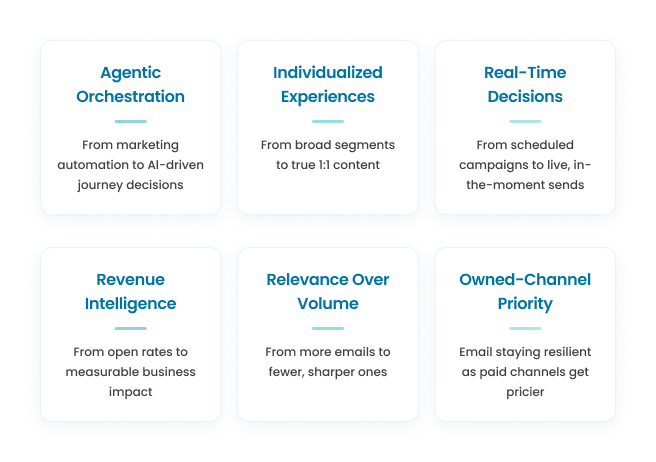
None of this replaces the core idea of email marketing – it just makes the good version of it more powerful and the lazy version of it more obviously broken.
How Should You Build an Email Marketing Strategy?
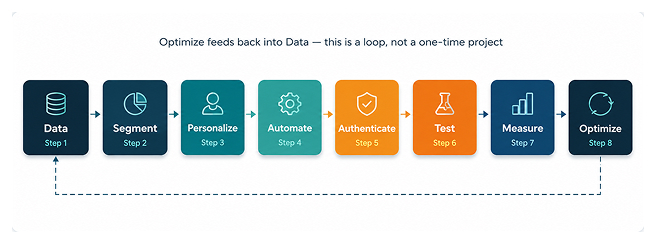
Pull everything above into one sequence, and the strategy becomes a repeatable framework rather than a list of trends to admire from a distance.
| . |
| ✅ Data – clean, permission-based, unified across CRM and CDP ✅ Segment – behavioral clusters, not just demographic guesses ✅ Personalize – dynamic content built on zero-party and first-party signals ✅ Automate – lifecycle journeys that adapt to behavior in real time ✅ Authenticate – SPF, DKIM, DMARC, and BIMI configured properly ✅ Test – AI-run variations across copy, timing, and offers ✅ Measure – engagement, conversion, revenue, and deliverability together ✅ Optimize – feed results back into step one and repeat |
Conclusion
Everything covered in this guide sounds great in a strategy meeting and then quietly stalls the moment someone has to actually build it – the predictive models, the lifecycle triggers, the authentication records, the personalization logic that has to run every time an email fires. Most internal teams don’t have a spare AI engineer sitting around, and most agencies don’t want to burn senior hours configuring send-time algorithms instead of managing client strategy.
That’s the gap ZealousWeb fills. AI automation is not a bolt-on we added to a services list – it’s the part of email marketing we’re genuinely strongest at, from predictive send-time models and behavioral triggers to full lifecycle journeys that adjust themselves instead of running on a fixed drip. Agencies bring us in to run this behind the scenes for their clients without adding headcount. Businesses bring us in to get an email program that behaves like it’s actually 2026, not 2016 with a nicer font.
Ready to Make Email Work Harder Across the Customer Lifecycle?
Talk to Our Email Marketing Experts
FAQs
How much does AI-powered email marketing implementation cost?
Cost depends on your platform, database quality, integrations, automation depth, and personalization requirements.
Is our existing customer database ready for AI-driven email marketing?
We assess data quality, segmentation, consent, duplication, and behavioral signals before automation begins.
Do we need to replace our current email marketing platform?
Not always. We first evaluate whether your existing stack can support your automation and personalization goals.
What happens if our customer data is incomplete or poorly structured?
We help clean, organize, map, and enrich the data before building advanced automation.
Who owns the data, workflows, and automation setup after implementation?
Your business retains ownership of customer data, campaign assets, automation logic, and implementation outputs.
How do we measure whether email automation is actually delivering ROI?
We track conversions, attributed revenue, pipeline influence, retention, engagement, and automation performance.
Cluster Topics
Cluster Topics