

Performance marketing used to mean one thing: chase the click, count the lead, report the CPL, repeat. That playbook is breaking. AI has quietly rewired every layer of the funnel – how ads get bid on, how creative gets tested, how leads get qualified, and even how customers find you in the first place. If your reports still lead with “cost per lead” and stop there, you’re already reading last season’s scoreboard.
This guide walks through what’s actually changed, why last-click attribution is losing its grip, and what a business needs in place – data, tracking, creative, measurement – to make AI work for revenue instead of just volume. We’ll keep it practical. No jargon soup, no theory for theory’s sake.
What Is AI-Powered Performance Marketing?
AI-powered performance marketing is the use of machine learning and predictive models to run and optimize paid campaigns – bidding, targeting, creative, and budget allocation – based on which actions actually drive revenue, not just clicks or leads.
Think of classic performance marketing as a person adjusting bids by hand, checking a spreadsheet every morning. AI-powered performance marketing replaces that manual guesswork with models that read thousands of signals in real time – browsing behavior, purchase history, device type, time of day – and decide, in milliseconds, who’s worth showing an ad to and how much to pay for that chance.
The shift isn’t just “more automation.” It’s a different question being asked. Old performance marketing asked, “Did this ad get clicked?” AI-powered performance marketing asks, “Will this specific person become a profitable customer?” That’s a much harder, much more useful question – and it’s the one platforms like Google, Meta, and Amazon are now built to answer by default.
How Is AI Changing Performance Marketing Today?
AI is changing performance marketing by automating bidding, generating creative at scale, predicting which leads will convert and connecting ad platforms directly to CRM and revenue data – shifting the job from “run the campaign” to “train and supervise the system running it”
A few years ago, marketers picked keywords, set manual bids, and split-tested two ad versions if they were being thorough. Today, most major ad platforms default to automated, AI-driven bidding, and manually overriding it often produces worse results, not better ones.
Here’s the practical shift happening across performance teams right now:
- Bidding has moved from rule-based (“bid $2 for this keyword”) to predictive (“bid whatever this specific auction is worth right now”).
- Creative production has gone from a handful of static ads to dozens of AI-generated variations tested simultaneously.
- Lead scoring has moved from gut feel to models trained on your actual closed-won data.
- Measurement has expanded from last-click reports to multi-touch and incrementality models.
None of this means marketers are less important. It means the job moved up a level – from pulling levers to deciding which levers are worth pulling, and feeding the machine better data than your competitors feed theirs.
Why Performance Marketing Is Moving Beyond Keywords and Last-Click Attribution
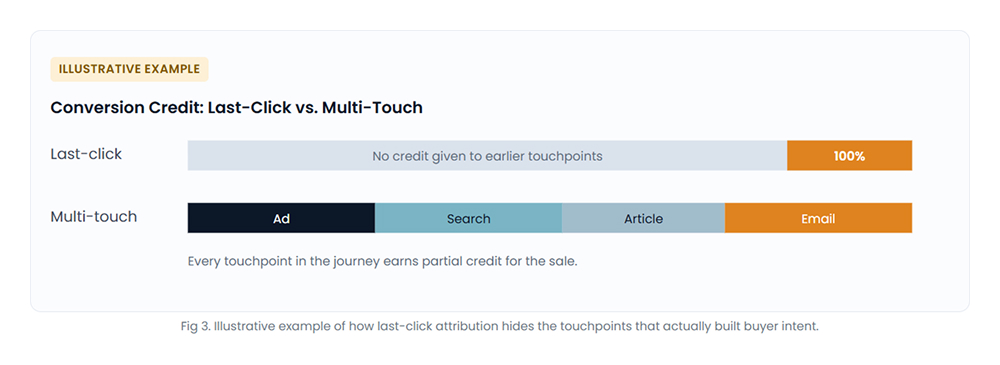
Picture a customer who sees an Instagram ad, googles the brand name two days later, reads a comparison article, then finally converts from a retargeting email. Last-click attribution hands the entire win to the email. Meanwhile, the Instagram ad and the comparison article – the parts that actually did the persuading – get zero credit and often get cut from the budget for “underperforming.”
Keywords have the same problem. People don’t only type search terms anymore – they ask AI assistants, scroll short-form video, or ask a friend for a recommendation and then just search the brand name. A strategy anchored only to exact-match keywords misses most of that journey entirely.
The businesses pulling ahead are the ones measuring the full path, not just the last step of it.
AI-Powered Media Buying: Smarter Bidding, Budgeting, and Campaign Optimization
Google’s Performance Max, Meta’s Advantage+, and similar smart-bidding systems all work the same basic way: feed the platform your conversion data, and it learns which auctions are worth winning. The better and cleaner the data you feed it, the smarter it gets – which is why data quality now matters more than bid strategy itself.
What this looks like in practice:
- Automated bid adjustments that respond to demand shifts within the same day, not the same week.
- Cross-channel budget shifting that moves spend toward whichever platform is converting best right now.
- Audience expansion that finds new, similar buyers based on your existing customers, not just your targeting guesses.
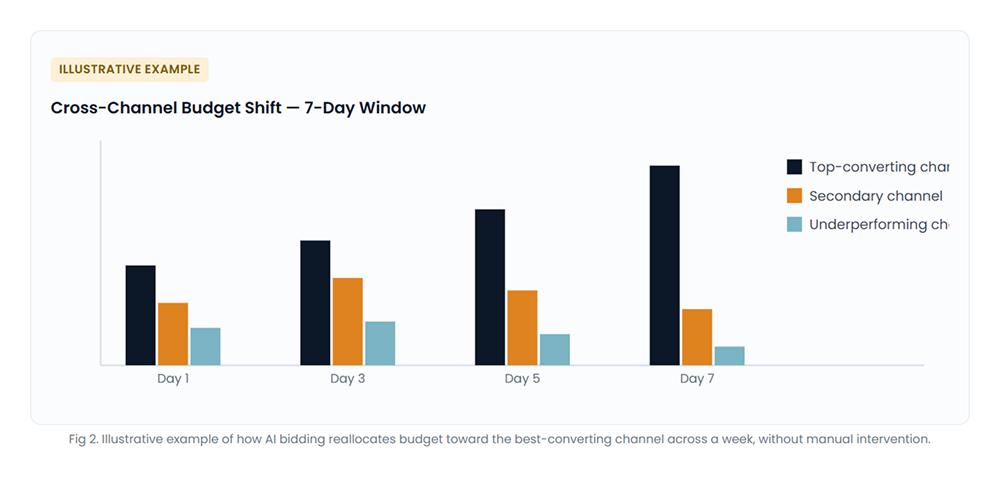

The catch: AI bidding systems are only as good as the conversion signal you send them. Feed them junk leads, and they’ll happily go find you more junk leads – just faster.
Why Creative Is Becoming the Biggest Performance Lever
When every advertiser has access to the same smart-bidding algorithms, the algorithm stops being the differentiator. What’s left to compete on is the ad itself – and AI has made that side of the equation move fast too.
AI-generated creative variations
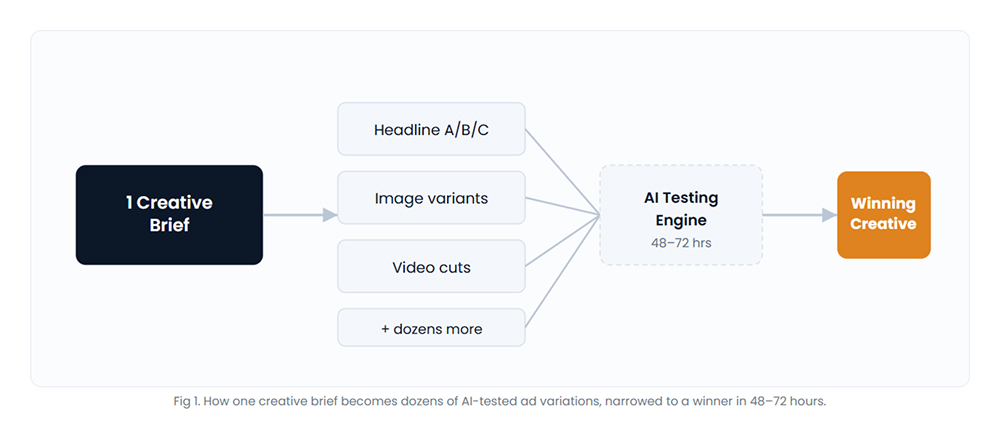
Tools can now generate dozens of headline, image, and video combinations from a single brief, letting platforms test which specific pairing performs best for which audience segment – something no human team could manually produce at that speed.
Short-form video and dynamic assets
Short, native-feeling video consistently outperforms static banners across most paid channels today. AI tools help resize, caption, and adapt one video into a dozen platform-specific formats in minutes instead of days.
Creative testing at scale
Instead of running one A/B test for two weeks, AI systems now run dozens of micro-tests simultaneously and reallocate spend toward the winners automatically, often within 48 to 72 hours.
Good creative used to be a nice-to-have next to a strong media plan. Now it’s the plan.
How First-Party Data Is Becoming the Foundation of Performance Marketing
For years, advertisers leaned on data bought or borrowed from someone else. That well is drying up fast, thanks to privacy regulation and browsers phasing out third-party tracking. AI models still need signal to learn from – so the businesses with the richest owned data are the ones whose AI campaigns actually get smarter over time.
First-party and Zero-party Data
First-party data is what you collect directly – purchase history, site behavior, email engagement. Zero-party data is what customers volunteer on purpose, like preferences shared in a quiz or a signup form. Both feed AI models far more reliably than any purchased list ever could.
CRM and Customer Data Integration
Connecting your CRM directly to ad platforms lets AI bidding systems learn from real closed-won and closed-lost outcomes, not just form fills. This single integration is often the highest-leverage fix a performance team can make.
Offline Conversion Signals
Phone calls, showroom visits, in-person sales – feeding these back into ad platforms as offline conversions closes a gap that used to make half the funnel invisible to the algorithm.
The businesses treating their CRM as marketing infrastructure, not just a sales tool, are the ones AI rewards first.
Why Server-Side Tracking Matters for Better Measurement
Server-side tracking sends conversion data from your own server directly to ad platforms instead of relying on a browser cookie, which means measurement keeps working even when browsers, ad blockers, or privacy settings block traditional tracking.
Browser-based tracking has been quietly leaking data for years – ad blockers, Safari’s privacy rules, and cookie consent banners all chip away at what a pixel can actually see. Server-side tracking (often through a tool like Google’s Conversion API or Meta’s Conversions API) fixes this by sending the same event straight from your server, bypassing the browser entirely.
Why it matters for AI specifically: smart-bidding algorithms are trained on conversion events. If 20 to 30% of those events silently disappear due to browser restrictions, the algorithm is learning from an incomplete, biased picture – and optimizing toward the wrong thing without anyone noticing.
Fixing tracking isn’t glamorous work. It’s also one of the few upgrades that makes every other AI tool downstream immediately smarter.
How AI Is Shifting Performance Marketing From Lead Volume to Lead Quality
AI is shifting performance marketing from lead volume to lead quality by scoring leads on likelihood to convert and close, using models trained on past sales outcomes – so campaigns can chase fewer, better leads instead of the cheapest possible ones.
Cheap leads have always been easy to generate. Filling out a form for a free ebook takes ten seconds and rarely signals real buying intent. AI lead scoring changes the incentive by measuring campaigns against who actually became a customer, not who filled out a form.
Qualified Leads Over Cheap Leads
A $40 lead that becomes a customer beats a $5 lead that never replies. AI models trained on your sales data can predict this before the sales team even makes the first call.
CRM Feedback Loops
When sales teams mark leads as won, lost, or disqualified inside the CRM, and that data flows back to the ad platform, the algorithm learns to find more of the leads that actually closed.
Optimizing for Real Buyers
Instead of optimizing toward “cost per lead,” campaigns increasingly optimize toward “cost per qualified opportunity” – a small wording shift with a very large budget impact.
Volume still matters. It’s just no longer the finish line.
How AI Is Connecting Ad Spend With Sales and Revenue
AI connects ad spend with sales and revenue by linking ad platform data directly to CRM and sales outcomes, so campaigns can be measured and optimized by actual dollars earned instead of leads generated.
The old handoff between marketing and sales was mostly a spreadsheet email once a month. AI-connected systems make that handoff live and continuous.
Marketing-to-sales Data Flow
Integrations between ad platforms and CRMs (Salesforce, HubSpot, and similar tools) let revenue data flow back into the same dashboard where ad performance lives, closing the loop that used to take weeks.
Revenue-based Conversion Tracking
Instead of counting every form fill as one conversion, revenue-based tracking assigns actual dollar values, letting the algorithm favor campaigns bringing in bigger deals, not just more of them.
Customer Lifetime Value Signals
Feeding predicted, or historical LTV into ad platforms helps AI bidding systems favor customers likely to stick around and spend more, not just convert once.
When ad spend and revenue finally sit in the same report, budget conversations get a lot shorter – and a lot more honest.
Why Last-Click Attribution Is No Longer Enough
Last-click attribution is no longer enough because it credits only the final touchpoint before conversion, ignoring every earlier ad, search, or piece of content that actually built the buyer’s intent – leading to budget cuts on channels that were quietly doing the real work.
| Method | What it Measures | Best Used For |
| Multi-touch attribution | Credit split across every touchpoint in the buyer journey | Understanding channel interplay |
| Marketing mix modeling | Statistical impact of channels on overall sales, including offline | Big-picture budget planning |
| Incrementality/lift testing | Actual sales lift caused by a channel, tested with holdout groups | Proving true causal impact |
Multi-touch attribution, marketing mix modeling, and incrementality testing exist to fix exactly this blind spot, each solving it a slightly different way.
Marketing Mix Modeling
Uses statistical modeling across months of data to estimate how much each channel – including offline ones like TV or events – actually contributes to sales.
Incrementality and Lift Measurement
Tests a channel by turning it off for a control group and measuring the sales difference, which is the closest thing performance marketing has to a real controlled experiment.
No single method is perfect. Most mature performance teams now run at least two of these side by side, rather than betting everything on one number.
How Predictive AI Is Changing Bidding and Budget Allocation
Predictive AI changes bidding and budget allocation by forecasting how likely a specific person is to convert and how valuable they’ll be as a customer, then adjusting bids and budget in real time instead of on a fixed weekly schedule.
This is where AI stops reacting to the past and starts betting on the future – and it’s the piece of the stack most responsible for the efficiency gains performance teams are seeing.
- Conversion probability
Models estimate, auction by auction, how likely a specific user is to convert based on hundreds of behavioral signals – and adjust the bid accordingly, in real time.
- Customer value prediction
Beyond “will they convert,” predictive models estimate “how much will they be worth,” letting budget flow toward higher-value prospects even if they’re a bit more expensive to acquire upfront.
- Real-time budget shifts
Budget can now move between campaigns and channels within hours based on live performance, instead of waiting for a weekly review meeting to approve the change.
The businesses winning here aren’t the ones with the biggest budgets. They’re the ones whose data lets the prediction be right more often.
Why Performance Marketing Metrics Are Moving From CPL to Profit
Performance marketing metrics are moving from cost-per-lead to profit-based metrics like CAC, ROAS, and LTV because CPL only measures how cheaply you can generate interest, not whether that interest ever turns into a profitable customer.
A campaign can hit a fantastic CPL and still lose the business money if none of those leads ever buy. Profit-based metrics close that gap by tracing spend all the way through to the bottom line.
| CAC (Customer Acquisition Cost) | Total cost to acquire one paying customer, not just one lead |
| Qualified CPL | Cost per lead that actually meets your sales-ready criteria |
| ROAS (Return on Ad Spend) | Revenue generated for every dollar spent on ads |
| LTV (Lifetime Value) | Total revenue a customer generates over their full relationship with you |
| Revenue per Lead | Average revenue produced by each lead, qualified or not |
| Gross Profit | Revenue minus cost of goods, the closest number to actual money kept |
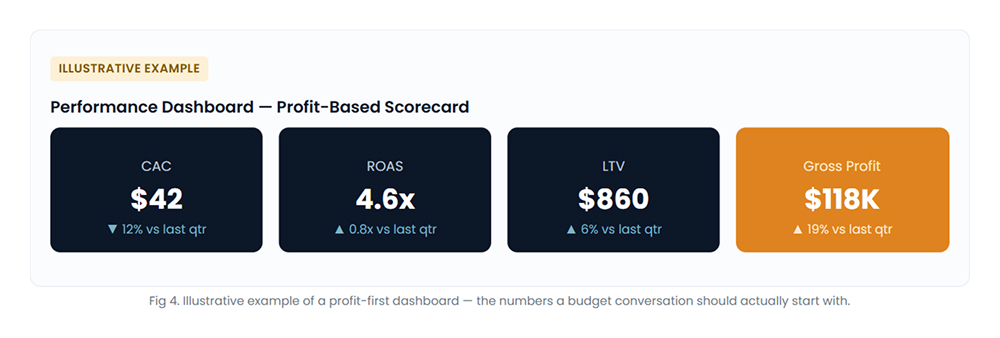
None of these metrics replace CPL entirely – it’s still useful for early funnel checks. But treating it as the finish line, instead of a checkpoint, is how budgets end up rewarding volume over value.
How AI Is Making Performance Marketing Experiments Faster
AI is making performance marketing experiments faster by automatically generating test variations, analyzing results in near real time, and reallocating budget toward winners within days instead of the weeks a manual test cycle used to take.
Testing used to be the bottleneck of performance marketing – slow, statistically fragile, and easy to skip under deadline pressure. AI has removed most of that friction.
- Faster campaign testing: Automated platforms can launch, monitor, and conclude simple tests within days, reaching statistical confidence far sooner than manual test setups ever could.
- Better hypotheses: AI-assisted analysis of past campaign data surfaces patterns humans might miss, turning “let’s just try something” into “let’s test this specific, data-backed idea.”
- Lean testing before scaling: Small-budget tests validate an idea before committing serious spend, letting teams fail cheap and scale only what’s already proven to work.
Faster testing doesn’t mean sloppier testing – it means more chances to be right before the budget gets big.
How AI Search Is Changing the Performance Marketing Customer Journey
AI search is changing the customer journey by moving discovery away from traditional keyword search results and into AI Overviews, ChatGPT, and Perplexity answers – meaning brands now need to be citable by AI, not just rankable on a search engine.
A growing share of research now happens inside an AI answer box, not a list of ten blue links. If your content isn’t structured for AI to quote, you can rank well on Google and still be invisible in the answer someone actually reads.
Search Beyond Traditional Google Results
Customers are asking AI tools direct questions – “what’s the best CRM for a 20-person agency” – and acting on the answer without ever clicking through to a website.
AI Overviews and LLM discovery
Google’s AI Overviews and chat-based tools pull short, self-contained passages from web pages to build their answers, which means the passage itself has to be clear enough to stand alone.
AEO and GEO visibility
Answer Engine Optimization (AEO) and Generative Engine Optimization (GEO) are the practices of structuring content so AI systems can find, understand, and cite it – direct answers, clear definitions, and clean formatting instead of long, meandering intros.
Intent and Context Over Exact Keywords
AI systems match meaning, not exact phrases, so content built around a real question and a direct answer performs better than content stuffed with exact-match keywords ever will.
Performance marketing that ignores AI search is optimizing for half the funnel that still exists.
How Performance Partnerships Are Becoming More Outcome-Focused
Performance partnerships are becoming more outcome-focused as brands shift from paying creators and affiliates a flat fee to paying them based on actual sales, signups, or verified leads generated – putting the risk and the reward on real results.
The affiliate and influencer world is quietly adopting the same “pay for outcomes” logic that’s reshaped paid media.
- Creator-led acquisition
Creators with an engaged, trusting audience are increasingly treated as a performance channel, tracked with the same rigor as a paid ad campaign.
- Affiliate and revenue-share models
Instead of a flat fee per post, affiliates increasingly earn a share of the actual revenue their content generates, aligning their incentive directly with yours.
- Pay-for-performance partnerships
Brands are structuring partner deals around verified conversions rather than impressions or clicks, which weeds out low-effort placements fast.
Partnerships built this way tend to survive budget cuts, because their value is already proven in the numbers.
What Should Businesses Do to Build an AI-Ready Performance Marketing Strategy?
Businesses can build an AI-ready performance marketing strategy by strengthening first-party data, connecting CRM to ad platforms, fixing conversion tracking, building a creative testing engine, and shifting reporting from leads to revenue.
None of this requires a complete rebuild overnight. It requires picking the right order.
- Strengthen first-party data – start capturing richer customer signals directly, not just email addresses.
- Connect CRM and ad platforms – this single integration usually produces the fastest visible improvement.
- Improve conversion tracking – move to server-side tracking before investing further in AI bidding.
- Build a creative testing engine – set up a repeatable process for producing and testing variations weekly, not quarterly.
- Optimize for revenue, not just leads – rebuild dashboards around CAC, ROAS, and LTV as the primary numbers, with CPL as a supporting metric.
Most teams try to jump straight to step five. The ones who actually see results start at step one.
Conclusion
AI is making performance marketing faster and more predictive, but access to better technology alone will not create a competitive advantage. The real advantage comes from connecting the right data, tracking, creative, automation, and revenue signals so every marketing decision gets closer to what actually grows the business. As AI becomes standard across platforms, how intelligently a business puts it to work will matter more than simply having access to it.
For agencies and businesses ready to make that shift, ZealousWeb brings AI-powered strategy, automation, performance marketing, and digital engineering together around measurable business outcomes. From building smarter acquisition systems to connecting marketing data with sales and revenue, we create AI-powered solutions designed to turn fragmented digital efforts into a more connected growth engine.
Turn Your Marketing Data Into Smarter Revenue Decisions
Talk To Our Experts

FAQs
Will AI actually improve our results, or are we just paying for another marketing buzzword?
Our team uses AI where it adds measurable value-better targeting, faster testing, stronger lead qualification, and smarter optimization. We focus on business outcomes, not AI for the sake of AI.
How do we know you won't just chase cheap leads to make the reports look good?
We look beyond CPL. Our experts track lead quality, sales feedback, conversions, CAC, and revenue so campaigns are optimized for customers who matter to your business.
Are real people still managing our campaigns?
Absolutely. AI supports our team; it does not replace them. Strategy, creative thinking, budget decisions, performance reviews, and major optimizations stay under expert human oversight.
Will we lose control once campaigns become heavily automated?
No. We keep you informed about where budgets are going, what is being tested, what is changing, and why. Automation should give you better control through clearer data-not less visibility.
Do we need a perfect CRM, tracking setup, or huge amount of data before working with you?
No. Our team first assesses what you already have, identifies the gaps, and improves the foundation gradually. We build around your current stage rather than forcing an unnecessarily complex setup.
How will you understand our business instead of applying the same AI strategy to every client?
We start with your customers, sales cycle, margins, priorities, and growth goals. Our experts then shape the campaigns, automation, measurement, and AI workflows around how your business actually makes money.
What if our campaigns are getting leads but sales are still not improving?
That is exactly where our approach goes deeper. We look at the full journey-from ad and landing page to lead quality, CRM follow-up, attribution, and revenue-to identify where performance is really breaking down.