
Your agency already invested time and expertise into getting visitors to your clients’ websites.
Paid media teams optimize campaigns. SEO teams improve visibility. UX teams refine layouts. Developers build faster experiences.
But after all that effort, there is still one question clients ask:
“Why are we getting traffic, but visitors are not converting?”
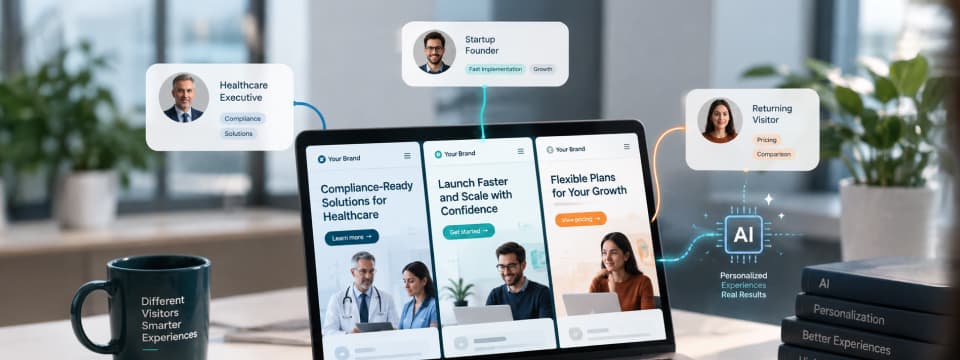
Sometimes, the answer is not more traffic. It is the experience visitors receive after they arrive. A healthcare executive searching for compliance-focused solutions. A startup founder looking for faster implementation. A returning visitor comparing pricing options.
They all have different reasons for visiting. Yet most websites still give them the same headline, the same case studies, and the same CTA. That is where AI website personalization creates a new opportunity for agencies.
Not as another AI buzzword to add to a proposal. But as a practical way to help clients make their existing website work harder by adapting experiences based on visitor intent, behavior, and context. For agencies offering website development, marketing, paid acquisition, UX, CRO, or digital strategy, personalization can become the next layer of value after the click.
What Website Personalization Actually Means
Website personalization means adapting website experiences based on visitor context, behavior, and intent.
It does not mean creating thousands of website versions or rebuilding every page for every audience. That approach would quickly become expensive and impossible to maintain.
Practical personalization focuses on identifying meaningful visitor differences and adjusting specific parts of the experience.
For agencies, this creates opportunities to improve areas they already influence, such as messaging, landing pages, content strategy, and conversion paths.
Common Website Personalization Areas
| Website Elements | Personalization Opportunities |
| Messaging | Adjust headlines based on visitor intent or industry |
| Content | Show relevant case studies, resources, or solutions |
| CTAs | Recommend actions based on buying readiness |
| Navigation | Guide visitors toward relevant pages |
| Recommendations | Highlight suitable products or services |
A visitor arriving from a targeted campaign should not always receive the same experience as someone casually exploring a website for the first time.
The goal of personalization is simple: make the website experience more relevant without adding unnecessary complexity.
Where AI Contributes to Website Personalization
AI is not the personalization strategy itself. It is the technology layer that helps agencies and businesses analyze visitor signals, identify patterns, and create more relevant website experiences at scale. Instead of relying only on manual rules, AI-powered personalization uses data from visitor behavior, campaigns, and customer interactions to support smarter decisions around content, messaging, and conversion paths.
- Understanding Visitor Intent AI can analyze signals such as pages visited, search behavior, content engagement, repeat visits, and previous interactions to understand what visitors may need next. This helps agencies create more personalized website experiences based on actual user intent rather than assumptions.
- Creating Dynamic Website Content AI-driven website experiences can help adapt headlines, content recommendations, case studies, product suggestions, and website messaging based on visitor context. This allows businesses to present more relevant information without creating separate websites for every audience.
- Automating Personalization Decisions AI automation helps identify patterns across large volumes of visitor data and supports decisions around which content, CTA, or experience may be most relevant for specific audiences. This reduces manual effort while allowing agencies to scale personalization strategies.
- Supporting Continuous Optimization AI personalization works alongside CRO and analytics by helping agencies understand which experiences perform better for different visitor segments. Teams can test, measure, and refine personalized journeys to improve conversions over time.
For agencies, the value of AI in website personalization is not replacing human strategy or creativity. It is helping teams use data more effectively to create AI-driven website experiences that are more relevant, measurable, and aligned with client business goals.
How Visitor Segmentation Creates More Relevant Website Experiences
Visitor segmentation helps agencies move beyond one-size-fits-all websites by identifying why different audiences arrive, what they are looking for, and what experience can help them take the next step. Instead of treating every visitor the same, AI website personalization uses signals such as intent, behavior, and context to create more relevant website experiences that improve engagement and conversion opportunities.
- Traffic Source and Campaign Intent Visitors arriving from different campaigns already carry different expectations. Agencies can use campaign data, search intent, and referral sources to align website messaging with the reason a visitor clicked. A visitor from a healthcare campaign, for example, can see relevant industry proof points instead of generic website content.
- Visitor Behavior and Website Interactions Actions such as repeated service page visits, content downloads, product views, and time spent on specific pages reveal visitor intent. AI automation can analyze these behavior patterns and help create behavior-driven website experiences with more relevant content, recommendations, and CTAs.
- Location and Industry Context Different industries and regions often have different priorities. AI-powered personalization can help businesses highlight relevant solutions, case studies, and messaging based on visitor context, making the website experience more aligned with audience expectations.
- First-Time vs Returning Visitors A first-time visitor usually needs awareness-building content, while a returning visitor may already be evaluating solutions. Personalizing experiences based on visitor history helps agencies create smoother customer journeys instead of showing the same content repeatedly.
- Customer Journey Stage Visitors at different stages require different information. AI-driven website experiences can support the journey by showing educational resources during awareness, proof points during consideration, and conversion-focused CTAs when visitors are ready to take action.
For agencies, visitor segmentation creates the foundation for meaningful AI website personalization. The goal is not creating endless website variations but helping clients deliver the right message, content, and experience to the right audience at the right moment.
Practical AI Website Personalization Use Cases Agencies Can Bring to Clients
This is where AI website personalization becomes a practical opportunity for agencies. Instead of positioning AI as another technology upgrade, agencies can use it to improve existing client websites by making experiences more relevant, conversion-focused, and aligned with visitor intent.
| Use Case | How Agencies Can Apply It |
| Personalized Website Messaging | Adjust headlines, content, and proof points based on visitor industry, campaign intent, or customer context. A healthcare visitor may see healthcare-focused case studies, while a manufacturing visitor sees relevant industry examples. |
| Dynamic CTAs Based on Intent | Display different calls-to-action based on visitor readiness. First-time visitors may receive educational CTAs, while high-intent visitors can be guided toward consultations or demos. |
| Behavior-Driven Experiences | Use visitor interactions such as pages viewed, resources downloaded, and previous visits to recommend relevant content, services, or next steps. |
| B2B Website Personalization | Create more relevant experiences for different decision-makers by adapting messaging around business outcomes, technical requirements, or industry-specific needs. |
| eCommerce Personalization | Improve product discovery through recommendations, recently viewed items, personalized offers, and category suggestions based on customer behavior. |
For agencies, the opportunity is not creating a completely different website for every visitor. It is helping clients make smarter adjustments that improve relevance, engagement, and conversion opportunities across existing digital experiences.
What Data Is Required for AI Website Personalization
AI website personalization does not start with technology. It starts with understanding what information can help agencies create more relevant visitor experiences. Most clients already have valuable data across their marketing channels, analytics platforms, and customer systems. The opportunity is connecting these signals to understand visitor intent and deliver more personalized website journeys.
Agencies should focus on collecting meaningful data points that answer three key questions: Who is visiting? Why did they arrive? What experience will help them move forward.
| Data Source | What Agencies Can Analyze | Personalization Opportunity |
| Website Behavior | Pages visited, time spent, repeat visits, navigation patterns | Show relevant content, case studies, and CTAs based on visitor interest |
| Campaign Data | Paid keywords, ad campaigns, landing page intent, referral sources | Align website messaging with the campaign that brought visitors in |
| CRM Data | Customer stage, previous interactions, account details, industry | Create more relevant B2B website experiences for prospects and customers |
| Content Engagement | Resources downloaded, articles viewed, topics explored | Recommend relevant content and guide visitors toward the next step |
| Product/Service Interest | Products viewed, categories explored, service pages visited | Personalize recommendations, offers, and conversion paths |
For agencies, the goal is not collecting unlimited data or adding unnecessary complexity. It is identifying the signals that reveal visitor intent and using AI automation to turn those insights into better digital experiences.
Before recommending AI website personalization, agencies should evaluate:
| Evaluation Area | Key Question |
| Traffic Volumne | Does the client have enough visitors to identify meaningful patterns? |
| Audience Segment | Are there clear differences between visitor groups? |
| Tracking Setup | Is the required data being captured accurately? |
| Business Goals | What specific outcome should personalization improve? |
When the right data, strategy, and technology come together, AI website personalization becomes more than a feature. It becomes an opportunity for agencies to help clients improve conversions, customer journeys, and long-term digital performance.
When Website Personalization Does Not Make Sense
AI website personalization can create significant value when applied to the right situation. However, agencies should avoid positioning it as a solution for every client website simply because it is an emerging AI capability.
A common mistake in the AI era is trying to add automation before fixing the fundamentals. A website with unclear messaging, poor user experience, weak conversion paths, or insufficient traffic will not suddenly perform better because it has personalization.
For agencies, the real expertise lies in identifying when personalization can create measurable impact and when another optimization approach should come first.
How Agencies Can Turn AI Personalization Into a Client Opportunity
AI website personalization can improve relevance, engagement, and conversions, but it is not a universal solution. For agencies, the real expertise is knowing when personalization can create measurable value and when improving the fundamentals should come first.
Before recommending AI-driven website experiences, agencies should evaluate the client’s website maturity, available data, audience differences, and business goals.
Personalization May Not Be the Right Fit When:
- The website foundation is weak If the website has unclear messaging, poor UX, slow performance, confusing navigation, or weak conversion paths, personalization will not fix the core problem. Agencies should first improve the overall user experience and conversion foundation.
- There is not enough traffic or behavioral data AI website personalization depends on meaningful visitor signals. Websites with limited traffic, unclear audience segments, or incomplete tracking may not have enough information to create reliable personalized experiences.
- Visitors have similar needs and journeys Personalization works best when different audiences require different information. If all visitors follow a similar journey and need the same content, adding multiple experiences may create unnecessary complexity.
- The client is not ready for continuous optimization Personalization is not a one-time AI automation project. It requires ongoing testing, analysis, content updates, and performance measurement to deliver results.
- The business goal is unclear Agencies should avoid implementing personalization without a defined objective. Whether the goal is improving lead quality, increasing conversions, or enhancing customer experience, success needs measurable outcomes.
Quick Agency Evaluation Checklist
| Questions | Why It Matters |
| Does the client have different visitor segments? | Personalization requires meaningful audience differences |
| Is the right data available? | AI needs reliable signals to make decisions |
| Can results be measured? | Success depends on clear business outcomes |
The best agencies do not recommend AI personalization because it is trending. They recommend it when it solves a real customer journey challenge and creates measurable value for the client.
How to Measure the Impact of Website Personalization
Website personalization should not be measured by how advanced the AI technology appears. For agencies and their clients, the real question is whether personalized experiences improve conversions, lead quality, customer journeys, and business outcomes.
The measurement approach should connect AI-powered personalization with clear marketing goals instead of focusing only on engagement metrics. A personalized experience is successful when it helps visitors find relevant information faster and encourages better actions.
Key Metrics Agencies Should Track
- Conversion Rate Improvement: Measure whether personalized messaging, landing pages, and CTAs are increasing actions such as form submissions, demo requests, purchases, or consultation bookings.
- Lead Quality and Business Impact: Track whether personalization is attracting better-fit prospects, improving sales opportunities, and contributing to revenue growth.
- Visitor Engagement Signals: Analyze whether visitors are interacting more with relevant content, spending more time on important pages, or exploring more resources.
- Customer Journey Progress: Evaluate whether personalized experiences help move visitors faster from awareness to consideration and decision stages.
- Campaign Performance Alignment: For paid media agencies, compare whether personalized landing experiences improve results from specific campaigns, audiences, or traffic sources.
How Agencies Can Measure and Optimize Personalization
A strong AI website personalization strategy follows a continuous optimization cycle:
- Analyze visitor behavior, audience segments, and campaign data.
- Personalize website content, messaging, and CTAs based on intent.
- Test personalized experiences against existing website journeys.
- Measure conversion, engagement, and business outcomes.
- Improve experiences based on performance insights.
For agencies, this creates a stronger client conversation. Instead of reporting only traffic or engagement numbers, teams can show how personalization improves the visitor journey and supports measurable growth.
A white-label partner like ZealousWeb can help agencies explore, implement, and optimize AI-driven website personalization opportunities without requiring them to build every capability internally. The goal is not to personalize every part of a website. The goal is to identify where the right experience for the right visitor can create better results.
Conclusion
The future of websites is not about creating more versions of the same page. It is about helping businesses deliver more relevant experiences to visitors who already arrive with different needs, expectations, and levels of intent.
Agencies are uniquely positioned to lead this shift because they already understand the complete digital journey – from driving traffic through campaigns and SEO to improving UX, CRO, and website performance. AI website personalization adds another layer by helping clients optimize what happens after the visitor arrives.
However, successful personalization requires more than implementing AI automation. It requires understanding visitor behavior, connecting marketing signals, identifying the right opportunities, and continuously improving experiences based on measurable outcomes.
For agencies looking to expand their capabilities without building every AI personalization workflow internally, ZealousWeb can act as a white-label technology and delivery partner. We help agencies identify personalization opportunities, support implementation, and optimize AI-driven website experiences while they continue owning client relationships.
The opportunity is not to personalize everything on a website. It is to identify where the right experience for the right visitor can improve engagement, conversions, and long-term client growth.
Explore a Client Personalization Opportunity
FAQs
Can AI personalization make website experiences feel robotic or remove the human touch?
No. AI personalization should enhance human decision-making, not replace it. Our team uses AI to identify patterns, improve relevance, and automate repetitive processes while keeping strategy, creativity, and customer understanding at the center. The goal is to create experiences that feel more meaningful and personalized, not less human.
How do you determine whether AI website personalization is the right opportunity for our client?
We do not start with technology recommendations. Our team first reviews the client's website, audience segments, marketing channels, analytics setup, and conversion goals. Based on these insights, we identify where personalization can create measurable value and where improving existing foundations may deliver better results.
Can you support personalization projects while our agency manages strategy and client communication?
Yes. Many agencies prefer to manage strategy, communication, and client ownership internally while relying on our team for specialized execution. We support personalization planning, technical implementation, AI workflows, testing, and optimization while fitting into your existing delivery process.
How will you work with our agency without disrupting our client relationship?
We understand that agencies own the client relationship. Our team works according to your preferred workflow, communication process, and level of involvement. Whether you need support behind the scenes or direct technical collaboration, we align our approach with your client engagement model.
What expertise do you bring beyond AI personalization tools?
Our team combines AI capabilities with practical digital execution across website development, UX, CRO, analytics, marketing automation, and AI-driven workflows. This helps agencies deliver personalization strategies connected to measurable business outcomes rather than technology implementation alone.
How is the engagement structured from a billing perspective?
We offer flexible engagement models based on project scope, complexity, and ongoing support requirements. Whether you need execution support for a specific initiative or continuous optimization assistance, we work with agencies to create a structure that aligns with their delivery model.