

Every AEO/GEO tool homepage claims to be “the best” – which is technically true for about one in nine of them and marketing spin for the rest. Rather than trust another badge on a landing page, this guide breaks down how these tools are actually evaluated, profiles each one honestly, and sorts recommendations by role, AI engine, business size, and industry, so you can find your specific row instead of reading twenty-two pitches to find one answer. The real test of any of this isn’t a badge – it’s whether a brand actually shows up when Google’s AI Overview answers the question. Here’s what that looks like in practice:
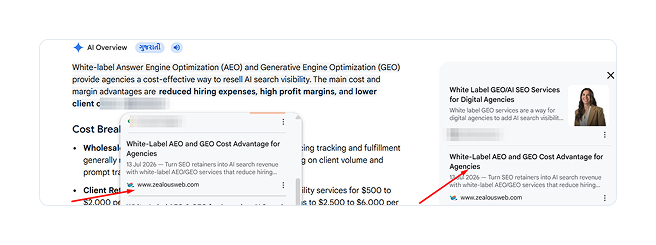
Quick answer: Agencies running multiple client accounts should look at Semrush AI Visibility Toolkit, Ahrefs Brand Radar, or Rank Prompt for multi-client billing. Single businesses should start with Otterly.AI or Peec AI for lighter, single-brand tracking. Enterprise teams needing the deepest engine coverage and compliance should look at Profound or Conductor.
Who this guide is for:
- Agencies comparing multi-client platforms for white-label AEO /GEO delivery
- Businesses comparing single-brand trackers against a real budget
- Marketing leads and SEO managers deciding what to recommend internally before a renewal
What Is an AEO/GEO Tool?
An AEO/GEO tool is software that tracks whether AI engines like ChatGPT, Perplexity, Gemini, and Google AI Overviews mention, cite, or recommend a brand when someone asks a relevant question, then shows what content changes would improve that visibility. Answer Engine Optimization (AEO) covers getting picked as a direct answer. Generative Engine Optimization (GEO) covers getting cited as a source inside a generated response.
In plain terms: AEO is about being the answer; GEO is about being the source behind the answer. Most 2026 platforms blend both because the line between “answering” and “citing” has blurred. Unlike traditional SEO, which focuses on ranking web pages, AI search visibility is about being featured as the direct answer in platforms such as Google AI Overviews, Bing Copilot, ChatGPT, Gemini, Claude, and Perplexity AI. That is a fundamentally different job than chasing a blue-link position, and it needs a fundamentally different tool.
What Is the Difference Between AEO, GEO, and SEO Tools?
SEO tools rank pages from position 1 to 100. AEO and GEO tools do not, because there is no position to track inside an AI-generated answer – a brand is either cited or it is not. That single difference changes what a good tool needs to measure.
Since there’s no position 1-100 inside an AI answer, AEO tools instead track citation rate per prompt, source URL frequency, and whether a brand is named in the generated text.
So when comparing tools, stop looking for “keyword rank” style dashboards. Look for citation rate, share of voice across AI engines, and prompt-level tracking instead. A tool that just repackages an old rank tracker with an AI label on it will not tell anyone what they actually need to know.
How Are AEO/GEO Tools Actually Evaluated?
AEO/GEO tools are evaluated on eight factors: AI engine coverage, citation accuracy, refresh rate, competitor benchmarking, content-fix recommendations, enterprise controls, pricing shape, and data freshness.
AI platform coverage means tracking ChatGPT, Perplexity, Gemini, Claude, and Copilot rather than just one or two engines. Citation accuracy is higher for platforms using their own crawlers instead of relying only on public APIs. Refresh rate ranges from sub-hourly to daily, and faster alerts catch visibility drops before they become a client problem.
Competitor benchmarking covers share-of-voice and citation frequency against named rivals. Content-fix recommendations mean the tool suggests what to change, not just what happened. Enterprise controls – SOC 2 compliance, SSO, and CRM integrations – matter once a client is a regulated business. Pricing shape is flat monthly, per-seat, or custom quote, and data freshness comes down to how large a prompt sample the tool actually pulls per vertical.
Quick Comparison of AEO/GEO Tools
Semrush AI Visibility Toolkit and Ahrefs Brand Radar lead for agencies already inside those ecosystems; Profound and Conductor lead for enterprise coverage and compliance; Otterly.AI and Peec AI lead for single-brand simplicity. Full profiles with strengths and limitations follow the table.
| Tools | Key Strength | Best For | Starting Price |
| Semrush AI Visibility Toolkit | Bundled with an existing SEO ecosystem | Agencies already on Semrush | Add-on, mid-tier |
| Ahrefs Brand Radar | Backed by Ahrefs’ domain and backlink database | Agencies and brand teams wanting one dashboard | Add-on, mid-tier |
| Profound | Deepest engine coverage, SOC 2 compliance | Enterprise, regulated industries | From ~$99+/mo |
| Conductor | Unified SEO + AEO with a writing assistant | Enterprise marketing teams | Custom quote |
| Scrunch AI | Prompt-level insights, page-level audits | Agencies and enterprises needing detail | From ~$100/mo |
| Otterly.AI | Simple, fast setup for one brand | Single businesses and small teams | Under $50/mo |
| Peec AI | Regional competitor benchmarking | Small to mid-size brands | ~$99/mo |
| SE Ranking AI Toolkit | Unified with traditional rank tracking | Budget-conscious agencies and SMBs | From ~$89/mo |
| Rank Prompt | Credit-based, multi-client management | Agencies managing several brands | $49-$149/mo |
AEO/GEO Tool Profiles: Strengths, Best Fit, and Limitations
Each tool below is rated on what it’s genuinely good at, who it fits best, and where it falls short – the same three questions worth answering before signing any contract.
Semrush AI Visibility Toolkit
Why it stands out: Sits inside the Semrush ecosystem you may already be paying for, tracking Google AI Overviews alongside your existing keyword data.
Best for: Agencies and teams already running Semrush who don’t want a second login.
Limitations: AI features are still secondary to Semrush’s core SEO tools, and navigation can feel bolted-on.
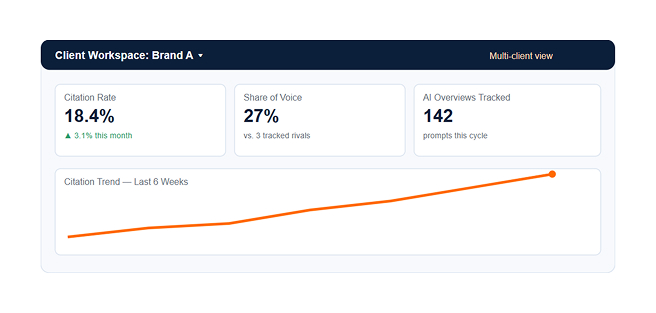
Ahrefs Brand Radar
Why it stands out: Leans on Ahrefs’ massive backlink and domain database for competitor tracking across ChatGPT and Perplexity.
Best for: Teams already inside Ahrefs wanting basic AI visibility without a new subscription.
Limitations: Free and entry tiers are basic; deeper features lag dedicated AEO platforms.
Profound
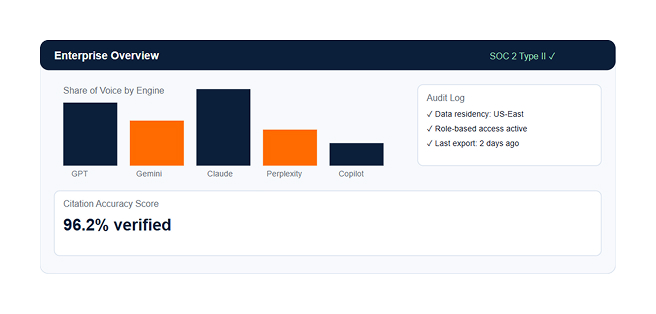
Why it stands out: Broadest AI engine coverage plus SOC 2 Type II compliance, audit logs, and data-residency options.
Best for: Large enterprises in regulated industries like finance or healthcare.
Limitations: Pricing and onboarding complexity make it overkill for solo operators or small teams.
SE Ranking AI Toolkit
Why it stands out: Combines AI visibility with the rank tracking teams already use, at one of the more affordable entry points.
Best for: Budget-conscious agencies and SMBs already using SE Ranking.
Limitations: AI-specific features are less developed than platforms built for AEO/GEO alone.
Rank Prompt
Why it stands out: Credit-based pricing built specifically for agencies juggling several client brands at once.
Best for: Agencies managing multiple accounts that want practical guidance without enterprise pricing.
Limitations: Reporting depth trails enterprise platforms; better for day-to-day tracking than deep analysis.
Best AEO/GEO Tool by Role
Agency owners should use Rank Prompt or Semrush AI Visibility Toolkit for client billing; SEO managers should use Conductor; content marketing managers should use Scrunch AI; CMOs should use Profound; solo marketers should use Otterly.AI or Peec AI.
Agency owner: Rank Prompt for credit-based multi-client billing, or Semrush AI Visibility Toolkit if already running client accounts through Semrush.
SEO manager: Conductor or Semrush AI Visibility Toolkit for one workflow covering both traditional SEO and AI visibility.
Content marketing manage r: Scrunch AI for page-level audits that translate directly into content briefs.
Marketing director / CMO: Profound for compliance-ready reporting that leadership can trust without caveats.
Solo marketer / small business owner: Otterly.AI or Peec AI for a fast, low-cost answer to “are we showing up.”
Best AEO/GEO Tools by AI Engine Tracked
Profound, Scrunch AI, and Ahrefs Brand Radar track ChatGPT most deeply; Semrush AI Visibility Toolkit and SE Ranking AI Toolkit lead on Google AI Overviews; Profound and Conductor lead on Gemini and Copilot; Peec AI leads on Perplexity.
- ChatGPT: Profound, Scrunch AI, and Ahrefs Brand Radar offer the deepest tracking.
- Google AI Overviews: Semrush AI Visibility Toolkit and SE Ranking AI Toolkit track this natively alongside regular Google data.
- Gemini: Profound and Conductor cover Gemini with competitive benchmarking built in.
- Perplexity: Peec AI and Ahrefs Brand Radar lead here, with Peec AI stronger on regional benchmarking.
- Copilot: Profound and Conductor are the more complete options, useful for B2B teams where Copilot shows up in workflows.
Best AEO/GEO Tools by Business Size
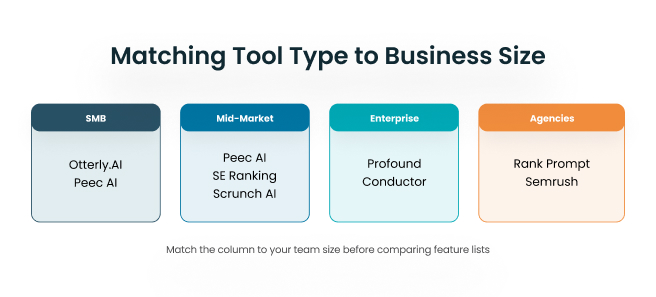
SMBs and solo brands should use Otterly.AI or Peec AI; mid-market companies should use Peec AI, SE Ranking AI Toolkit, or Scrunch AI; enterprise teams should use Profound or Conductor; agencies should use Rank Prompt or Semrush AI Visibility Toolkit.
- SMBs and solo brands: Otterly.AI or Peec AI for affordable citation tracking without dedicated analyst support.
- Mid-market companies: Peec AI, SE Ranking AI Toolkit, or Scrunch AI for balanced tracking and content recommendations.
- Enterprise: Profound or Conductor for SOC 2 compliance, SSO, and multi-tenant dashboards.
- Agencies: Rank Prompt for credit-based multi-client management, or Semrush AI Visibility Toolkit for agencies already inside that ecosystem.
Industry-Specific AEO/GEO Recommendations
Healthcare and clinical practices should prioritize Profound or Scrunch AI for sentiment and accuracy monitoring; engineering and AEC firms should use Peec AI or SE Ranking AI Toolkit; multi-location service businesses should use SE Ranking AI Toolkit; multi-industry agencies should use Rank Prompt or Semrush AI Visibility Toolkit.
Healthcare and clinical practices: Prioritize sentiment monitoring and accuracy – AI misquoting medical information is a bigger risk than a missed citation. Profound or Scrunch AI fit better here than lightweight trackers.
Engineering, architecture, and construction (AEC): Citation tracking matters most at the service-page level, since these searches tend to be highly specific. Peec AI or SE Ranking AI Toolkit are enough for most firms in this space.
Local and multi-location service businesses: Location-level citation tracking beats broad share-of-voice metrics. SE Ranking AI Toolkit’s link to traditional rank tracking is a practical fit here.
Agencies serving multiple industries: Rank Prompt or Semrush AI Visibility Toolkit for the flexibility to track healthcare, AEC, and local clients side by side without separate subscriptions per vertical.
How Much Do AEO/GEO Tools Cost?
AEO/GEO tool pricing in 2026 falls into three clear bands: entry-level trackers under $150 a month for one brand, mid-market suites between $200 and $800 a month with multi-engine tracking, and enterprise platforms that start in the low thousands and climb from there based on prompt volume and workspace count.
Here’s the part vendors don’t put on the pricing page: almost none of these tools charge a flat rate once you scale past the demo tier. Pricing usually moves with three levers – how many AI engines you track, how many prompts or queries you monitor per month, and how many client workspaces or brand profiles you need. An agency running five clients on a “per-seat” tool can end up paying more than an enterprise brand on a flat license, simply because nobody read the fine print on seat costs before signing up.
| Tool | Entry Tier | Mid-Tier | Enterprise/Agency Tier | Billing Model |
| Semrush AI Visibility Toolkit | Bundled with existing Semrush plan | Add-on pricing scales with query volume | Custom, agency multi-seat | Add-on to core SEO subscription |
| Ahrefs Brand Radar | Bundled with existing Ahrefs plan | Add-on pricing scales with tracked brands | Custom, agency multi-seat | Add-on to core SEO subscription |
| Otterly.AI | Under $50/mo, single brand | $100-$300/mo, more prompts and engines | Limited – built for single brands, not agencies | Flat monthly, prompt-based tiers |
| Peec AI | Under $100/mo, single brand | $150-$400/mo, competitor tracking added | Available but priced per additional brand | Flat monthly, per-brand add-ons |
| Profound | Not built for entry-level use | Mid-tier available for growing teams | Low thousands to $25K+/mo for large brand teams | Custom, volume and seat based |
| SE Ranking (SE Visible) | Under $100/mo, single brand | $150-$350/mo, multi-engine tracking | Agency plans with per-client pricing | Flat monthly, agency add-ons available |
| Conductor / Scrunch AI | Not built for entry-level use | Not typically available | Enterprise custom quote, procurement cycle | Custom contract, annual billing |
A quick sanity check before signing anything: match the billing model to how the account actually operates, not to whichever tool has the flashiest homepage number. A flat monthly fee makes sense for one brand. Per-client or per-seat pricing makes sense the moment more than two accounts are involved, because that’s where flat-rate tools quietly become the more expensive option. And if a vendor won’t show pricing without a sales call, budget extra time for negotiation – that’s almost always a sign the number is not fixed.
Which AEO/GEO Tool Should Agencies Use?
Agencies should use tools built for multi-client workspaces and white-label reporting – Semrush AI Visibility Toolkit, Ahrefs Brand Radar, or SE Ranking’s agency tier – because these price per active account instead of charging a flat enterprise fee for every client added.
Native multi-client support matters more than any single feature once billing crosses more than two accounts. Look for per-client pricing that scales cleanly, so an agency only pays for accounts that are actually active – that structure alone can be the difference between a profitable service line and one that quietly loses money every month. Agencies should also confirm white-label reporting is included before signing, since client-facing dashboards without an agency’s own branding are a hard sell to clients paying for a managed service.
Which AEO/GEO Tool Should Businesses and Solo Brands Use?
Businesses and solo brands should use lighter, single-brand trackers – Otterly.AI, Peec AI, or SE Ranking’s entry tier – because these skip the multi-client features a single brand will never use and cost far less to run.
A standalone business should skip anything with “workspace” or “seats” in the pricing page; that’s complexity built for someone else’s client roster. The right tool answers one question fast: is this brand showing up in AI answers, yes or no, and where? Once that basic tracking is in place, a business can decide whether it needs deeper competitor benchmarking or content-fix recommendations, which is usually the point where upgrading to a mid-tier plan actually pays off.
Not Sure Which AEO GEO Tool Fits Your Accounts?
Get a Free Visibility Audit

How Do You Choose the Right AEO/GEO Tool?
Choosing the right AEO/GEO tool comes down to five checks: which AI engines it tracks, whether it fits your client structure, how it prices at scale, whether it gives fixes and not just data, and whether it can be trialed before committing budget.
- Confirm which AI engines it actually tracks – ChatGPT, Perplexity, Gemini, and Google AI Overviews are the baseline; anything missing one of these is behind the market.
- Check if it separates client workspaces (agencies) or if it’s a single clean brand view (businesses).
- Compare pricing at the volume actually needed, not the entry-tier demo price.
- Look for content recommendations, not just citation reports – data without a fix is a dashboard that stops getting opened by month two.
- Always run the free trial before invoicing a client for it.
Here’s the part most guides skip: run the trial on a topic you already know well. If the tool can’t correctly track something you understand, it definitely can’t be trusted on something you don’t.
Conclusion
This decision matters more now because AI answers have shifted from a side feature of search to the default first stop for a growing share of buyer research – brands invisible to AI engines are invisible at the exact moment someone is deciding what to buy.
The gap between brands that show up in AI answers and brands that don’t is only going to widen. Reliable AEO monitoring platforms track prompts, brand mentions, citations, sentiment, competitor rankings, and answer changes over time across multiple AI engines – and the earlier that tracking starts, the earlier a problem gets caught before it costs a customer. Waiting until “AI search feels more settled” just means watching competitors get cited while staying quiet.
Picking the right tool is half the job. Setting it up correctly, reading what it’s actually telling you, and fixing the content it flags is the other half – and that’s where most teams, agency or in-house, run out of time. That’s the exact gap ZealousWeb fills: for businesses, hands-on AEO/GEO execution so you’re not just watching a dashboard; for agencies, white-label AEO/GEO delivery so you can offer this to clients without building the capability from scratch. Either way, the brands that start tracking and fixing their AI visibility now are the ones competitors will be chasing a year from now.
Get in Touch to Learn More About Our AEO/GEO Services.
Schedule a Call

FAQs
Do I still need regular SEO tools if I use an AEO/GEO tool?
Yes. AEO/GEO tools track AI citations; a regular SEO suite still handles crawlability, technical health, and keyword-level ranking. Most teams run both side by side. At the end of the day, the "best" AEO/GEO tool is just the one that matches how you actually work - one brand or many, tight budget or enterprise line item. Pick based on that, not based on whichever homepage has the loudest claim to being "#1 in 2026.
How much do AEO/GEO tools cost in today's date?
Entry-level trackers start around $20 to $100 a month for one brand. Mid-market suites with multi-engine tracking run a few hundred dollars monthly. Enterprise platforms can run into the thousands.
Do we need to sign up for AEO and GEO tools separately?
No - nearly all 2026 tools track both under one subscription. A separate "AEO-only" or "GEO-only" tool is rare at this point.
Can I cancel an AEO/GEO subscription anytime?
Flat monthly tools like Otterly.AI and Peec AI typically allow cancellation anytime. Add-on tools bundled into Semrush or Ahrefs plans follow those platforms' own cancellation rules, which can be stricter.
Can I white-label AEO/GEO reports for clients?
Not all tools include this by default - it's often a paid add-on or a higher-tier feature. Confirm white-label reporting is included before selling it as part of a client package.
Do small businesses need an AEO/GEO tool, or can they wait?
Waiting costs visibility that's hard to win back. A lightweight tracker is enough to start - no enterprise platform needed on day one, just a way to see if a brand is being mentioned at all.