



A 70%+ bounce rate in baby e-commerce isn’t just bad data; it’s a silent vote of no confidence from your customers.
This staggering number sends a clear warning that your visitors are leaving quickly due to poor user experience, technical glitches, or a mismatch between their expectations and what your site offers.
For baby e-commerce specifically, bounce rate is a critical trust signal. Parents are not casual shoppers; they are making highly emotional, often high-stakes purchases where safety, quality, and reliability are paramount. A poor, confusing, or slow website immediately erodes this foundational trust. This ties directly into the unique psychology of parents shopping for baby products: new parents, in particular, shop with elevated anxiety and the intense desire to be the “perfect parent”. They seek reassurance, detailed information (like safety standards and ingredients), and social proof (reviews) before committing.
If your site’s performance—or its lack of clear information—causes them to “bounce,” it means you have failed to provide the instant trust and seamless journey they need, costing you not just a sale, but potentially a loyal family.
Stay tuned as we uncover the key bounce rate red flags unique to baby stores and explore how to regain visitor trust and boost engagement through targeted fixes.
What Bounce Rate Really Tells You
Bounce rate is not just a statistic; it’s a window into how well your baby e-commerce store captures and holds the attention of parents seeking trusted baby products. Understanding what bounce rate reveals enables you to fine-tune your website to deliver the seamless, trustworthy experience that parents expect and deserve.
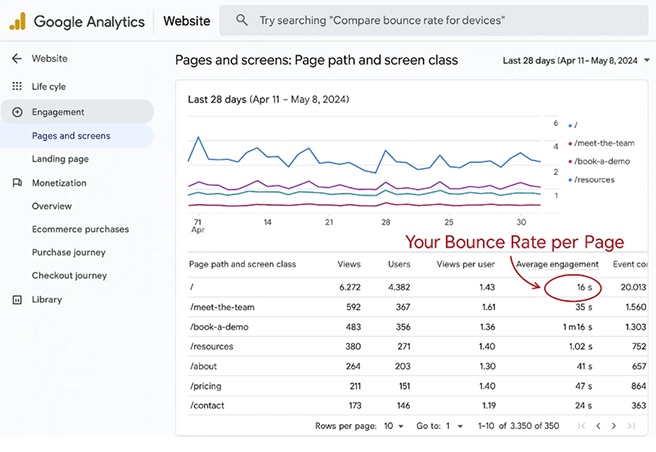
When you review your analytics dashboard and see bounce rate broken down per page alongside average engagement time, you gain deeper clarity into which pages truly connect with visitors and which ones need improvement. That page-level insight helps you identify where parents are staying, exploring, and building trust — and where they’re leaving too quickly.
Simple Definition of Bounce Rate in E-commerce
Bounce rate refers to the percentage of visitors who land on a page of your baby product website and leave without visiting any other pages or interacting further. This metric serves as a direct indicator of visitor engagement and whether your site is meeting parental needs right away.
- Measures visits with zero further action
- Reveals immediate user disinterest or website barriers
- Highlights the effectiveness of landing page content
- Acts as an early warning for UX or content issues
Bounce Rate Benchmarks for Baby Stores: High vs. Low
When it comes to baby product e-commerce, bounce rate isn’t just a number — it’s a trust signal. New parents make emotionally charged decisions, and how long they stay on your site depends heavily on whether your homepage reassures or frustrates them. A low bounce rate reflects credibility, clarity, and engagement, while a high bounce rate signals friction or mistrust.
Here’s a clear snapshot of how to interpret bounce rates in baby stores:
| High Bounce Rate | Low Bounce Rate |
| 56% and above | 20%–40% |
| Parents leave after viewing only one page | Parents explore multiple products and categories |
| Signals distrust, slow load times, or overwhelming design | Indicates strong trust signals, smooth navigation, and clear CTAs |
| Higher cart abandonment risk | Increased conversions and longer session durations |
| Urgent need for UX fixes and clearer value presentation | Reinforces credibility and reassures anxious parents |
Why “Average” Bounce Rates Can Still Be a Red Flag
An average bounce rate may mask deeper problems. In baby e-commerce, parents often demand instantaneous trust, clear information, and easy navigation. If your bounce rate is average but conversions lag, subtle friction points or missing trust signals could be silently driving visitors away.
- Average bounce doesn’t always equal healthy engagement
- Low conversions despite average bounce indicate hidden issues
- Small UX or messaging gaps can silently increase bounces
- Regular analysis of bounce alongside other KPIs is critical for growth
Common Bounce Rate Red Flags in Baby E-commerce
Bounce rate isn’t random—it usually points to specific problems in the shopping journey. In baby e-commerce, these issues often stem from trust gaps, missing reassurances, or friction in the buying process. To make it clearer, here’s a breakdown of the most common red flags that cause parents to leave without exploring further:
| Red Flag | Why It Drives Parents Away |
| Homepage Exits | Lack of instant trust or reassurance when landing on the site |
| Products Page Drop-offs | Missing safety details, weak imagery, or unclear product descriptions |
| Checkout Abandonment | Complicated steps, hidden fees, or untrustworthy payment options |
| Mobile User Bounces | Slow load times, hard-to-navigate layouts, or a clunky mobile experience |
| Ad/Search Traffic Bounces | Landing pages don’t match the promise of ads or search results |
| Confusing Navigation | Overloaded menus or cluttered categories make browsing frustrating |
| No Social Proof | Absence of reviews, testimonials, or trust badges creates doubt |
| Out-of-Stock Frustration | Showing products as available but marking them unavailable at checkout |
| Aggressive Pop-Ups | Overwhelming sign-ups or discount pop-ups break the shopping flow |
| Unclear Policies | Returns, shipping, or exchange details are hidden or hard to locate |
| Overloaded Design | Too many banners, colors, or CTAs distract from the buying journey |
What These Red Flags Mean for Baby E-commerce Brands
Red flags in bounce rate aren’t just metrics—they reveal where your brand is losing opportunities. In baby e-commerce, every drop-off carries weight because parents arrive with high intent and heightened emotions. Here’s what those warning signs translate to for your business:
- Trust Breakdown = Lost High-Intent Parents
- UX Friction = Wasted Traffic and Low Conversions
- Marketing Mismatch = Draining Ad Spend
- Poor Reassurance = Lost Repeat Business
Diagnosing Your Baby Store’s Bounce Rate: Key Questions to Ask
Bounce rate isn’t just a number—it’s a window into how parents experience your store. When it spikes, it often signals trust gaps, friction, or a mismatch between expectations and reality. By treating it as a diagnostic tool, you can uncover the exact pain points driving parents away and fix them before they cost you sales.
- Are parents finding the safety and reassurance they expect right away?
- Do product pages clearly highlight materials, certifications, and benefits?
- Is navigation intuitive, or are parents getting lost in cluttered menus?
- Does mobile performance reflect the urgency of on-the-go shopping?
- Are ad promises consistent with the landing pages they lead to?
- Is the page meeting user intent, or leaving questions unanswered?
- Are visitors spending enough time engaging with the content?
- Does the page encourage conversions or contribute to other business goals?
- Can users get the context and value within a few seconds or minutes, or do they leave uncertain?
Reducing Bounce Rate: Practical Fixes
A high bounce rate doesn’t have to mean lost business—it can guide improvements. Parents who click away are often signaling what’s missing: clarity, reassurance, or simplicity. The key is to address these issues directly, making it easier for them to trust and shop without hesitation.
- Build above-the-fold trust signals — add security badges, testimonials, and clear guarantees.
- Mobile-first speed and clarity — optimize load times and ensure seamless usability on small screens.
- Transparent shipping and return policies — display them clearly, not buried in footers.
- Visual storytelling that reassures parents — use lifestyle imagery, product-in-use photos, and safety icons.
- Landing pages aligned with ad/SEO promises — match headlines and offers so visitors feel continuity.
From Bounce to Conversion: Making Insights Actionable
Reducing bounce rate is only the beginning—the goal is to turn saved visits into revenue. Each insight about why visitors leave gives you a roadmap for conversion optimization. By testing, refining, and tracking, you shift bounce rate from a vanity metric into a practical trust KPI.
- Using analytics and heatmaps to identify where parents hesitate or drop off.
- Running A/B tests to refine messaging, layout, and CTA clarity.
- Treating bounce rate as a trust KPI—a signal of reassurance delivered, not just a vanity metric.
Top Tools & Analytics to Monitor Bounce Rate
Numbers do not lie, but they often whisper. A high bounce rate in e-commerce can quietly bleed away sales from your baby store unless you know where to look. Parents do not forgive uncertainty; when they land on your site, they expect clarity, trust, and relevance in seconds. The right analytics tools reveal whether your pages deliver that reassurance or drive them to competitors. Better still, these tools turn vague metrics into actionable insights you can use to fix UX issues, polish trust signals, and protect every marketing dollar from waste. That is why monitoring bounce rate with precision is not optional; it is the difference between engagement and exit. Let us walk through the essential tools every baby e-commerce brand must master:
Google Analytics 4 (GA4): The gold standard of e-commerce analytics. GA4 tracks user engagement, page views, session duration, and bounce rate definitions across your store. It shows where parents leave, how long they stay, and whether your landing pages meet user intent.
Hotjar: A behavior analytics tool that transforms numbers into visuals. With heatmaps, session recordings, and on-page feedback, you can see where parents hesitate, scroll, or drop off. It pinpoints the exact friction killing conversions.
Crazy Egg: A conversion-focused tool designed to help you test and refine. It delivers A/B testing, scroll maps, and click tracking so you can identify weak spots and experiment with fixes that reduce bounce rate and boost conversion optimization.
Microsoft Clarity: A free, powerful tool for session replays and user journey tracking. It uncovers rage clicks, confusion, and technical bottlenecks that cause unnecessary bounces. Ideal for sharpening your mobile experience.
Kissmetrics: A customer-centric analytics platform that connects bounce rate with customer lifetime value and revenue. It highlights not just where parents leave, but how those exits impact your bottom line.
Every tool has its strength, but together they answer the critical question: are you delivering reassurance or creating doubt? When you measure bounce rate with these lenses, you are not just watching numbers—you are diagnosing intent, shaping conversion paths, and building the kind of trust that parents reward with loyalty.
Future-Proofing: Trends & Innovations Reducing Bounce Rate
The future of baby e-commerce belongs to brands that understand one truth: parents will only stay where trust is instant and experience is effortless. While you can fix today’s bounce rate problems with design and messaging tweaks, real growth comes from adopting the trends and innovations shaping tomorrow’s shopping behavior. These are not fads; they are long-term shifts that redefine how parents engage online.
AI-Powered Personalization: By tailoring recommendations and product displays, AI in e-commerce ensures parents see relevant items the moment they land, reducing exits caused by generic content.
Voice and Visual Search: Parents increasingly search by voice or images. Optimizing your store for voice search SEO and visual search tools helps you capture intent faster. Platforms like Rosetta.ai showed that one-to-one personalization combined with smart exit-intent detection significantly cut bounce rates.
AR & 3D Product Visualization: Interactive product previews—from strollers to baby clothing—offer reassurance that photos alone cannot. IKEA’s AR app lets shoppers visualize furniture in their homes, boosting confidence and keeping users engaged longer. Similarly, Sayduck’s 3D tools have increased time on page for retailers adopting immersive experiences.
Headless Commerce Experiences: Flexible architectures deliver lightning-fast performance and mobile-first UX, ensuring no parent bounces because of sluggish load times. Beauty brand Glamnetic optimized site performance, cutting TTFB by 72.5% and reducing bounce rate by an impressive 77.48%.
Trust-Tech Integrations: Advanced trust badges, blockchain-backed product authenticity, and transparent review systems build credibility instantly. Brands adopting enhanced trust signals not only lower bounce rates but also strengthen repeat purchases—critical in the baby products category where reassurance is everything.
The brands that invest in these innovations are not just lowering bounce rates; they are future-proofing conversions by staying ahead of parent expectations. Bounce rate becomes less about exits and more about how effectively you anticipate intent.
Conclusion
In baby e-commerce, bounce rate is a trust thermometer—a reflection of how quickly parents feel safe, reassured, and understood. Every spike is not just a warning but a signal pointing toward improvement: clearer journeys, faster experiences, stronger reassurances. The brands that thrive are those that turn bounce rate into feedback, using it to build confidence, conversions, and long-term loyalty. With thoughtful design and data-led refinement, stores evolve into destinations parents rely on. That’s the approach trusted partners like ZealousWeb bring—quietly ensuring your e-commerce experience inspires trust at every click.
FAQs
Do you offer UX audits specifically tailored for baby product stores?
Yes. We conduct specialized UX audits for baby e-commerce brands that focus on parental behavior. Our audits highlight issues such as unclear product safety details, poor mobile usability, and confusing checkout flows. From there, we create actionable recommendations that not only reduce bounce but also improve conversion rates and customer trust.
Can your team integrate analytics tools to track and diagnose bounce rate?
Absolutely. We set up and configure Google Analytics 4, Hotjar, Microsoft Clarity, and other analytics tools so you can see exactly where parents are leaving and why. Beyond setup, we help you interpret the data and run A/B tests to refine messaging, layouts, and trust signals for maximum engagement.
How does ZealousWeb’s development approach ensure mobile-first engagement?
Mobile is often the first touchpoint for parents researching products. Our development approach is mobile-first by default, focusing on fast load times, responsive layouts, and clutter-free designs that eliminate frustration. This ensures parents browsing on the go get a seamless, trustworthy shopping experience, which directly reduces bounce.
What ongoing support do you provide to keep bounce rate low after launch?
Reducing bounce rate isn’t a one-time fix—it requires continuous monitoring and refinement. Our team provides ongoing performance optimization, UX enhancements, and content alignment with marketing campaigns. We position ourselves as long-term partners, ensuring your baby store evolves with parent expectations and remains competitive.
Why choose ZealousWeb over other e-commerce agencies for baby product brands?
Because we understand that baby e-commerce is different. Parents shop with urgency, emotion, and trust at stake. Our team blends technical excellence with empathy-driven design, ensuring every click reassures parents. We don’t just build stores—we craft experiences that reduce bounce rate, increase conversions, and foster long-term loyalty.


