

ZealousWeb
brand refresh vs rebrand

Brand Refresh vs. Complete Rebrand: What Does Your Business Need?

August 18, 2026Posted By: Jalpa Gajjar
Brand RefreshBrand StrategyBrandingRebranding

Somewhere right now, a leadership team is sitting in a room deciding whether the logo needs “freshening up.” Two hours later, they’ve agreed to change the company name, the tagline, the color palette, and possibly the industry they operate in. That’s how these conversations go. Branding decisions start small and expand fast, because nobody in the room has agreed on what problem they’re actually solving.

So let’s fix that first. A brand refresh and a complete rebrand are not two sizes of the same service. They fix different problems, cost different amounts, and carry very different risks when you pick the wrong one. This guide gives you the difference, the warning signs for each, what actually changes in scope, what drives cost, and an eight-question test you can run before anyone opens a design tool.
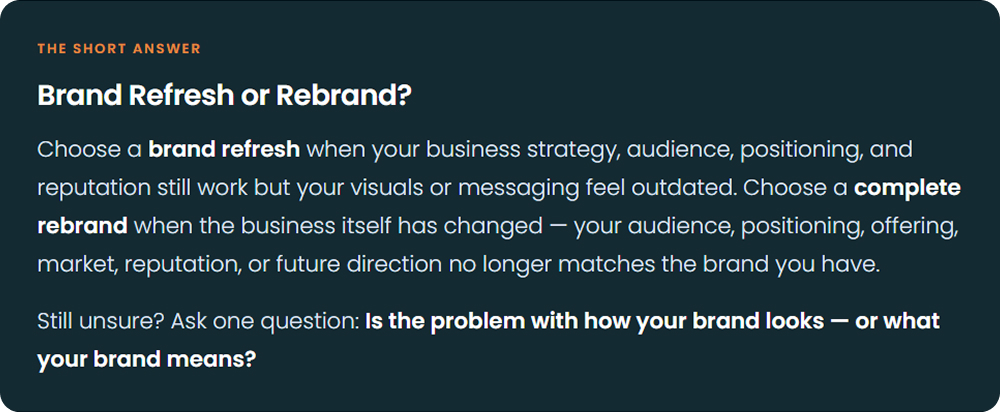
Brand Refresh Decision

That single question does more work than most branding workshops. Looks are an expression problem. Meaning is a strategy problem. You cannot design your way out of a strategy problem, no matter how good the typography is.

Brand Refresh vs. Rebrand: What's the Actual Difference?

Before you can choose, you need clean definitions. Most of the confusion here comes from teams using “rebrand” as a catch-all term for any visual change. Below is what each one really involves, followed by a side-by-side comparison you can take straight into a stakeholder meeting.

What Is A Brand Refresh?

A brand refresh is a strategic update to how your business looks, sounds, and shows up without changing the core identity customers already know. It is less about starting over and more about bringing the brand expression up to the standard of the business behind it.

The goal is to modernize what feels dated, inconsistent, or digitally weak while protecting the recognition, trust, and brand equity you have already earned.
Brand Refresh

  • What stays: your name, your positioning, your audience, your core promise, and the equity customers already associate with you.
  • What changes: the visual system, messaging polish, digital experience, and the guidelines that keep everything consistent.
  • What problem it solves: a business that has quietly outgrown its own presentation. The company matured. The branding didn’t get the memo.

A strong refresh creates a more cohesive, digital-first brand system built for responsive websites, omnichannel campaigns, accessibility, conversion-focused experiences, and AI-driven discovery.

Instead of replacing what already works, it sharpens the signals customers use to judge relevance, credibility, and quality. Done well, a refresh makes the brand feel current, scalable, and future-ready without sacrificing the familiarity that made it valuable in the first place.

What Is a Complete Rebrand?

A complete rebrand is a strategic reset of how a business is positioned, perceived, and presented in the market. It goes far beyond changing the logo or updating the website because the work starts with the business strategy underneath the brand.

This is the right path when your existing identity no longer reflects your audience, offering, competitive landscape, growth direction, or value proposition. Instead of modernizing the existing system, a rebrand questions whether that system still represents the business accurately at all.

What stays or disappears: almost nothing is automatically protected. Name, category, tone, and visual identity are all on the table – though keeping recognizable equity is often a deliberate choice, not an accident.
Complete Rebrand

  • What stays or disappears: almost nothing is automatically protected. Name, category, tone, and visual identity are all on the table – though keeping recognizable equity is often a deliberate choice, not an accident.
  • What changes: strategy first, then everything downstream of it.
  • What problem it solves: misalignment between the business you are and the business your brand advertises.

A successful rebrand creates a new strategic foundation for positioning, messaging architecture, visual identity, digital experience, and customer perception. It helps the business communicate a sharper point of difference while creating consistency across websites, campaigns, sales journeys, omnichannel touchpoints, and AI-driven discovery.

The goal is not simply to look different. It is to make the brand more accurate, relevant, differentiated, and scalable for where the business is going next.

When the strategy, customer experience, and market narrative are aligned, a rebrand becomes more than an identity change – it becomes a platform for stronger brand authority, category relevance, conversion potential, and long-term growth.

Brand Refresh vs. Rebrand at a Glance

Here’s the comparison in one place. If you’re building a case for one approach over the other, this table is the fastest way to move a room from opinion to decision.

Factor Brand Refresh Complete Rebrand
Core strategy Usually stays Reconsidered from scratch
Positioning Mostly stays May change completely
Audience Usually stays May change
Logo Refined or updated Often redesigned
Messaging Improved Rebuilt
Brand name Usually stays May change
Website Updated or redesigned Often rebuilt around the new brand
Disruption Lower Higher
Best when The brand feels dated The business has fundamentally changed


Read down the last row first. That single line settles most arguments faster than the other eight combined.

Do You Need a Brand Refresh? 7 Signs the Answer Is Yes

A refresh is the right call when the business is healthy and the presentation isn’t keeping up. These are the seven patterns that most often appear when a refresh is genuinely the correct scope.

Your positioning may still be relevant, customers may still recognize and trust the brand, and the business model may not have fundamentally changed. The problem is often that the visual identity, messaging, website experience, or content system no longer reflects the quality of the business behind it.

That gap matters more in a digital-first market where brands are judged across websites, social channels, search results, AI-powered discovery, mobile experiences, and increasingly personalized customer journeys. An outdated or inconsistent brand system can weaken perceived credibility even when the underlying offer remains strong.

A refresh helps modernize those customer-facing signals without sacrificing the brand equity, recognition, and trust you have already built.

.
Your Brand Looks Older Than the Business It Represents

You’ve grown, hired, expanded, and improved. The branding still reflects the version of you from three funding rounds ago.

Your Visual Identity Has Become Inconsistent

Four logo variations, six blues, and a deck template nobody can find. Consistency broke before the brand did.

Your Website Has Evolved, but Your Branding Hasn’t

The site got new pages, new sections, and new products. The visual system was never updated to hold any of it.

Your Messaging Feels Stale, but Your Positioning Still Works

What you say is accurate. How you say it sounds like a 2016 brochure that survived three website migrations.

Customers Still Recognize and Trust the Brand

Recognition is expensive to build and easy to destroy. If you already have it, protect it — don’t reset it.

You Need to Compete Better Without Starting Over

Newer competitors look sharper. Your offering is stronger. That gap is a presentation problem, not an identity crisis.

Your Brand Works — It Just Doesn’t Look Like It

The strategy holds up under questioning. The expression doesn’t hold up on a screen.

Brand Visual Refresh

The strongest signal that you need a refresh is simple: the business has evolved faster than the brand expression around it.

In that situation, you do not need to reinvent your positioning or erase years of recognition. You need a more adaptive brand system – one built for responsive digital experiences, omnichannel consistency, accessibility, conversion-focused messaging, and AI-driven discovery.

Done well, a refresh protects existing brand equity while making the business feel more current, credible, differentiated, and ready for its next stage of growth.

Do You Need a Complete Rebrand? 7 Signs You Probably Do

Rebrands are triggered by structural change, not by boredom. When any of the following are true, a refresh will look nice and solve nothing.

A complete rebrand becomes necessary when the gap between what your business has become and what your brand still communicates is too wide to fix cosmetically. That gap can show up in your positioning, audience, offer, market perception, naming, or overall customer experience.

If buyers misunderstand what you do, your identity attracts the wrong audience, or your brand still reflects an earlier version of the business, visual updates alone will not correct the problem. You need to revisit the strategic foundation before changing how the brand looks.

The following signs usually point to a deeper brand transformation rather than a surface-level refresh.

.
Your Business Has Outgrown Its Original Positioning

You started as one thing and became another. The brand still sells the starting point.

You’re Selling to a Different Audience Now

You moved from small business to enterprise, or B2C to B2B. New buyer, new expectations, new brand job.

Your Products or Services Have Fundamentally Changed

What you sell today barely overlaps with what the brand was originally built to sell.

You’re Entering a New Market or Category

New geography, new vertical, or a category where your current brand has no credibility or context.

A Merger or Acquisition Changed the Business

Two brands, one company, and a market that can’t tell which promise applies to whom.

Your Current Brand Carries the Wrong Perception

You’re seen as cheap when you’re premium, or local when you’re global. Perception is now a sales cost.

You Spend Too Much Time Explaining What You Do

Every deal starts with a correction. That’s your brand quietly failing at its only job.

If every sales call starts with “Well, the name is a little misleading…” your brand may already be answering this question for you. Notice what all seven have in common – they’re business changes, not design complaints. That’s the signal.

Refresh or Rebrand? Use This 8-Question Decision Test

Enough theory. Run these eight questions with your leadership team, mark each answer, and let the pattern make the call. No 2,000-word “it depends” required.

# Questions If Yes If No
1 Has your target audience changed? Lean rebrand Keep assessing
2 Has your market positioning changed? Lean rebrand Keep assessing
3 Has what you sell changed significantly? Lean rebrand Keep assessing
4 Does your brand name still make sense? Lean rebrand Lean rebrand
5 Do customers still recognize and trust the brand? Lean rebrand Lean rebrand
6 Is the real problem mainly visual? Lean rebrand Lean rebrand
7 Does your messaging still describe the business Lean rebrand Lean rebrand
8 Will this brand still fit where you want to be in 3-5 years? Lean rebrand Lean rebrand

Your Results

.
✅ Mostly visual problems → Brand refresh. Your strategy is intact; the expression needs rebuilding.
✅ Several strategic problems → Complete rebrand. Design alone won’t close the gap between what you are and what you look like.
✅ A messy mix of both → Start with a brand audit. Don’t buy a solution before someone diagnoses the problem.
✅ Most teams land in that third bucket, and that’s genuinely fine. Ambiguity is a research finding, not a failure.

Not Sure Which Side You're On? Let's Audit It Before You Redesign It

Let Get Your Brand Audit
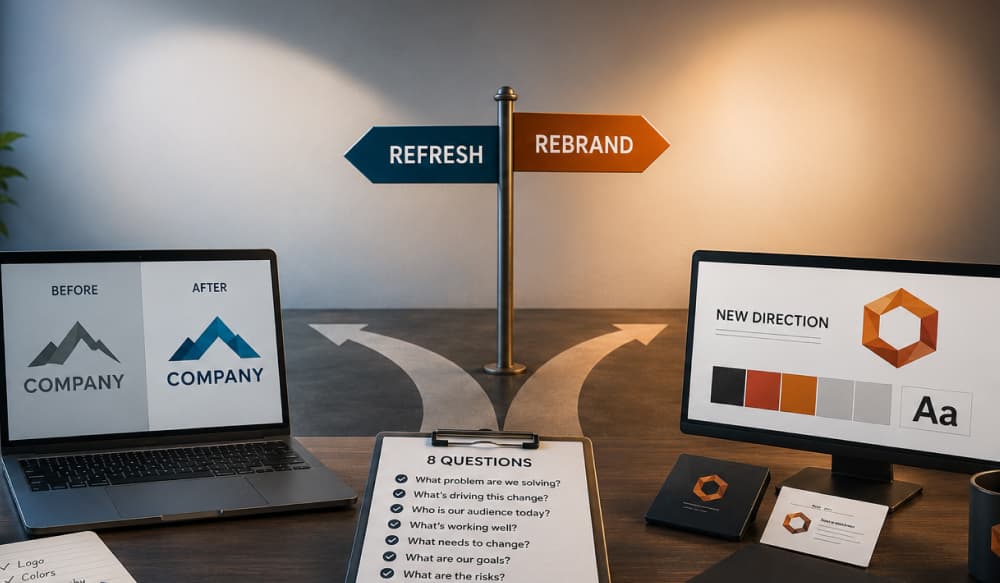
Brand Audit

What Actually Changes in a Brand Refresh?

A brand refresh updates how the brand looks, sounds, and shows up without rebuilding the strategic foundation underneath it. The core positioning, audience, brand equity, and market recognition usually stay intact while the expression of the brand becomes more current, consistent, and digitally relevant.

Scope confusion is where budgets go to die. Here’s what typically sits inside a refresh – and what a good agency should be quoting against:

  • Scope confusion is where budgets go to die. Here’s what typically sits inside a refresh – and what a good agency should be quoting against
  • Logo refinements – cleaner construction, better scaling, digital-first legibility
  • Color palette – modernized primaries, expanded secondaries, accessible contrast ratios
  • Typography – a type system that works across web, print, and product
  • Visual system – layout rules, iconography, spacing, graphic devices
  • Photography and illustration style – a consistent look instead of a stock-image lottery
  • Brand messaging – sharper value proposition, tone, and boilerplate
  • Website look and feel – applying the new system to the site experience
  • Marketing templates – decks, proposals, social, email, one-pagers
  • Brand guidelines – the document that stops the inconsistency from returning

Brand guidelines – the document that stops the inconsistency from returning

Brand Refresh Scope

A well-executed refresh should make the brand feel more modern without making existing customers wonder whether they have landed on the wrong company. The goal is continuity with stronger visual impact, clearer messaging, better digital usability, and a more scalable brand system.

Everything on that list is downstream of decisions you already made. That’s exactly why it’s the cheaper path.

You are improving brand performance rather than rebuilding brand meaning. That allows you to preserve recognition and existing brand equity while strengthening consistency, accessibility, conversion-focused messaging, omnichannel execution, and readiness for AI-driven discovery.

The best refreshes feel evolutionary rather than disruptive – familiar enough to retain trust, modern enough to signal progress, and flexible enough to support where the business is heading next.

What Changes in a Complete Rebrand?

A rebrand includes everything above, plus the strategic layer that sits underneath it. The order matters more than the list – strategy comes first, or the design work is guesswork with a mood board.

A complete rebrand can rethink your positioning, value proposition, audience priorities, messaging architecture, brand personality, naming system, visual identity, and digital experience. It is designed for moments when the existing brand no longer reflects the business you are becoming.

That strategic reset then shapes every visible expression of the brand – from the logo, typography, and color system to website UX, campaign creative, sales collateral, social presence, and customer touchpoints.

The goal is not simply to look newer. It is to create a more relevant, differentiated, and scalable brand system that aligns with current market expectations, supports omnichannel consistency, and performs across search, AI-driven discovery, and emerging digital experiences.

When done properly, a complete rebrand gives the business a clearer market position and a stronger foundation for its next stage of growth.
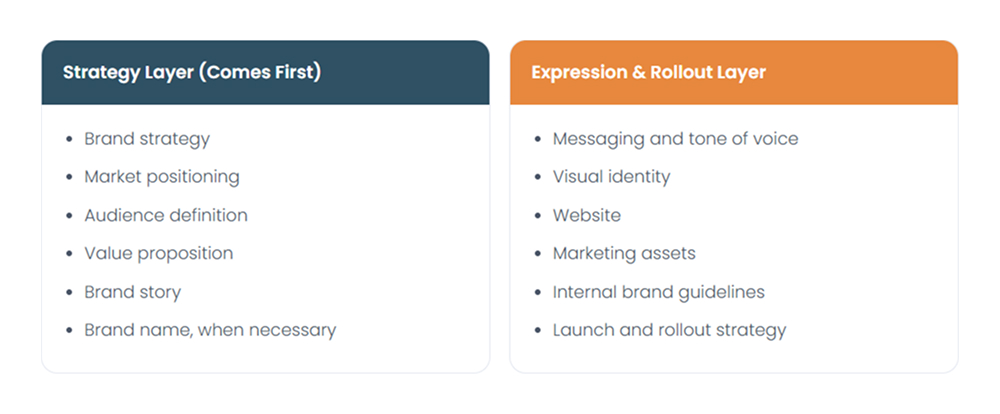
Rebrand ScopeIf a proposal skips the left column entirely and starts at “visual identity,” you’re buying a refresh with a rebrand price tag.

What Determines Brand Refresh Cost?

Brand refresh cost depends less on changing the logo and more on how far the updated brand system needs to travel. A focused visual update can stay relatively lean, while broader changes involving messaging, website UX, content systems, and multiple customer touchpoints can quickly expand the scope.

The biggest cost drivers are usually the number of assets involved, the depth of strategic work required, and how extensively the refreshed identity must be implemented across digital and offline channels.

.
✅Number of assets – five templates versus fifty is not the same project
✅Website involvement – applying a system to an existing site versus redesigning it
✅Messaging work – light polish versus a full value-proposition rewrite
✅Research requirements – internal input only versus customer and market research
✅Markets and touchpoints – one market, one language, one channel keeps it lean

A well-scoped refresh protects existing brand equity while concentrating investment where it can create the greatest impact. That might mean modernizing the visual system, sharpening positioning, improving conversion-focused messaging, or creating a more consistent digital-first brand experience.

The key is to avoid expanding a refresh into a disguised rebrand. Clear scope, prioritized touchpoints, and a scalable brand system help control costs while improving consistency, relevance, brand recall, and omnichannel performance.

When the investment is aligned with genuine business needs, a brand refresh can deliver stronger market perception and digital experience without paying to rebuild recognition your business has already earned.

What Makes a Complete Rebrand More Expensive?

A complete rebrand costs more because it changes far more than the visible identity. It requires research, strategic repositioning, new brand architecture, digital redevelopment, and coordinated rollout across every customer and internal touchpoint.

The investment grows because each decision affects the next. Positioning shapes messaging, messaging influences identity, identity guides the website experience, and the entire system must then scale consistently across campaigns, sales assets, AI-driven discovery, and future digital channels.

.
✅ What Makes a Complete Rebrand More Expensive?
✅ Research – customer interviews, market analysis, perception studies
✅ Strategy and positioning – the thinking that everything else depends on
✅ Naming – including trademark screening and domain availability
✅ Identity development – building a system, not decorating a logo
✅ Website redevelopment – usually a full rebuild, not a reskin
✅ Rollout – signage, packaging, profiles, listings, legal, and redirects
✅ Internal adoption – training the team to actually use the thing

Which Gives Better ROI: Refresh or Rebrand?

The better ROI comes from choosing the level of change your business actually needs. A brand refresh usually delivers faster returns when your positioning and recognition are already working but the visual identity, messaging, or digital experience feels outdated.

A full rebrand requires a larger investment, but it can create significantly more value when the business has entered new markets, changed its audience, repositioned its offering, or outgrown what the existing brand represents.
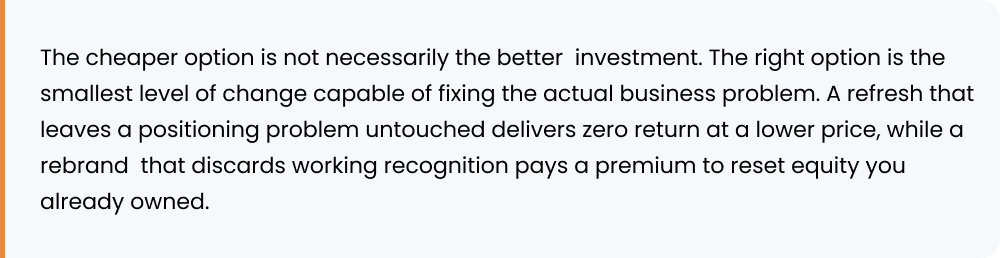
Brand ROI Comparison

ROI in branding isn’t about spending less. It’s about not paying twice. The strongest return comes when brand strategy, customer perception, digital experience, and business direction move together. A well-timed refresh can protect brand equity while improving relevance and conversion performance. A strategic rebrand can unlock new market positioning, stronger differentiation, and long-term growth when incremental changes are no longer enough.

In both cases, the real ROI is measured beyond a new visual identity. It shows up in stronger brand recall, clearer positioning, higher conversion potential, improved customer trust, and a brand system built to scale across websites, campaigns, AI-driven discovery, and future digital touchpoints.

The Cost Nobody Mentions: Choosing the Wrong One

Scope mistakes rarely announce themselves. They show up six months later as flat campaigns and confused buyers. Here’s what each wrong turn actually costs.

Refreshing When You Actually Need a Rebrand

New logo. Same positioning problem. Congratulations – you’ve professionally redesigned the confusion.

What continues happening after launch: messaging still misses the audience you’re actually selling to, buyers still misunderstand what you do, differentiation stays weak because nothing differentiating was decided, and campaigns keep underperforming for reasons the marketing team can’t fix with better creative.

Rebranding When a Refresh Would Have Worked

The damage here is quieter but just as expensive. You lose hard-won recognition, spend budget you didn’t need to spend, disrupt a team that was doing fine, confuse customers who liked the old version, and take on a rollout – plus the SEO migration risk that comes with new URLs, new domains, and years of accumulated authority pointing at pages that no longer exist.
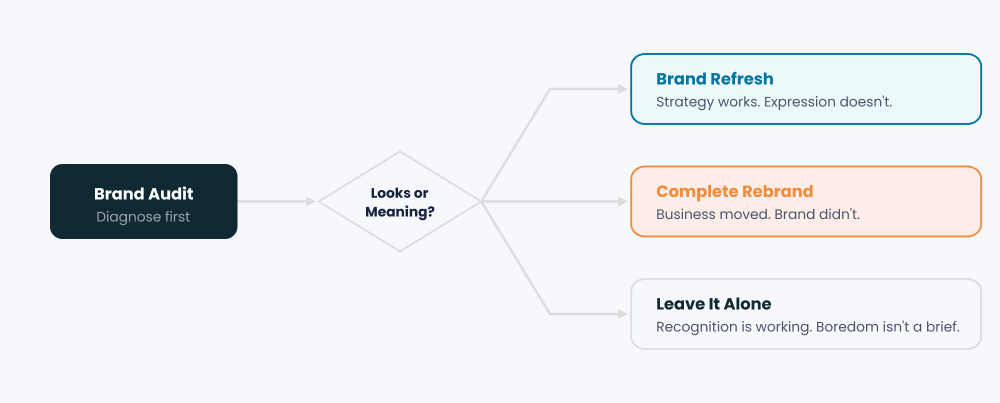
Unnecessary Rebrand

Brand Refresh vs. Rebrand Examples: What Real Brands Teach Us

Skip the famous logo-history slideshow. What matters is the reasoning behind each decision, not the before-and-after image. Here are three patterns worth learning from.

Strong brands do not change simply because their identity feels dated. They respond to specific business signals-shifting customer expectations, new market positioning, category expansion, digital-first experiences, or declining brand relevance.

Some brands protect their existing equity and modernize only what customers see and experience. Others make a deeper strategic reset because the old identity, messaging, or positioning no longer reflects where the business is headed.

The lesson is simple: the scale of the brand change should match the scale of the business change.

Example of a Successful Brand Refresh

A B2B services firm with twelve years of market presence and strong client retention. What changed: typography, color system, photography direction, website experience, and messaging tone. What stayed: the name, the positioning, the audience, and the logo mark itself. Why a refresh made sense: buyers already knew who they were and what they did – the brand simply looked older than the work it produced. Resetting recognition would have destroyed the one asset that was performing.

Example of a Successful Complete Rebrand

A company that started as a regional service provider and evolved into a technology product business serving enterprise buyers. Business change: new audience, new offering, new competitive set. Brand response: new positioning, new value proposition, new name architecture, new identity, new site. Why a refresh wouldn’t have been enough: the old brand told an accurate story about a company that no longer existed. No amount of visual polish fixes a description that’s simply wrong.

The Most Useful Lesson From Both

Change only what the business has actually outgrown. Everything else is expensive redecoration.

A strong brand decision starts with diagnosis, not aesthetics. If your positioning still resonates, your audience still recognizes you, and your market perception remains strong, protect that brand equity and modernize selectively. If the business model, buyer profile, value proposition, or competitive landscape has fundamentally changed, a deeper rebrand may be justified.

The smartest approach is to align the scale of the brand transformation with the scale of the business transformation. That keeps the investment strategic, reduces unnecessary disruption, and ensures every change supports stronger relevance, differentiation, and long-term brand growth.

Brand Strategy Lesson

Should You Refresh Your Brand Before Redesigning Your Website?

The sequence differs depending on which path you’re on, and getting the order right saves an entire round of rework. If your visual identity, messaging, positioning, or brand voice is changing, those decisions should usually come before the website redesign.

A website is where your brand comes to life digitally. Redesigning it first and refreshing the brand later can mean revisiting colors, typography, layouts, imagery, messaging, and even the overall user experience.

When the brand foundation is clear first, the website redesign can translate it consistently from the start-making the process faster, more cohesive, and easier to scale across other marketing touchpoints.
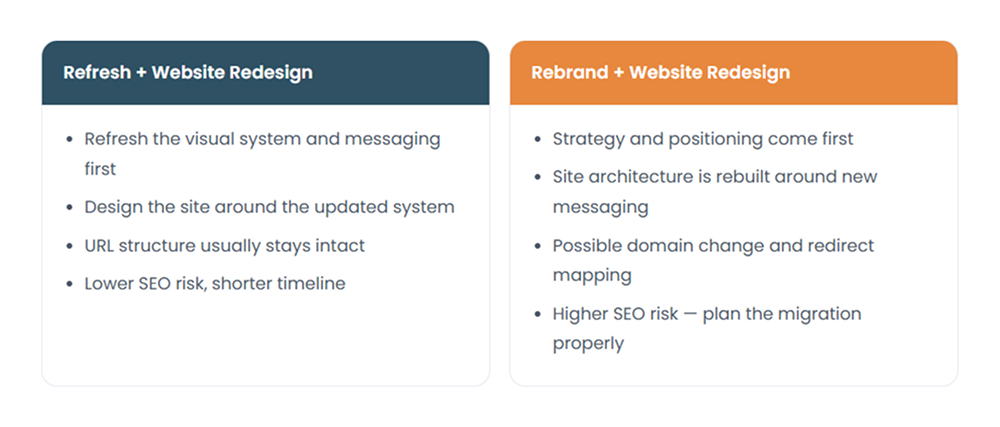
Brand Website Redesign

That right-hand column is where most rebrand traffic losses come from. Not the design – the migration nobody scoped.

A brand refresh does not require a logo change. Many refreshes leave the mark completely untouched and focus instead on typography, color palette, photography style, iconography, layout systems, messaging, digital experience, and updated brand guidelines. The logo is one element of a brand system, not the brand itself.

Elements a refresh can update while keeping the logo exactly as-is:

.
✅Messaging – value proposition, tone of voice, boilerplate
✅Typography – a modern, readable, scalable type system
✅Color – expanded palette with accessible contrast
✅Imagery – photography and illustration direction
✅Digital experience – navigation, layout, interaction patterns
✅Brand system – spacing, grids, components, iconography
✅Guidelines – documented rules so consistency actually holds

Branding and logo design have never been the same discipline. The logo is the signature; the brand is everything the signature is attached to.

Can You Rebrand Without Changing Your Business Name?

A rebrand is about strategic identity and positioning. A name change can be part of it, but it is not mandatory. Most rebrands keep the existing name and rebuild everything around it – audience, positioning, value proposition, story, and visual system. A name change becomes necessary only when the name actively misdescribes the business, blocks expansion, or carries associations you cannot outrun.

Three situations where a name change genuinely earns its cost: the name locks you into a category or geography you’ve left, the name is legally or digitally unavailable in markets you’re entering, or the name is tied to reputational damage that new messaging cannot repair. Outside of those, keeping the name preserves recognition while everything meaningful still changes.

How Long Does a Brand Refresh or Complete Rebrand Take?

Timelines depend on scope, decision-making speed, and how many people have veto power. Rather than quote generic weeks, here’s what each project type genuinely requires – use it to sanity-check any timeline you’re given.

Project Usually Requires Biggest Timeline Risk
Brand Refresh Smaller research and design scope, applied across existing assets Asset volume – the templates nobody counted
Complete Rebrand Deeper research, strategy, positioning, identity, and rollout Stakeholder alignment on positioning
Rebrand +Website Strategy through full digital implementation and migration Content production and redirect mapping

One consistent pattern worth naming: branding projects almost never run late because of design. They run late because the decisions above the design weren’t made yet.

What Should You Do Before Refreshing or Rebranding?

Do the homework before commissioning the artwork. These seven steps take a fraction of the project budget and routinely change the scope people thought they needed.

  • Audit Your Current Brand

Inventory every asset, every version, every inconsistency. You’ll usually find the problem is fragmentation, not design quality.

  • Speak to Customers

Ask why they chose you and how they describe you to others. Their words are more useful than any internal positioning workshop.

  • Review Competitor Positioning

Map what everyone else claims. If four competitors say the same three things, that’s a gap worth taking, not a template to copy.

  • Check Brand Recognition

Measure whether your name, colors, and mark carry recall in your market. Recognition you already have is an asset on the balance sheet.

  • Review Website and Conversion Data

Look at bounce patterns, page paths, and where qualified traffic drops off. Sometimes the “brand problem” is a messaging problem on three pages.

  • Clarify Where the Business Is Going

Brand decisions should serve the three-to-five-year plan, not last quarter’s org chart.

  • Decide What Is Actually Broken

Write it in one sentence. If you can’t, you’re not ready to brief anyone.

The goal is not to follow a rebranding trend but to identify the change that will create the strongest business impact. With the right brand audit, customer insights, positioning clarity, conversion data, and AI-era market signals in place, you can decide whether you need a light refresh or a full strategic rebrand. That clarity reduces wasted spend, protects existing brand equity, and gives your next website, campaign, and digital experience a stronger foundation to scale from.

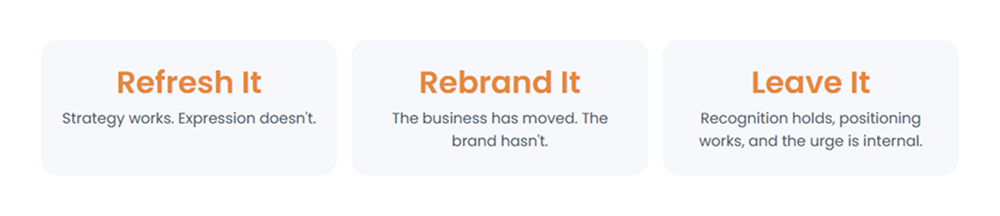
Should You Refresh, Rebrand, or Leave the Brand Alone?

Two options get all the attention, but there’s a third that quietly saves more money than either. Here are all three, stated plainly.
Brand Decision

That third option deserves more respect than it gets. People inside a business see their own brand dozens of times a day; customers might see it a handful of times a year. Internal fatigue feels like a market signal, but it usually isn’t one. Before you spend on change, check whether anyone outside the building has actually complained.

Conclusion

Here’s the part most agencies skip because it’s harder to sell than a redesign package. You shouldn’t have to decide the solution before someone diagnoses the problem.

A useful brand audit should answer seven things before anyone quotes you a project:

.
✅What should stay – the equity worth protecting
✅What should change – and in what order
✅What customers recognize – measured, not assumed
✅Where positioning is weak – against real competitors
✅Whether messaging matches the audience – the one you sell to now
✅Whether your identity scales – across channels, markets, and products
✅Whether you need refresh or rebrand scope – with a reason attached
✅Walk out of that process and the decision makes itself. More importantly, you’ll
✅know what not to pay for.

Don't Pay for a Complete Rebrand for a Complete Rebrand If Your Brand Needs A Smarter Fresh

Request a Brand Review
Brand Review

FAQs

Related Blog Posts

Best AEO/GEO Tools Comparison

Best AEO/GEO Tools Compared: Which One Should Agencies and Businesses Use

August 10, 2026
AEO ToolsAI Search OptimizationAnswer Engine OptimizationGEO Tools
Google AI Search Readiness

Website Readiness for Google AI Search: What Matters and What Doesn’t

August 06, 2026
Answer Engine Optimization (AEO)Generative Engine Optimization (GEO)Google AI SearchTechnical SEO
White-Label AEO

Scale Your AI Search Services with Specialized AEO & GEO Execution for Agencies

August 04, 2026
AEO ServicesAI Search VisibilityGEO StrategyWhite Label SEO
GEO readiness framework

What Makes a Business Ready for GEO? A Practical Framework for Evaluating Readiness and ROI

July 30, 2026
AI Search OptimizationAnswer Engine Optimizationgenerative engine optimizationGEO Readiness
White-label AEO GEO services for agencies

The Cost Advantage of White-Label AEO & GEO for Digital Agencies

July 13, 2026
AI Search OptimizationDigital Agency GrowthWhite-Label AEOWhite-Label GEO
Technical SEO execution improves client retention

How Technical SEO Execution Improves SEO Client Retention and Client LTV

July 10, 2026
client retentionSEO AgencyTechnical SEOWhite Label SEO