
Fraud Blocker
Branding Services Cost Guide

How Much Do Branding Services Cost in 2026? Pricing, Packages, and ROI

September 17, 2026Posted By: Jalpa Gajjar
Brand ROIBrand StrategyBranding CostsBranding Services

AI can create a logo, suggest a tagline, generate visual directions, and produce dozens of campaign variations faster than most teams can schedule a kickoff call.

That has not made professional branding irrelevant. It has changed what businesses and agencies are actually paying for.

The real investment now sits in research, positioning, messaging, differentiation, creative direction, brand systems, implementation, and keeping the brand consistent when humans and AI are both creating content.

As a current benchmark, many branding projects reviewed on Clutch fall between $10,000 and $49,999, while branding agencies commonly charge $100-$149 per hour. The actual investment can be much lower or considerably higher depending on the scope.

So, what does branding really cost? Let’s break down the services, packages, agency pricing, AI-era considerations, and ROI behind the number.

What Branding Really Costs

Professional branding can range from a few thousand dollars for focused identity work to $100,000+ for comprehensive or enterprise branding.

The range is wide because “branding” can mean anything from creating a visual identity to researching markets, repositioning a company, rebuilding its messaging, developing a full brand system, and rolling that system out across several locations or countries.

DesignRush currently places boutique agency engagements around $5,000-$20,000, full-service branding around $11,000-$70,000+, and enterprise branding around $40,000-$100,000+.

Here is a simpler way to view the market:

Branding Scope Typical Cost Range Common Requirements
Focused identity work $2,500-$10,000+ Logo and essential visual assets
Boutique branding engagement $5,000-$20,000 Identity, guidelines, light strategy
Full-service branding $11,000-$70,000 Strategy, positioning, messaging, identity
Comprehensive branding $20,000-$100,000+ Research, strategy, identity, extensive assets
Enterprise branding $40,000-$100,000+ Research, architecture, workshops, rollout
Complex enterprise rebrand $100,000-$250,000+ Large-scale strategy and implementation


Published market guides place comprehensive branding and complex rebrands within these broader ranges.

That is why comparing two branding quotes by price alone rarely tells you much. A $7,000 identity project and a $60,000 strategy-led rebrand may both say “branding” on the proposal, but they are not selling the same work.

Pricing for Branding Services: What Are You Actually Paying For?

Pricing for branding services is usually shaped by four things: how much thinking is required, how much must be created, how complex the business is, and how widely the finished brand needs to work.

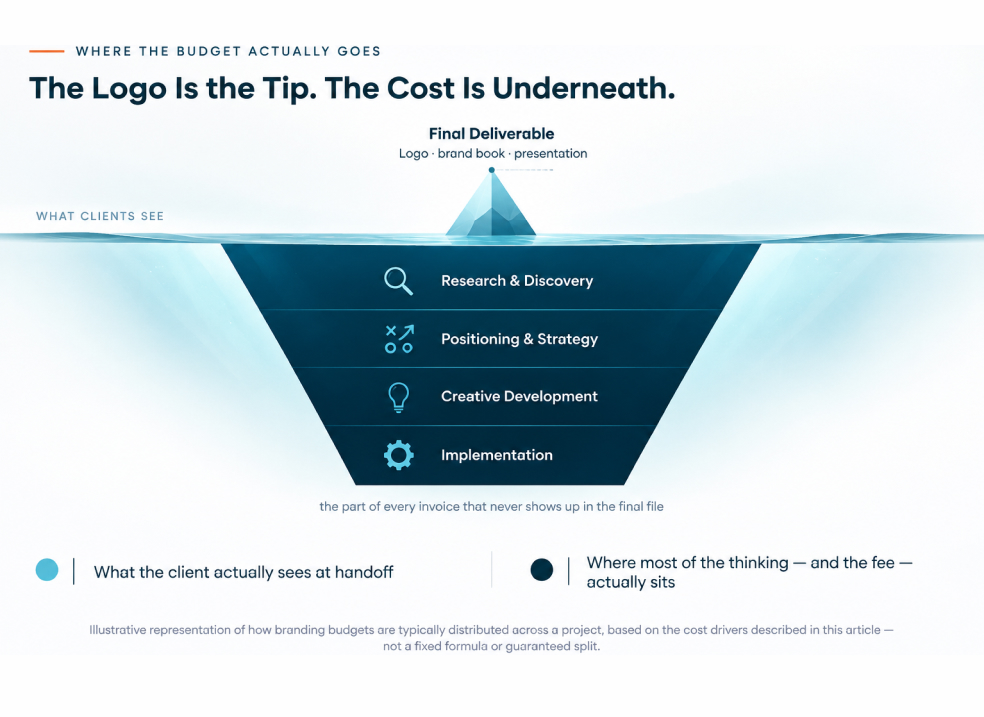
The final logo, brand book, or presentation is simply the visible output. A large part of the cost sits behind it.
Branding Cost Overview

Research and Discovery

Research may include:

  • Customer interviews
  • Competitor analysis
  • Market research
  • Stakeholder discussions
  • Existing brand audits
  • Category analysis
  • Customer perception research

A local service business may only need focused discovery. An enterprise entering several markets may need months of research.

Naturally, the invoices will not look identical.

Positioning and Strategy

Strategy determines:

  • Who the brand is for
  • What it stands for
  • Why customers should choose it
  • How it differs from competitors
  • What it should communicate
  • How different products or services fit together

This is also where businesses avoid spending six weeks choosing a shade of green before deciding what they actually want customers to remember.

Creative Development

Creative work may cover:

  • Visual identity
  • Logo systems
  • Typography
  • Color systems
  • Image direction
  • Graphic language
  • Messaging
  • Tone of voice
  • Brand story

Implementation

Once the identity is approved, it still needs to work across actual customer touchpoints.

That could include:

  • Website
  • Advertising
  • Social media
  • Sales presentations
  • Packaging
  • Apps
  • Email
  • Proposals
  • Signage
  • Internal communication

The more markets, channels, people, and assets involved, the more the cost moves from simply “creating a brand” toward building a system the organization can actually use.

How Does Branding Cost Vary by Specific Service?

Not every business needs a complete branding program. Sometimes the gap is clearly strategy, messaging, visual identity, research, or guidelines.

Looking at the cost by specific service can therefore make budgeting and comparing agency proposals much easier.

The following ranges provide a practical reference point:

Branding Service Typical Cost Range
Brand strategy $5,000-$50,000
Brand Identity design $2,500-$30,000
Logo design $2,500-$10,000+
Logo + Visual identity package $5,000-$20,000+
Brand collateral and templates $2,000-$7,500
Brand research and analysis $5,000-$250,000
Managing and positioning Often project- or hourly-priced
Brand guidelines Depends on scope and depth
Naming Often project- or hourly-priced


These ranges align with current agency marketplace data from DesignRush, while Clutch places many strategy, messaging, naming, corporate branding, and product branding services around $100-$149 per hour when billed hourly.

Need Stronger Brand Visuals Without the Cost of a Full Branding Engagement?

Hire Graphic Designers


What Does a Logo Branding Price Usually Include?

A logo branding package price depends heavily on whether the engagement covers only logo creation or a wider visual identity.

Current DesignRush data places many agency-led logo projects around $2,500-$10,000+, while some boutique logo packages that include visual identity assets fall around $5,000-$20,000.

A broader package may include:

  • Primary logo
  • Secondary logo
  • Brand mark
  • Color variations
  • Typography
  • Color palette
  • Logo usage rules
  • Clear-space guidance
  • Basic visual system
  • Exported brand files

There is an important distinction here.

A logo identifies the brand. Branding builds the system around it.

Shopify similarly defines a logo as the graphic mark representing the brand, while branding includes the wider identity, personality, colors, typefaces, and related elements.

So if the requirement really is just a professional logo, there is no need to turn it into a huge branding exercise. But if positioning, messaging, and consistency are already unclear, the logo alone is unlikely to fix them.

Standard Branding Packages: What Do You Get at Each Level?

There is no universal standard for branding packages. A “premium package” from one provider may contain less than a “growth package” from another.

Still, most engagements can be grouped into three useful levels based on how much strategy and implementation they include.

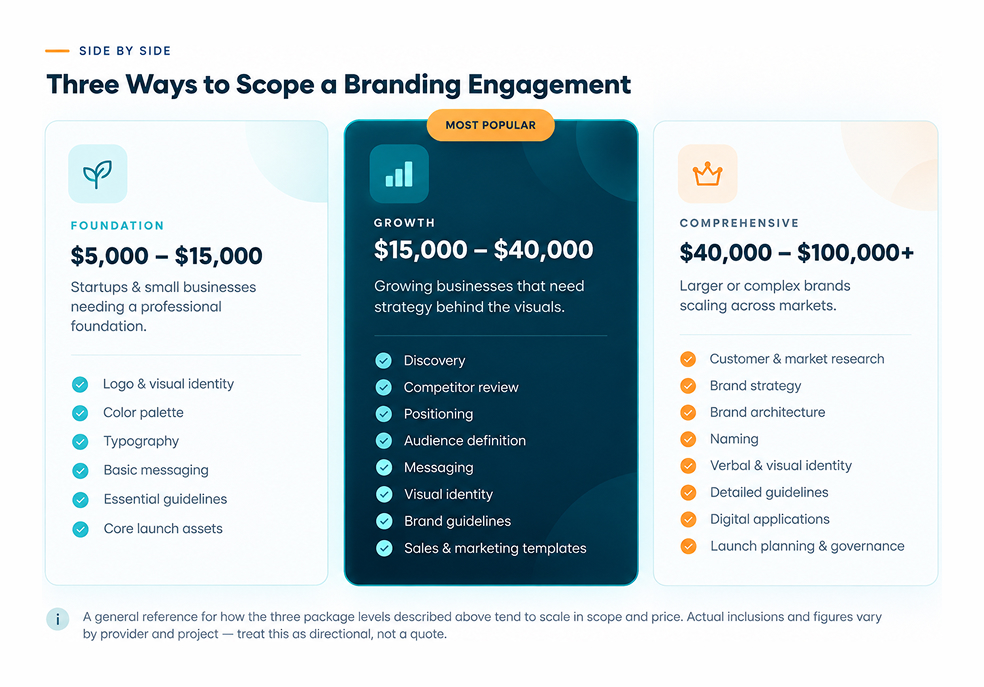
Foundation Branding Package

Typical investment: $5,000-$15,000

This level can work well for startups, small businesses, or focused service brands that need a professional foundation.

It may include:

  • Logo and visual identity
  • Color palette
  • Typography
  • Basic messaging
  • Essential guidelines
  • Core launch assets

The aim is to create enough consistency that the brand does not reinvent itself every time someone opens Canva.

Growth Branding Package

Typical investment: $15,000-$40,000

Growing businesses often need stronger strategy alongside the visual identity.

The package may include:

  • Discovery
  • Competitor review
  • Positioning
  • Audience definition
  • Messaging
  • Visual identity
  • Brand guidelines
  • Sales and marketing templates

At this stage, the conversation starts moving from “How should we look?” toward “Why should customers choose us?”

Comprehensive Branding Package

Typical investment: $40,000-$100,000+

Larger businesses or more complex brands may need:

  • Customer and market research
  • Brand strategy
  • Brand architecture
  • Naming
  • Messaging
  • Verbal identity
  • Complete visual identity
  • Detailed guidelines
  • Digital applications
  • Launch planning
  • Governance

A more expensive package should not simply mean receiving more files. It should provide a brand system capable of solving more complex business and communication needs.

Branding Package Levels

The best way to compare standard branding packages is therefore to look beyond the package name and compare strategy, deliverables, implementation, and ongoing usability.

Branding Strategy Cost: What Makes Strategy More Costly?

Branding strategy cost commonly ranges from about $5,000 to $50,000, although focused strategy work may cost less and large research-heavy engagements can cost significantly more. DesignRush currently reports similar market ranges for brand strategy services.

Strategy becomes more expensive as the number of decisions it needs to support increases.

A Branding Strategy May Cover

  • Market positioning
  • Audience definition
  • Customer research
  • Competitor analysis
  • Value proposition
  • Brand promise
  • Brand personality
  • Messaging framework
  • Brand architecture
  • Go-to-market direction

What Pushes the Cost Higher?

Typical factors include:

  • Multiple customer groups
  • Several products or services
  • International markets
  • Leadership workshops
  • Customer interviews
  • Major repositioning
  • Mergers or acquisitions
  • Complex brand architecture

DesignRush also reports that its top 50 listed brand strategy agencies average around $142 per hour, although actual project fees depend heavily on scope.

The right way to judge a branding strategy quote is not by how many slides arrive at the end. Ask what important business decisions the strategy will make clearer afterward.

Branding Agency Pricing: How Do Agencies Charge?

Branding agency pricing commonly follows fixed project fees, hourly billing, monthly retainers, or phased pricing.

Clutch currently places typical branding agency rates on its platform at around $100-$149 per hour, with many reviewed projects falling between $10,000 and $49,999.

How Branding Agency Pricing Varies Across Global Markets

Where an agency is based can have a noticeable impact on branding costs. Team structure, operating costs, talent markets, and local pricing standards all influence hourly rates-even when the branding scope looks similar.

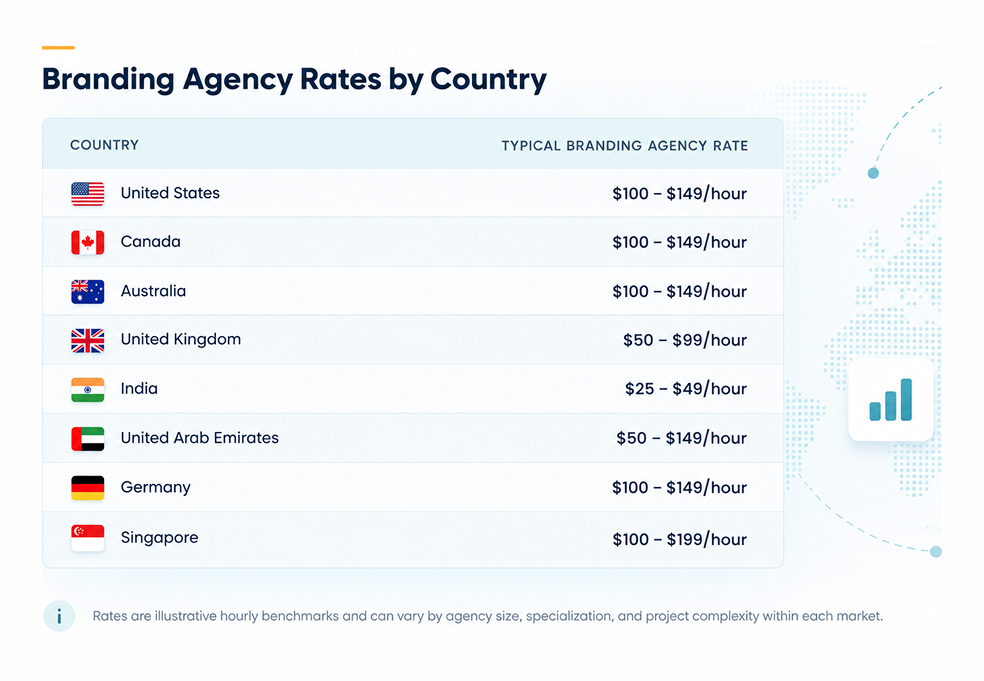
For a quick comparison, here is what branding agency pricing looks like across some of the major markets. All figures below are in U.S. dollars.
Global Branding Pricing

Clutch’s current pricing guide lists the United States, Canada, and Australia at $100-$149/hour, the United Kingdom at $50-$99/hour, and India at $25-$49/hour. Current country listings also show UAE agencies commonly appearing across the $50-$149/hour bands, Germany with a strong concentration around $100-$149/hour, and Singapore frequently ranging from $100-$199/hour, with specialist firms sometimes charging more.

These figures work best as market reference points rather than fixed national averages. The final branding cost still depends more heavily on strategy depth, research, scope, seniority, deliverables, and rollout requirements.

Each pricing model suits a different type of engagement.

Pricing Model Best For Main Consideration
Fixed project Clearly defined branding work Check what is excluded
Hourly Workshops, consulting, smaller tasks Hours can expand
Monthly retainer Ongoing creative and brand support Check deliverables
Phased pricing Large branding or rebranding programs Understand dependencies

What Should a Branding Proposal Include?

Whether you are a business evaluating a provider or an agency defining the work, the proposal should clearly state:

  • Project scope
  • Deliverables
  • Research included
  • Number of concepts
  • Revision rounds
  • Timeline
  • Stakeholder requirements
  • File ownership
  • Usage rights
  • Rollout support
  • Out-of-scope work

A low project price can look attractive until the team discovers that research, messaging, guidelines, templates, and implementation were never included.

Compare scope with scope, not just number with number.

How Much Does Branding Cost for a Small Business?

Small business branding can range from a few thousand dollars for focused identity work to approximately $5,000-$30,000 for broader professional branding, depending on whether research, strategy, messaging, identity, and implementation are included.

Current market guides place boutique branding and identity work within similar ranges. A small business rarely needs every branding deliverable available. It needs the ones customers will actually experience.

What Should Small Businesses Prioritize?

For many businesses, the order should be:

  • Clear positioning
  • Customer-focused messaging
  • Professional visual identity
  • Practical brand guidelines
  • Website and sales applications

A 90-page brand manual may be nice.

If most leads encounter the business through a website, proposal, and sales call, those three touchpoints probably deserve attention first.

When Does a Bigger Branding Investment Make Sense?

A small business may need a broader branding investment when it is:

  • Moving into a premium market
  • Expanding locations
  • Entering new regions
  • Launching new services
  • Preparing for investment
  • Repositioning after growth
  • Competing with larger brands

Business size maters, but the role branding needs to play in the next growth stage matters more.

How Much Do Personal Branding Services Cost?

Personal branding services cost varies widely because the service may range from profile optimization and content creation to full executive positioning, thought leadership, PR, and reputation management. Rather than viewing personal branding as one fixed package, it is better to look at the level of support being purchased.

Depending on the scope, personal branding services may include:

  • Personal positioning
  • Executive messaging
  • LinkedIn optimization
  • Content strategy
  • Ghostwriting
  • Visual identity
  • Personal website
  • Thought leadership
  • Digital PR
  • Podcast or media outreach
  • Video content
  • Reputation support

Basic monthly execution may begin in the hundreds or low thousands of dollars, while comprehensive executive-branding programs can run into several thousand dollars per month or more.

The important question is not simply, “How much do personal branding services cost?” It is “What authority or business outcome is the person trying to build?” A founder who needs a stronger LinkedIn presence and a CEO trying to become a recognized category authority are buying very different programs.

The Enterprise Rebrand Package: Why Does It Cost More?

An enterprise rebrand package can move well beyond standard branding costs because it usually affects products, markets, teams, systems, and customer touchpoints across the organization.

Current market benchmarks place enterprise branding around $40,000-$100,000+, while large and complex rebranding projects can move beyond $100,000-$250,000.

Several factors create the additional cost.

  • Multi-Market Research
  • Customers, competitors, and category expectations may vary by geography.
  • Brand Architecture
  • An enterprise may need to organize:
  • Parent brands
  • Product brands
  • Sub-brands
  • Service lines
  • Acquired companies
  • Stakeholder Alignment
  • Marketing may not be the only team involved.
  • Leadership, sales, HR, product, legal, operations, and regional teams may all need input.

The design might take three weeks. Getting twelve stakeholders to agree why it exists can be the longer adventure.

Governance

Enterprise brands may require:

  • Detailed guidelines
  • Brand portals
  • Asset libraries
  • Approval systems
  • Templates
  • Training
  • AI usage guidelines
  • Regional governance

Rollout

A rebrand may affect:

  • Websites
  • Apps
  • Packaging
  • Offices
  • Signage
  • Advertising
  • Sales material
  • Employee communication
  • Customer portals

Enterprise branding therefore costs more because the team is not simply changing how the business looks. It is coordinating how a large organization presents itself everywhere.

The Global Shift: AI and Generative Branding

AI is changing branding from both sides. It is making creative production faster, while simultaneously making distinctiveness, accuracy, consistency, and brand governance harder to maintain.

That changes what businesses are paying branding teams to solve.

AI Is Making Production Faster

Generative tools can speed up:

  • Concept exploration
  • Image generation
  • Layout variations
  • Copy variations
  • Campaign adaptation
  • Asset resizing
  • Template creation

That is useful.

But twenty ideas generated in ten minutes still leave someone responsible for deciding whether any of them are strategically right

Strategy Becomes More Valuable When Creation Becomes Easier

When every competitor has access to similar generation tools, using AI itself is not differentiation.

Brands still need clear answers to:

  • Who are we for?
  • Why should customers choose us?
  • What should we be known for?
  • What should we sound like?
  • What makes us recognizable?
  • What should never change?

Generative tools can support the process. They do not remove the need for those decisions.

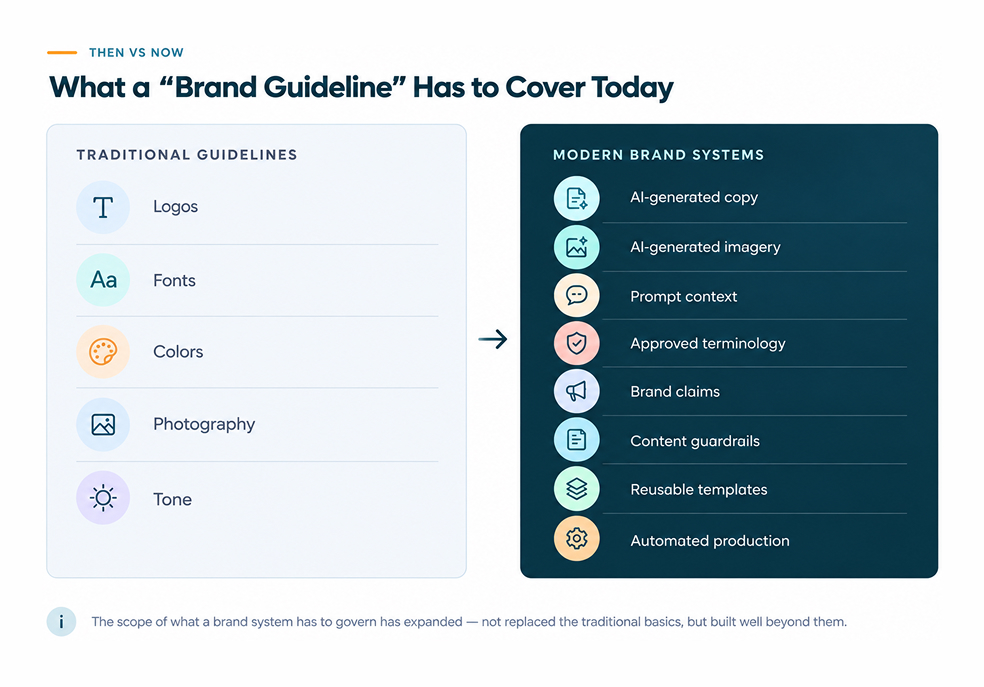
Guidelines Are Evolving Into Brand Systems

Traditional brand guidelines focused heavily on:

  • Logos
  • Fonts
  • Colors
  • Photography
  • Tone

Modern brand systems increasingly need to account for:

  • AI-generated copy
  • AI-generated imagery
  • Prompt context
  • Approved terminology
  • Brand claims
  • Content guardrails
  • Reusable templates
  • Automated production

AI Branding Systems

The question is no longer only: “Can our designer follow the guidelines?”

It is also:

“Can our employees, agency partners, automation tools, and AI workflows create content without gradually turning us into five different brands?” That is one reason the strategic and governance side of branding is becoming more important in the AI era.Adobe’s current AI Visibility tools specifically track how brands appear across AI-generated responses and whether their owned and external content supports that visibility.

Branding in the Age of AEO, GEO, and AI Discovery

Branding is also moving beyond what customers visually see.

People are increasingly researching brands through AI Overviews, ChatGPT, Gemini, Copilot, Perplexity, and other AI-generated answers. That means businesses also need to consider whether these systems correctly understand who they are and what they do.

Adobe now describes Generative Engine Optimization and Answer Engine Optimization as methods for improving how brands and content become visible, trustworthy, and retrievable inside AI-generated answers.

So where does branding fit?

Clear Brand Entities Matter

AI systems need consistent information around:

  • Company name
  • Services
  • Products
  • Industry
  • Expertise
  • Leadership
  • Locations
  • Credentials
  • Core terminology
  • Relationships between products and services

Consistency Needs to Extend Beyond the Website

Useful signals can come from:

  • Service pages
  • About pages
  • Case studies
  • Leadership profiles
  • Reviews
  • Media mentions
  • Business listings
  • Structured data
  • Authoritative third-party sources

Adobe’s current AI Visibility tools specifically track how brands appear across AI-generated responses and whether their owned and external content supports that visibility. AEO and GEO do not replace branding, and branding does not replace SEO. They increasingly overlap around one basic question:

Can people and AI systems clearly understand who the brand is, what it does, and why it is credible?

In the AI era, that clarity is becoming part of brand visibility itself.

Additional Considerations in Branding Costs

The amount quoted by an agency is not always the complete cost of changing a brand. Several implementation expenses can appear later if they are not planned at the beginning.

  • Website Updates

A new identity may require design, development, copy, and content changes.

  • Photography and Video

A new visual direction may call for original photography or video rather than existing assets.

  • Font and Asset Licensing

Commercial typefaces, photography, illustration, or other assets may have separate licensing fees.

  • Trademark and Legal Review

Naming and identity projects may require trademark searches or legal checks.

  • Packaging and Print Production

Creative fees usually do not include the physical cost of producing new materials.

  • Localization

Businesses operating across countries may need translation and cultural adaptation.

  • Additional Revision Rounds

Feedback beyond the agreed project scope can increase costs.

  • Internal Rollout

Larger brands may need training, templates, documentation, asset migration, and internal launch support.

These costs tend to feel “unexpected” only when nobody discussed them early enough. The most realistic budget covers both building the brand and putting it into use.

How to Budget for Branding

A branding budget should begin with the business problem, not with the largest package an agency happens to offer. Working backward from the desired outcome creates a much more useful scope.

Step 1: Define Why the Brand Needs to Change

Is the business trying to:

  • Launch?
  • Reposition?
  • Move upmarket?
  • Enter a new market?
  • Increase credibility?
  • Support sales?
  • Unify several brands?
  • Modernize its presence?
  • Prepare for investment?

The reason for the project should influence what gets funded.

Step 2: Decide What Actually Needs Work

Separate:

  • Research
  • Strategy
  • Messaging
  • Identity
  • Guidelines
  • Digital application
  • Rollout

Not every business needs to rebuild everything. Sometimes the positioning is strong and the identity needs work. In other cases, the visuals look fine but the messaging no longer reflects where the business is headed.

Before committing to a full rebrand, compare whether a brand refresh vs. rebrand makes more sense for what actually needs to change.

Making that distinction early can prevent unnecessary work and keep the branding investment focused on the areas that can create the most value.

Step 3: Count the Touchpoints

Think about where the brand must appear:

  • Website
  • Sales materials
  • Advertising
  • Social media
  • Packaging
  • Apps
  • Physical locations
  • Email
  • Proposals

One website is a very different rollout from forty retail locations and three product platforms.

Step 4: Separate Brand Creation From Implementation

Ask whether the quoted fee includes:

  • Website redesign
  • Templates
  • Signage
  • Packaging
  • Photography
  • Development
  • Internal rollout
  • Training

This avoids discovering halfway through the project that “full branding” apparently did not include using the brand anywhere.

Step 5: Leave Room for Change

Brand projects involve feedback, production decisions, and sometimes additional applications that were not obvious at the start. A sensible contingency makes the final budget more realistic.

The best branding budget is not the biggest one. It is the one that funds the parts of the brand that genuinely need to change.

The Cost of Not Investing in Branding

Choosing not to invest in branding does not always eliminate the cost. Often, it simply moves the cost somewhere less obvious.

Weak or inconsistent branding can contribute to:

  • Repeated redesigns
  • Confusing sales messages
  • Generic marketing
  • Lower perceived credibility
  • Slower creative approvals
  • Inconsistent customer experiences
  • Poor differentiation
  • Teams rebuilding the same assets
  • AI-generated content drifting off-brand

The AI era makes this particularly important.

Businesses can now create more content in less time than ever before. Without clear positioning and brand guardrails, they can also create more inconsistent content in less time than ever before.

More output is not automatically more brand value. Sometimes it is just more noise wearing the same font. Investing in branding should therefore be judged against the cost of repeated rework, inconsistent communication, weak recognition, and lost differentiation-not only against the agency invoice.

Calculating the Return on Investment - ROI of Branding

Branding ROI looks at whether the measurable financial and operational value created after a branding investment outweighs what was spent.

A simple starting formula is:

Branding ROI = (Value Generated − Branding Investment) ÷ Branding Investment × 100

For example, suppose a business invests $30,000 in branding and attributes $60,000 in additional gross profit or measurable savings to improvements following the project.

The calculation would be:

($60,000 − $30,000) ÷ $30,000 × 100 = 100% ROI
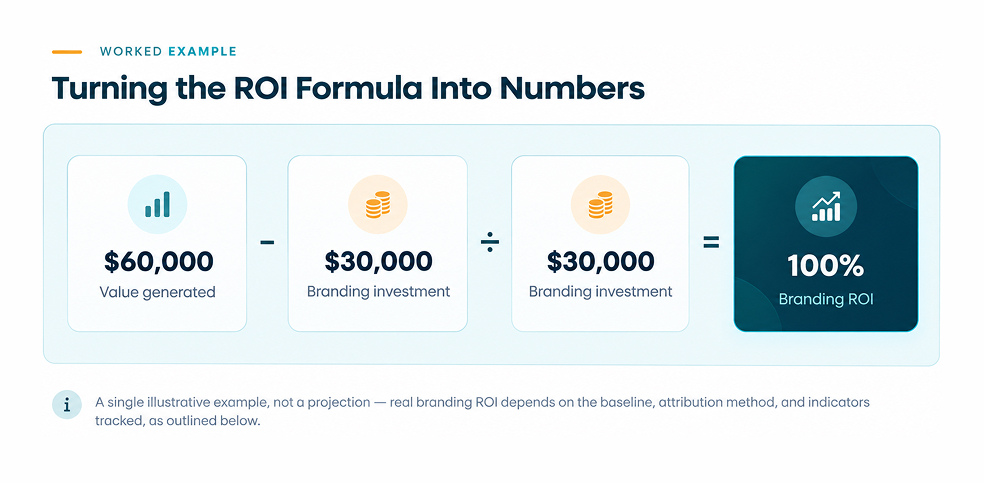
Branding ROI Formula

Simple formula.

Less simple attribution.

Branding usually works alongside marketing, sales, pricing, product, and customer experience. The strongest measurement therefore uses several indicators.

Revenue Indicators

Track changes in:

  • Conversion rate
  • Sales win rate
  • Average deal value
  • Price acceptance
  • Campaign-generated revenue

Demand Indicators

Measure:

  • Branded search volume
  • Direct website traffic
  • Referral traffic
  • Qualified inbound leads
  • Share of search

Brand Indicators

Track:

  • Awareness
  • Recall
  • Preference
  • Trust
  • Message understanding

Operational Indicators

Brand systems can also create internal value through:

  • Faster asset creation
  • Fewer revisions
  • Reusable templates
  • Faster approval cycles
  • More consistent communication

The most useful ROI measurement starts before the branding project .Without a baseline, the post-launch result often becomes:

“It definitely feels better.” Possibly true. Slightly difficult to place in a board report.

Is Professional Branding Worth the Cost?

Professional branding is generally worth the investment when the business has a clear reason for changing the brand and the project addresses that reason.

It becomes much harder to justify when the entire brief is:

“We have looked at this logo for four years and we are tired of it.”

Different delivery models make sense at different stages.

DIY Branding Can Work When:

  • The business is testing an idea
  • Budgets are very limited
  • The identity may change quickly
  • Only basic assets are required

A Freelancer Can Work When:

  • The project is focused
  • Strategy already exists
  • A specific skill is required
  • Internal teams can manage implementation

An Agency Can Work When:

  • Research and strategy are required
  • Several creative skills are needed
  • Multiple stakeholders are involved
  • The brand must work across several channels
  • Rollout needs coordination
  • Ongoing governance matters

The right choice is not automatically the most expensive provider.

It is the provider model that matches the complexity of the problem being solved.

What Is the 3-7-27 Rule of Branding?

The 3-7-27 rule of branding is a guideline suggesting that repeated brand exposure can move customers from recognition toward recall and eventually purchase.

Shopify describes the rule as:

  • 3 exposures to recognize the brand
  • 7 exposures to remember it
  • 27 exposures before making a purchase

It is best treated as a branding guideline rather than a guaranteed behavioral formula.
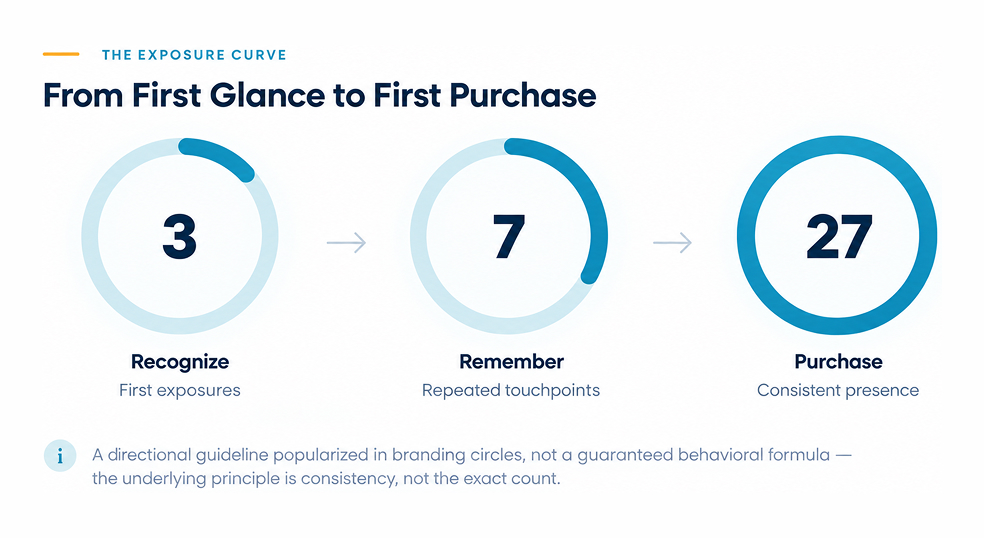
3-7-27 Branding Rule

The useful principle is consistency.

Customers rarely remember a company because they saw one logo once. Familiarity builds through repeated experiences across advertising, websites, social content, search, sales interactions, reviews, and increasingly, AI-driven discovery.

That is precisely why a consistent identity and messaging system matters long after the original branding project is complete.

Conclusion

Branding costs are increasingly less about how long it takes someone to create a design asset and more about how much strategic clarity and brand infrastructure the business needs.

A focused branding project may cost a few thousand dollars. Strategy-led branding often moves into tens of thousands. Large enterprise programs can cross six figures. None of those numbers mean much until they are compared with the research, strategy, creative work, rollout, and business outcomes included.

AI is making brand creation faster. It is also making generic content easier to produce.

That puts more value on what actually makes a brand recognizable: clear positioning, strong messaging, distinctive identity, consistent systems, credible entity signals, and the ability to stay coherent across traditional search, AEO, GEO, and AI-driven discovery.

So before comparing branding strategy cost, logo branding package price, branding agency pricing, or standard branding packages, define what the brand needs to achieve next.

That turns the conversation from “How much will branding cost us?” into a much more useful one:

“What level of branding investment will move the business forward?”

Make Sure Your Branding Investment Matches What Your Business Really Needs

Talk To Our Brand Expert

Talk To Brand Expert

FAQs

Related Blog Posts

CRO model for digital agencies

From Project Revenue to Recurring Value: A Practical CRO Model for Digital Agencies

September 17, 2026
CRODigital AgenciesRecurring RevenueWebsite Optimization
Digital Agency CRM Automation

The Lead Came In. What Happens Next? A CRM & Automation Guide for Digital Agencies

September 16, 2026
CRM AutomationDigital AgenciesLead ManagementMarketing Automation
AI Website Personalization for Agencies

What AI Website Personalization Could Actually Look Like for Your Agency’s Clients

September 16, 2026
AI PersonalizationConversion OptimizationDigital AgenciesWebsite Personalization
White-label analytics support for agencies

Why Good Campaigns Still Underperform: The Conversion Gap Agencies Can Help Fix

September 16, 2026
Conversion OptimizationCRODigital Marketing AgenciesLanding Page Optimization
Grow Existing Client Accounts

How Digital Agencies Can Grow Existing Client Accounts Without Building Every Capability In-House

September 16, 2026
Agency PartnershipsClient Account GrowthDigital AgenciesWhite-Label Services
performance marketing budget allocation

Which Performance Marketing Channel Deserves More of Your Budget?

September 10, 2026
Digital MarketingMarketing BudgetPaid MediaPerformance Marketing
Cheap Leads in Lead Generation

Why Cheap Leads Can Become Your Most Expensive Lead Generation Mistake

September 09, 2026
Google AdsLead GenerationLead QualityPerformance Marketing
AI performance marketing

How AI Is Transforming Performance Marketing From Ad Spend to Revenue

August 24, 2026
AI marketingArtificial IntelligenceDigital MarketingPerformance Marketing