

The businesses that succeed with AI will not necessarily use the most tools. They will operate with the most clarity.
Over the last couple of years, I’ve noticed something interesting while speaking with business owners, leadership teams, and operational heads across industries.
Almost everyone is investing in AI.
Some are experimenting with AI-generated content. Some are automating workflows. Some are integrating AI into customer support, reporting, marketing, sales, recruitment, or internal operations. Every week, a new platform promises higher productivity, faster execution, and smarter decision-making.
On the surface, it feels like businesses are moving faster than ever before.
But underneath that speed, many teams feel more overwhelmed than empowered.
There are more dashboards to monitor. More tools to manage. More automations to maintain. More prompts to standardize. More notifications to respond to. More disconnected systems are trying to work together.
Ironically, many businesses that adopted AI to reduce operational friction are now experiencing a different problem altogether: operational noise.
And I don’t believe AI itself is the problem.
In most cases, AI is simply exposing and accelerating the operational realities that already existed inside businesses.
Unclear workflows. Fragmented ownership. Inconsistent communication. Lack of documentation. Decision bottlenecks. Dependency on specific individuals. Too many disconnected tools. Reactive operations.
AI did not create most of these issues.
It simply made them harder to ignore.
That is why I believe businesses today do not necessarily need more AI tools.
They need more clarity.
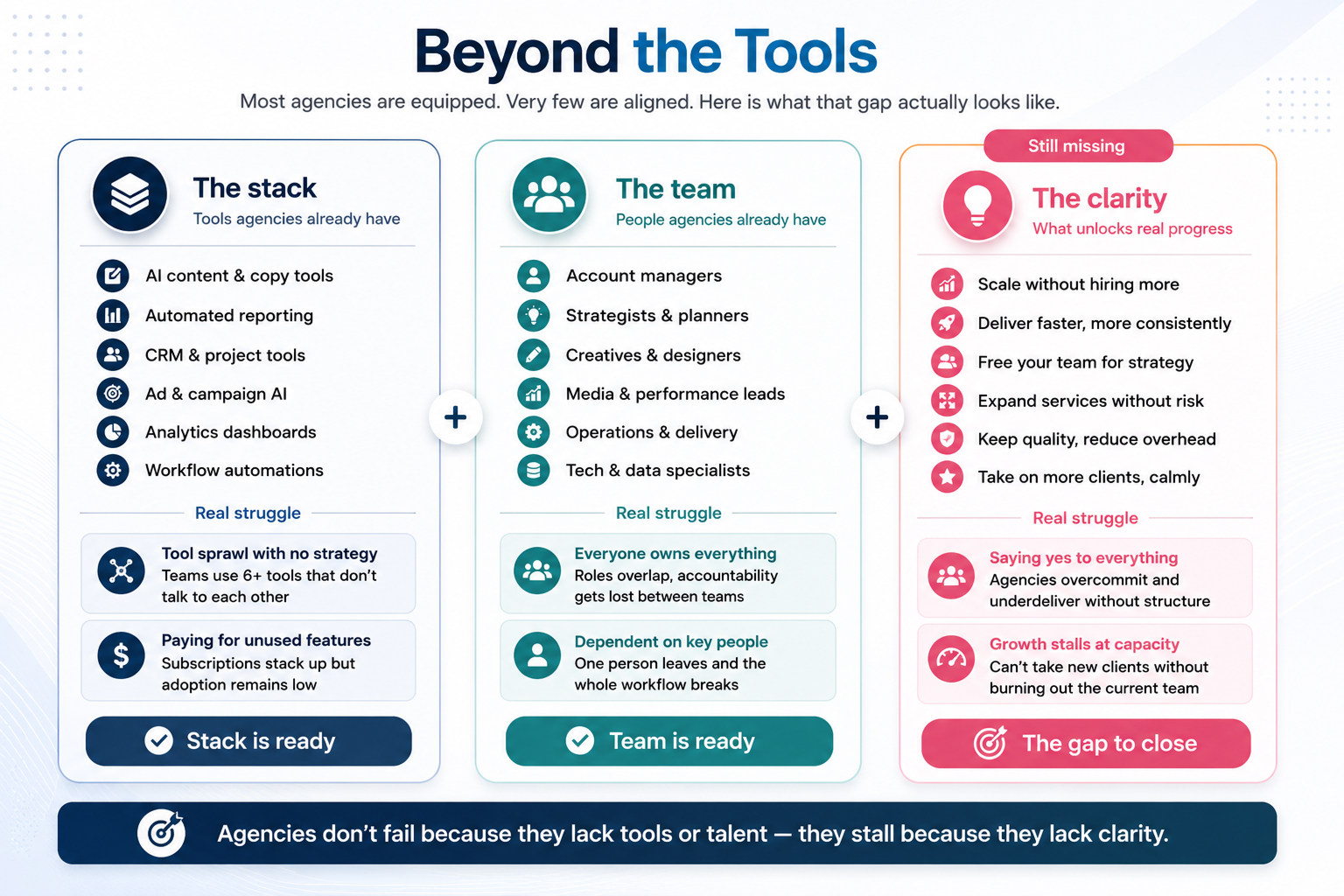
Most Businesses Are Layering AI on Top of Existing Chaos
One of the most common patterns I see today is businesses trying to automate before they simplify.
A team already struggling with approvals introduces AI-generated workflows.
A company with unclear processes adds five new automation tools.
A leadership team without standardized reporting implements AI dashboards.
A marketing team without clarity on positioning starts scaling AI-generated content production.
The result is predictable.
Output increases. Alignment decreases.
Speed increases. Clarity decreases.
And eventually, businesses begin confusing activity with effectiveness.
This is where many AI conversations become misleading.
The discussion often revolves around:
- Which AI tools to use
- Which automations to build
- Which prompts perform better
- Which platform is faster
- Which workflow saves time
But very few organizations pause to ask a more foundational question:
Are Our Operational Systems Actually Ready for Acceleration?
Because acceleration magnifies everything.
If your workflows are clear, AI can create extraordinary leverage. If your workflows are chaotic, AI simply scales the chaos faster.
I’ve seen teams produce more content than ever before while becoming less differentiated in the market.
I’ve seen businesses automate internal processes that nobody fully understood manually in the first place.
I’ve seen organizations create sophisticated automation layers while still struggling with basic ownership clarity.
And I’ve seen leadership teams spend more time managing tools than improving actual business outcomes.
“AI is not replacing operational discipline. It is exposing the lack of it.”
That distinction matters.
Because it changes how businesses should think about AI adoption entirely.
Speed Without Clarity Is Not Efficiency
There is a dangerous assumption developing in the market today:
“If something becomes faster, it automatically becomes better.”
That is not always true.
Faster execution without operational alignment often creates:
- More rework
- More inconsistency
- More dependency
- More confusion
- More decision fatigue
AI is incredibly effective at accelerating output.
But businesses are learning that output alone does not create operational maturity.
For example:
- Faster meetings do not guarantee better decisions
- Faster content does not guarantee stronger positioning
- Faster communication does not guarantee better collaboration
- Faster workflows do not guarantee accountability
- Faster reporting does not guarantee clarity
In many organizations, teams are now operating in a constant state of acceleration without reflection.
- Everything feels urgent.
- Everything feels active.
- Everything feels productive.
But when you step back, the organization itself often feels fragmented.
And fragmentation is expensive.
It creates:
- Duplicated efforts
- Quality inconsistencies
- Dependency risks
- Communication gaps
- Operational fatigue
- Strategic drift
The irony is that many businesses adopted AI, hoping to simplify operations, while unintentionally making operations more mentally demanding for teams.
Because complexity does not disappear simply because technology becomes smarter.
In fact, unmanaged complexity often becomes harder to control when layered with automation.
The Hidden Problem: Businesses Are Automating Before They Are Operationally Ready
This, in my opinion, is the real issue.
Most businesses are approaching AI implementation as a technology problem instead of an operational maturity problem.
But AI performs best in environments with:
- Clear ownership
- Repeatable systems
- Standardized processes
- Documentation culture
- Operational discipline
- Defined expectations
Without those foundations, businesses often end up creating fragile operational ecosystems.
Everything becomes dependent on:
- Specific prompts
- Specific tools
- Specific people
- Specific integrations
- Specific workflows
And suddenly, the organization becomes more difficult to manage than before.
- One broken integration affects reporting.
- One undocumented automation disrupts execution.
- One key employee leaving creates workflow instability.
- One AI-generated process introduces quality inconsistency at scale.
This is why many companies today are experiencing a strange contradiction.
They are becoming technologically advanced while operationally unstable.
And the instability is not always visible immediately.
Initially, AI creates excitement.
Teams move faster.
Leadership sees productivity gains.
Output increases.
But over time, deeper operational cracks begin to surface.
Because sustainable scale requires more than acceleration.
It requires clarity.
I believe businesses often underestimate how important operational simplicity becomes during periods of technological acceleration.
When systems are unclear, every new AI layer increases cognitive load.
Teams must now understand:
- The workflow itself
- The automation logic
- The platform dependencies
- The reporting structure
- The prompt standards
- The approval process
- The maintenance process
Without clarity, operational environments become mentally exhausting.
And exhausted systems eventually become inefficient systems.
More Tools Are Not Creating More Alignment
One of the biggest misconceptions in modern business operations is the belief that adding more tools automatically improves efficiency.
In reality, many organizations are becoming digitally overloaded.
There are tools for:
- Communication
- Documentation
- Project management
- AI generation
- AI summarization
- Automation
- Reporting
- Collaboration
- Analytics
- Approvals
- Workflow orchestration
Individually, many of these platforms are excellent.
But collectively, they can create fragmented operational behavior if not implemented thoughtfully.
Teams begin switching contexts constantly.
Information becomes scattered across systems.
Conversations happen in multiple places.
Decision histories become difficult to track.
Ownership becomes diluted.
And eventually, people spend more time navigating systems than solving problems.
Operational Calm Is Becoming a Competitive Advantage
What concerns me most is not tool adoption itself.
It is the growing normalization of operational overload.
Many businesses now assume that feeling overwhelmed is simply part of modern work.
I disagree.
I think operational calm is becoming one of the most underrated competitive advantages in business.
Because clarity creates:
- Faster decision-making
- Stronger accountability
- Better execution quality
- Lower dependency risks
- Healthier collaboration
- More sustainable scale
The businesses moving thoughtfully right now are often outperforming the businesses moving noisily.
Not because they are avoiding AI. But because they are implementing it with operational maturity.
The Businesses Moving Calmly Are Often Winning Quietly
There is an interesting pattern I continue to observe.
Some of the most operationally effective businesses are not necessarily the ones using the highest number of AI tools.
They are often the ones with:
- Simpler systems
- Clearer workflows
- Stronger documentation
- Better workflow discipline
- Defined ownership
- Intentional implementation
These organizations are not rushing to automate everything immediately.
They are asking smarter foundational questions first:
- What problem are we actually solving?
- Is this workflow already clear manually?
- Who owns this process?
- What happens if this automation fails?
- Is this reducing friction or adding hidden complexity?
- Are we improving clarity or increasing dependency?
That mindset creates operational resilience.
And resilience matters far more than temporary productivity spikes.
Because AI will continue evolving rapidly.
Tools will continue changing.
Platforms will continue competing.
Workflows will continue transforming.
But businesses with operational clarity will adapt faster than businesses dependent on unstable complexity.
That is the real long-term advantage.
What Businesses Must Clarify Before AI Acceleration
AI adoption should not begin with tools, prompts, or integrations. It should begin with operational clarity.
Before businesses move faster with AI, they need to understand how work currently moves, where decisions are made, who owns outcomes, and what standards define quality.
Without that clarity, AI does not simplify operations. It multiplies existing confusion at a faster pace.
A calmer approach to AI adoption asks better questions first:
- Who owns the workflow?
- Is the process simple enough to automate?
- Is thinking standardized across teams?
- Is information centralized and visible?
- Is quality protected before speed is prioritized?
The following sections break down the key areas businesses should clarify before AI starts shaping their workflows, decisions, and output quality.
Before You Automate, Simplify
I believe businesses need a calmer and more disciplined framework for AI adoption.
Not slower.
Not resistant.
Just more thoughtful.
Because AI should strengthen operational clarity — not weaken it.
Before You Automate, Define Ownership
AI cannot solve unclear accountability.
If nobody owns decisions manually, automation only accelerates confusion digitally.
Every workflow needs:
- Ownership
- Responsibility
- Escalation clarity
- Review structure
Without accountability, AI systems become operational noise generators.
Before You Use AI, Simplify the Workflow
Many workflows are too complex even before automation begins.
Automating broken systems rarely creates sustainable efficiency.
The sequence matters:
Simplify → Standardize → Automate
Not the other way around.
Before You Scale Prompts, Standardize Thinking
One of the hidden operational risks today is inconsistency in organizational thinking.
Different people prompting AI differently can produce dramatically inconsistent outputs.
That inconsistency eventually affects:
- Brand positioning
- Decision-making
- Communication quality
- Reporting standards
- Customer experience
AI output quality often reflects organizational clarity quality.
Before You Connect Tools, Centralize Clarity
More integrations do not automatically create better operations.
Sometimes they simply create more dependency chains.
Before businesses aggressively layer integrations, they should first prioritize:
- Centralized understanding
- Documentation
- Visibility
- Process transparency
Because when teams lack clarity around how work actually moves, integrations often amplify confusion instead of improving efficiency.
Clarity should come before connectivity.
When teams understand ownership, workflows, dependencies, and decision flow, integrations become useful support systems instead of another operational burden.
Before connecting more tools, businesses need to connect their thinking first.
Before You Pursue Speed, Protect Quality
This may become one of the most important leadership disciplines in the AI era.
Because speed is becoming easier. Quality is becoming harder.
As AI accelerates output creation, businesses that maintain:
- Judgment
- Clarity
- Consistency
- Positioning
- Operational discipline
Because when everyone can produce more, the real difference will come from what a business chooses to refine, approve, and put into the market.
Speed may create momentum. Quality is what protects trust, reputation, and long-term value.
AI Will Reward Operationally Mature Businesses
I believe the long-term AI advantage will not belong equally to everyone.
The businesses that benefit most from AI will likely be the ones that already operate with:
- Clarity
- Discipline
- Documentation
- Adaptability
- Accountability
- Structured thinking
Because AI amplifies organizational maturity.
It does not replace it.
This is why I believe the future competitive gap may not primarily be technological.
It may be operational.
Some businesses will continue adding more tools while becoming increasingly fragmented internally. Others will intentionally simplify, align, standardize, and then scale intelligently with AI. The difference between those two paths will become increasingly visible over the next few years.
And I suspect operational calm will quietly outperform operational chaos.
Conclusion
I am optimistic about AI.
I believe it will transform businesses profoundly.
I believe it will remove unnecessary friction from operations.
I believe it will create extraordinary leverage for teams and organizations.
But I also believe businesses are underestimating the importance of operational maturity during this transition.
Technology alone does not create clarity.
- Leadership does
- Systems do
- Discipline does
- Communication does
- Ownership does
- Simplification does
The goal should not be to build the most automated organization possible.
The goal should be to build the clearest one.
Because ultimately, businesses do not need more AI tools. They need better operational thinking around how those tools fit into the business itself. And the businesses that succeed with AI will not necessarily use the most tools.
They will operate with the most clarity.
Ready To Make Scaling Feel Less Fragmented and More Structured?
Discuss Your Growth Needs

FAQs
How soon can agencies see results with ZealousWeb’s support?
Timelines depend on the scope of work, but agencies usually start seeing better delivery clarity, reduced execution gaps, and smoother client handling once the workflow, ownership, and reporting structure are aligned.
How does ZealousWeb help agencies control delivery costs?
ZealousWeb helps agencies reduce the pressure of hiring, training, and maintaining large in-house teams by providing flexible execution support across web, SEO, marketing, and technical projects.
Can ZealousWeb help agencies protect their margins?
Yes. By supporting execution without adding unnecessary internal overhead, ZealousWeb helps agencies manage delivery costs more predictably and protect project profitability.
How does ZealousWeb maintain transparency during delivery?
ZealousWeb follows a structured process with clear communication, defined responsibilities, practical reporting, and progress visibility, helping agencies avoid surprises during execution.
How does ZealousWeb help agencies reduce delivery pressure?
ZealousWeb helps by taking ownership of execution layers such as development, SEO, marketing operations, analytics, automation, and technical implementation, so agencies can focus more on strategy, client relationships, and growth.
Do you offer custom engagement models for agencies?
Yes. ZealousWeb offers flexible partnership models based on agency needs, project scope, team capacity, and long-term growth goals.
How does ZealousWeb support agencies without disrupting their client relationships?
We work as an extension of your team, strengthening execution behind the scenes while helping you maintain control, consistency, and client confidence.
Does ZealousWeb offer flexible pricing models?
Yes. ZealousWeb offers flexible engagement models based on project scope, required expertise, workload, and long-term partnership needs.