
Fraud Blocker
Cheap Leads in Lead Generation

Why Cheap Leads Can Become Your Most Expensive Lead Generation Mistake

September 09, 2026Posted By: Jalpa Gajjar
Google AdsLead GenerationLead QualityPerformance Marketing

A $20 lead can feel like good news. Your cost per lead (CPL) is down, the campaign is generating more enquiries, and the dashboard looks healthier. But if those leads are not turning into qualified leads, sales opportunities, or customers, the apparent saving can disappear very quickly.

That is where lead quality starts to matter more than lead volume. Sales spends more time filtering poor-fit enquiries, close rates begin to slip, and cost per acquisition (CPA) can rise even while CPL keeps falling.

For business owners and marketing decision-makers, that is the real tension: the campaign may look more efficient at the top of the funnel while becoming more expensive further down.

And that is exactly where this article goes next-into the hidden costs, warning signs, and campaign decisions that can make your cheapest leads the most expensive ones to scale.

The $20 Lead That Looked Cheap-Until the Sales Math Came In

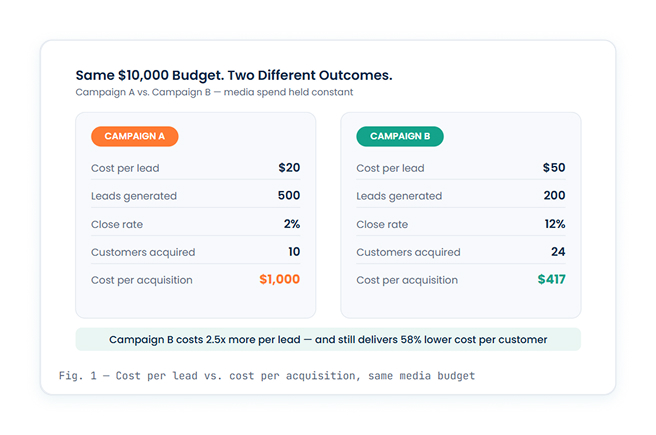
Consider two campaigns with the same $10,000 media budget.

Campaign A Campaign B
Cost per lead $20 $50
Lead generated 500 $200
Close rate 2% 12%
Customer acquired 10 24
Cost per acquisition $1000 $417


Cheap lead cost comparison

If the business evaluates performance by cost per lead, Campaign A looks unbeatable. It generates 2.5X more leads at less than half the CPL.

But Campaign B produces more than twice as many customers and acquires each one for roughly 58% less.

That is the difference between optimizing marketing activity and optimizing business growth.

The $20 lead is not automatically bad. If it qualifies and converts, it is excellent. But once lower CPL is being achieved at the expense of lead quality, sales-qualified leads, close rate, or customer acquisition cost, cheap leads become a false economy.

The cheapest lead does not win. The campaign producing the best customer economics does.

Your Cost Per Lead Is Hiding the Number That Actually Matters

Businesses frequently ask, “What is a good cost per lead?”

But without qualification and conversion data, there is no commercially useful answer.

A $150 CPL can make sense when the average deal is worth $20,000 and the close rate is strong. A $15 CPL can be disastrous when 98% of enquiries never become a genuine sales opportunity.

This is why cost per lead vs. cost per acquisition needs to be part of every serious performance conversation.

CPL answers: How much did it cost to generate an enquiry?

CPA answers: How much did it cost to acquire the customer?

And for businesses with longer sales cycles, there is another number that often exposes the problem even earlier:

Cost per qualified lead.

If you spend $10,000 to generate 500 leads but only 20 meet your sales criteria, your $20 CPL has effectively become a $500 cost per qualified lead.

Your target CPL therefore should not come from an industry benchmark alone. It should work backward from:

Customer value → allowable CPA → close rate → qualification rate → target CPL

That is the economics your P&L actually cares about.

What Cheap Leads Are Really Costing Your Business

Poor lead quality rarely stays inside the advertising budget.

Imagine 300 unqualified leads entering your CRM in a month. If each one consumes only 12 minutes across review, calls, follow-up, notes, and administration, that creates 60 hours of sales effort before generating a dollar of revenue.

For a senior B2B sales team, that is expensive capacity being used to determine who should never have entered the pipeline. The business starts paying the cheap-lead tax in several places at once.

  • Sales capacity: Representatives spend more time filtering than selling.
  • Pipeline velocity: High-intent prospects compete for attention with low-value enquiries.
  • Cost per qualified lead: The attractive CPL disappears once qualification is considered.
  • Customer acquisition cost: More leads have to be worked to generate the same number of customers.
  • Opportunity cost: Time spent chasing weak prospects is time not spent advancing serious deals.
  • Management visibility: Lead volume rises, creating the appearance of growth even when qualified pipeline and revenue remain flat. That is why lead quality vs. quantity is not simply a marketing preference.

It is a profitability decision.

5 Signs Your Lead Quality Is Hurting Sales

Cheap leads rarely become expensive overnight. The cost usually shows up gradually-first in lead quality, then in sales efficiency, then in customer acquisition cost.

If you’re wondering why leads are not converting, whether your cost per lead is actually good, or why sales keeps pushing back on lead quality, these five signals usually reveal where the economics are starting to break.

Your Lead Volume Is Rising Faster Than Qualified Pipeline

More leads should create more opportunities. When that relationship starts weakening, lead volume becomes a misleading growth signal.

If campaign conversions rise 40% but sales-qualified opportunities increase only 5%, the business has not created 40% more demand. It has created more activity at the top of the funnel without equivalent commercial value further down.

That is why businesses should track lead qualification rate alongside CPL.

Ask:

  • What percentage of leads meet your qualification criteria?
  • How many become sales-qualified leads?
  • How many progress into real opportunities?

If volume is climbing while these numbers stay flat, your campaigns may be getting cheaper without getting better.

Sales Rejects More Leads Than It Progresses

A high rejection rate is one of the clearest signs of a lead quality problem.

CRM outcomes such as:

  • wrong fit;
  • insufficient budget;
  • outside target geography;
  • not the decision-maker;
  • duplicate enquiry;
  • no clear requirement;
  • repeated non-response;

should not be treated as sales commentary. They are performance data.

When the same rejection reasons appear repeatedly from specific campaigns, search terms, audiences, or lead sources, they tell you exactly where acquisition quality is breaking down.

This is also where businesses searching how to improve lead quality should start-not by immediately changing bids or budgets, but by understanding why existing leads fail qualification.

If you cannot explain why leads are being rejected, you cannot reliably improve them.

Your Cheapest Campaign Has One of Your Weakest Close Rates

This is where low CPL can become particularly deceptive.

Consider two campaigns:

Campaign A: $25 CPL with a 3% close rate Campaign B: $60 CPL with a 14% close rate

Campaign A looks more efficient inside the advertising platform.

But once you calculate how many leads are needed to generate one customer, Campaign B may be producing substantially better acquisition economics.

This is why performance should be reviewed across the full chain:

CPL → Qualification Rate → Cost per Qualified Lead → Opportunity Rate → Close Rate → CPA

A campaign should not be scaled simply because it has the lowest cost per lead. It should be scaled when the leads it produces continue creating value further down the funnel.

CPL Is Falling While CPA Keeps Rising

This is one of the strongest warning signs that your campaigns are optimizing toward the wrong outcome.

For example:

Last quarter:

CPL: $50CPA: $600

This quarter:

CPL: $35CPA: $900

The marketing dashboard shows a 30% improvement in lead cost. The business is paying 50% more to acquire a customer. That is why cost per lead vs. cost per acquisition matters so much.
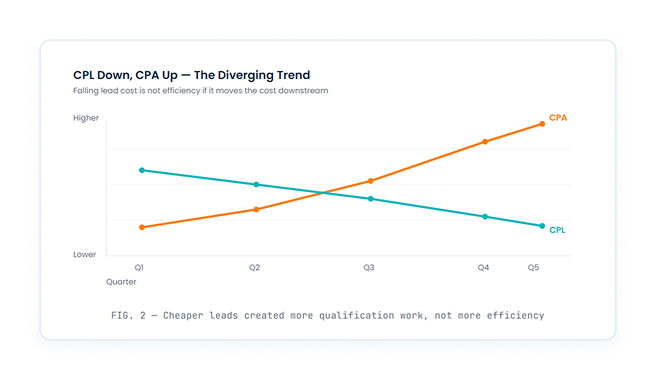
CPL falling CPA rising

If CPL is improving while CPA or customer acquisition cost is getting worse, cheaper leads are not creating efficiency. They are creating more work between the first conversion and the final sale.

At that point, reducing CPL further should not be the priority. Finding out where qualification and conversion are being lost should be.
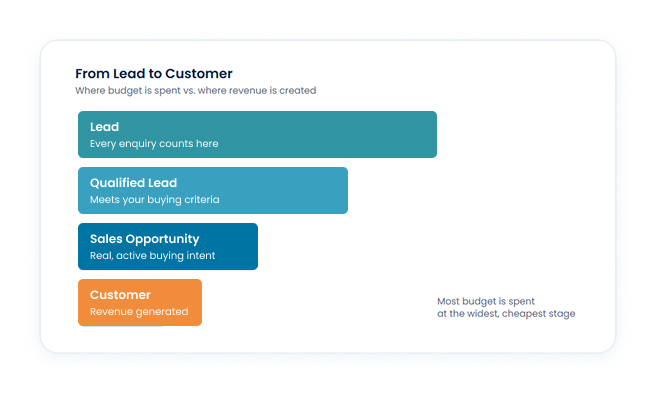
Marketing Reports More Leads While Sales Keeps Asking for Better Leads

This is often treated as a marketing-versus-sales disagreement. It should be treated as a measurement problem.

Marketing may genuinely be generating more conversions. Sales may genuinely be receiving fewer prospects they believe are worth pursuing. Both teams can be right.

The problem is usually that the business has never created one shared definition of a qualified lead. Marketing may count every form submission.

Sales may care about:

  • buying authority;
  • budget;
  • geography;
  • company profile;
  • use case;
  • timeline;
  • actual purchase intent.

Until those definitions are aligned and tracked, marketing can appear to improve while sales performance deteriorates.

A stronger lead-generation system creates a common language:

Lead → Qualified Lead → Sales Opportunity → Customer

Once those stages are measured consistently, businesses can stop debating whether lead quality is “good” and start proving which campaigns actually generate revenue.

Marketing sales lead quality

If two or more of these signs are already visible in your business, the issue is probably no longer just lead volume. It is the economics behind that volume-and the longer those economics stay hidden behind a low CPL, the more expensive scaling becomes.

Why Cheap Leads Keep Entering Your Funnel

Cheap leads usually enter because the acquisition model is rewarding the wrong outcome.

A low-cost lead vendor may be commercially rewarded for producing more contacts. A purchased database may be priced attractively precisely because intent was never proven. A PPC campaign may optimize heavily toward form submissions because that is the conversion signal available to the platform.

In every case, the business inherits the expensive part: qualification. The same problem can happen inside well-funded Google Ads accounts.

Broad or automated reach can find incremental demand, but incremental reach is not automatically incremental buying intent.

An offer built around “lowest price,” “free,” or “instant quote” can also reduce CPL while attracting a larger percentage of price shoppers rather than strong-fit prospects.

And a landing page designed only to maximize form completion can create another false win. Removing every question may improve conversion rate, but it can also move the qualification burden directly onto sales.

You did not remove friction. You transferred it to a more expensive part of the business.

In 2026, Google Ads Can Scale the Wrong Signal Faster Than Ever

Paid lead generation has changed materially.

Google now relies more heavily on AI-led bidding, broader search matching, keywordless technologies, automated asset optimization, search themes, and cross-inventory campaigns.

AI Max for Search can extend beyond existing keywords using broad match and keywordless technology, learning from keywords, creatives, and URLs to identify additional relevant searches.

Performance Max also gives advertisers more search controls than it once did, including campaign-level negative keywords for Search and Shopping inventory and search themes that provide Google’s AI with additional context about the business and customer intent.

For businesses, this creates both opportunity and risk. AI-led campaigns can scale what you define as success.

If your success signal is: Form submitted ✅

Google knows it generated a conversion.

Your CRM may later know that the same lead was: Unqualified ❌

If that downstream information never makes it back into campaign optimization, the platform has little reason to distinguish between the two.

This is why Google’s current lead measurement framework supports Qualified Lead and Converted Lead goals based on offline CRM outcomes. Enhanced conversions for leads also allow businesses to associate offline lead outcomes with earlier advertising interactions, helping improve conversion measurement and bidding signals. Google unified its enhanced-conversion setup further in 2026, with website, Data Manager, and API inputs working under the updated framework.

For a business already complaining about Google Ads lead quality, this changes the conversation.

The question can no longer stop at: “Why is Google sending us bad leads?”

It needs to become: “What signals are we giving Google to identify a good one?”

Search Terms, PMax, and Landing Pages Still Shape Lead Quality

Automation has not made Google Ads account discipline irrelevant. It has made it more important.

With Performance Max, broader matching, AI-led bidding, and increasingly automated campaign decisions, businesses can reach more potential buyers faster than before. But if the account is learning from weak conversion signals, that same automation can also scale unqualified leads faster.

That is why businesses asking “how to improve lead quality in Google Ads?” should look beyond CPL. The real issue is usually the quality of the search intent entering the campaign, the amount of qualification happening before the form fill, and whether Google receives any signal about what happened after the lead reached sales.

Search Intent Still Needs to Be Commercially Relevant

A conversion is only valuable when the search behind it reflects a realistic buying need.

This is where Google Ads lead quality can start breaking down. A campaign may report conversions from keywords that appear relevant, while the actual search terms reveal very different intent-research, employment, training, support, free resources, or price-only enquiries.

For a B2B business, that distinction has a direct commercial impact. If high-converting search terms rarely become qualified leads or sales opportunities, their attractive CPL is giving you the wrong performance signal.

Search-term analysis should therefore go beyond asking “Which queries converted?” and answer:

  • Which searches produced qualified leads?
  • Which searches progressed into opportunities?
  • Which terms repeatedly generated poor-fit enquiries?
  • Where is budget being spent on intent that sales cannot monetize?

Performance Max search-term visibility and negative keyword controls give advertisers more ability to act on those patterns. But the objective is not to build the biggest exclusion list-it is to identify which search intent consistently produces business value and protect more budget for it.

The search term that produces the cheapest form fill is not necessarily the search term you want to scale. The one that repeatedly produces qualified pipeline is.

Performance Max Works Better With Stronger Business Signals

Performance Max increasingly depends on signals that help Google’s AI understand who the business wants to reach.

Search themes, for example, let advertisers provide additional context about what customers are likely to search for-particularly useful when the product is niche, the offering is new, or the intent is difficult for the landing page alone to communicate.

For a specialized B2B company, that matters.

Your website may explain what you sell.

It may not clearly explain:

  • which industries are commercially valuable;
  • which use cases produce the strongest opportunities;
  • what technical problem signals serious buying intent;
  • which searches come from decision-makers rather than researchers.

If your Performance Max audience and search signals are broad while your real buying market is narrow, generating more conversions may simply mean generating more qualification work.

Landing Pages Need to Qualify As Well As Convert

For high-value B2B services, asking only for name, email, and phone number may maximize form fills but tell sales almost nothing.

Selective friction can be commercially useful.

  • Location.
  • Company size.
  • Service requirement.
  • Timeline.
  • Budget range.

Not fifteen questions-just enough to distinguish curiosity from genuine buying potential.

Conversion Data Needs to Travel Downstream and Back Again

The strongest campaign feedback often lives inside your CRM: qualified lead, opportunity created, proposal issued, deal won.

Google recommends Qualified Lead or Converted Lead conversion goals when setting up enhanced conversions for leads. That is how performance marketing starts moving from form optimization toward revenue optimization.

Search terms determine who discovers you. PMax and match expansion influence how far the campaign reaches. Landing pages determine who enters the funnel. CRM data tells you whether they were worth acquiring.

When those four signals are disconnected, cheap leads multiply. When they work together, Google Ads can start optimizing toward business value instead of form volume.

For businesses operating in highly specialized B2B markets, that distinction becomes even more important-because when the real buyer pool is limited, there is far less room to spend budget manufacturing volume that sales can never convert.

In Niche B2B Markets, Chasing Volume Can Be the Wrong Growth Strategy

The cheaper-lead mindset becomes even more dangerous when the addressable market is already small.

In niche B2B categories, there may only be a limited number of prospects who have the right technical requirement, budget, authority, and buying intent. That means pushing aggressively for more form fills can quickly reduce lead quality rather than create more real opportunities.

For businesses selling specialized or high-value solutions, the better question is not:

“How do we generate more leads?”

It is:

  • Are we visible for the right high-intent searches?
  • Are we reaching the people who actually fit the buying profile?
  • Are our ads and landing pages helping those prospects move forward?
  • Is the budget being concentrated where qualified demand actually exists?

That was the reality for one global technology business operating in highly specialized sectors such as defense and aviation. Its solutions were built for complex enterprise and institutional buyers, which naturally meant a smaller lead pool, limited keyword options, and very little room for irrelevant traffic.

Trying to manufacture cheap volume would have worked against the market.

Instead, the paid marketing strategy focused on:

  • highly relevant keyword targeting;
  • matching content with real search intent;
  • improving CTA visibility;
  • analyzing user behavior through heatmaps;
  • reducing navigation friction; and
  • concentrating budget on placements with stronger commercial relevance.

The result was a 2.1% increase in CTR, 80 additional clicks, improved visibility in high-impact search positions, and fewer dead and rage clicks.

The bigger takeaway is not the click volume. When the market is specialized, precision becomes the growth strategy-and this paid media case study shows what that looks like in practice.

A business selling a complex, high-value solution does not need thousands of random form fills. It needs the right buying committee, the right requirement, and the right intent entering the funnel. That is the difference between lead generation and qualified lead generation.

Stop Asking "How Can We Get More Leads?"

For businesses that have already been burned by low-quality enquiries, the next campaign conversation should sound different.

Do not start with: Can we lower CPL?

Start with:

  • Which campaigns generate the highest qualification rate?
  • What is our cost per qualified lead?
  • Which search terms produce opportunities-not just conversions?
  • Which lead sources actually close?
  • What is CPA by campaign?
  • How much sales capacity is being consumed before qualification?
  • What is the lifetime value of customers acquired from each source?

These questions make it much harder for a vanity metric to disguise poor performance.
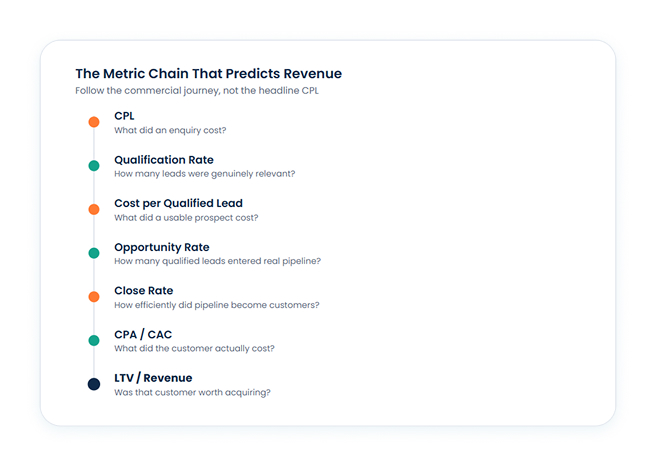
Focus on qualified leads

Your reporting should follow the commercial journey:

Metric What the Business Should Ask
CPL What did an enquiry cost?
Qualification Rate How many leads were genuinely relevant?
Cost per Qualified Lead What did a usable prospect cost?
Opportunity Rate How many qualified leads entered real pipeline?
Close Rate How efficiently did pipeline become customers?
CPA/CAC What did the customer actually cost?
LTV/Revenue Was that customer worth acquiring?


If your performance marketing team cannot connect those stages, you may know how much your leads cost without knowing whether your lead generation is profitable.

Stop Optimizing for Volume. Start Optimizing for Revenue.

More leads do not automatically mean more growth.

If 500 cheap leads produce ten customers while 200 higher-intent leads produce twenty-four, the smaller lead number represents the stronger acquisition engine.

This matters even more in today’s AI-driven advertising environment because automation can scale the signal you give it faster than manual campaigns ever could.

So make the signal worth scaling. Not the cheapest click. Not the easiest form completion. Not a dashboard-friendly CPL.

Qualified pipeline. Profitable customers. Sustainable CPA. Stronger LTV. Revenue.

Because if your cheapest leads are creating your most expensive customers, lowering CPL is not performance optimization.

It is simply scaling the wrong outcome faster.

Conclusion

A lower CPL is valuable only when that efficiency survives the rest of the funnel. If lead quality falls, sales effort rises, qualified opportunities stall, and CPA keeps climbing, the business is not acquiring customers more efficiently-it is simply creating more activity at a cheaper headline cost.

In today’s AI-led paid media environment, that distinction matters even more. Platforms can identify and scale conversion patterns faster than ever, but they still need the right definition of success. The businesses that gain the most will be the ones connecting search intent, campaign signals, lead qualification, CRM outcomes, and revenue rather than treating every form submission as equal.

That is the thinking behind ZealousWeb’s performance marketing approach-working backward from business outcomes to understand which prospects qualify, which campaigns create real pipeline, where acquisition economics begin to weaken, and what deserves to be scaled.

The objective is not a lower CPL for a better-looking report. It is stronger lead quality, sustainable CPA, healthier pipeline, and profitable growth.

If your CPL looks healthy but sales and revenue are telling a different story, that gap is worth finding before more budget makes it bigger.

Get More Qualified Leads From the Budget You Already Spend

Improve My Lead Generation

Get more qualified leads

FAQs

Related Blog Posts

AI performance marketing

How AI Is Transforming Performance Marketing From Ad Spend to Revenue

August 24, 2026
AI marketingArtificial IntelligenceDigital MarketingPerformance Marketing
AI email marketing automation

How AI Is Reshaping Email Marketing Through Automation and Hyper-Personalization

August 21, 2026
AI Email MarketingDigital MarketingEmail Marketing AutomationHyper-Personalization
brand refresh vs rebrand

Brand Refresh vs. Complete Rebrand: What Does Your Business Need?

August 18, 2026
Brand RefreshBrand StrategyBrandingRebranding
Best AEO/GEO Tools Comparison

Best AEO/GEO Tools Compared: Which One Should Agencies and Businesses Use

August 10, 2026
AEO ToolsAI Search OptimizationAnswer Engine OptimizationGEO Tools
Google AI Search Readiness

Website Readiness for Google AI Search: What Matters and What Doesn’t

August 06, 2026
Answer Engine Optimization (AEO)Generative Engine Optimization (GEO)Google AI SearchTechnical SEO
White-Label AEO

Scale Your AI Search Services with Specialized AEO & GEO Execution for Agencies

August 04, 2026
AEO ServicesAI Search VisibilityGEO StrategyWhite Label SEO
GEO readiness framework

What Makes a Business Ready for GEO? A Practical Framework for Evaluating Readiness and ROI

July 30, 2026
AI Search OptimizationAnswer Engine Optimizationgenerative engine optimizationGEO Readiness